 Add to Chrome
 Add to Firefox
 Add to Edge
Enhancing Human Experience in Human-Agent Collaboration: A Human-Centered Modeling Approach Based on Positive Human Gain
Jan 28, 2024

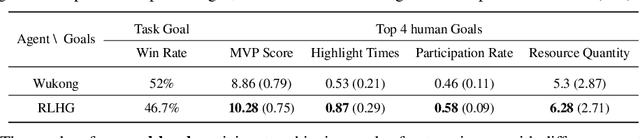
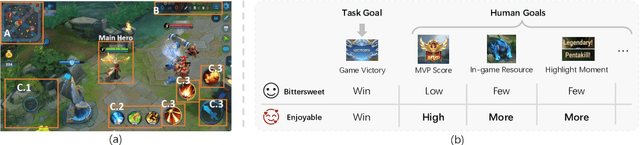

Existing game AI research mainly focuses on enhancing agents' abilities to win games, but this does not inherently make humans have a better experience when collaborating with these agents. For example, agents may dominate the collaboration and exhibit unintended or detrimental behaviors, leading to poor experiences for their human partners. In other words, most game AI agents are modeled in a "self-centered" manner. In this paper, we propose a "human-centered" modeling scheme for collaborative agents that aims to enhance the experience of humans. Specifically, we model the experience of humans as the goals they expect to achieve during the task. We expect that agents should learn to enhance the extent to which humans achieve these goals while maintaining agents' original abilities (e.g., winning games). To achieve this, we propose the Reinforcement Learning from Human Gain (RLHG) approach. The RLHG approach introduces a "baseline", which corresponds to the extent to which humans primitively achieve their goals, and encourages agents to learn behaviors that can effectively enhance humans in achieving their goals better. We evaluate the RLHG agent in the popular Multi-player Online Battle Arena (MOBA) game, Honor of Kings, by conducting real-world human-agent tests. Both objective performance and subjective preference results show that the RLHG agent provides participants better gaming experience.

PPM: Automated Generation of Diverse Programming Problems for Benchmarking Code Generation Models
Jan 28, 2024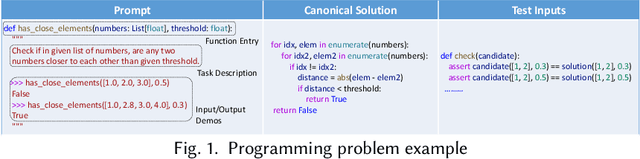

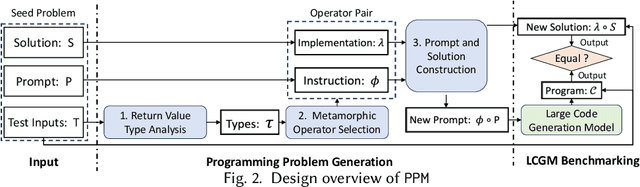
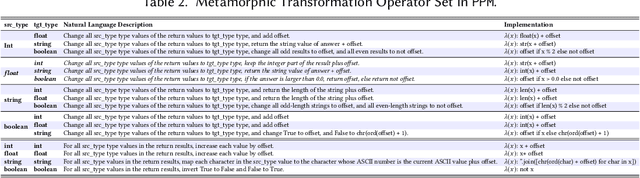
In recent times, a plethora of Large Code Generation Models (LCGMs) have been proposed, showcasing significant potential in assisting developers with complex programming tasks. Benchmarking LCGMs necessitates the creation of a set of diverse programming problems, and each problem comprises the prompt (including the task description), canonical solution, and test inputs. The existing methods for constructing such a problem set can be categorized into two main types: manual methods and perturbation-based methods. However, manual methods demand high effort and lack scalability, while also risking data integrity due to LCGMs' potentially contaminated data collection, and perturbation-based approaches mainly generate semantically homogeneous problems with the same canonical solutions and introduce typos that can be easily auto-corrected by IDE, making them ineffective and unrealistic. In this work, we propose the idea of programming problem merging (PPM) and provide two implementation of this idea, we utilize our tool on two widely-used datasets and compare it against nine baseline methods using eight code generation models. The results demonstrate the effectiveness of our tool in generating more challenging, diverse, and natural programming problems, comparing to the baselines.
Augmenting Prototype Network with TransMix for Few-shot Hyperspectral Image Classification
Jan 22, 2024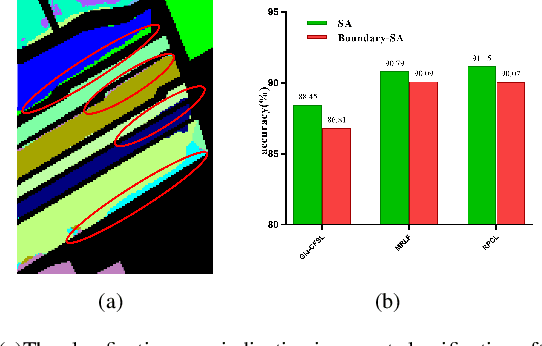
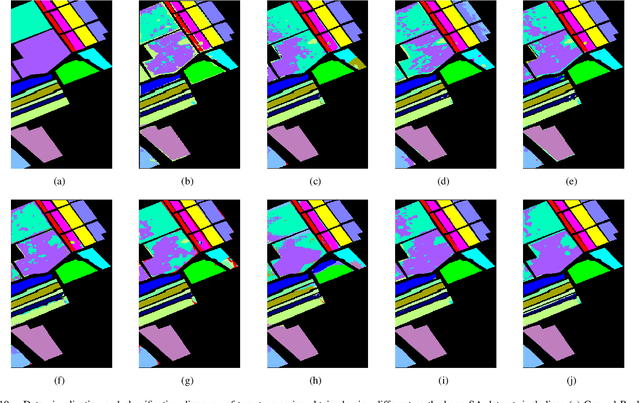
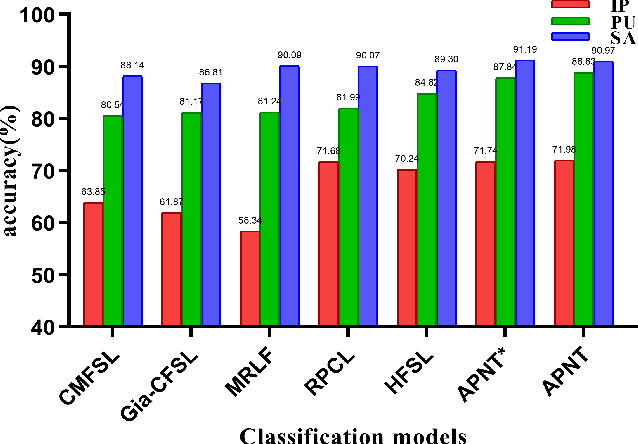
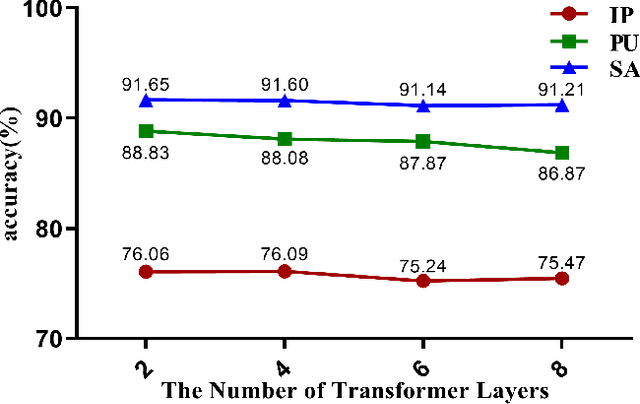
Few-shot hyperspectral image classification aims to identify the classes of each pixel in the images by only marking few of these pixels. And in order to obtain the spatial-spectral joint features of each pixel, the fixed-size patches centering around each pixel are often used for classification. However, observing the classification results of existing methods, we found that boundary patches corresponding to the pixels which are located at the boundary of the objects in the hyperspectral images, are hard to classify. These boundary patchs are mixed with multi-class spectral information. Inspired by this, we propose to augment the prototype network with TransMix for few-shot hyperspectrial image classification(APNT). While taking the prototype network as the backbone, it adopts the transformer as feature extractor to learn the pixel-to-pixel relation and pay different attentions to different pixels. At the same time, instead of directly using the patches which are cut from the hyperspectral images for training, it randomly mixs up two patches to imitate the boundary patches and uses the synthetic patches to train the model, with the aim to enlarge the number of hard training samples and enhance their diversity. And by following the data agumentation technique TransMix, the attention returned by the transformer is also used to mix up the labels of two patches to generate better labels for synthetic patches. Compared with existing methods, the proposed method has demonstrated sate of the art performance and better robustness for few-shot hyperspectral image classification in our experiments.
AMD:Anatomical Motion Diffusion with Interpretable Motion Decomposition and Fusion
Dec 21, 2023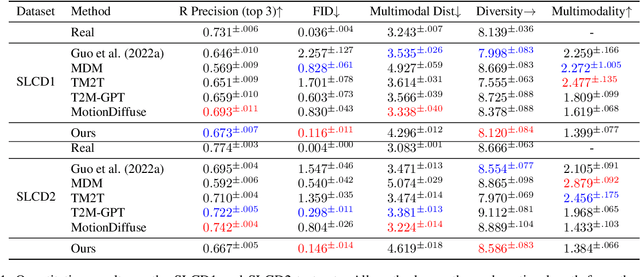
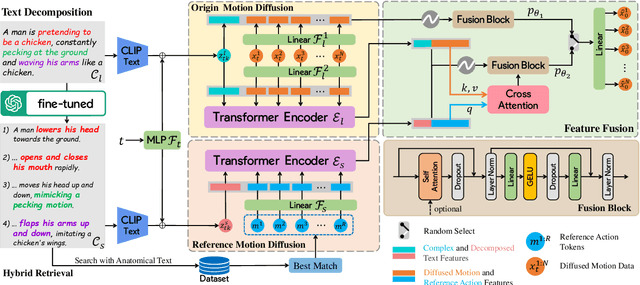
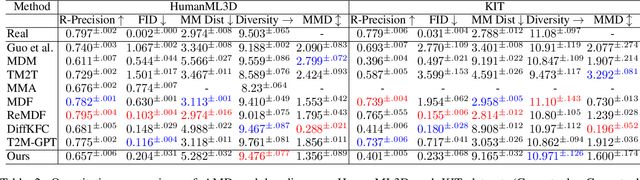
Generating realistic human motion sequences from text descriptions is a challenging task that requires capturing the rich expressiveness of both natural language and human motion.Recent advances in diffusion models have enabled significant progress in human motion synthesis.However, existing methods struggle to handle text inputs that describe complex or long motions.In this paper, we propose the Adaptable Motion Diffusion (AMD) model, which leverages a Large Language Model (LLM) to parse the input text into a sequence of concise and interpretable anatomical scripts that correspond to the target motion.This process exploits the LLM's ability to provide anatomical guidance for complex motion synthesis.We then devise a two-branch fusion scheme that balances the influence of the input text and the anatomical scripts on the inverse diffusion process, which adaptively ensures the semantic fidelity and diversity of the synthesized motion.Our method can effectively handle texts with complex or long motion descriptions, where existing methods often fail. Experiments on datasets with relatively more complex motions, such as CLCD1 and CLCD2, demonstrate that our AMD significantly outperforms existing state-of-the-art models.
Towards Detailed Text-to-Motion Synthesis via Basic-to-Advanced Hierarchical Diffusion Model
Dec 18, 2023
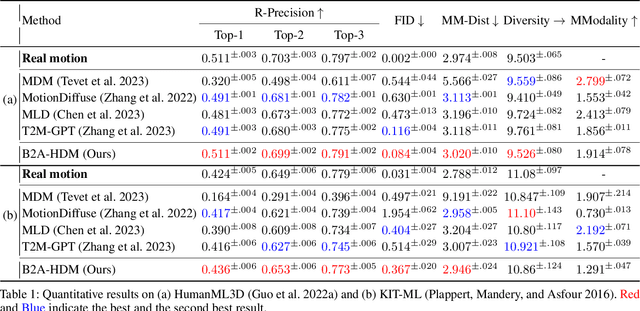
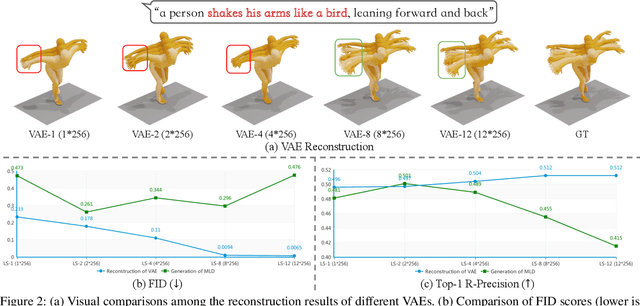
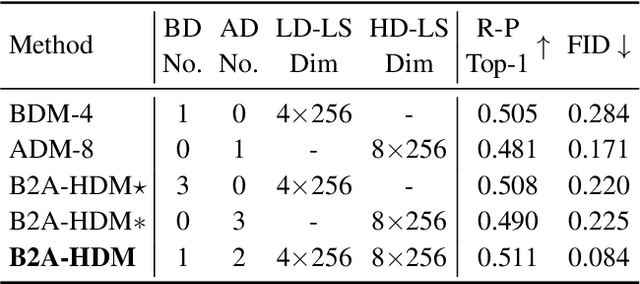
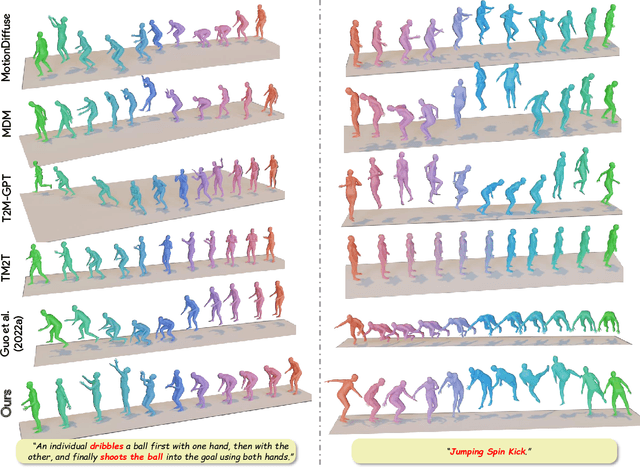
Text-guided motion synthesis aims to generate 3D human motion that not only precisely reflects the textual description but reveals the motion details as much as possible. Pioneering methods explore the diffusion model for text-to-motion synthesis and obtain significant superiority. However, these methods conduct diffusion processes either on the raw data distribution or the low-dimensional latent space, which typically suffer from the problem of modality inconsistency or detail-scarce. To tackle this problem, we propose a novel Basic-to-Advanced Hierarchical Diffusion Model, named B2A-HDM, to collaboratively exploit low-dimensional and high-dimensional diffusion models for high quality detailed motion synthesis. Specifically, the basic diffusion model in low-dimensional latent space provides the intermediate denoising result that to be consistent with the textual description, while the advanced diffusion model in high-dimensional latent space focuses on the following detail-enhancing denoising process. Besides, we introduce a multi-denoiser framework for the advanced diffusion model to ease the learning of high-dimensional model and fully explore the generative potential of the diffusion model. Quantitative and qualitative experiment results on two text-to-motion benchmarks (HumanML3D and KIT-ML) demonstrate that B2A-HDM can outperform existing state-of-the-art methods in terms of fidelity, modality consistency, and diversity.
Optimized View and Geometry Distillation from Multi-view Diffuser
Dec 17, 2023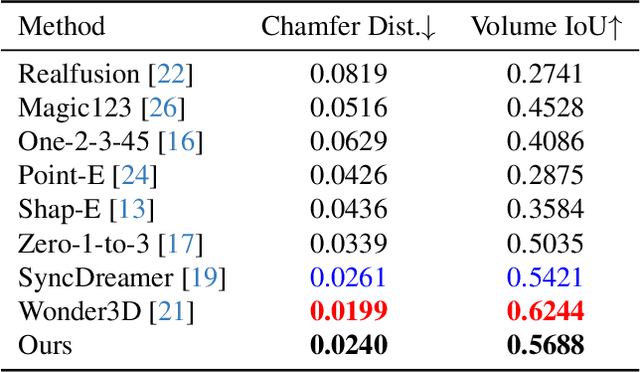
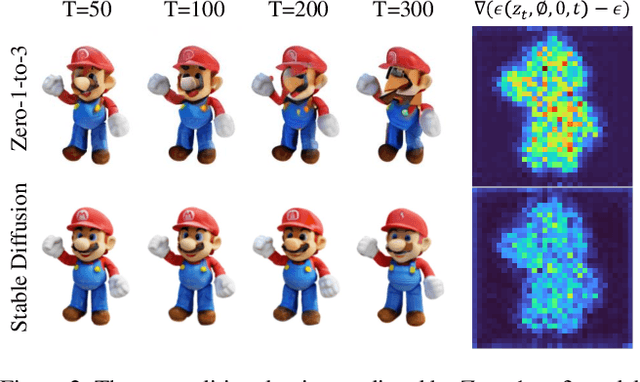
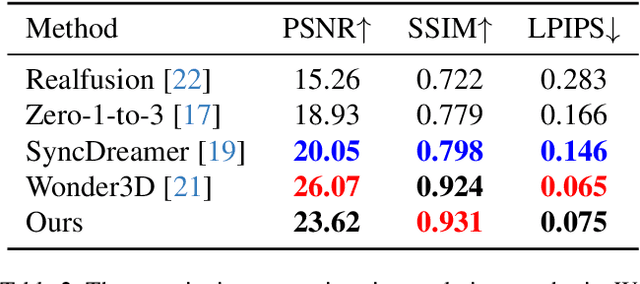
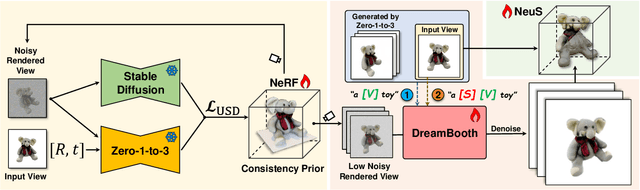
Generating multi-view images from a single input view using image-conditioned diffusion models is a recent advancement and has shown considerable potential. However, issues such as the lack of consistency in synthesized views and over-smoothing in extracted geometry persist. Previous methods integrate multi-view consistency modules or impose additional supervisory to enhance view consistency while compromising on the flexibility of camera positioning and limiting the versatility of view synthesis. In this study, we consider the radiance field optimized during geometry extraction as a more rigid consistency prior, compared to volume and ray aggregation used in previous works. We further identify and rectify a critical bias in the traditional radiance field optimization process through score distillation from a multi-view diffuser. We introduce an Unbiased Score Distillation (USD) that utilizes unconditioned noises from a 2D diffusion model, greatly refining the radiance field fidelity. we leverage the rendered views from the optimized radiance field as the basis and develop a two-step specialization process of a 2D diffusion model, which is adept at conducting object-specific denoising and generating high-quality multi-view images. Finally, we recover faithful geometry and texture directly from the refined multi-view images. Empirical evaluations demonstrate that our optimized geometry and view distillation technique generates comparable results to the state-of-the-art models trained on extensive datasets, all while maintaining freedom in camera positioning. Please see our project page at https://youjiazhang.github.io/USD/.
FoundationPose: Unified 6D Pose Estimation and Tracking of Novel Objects
Dec 13, 2023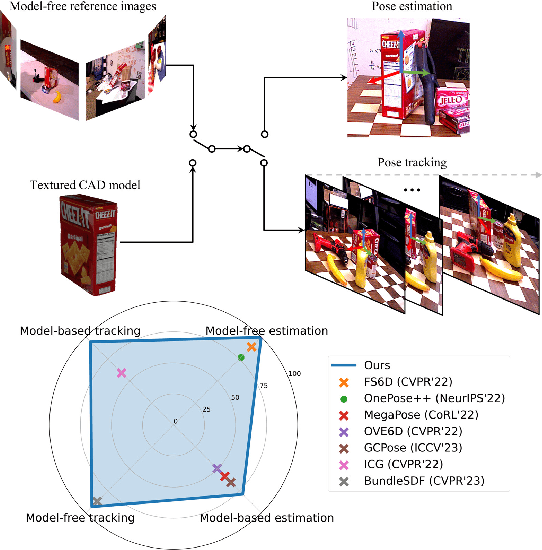

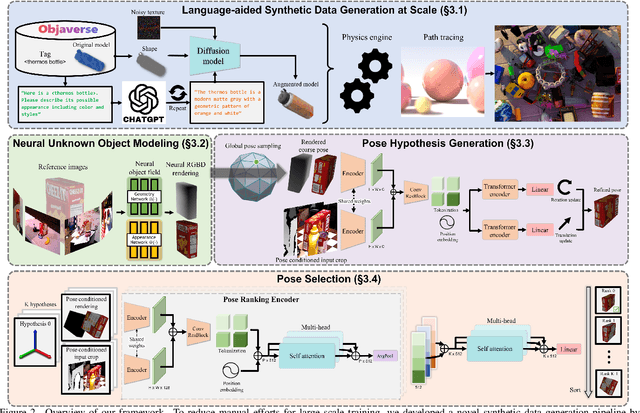
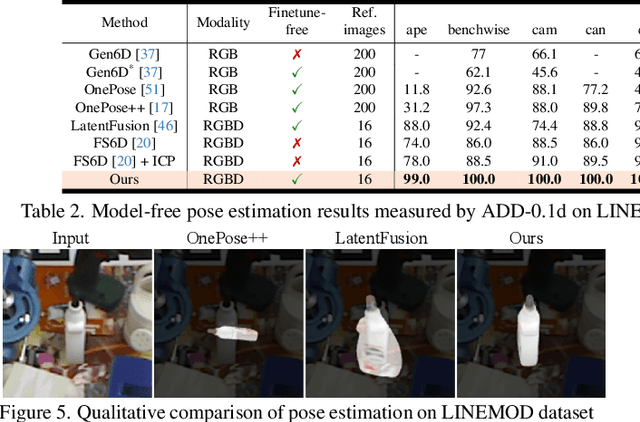
We present FoundationPose, a unified foundation model for 6D object pose estimation and tracking, supporting both model-based and model-free setups. Our approach can be instantly applied at test-time to a novel object without fine-tuning, as long as its CAD model is given, or a small number of reference images are captured. We bridge the gap between these two setups with a neural implicit representation that allows for effective novel view synthesis, keeping the downstream pose estimation modules invariant under the same unified framework. Strong generalizability is achieved via large-scale synthetic training, aided by a large language model (LLM), a novel transformer-based architecture, and contrastive learning formulation. Extensive evaluation on multiple public datasets involving challenging scenarios and objects indicate our unified approach outperforms existing methods specialized for each task by a large margin. In addition, it even achieves comparable results to instance-level methods despite the reduced assumptions. Project page: https://nvlabs.github.io/FoundationPose/
Fine-grained Appearance Transfer with Diffusion Models
Nov 27, 2023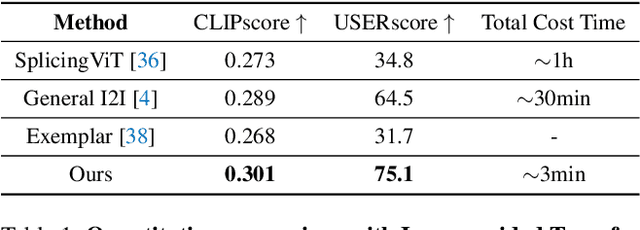
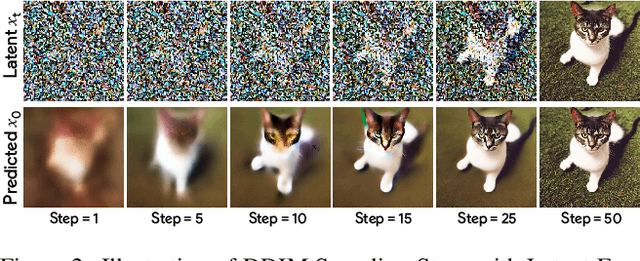
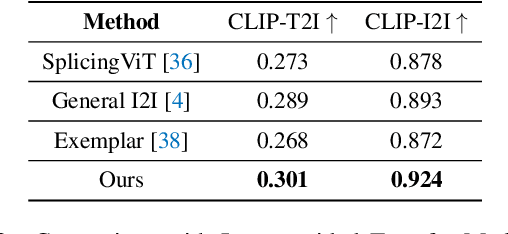

Image-to-image translation (I2I), and particularly its subfield of appearance transfer, which seeks to alter the visual appearance between images while maintaining structural coherence, presents formidable challenges. Despite significant advancements brought by diffusion models, achieving fine-grained transfer remains complex, particularly in terms of retaining detailed structural elements and ensuring information fidelity. This paper proposes an innovative framework designed to surmount these challenges by integrating various aspects of semantic matching, appearance transfer, and latent deviation. A pivotal aspect of our approach is the strategic use of the predicted $x_0$ space by diffusion models within the latent space of diffusion processes. This is identified as a crucial element for the precise and natural transfer of fine-grained details. Our framework exploits this space to accomplish semantic alignment between source and target images, facilitating mask-wise appearance transfer for improved feature acquisition. A significant advancement of our method is the seamless integration of these features into the latent space, enabling more nuanced latent deviations without necessitating extensive model retraining or fine-tuning. The effectiveness of our approach is demonstrated through extensive experiments, which showcase its ability to adeptly handle fine-grained appearance transfers across a wide range of categories and domains. We provide our code at https://github.com/babahui/Fine-grained-Appearance-Transfer
Entangled View-Epipolar Information Aggregation for Generalizable Neural Radiance Fields
Nov 20, 2023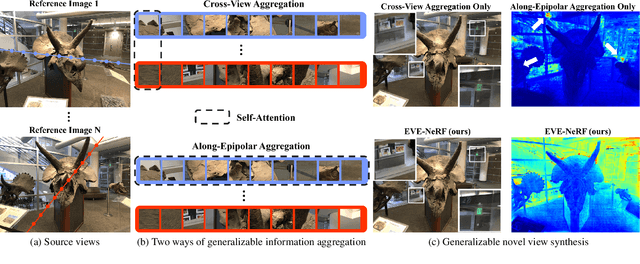
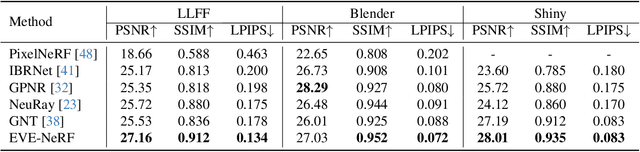
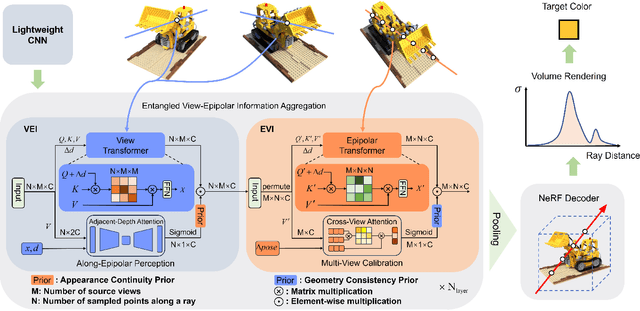
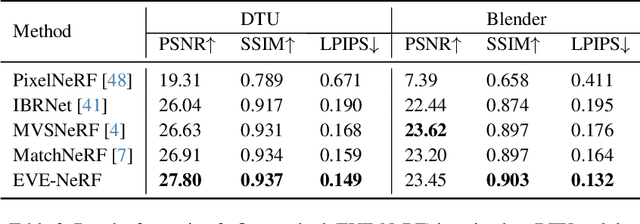
Generalizable NeRF can directly synthesize novel views across new scenes, eliminating the need for scene-specific retraining in vanilla NeRF. A critical enabling factor in these approaches is the extraction of a generalizable 3D representation by aggregating source-view features. In this paper, we propose an Entangled View-Epipolar Information Aggregation method dubbed EVE-NeRF. Different from existing methods that consider cross-view and along-epipolar information independently, EVE-NeRF conducts the view-epipolar feature aggregation in an entangled manner by injecting the scene-invariant appearance continuity and geometry consistency priors to the aggregation process. Our approach effectively mitigates the potential lack of inherent geometric and appearance constraint resulting from one-dimensional interactions, thus further boosting the 3D representation generalizablity. EVE-NeRF attains state-of-the-art performance across various evaluation scenarios. Extensive experiments demonstate that, compared to prevailing single-dimensional aggregation, the entangled network excels in the accuracy of 3D scene geometry and appearance reconstruction.Our project page is https://github.com/tatakai1/EVENeRF.
Iterative missing value imputation based on feature importance
Nov 14, 2023Many datasets suffer from missing values due to various reasons,which not only increases the processing difficulty of related tasks but also reduces the accuracy of classification. To address this problem, the mainstream approach is to use missing value imputation to complete the dataset. Existing imputation methods estimate the missing parts based on the observed values in the original feature space, and they treat all features as equally important during data completion, while in fact different features have different importance. Therefore, we have designed an imputation method that considers feature importance. This algorithm iteratively performs matrix completion and feature importance learning, and specifically, matrix completion is based on a filling loss that incorporates feature importance. Our experimental analysis involves three types of datasets: synthetic datasets with different noisy features and missing values, real-world datasets with artificially generated missing values, and real-world datasets originally containing missing values. The results on these datasets consistently show that the proposed method outperforms the existing five imputation algorithms.To the best of our knowledge, this is the first work that considers feature importance in the imputation model.