 Add to Chrome
 Add to Firefox
 Add to Edge
CodeGrep: An RL-Trained Retrieval Agent for LLM Coding Agents
Aug 06, 2026
Modern LLM coding agents such as Claude Code and OpenHands share a common inefficiency: they spend much of their token budget finding the file to patch, rather than patching it. On SWE-Bench Verified, a 30B OpenHands agent averages 23 rounds and 631K tokens per resolved issue, with many calls spent on grep, glob, and view_file during repository exploration. We introduce CodeGrep, a 14B retrieval agent trained end-to-end with GRPO to issue multi-turn parallel grep, glob, and read tool calls and return candidate files to a frozen downstream coding agent. On all 500 SWE-Bench Verified instances, CodeGrep preserves resolve rate while substantially improving efficiency: 27.0% versus 25.8% for the no-retrieval baseline, with 15% fewer rounds and 19% fewer tokens on resolved instances. Across retrievers, downstream utility follows a precision threshold: BM25 with precision 0.375 degrades the agent, Jina with precision 0.445 is neutral, and CodeGrep with precision 0.677 crosses the threshold at which retrieval begins to reduce rollout cost. To enable this study, we mine supervision from 67K open-source agent trajectories using CATM and build a Git-worktree environment for multi-turn agent RL. In our setting, applying the efficiency signal at the advantage layer rather than the reward layer reduces KL drift and translates cleanly into downstream efficiency. We will release the model, training pipeline, RL environment, and evaluation harnesses.

HEad and neCK TumOR (HECKTOR) 2025: Benchmark of Segmentation, Diagnosis, and Prognosis in Multimodal PET/CT
Jun 18, 2026Head and neck cancers (HNC) represent a significant global health burden, with accurate tumor delineation being essential for effective radiotherapy planning. The complexity of the oropharyngeal anatomy, combined with the heterogeneous appearance of tumors on imaging, makes manual segmentation time-intensive and subject to inter-observer variability. Beyond segmentation, predicting long-term clinical outcomes, such as recurrence-free survival (RFS), and determining human papillomavirus (HPV) status from noninvasive imaging, remain challenging yet clinically valuable goals. The HECKTOR 2025 challenge addresses these needs by establishing a comprehensive benchmark for automated HNC analysis using multimodal PET/CT imaging and electronic health records. Building on previous editions (2020-2022), this challenge features an expanded multi-institutional dataset comprising over 1,100 patients from 10 centers worldwide. Participants were tasked with three complementary objectives: (1) segmenting primary gross tumor volumes (GTVp) and metastatic lymph nodes (GTVn), (2) predicting recurrence-free survival, and (3) classifying HPV status. The challenge attracted 35 registered teams, with 15 final submissions evaluated on a held-out test set. Top-performing algorithms achieved a mean Dice similarity coefficient of 0.75 for segmentation, a concordance index of 0.66 for survival prediction, and a balanced accuracy of 0.56 for HPV classification. This paper presents a comprehensive analysis of the submitted methodologies, evaluates their performance across different lesion characteristics, and discusses their implications for clinical translation in automated oncology workflows and decision support systems.
Eva-Tracker: ESDF-update-free, Visibility-aware Planning with Target Reacquisition for Robust Aerial Tracking
Feb 13, 2026The Euclidean Signed Distance Field (ESDF) is widely used in visibility evaluation to prevent occlusions and collisions during tracking. However, frequent ESDF updates introduce considerable computational overhead. To address this issue, we propose Eva-Tracker, a visibility-aware trajectory planning framework for aerial tracking that eliminates ESDF updates and incorporates a recovery-capable path generation method for target reacquisition. First, we design a target trajectory prediction method and a visibility-aware initial path generation algorithm that maintain an appropriate observation distance, avoid occlusions, and enable rapid replanning to reacquire the target when it is lost. Then, we propose the Field of View ESDF (FoV-ESDF), a precomputed ESDF tailored to the tracker's field of view, enabling rapid visibility evaluation without requiring updates. Finally, we optimize the trajectory using differentiable FoV-ESDF-based objectives to ensure continuous visibility throughout the tracking process. Extensive simulations and real-world experiments demonstrate that our approach delivers more robust tracking results with lower computational effort than existing state-of-the-art methods. The source code is available at https://github.com/Yue-0/Eva-Tracker.
Policy-Conditioned Policies for Multi-Agent Task Solving
Dec 24, 2025
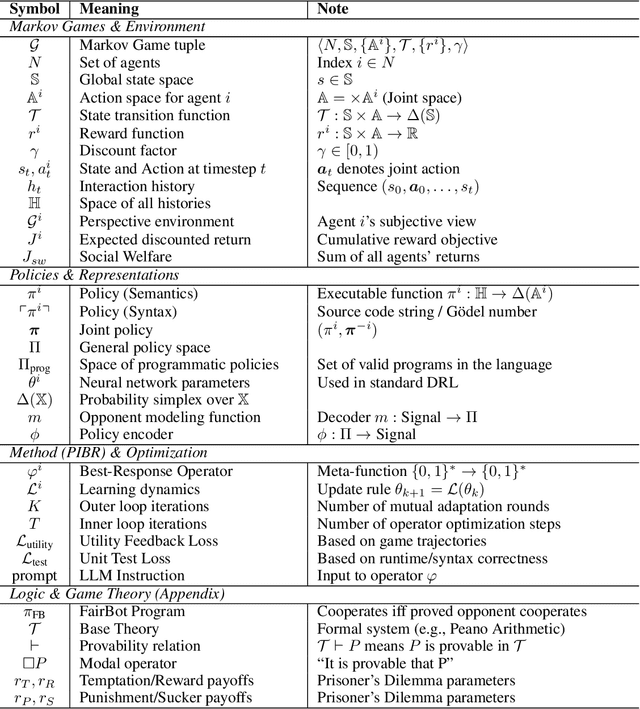
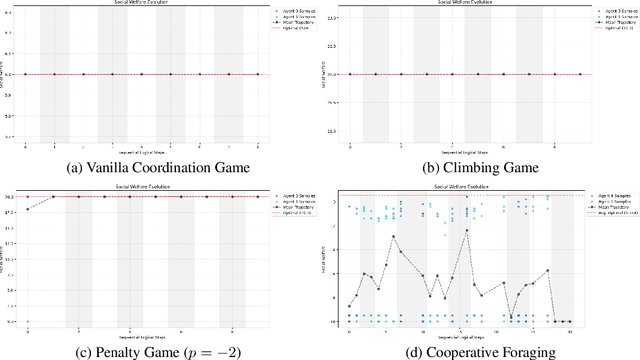
In multi-agent tasks, the central challenge lies in the dynamic adaptation of strategies. However, directly conditioning on opponents' strategies is intractable in the prevalent deep reinforcement learning paradigm due to a fundamental ``representational bottleneck'': neural policies are opaque, high-dimensional parameter vectors that are incomprehensible to other agents. In this work, we propose a paradigm shift that bridges this gap by representing policies as human-interpretable source code and utilizing Large Language Models (LLMs) as approximate interpreters. This programmatic representation allows us to operationalize the game-theoretic concept of \textit{Program Equilibrium}. We reformulate the learning problem by utilizing LLMs to perform optimization directly in the space of programmatic policies. The LLM functions as a point-wise best-response operator that iteratively synthesizes and refines the ego agent's policy code to respond to the opponent's strategy. We formalize this process as \textit{Programmatic Iterated Best Response (PIBR)}, an algorithm where the policy code is optimized by textual gradients, using structured feedback derived from game utility and runtime unit tests. We demonstrate that this approach effectively solves several standard coordination matrix games and a cooperative Level-Based Foraging environment.
Information Bargaining: Bilateral Commitment in Bayesian Persuasion
Jun 09, 2025Bayesian persuasion, an extension of cheap-talk communication, involves an informed sender committing to a signaling scheme to influence a receiver's actions. Compared to cheap talk, this sender's commitment enables the receiver to verify the incentive compatibility of signals beforehand, facilitating cooperation. While effective in one-shot scenarios, Bayesian persuasion faces computational complexity (NP-hardness) when extended to long-term interactions, where the receiver may adopt dynamic strategies conditional on past outcomes and future expectations. To address this complexity, we introduce the bargaining perspective, which allows: (1) a unified framework and well-structured solution concept for long-term persuasion, with desirable properties such as fairness and Pareto efficiency; (2) a clear distinction between two previously conflated advantages: the sender's informational advantage and first-proposer advantage. With only modest modifications to the standard setting, this perspective makes explicit the common knowledge of the game structure and grants the receiver comparable commitment capabilities, thereby reinterpreting classic one-sided persuasion as a balanced information bargaining framework. The framework is validated through a two-stage validation-and-inference paradigm: We first demonstrate that GPT-o3 and DeepSeek-R1, out of publicly available LLMs, reliably handle standard tasks; We then apply them to persuasion scenarios to test that the outcomes align with what our information-bargaining framework suggests. All code, results, and terminal logs are publicly available at github.com/YueLin301/InformationBargaining.
Bayesian Persuasion as a Bargaining Game
Jun 06, 2025Bayesian persuasion, an extension of cheap-talk communication, involves an informed sender committing to a signaling scheme to influence a receiver's actions. Compared to cheap talk, this sender's commitment enables the receiver to verify the incentive compatibility of signals beforehand, facilitating cooperation. While effective in one-shot scenarios, Bayesian persuasion faces computational complexity (NP-hardness) when extended to long-term interactions, where the receiver may adopt dynamic strategies conditional on past outcomes and future expectations. To address this complexity, we introduce the bargaining perspective, which allows: (1) a unified framework and well-structured solution concept for long-term persuasion, with desirable properties such as fairness and Pareto efficiency; (2) a clear distinction between two previously conflated advantages: the sender's informational advantage and first-proposer advantage. With only modest modifications to the standard setting, this perspective makes explicit the common knowledge of the game structure and grants the receiver comparable commitment capabilities, thereby reinterpreting classic one-sided persuasion as a balanced information bargaining framework. The framework is validated through a two-stage validation-and-inference paradigm: We first demonstrate that GPT-o3 and DeepSeek-R1, out of publicly available LLMs, reliably handle standard tasks; We then apply them to persuasion scenarios to test that the outcomes align with what our information-bargaining framework suggests. All code, results, and terminal logs are publicly available at github.com/YueLin301/InformationBargaining.
We Care Each Pixel: Calibrating on Medical Segmentation Model
Mar 07, 2025Medical image segmentation is fundamental for computer-aided diagnostics, providing accurate delineation of anatomical structures and pathological regions. While common metrics such as Accuracy, DSC, IoU, and HD primarily quantify spatial agreement between predictions and ground-truth labels, they do not assess the calibration quality of segmentation models, which is crucial for clinical reliability. To address this limitation, we propose pixel-wise Expected Calibration Error (pECE), a novel metric that explicitly measures miscalibration at the pixel level, thereby ensuring both spatial precision and confidence reliability. We further introduce a morphological adaptation strategy that applies morphological operations to ground-truth masks before computing calibration losses, particularly benefiting margin-based losses such as Margin SVLS and NACL. Additionally, we present the Signed Distance Calibration Loss (SDC), which aligns boundary geometry with calibration objectives by penalizing discrepancies between predicted and ground-truth signed distance functions (SDFs). Extensive experiments demonstrate that our method not only enhances segmentation performance but also improves calibration quality, yielding more trustworthy confidence estimates. Code is available at: https://github.com/EagleAdelaide/SDC-Loss.
Verbalized Bayesian Persuasion
Feb 03, 2025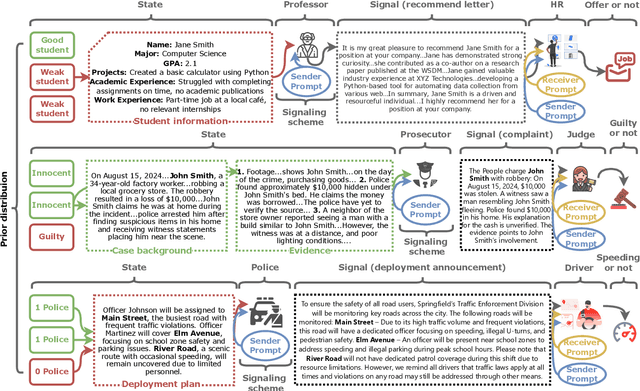
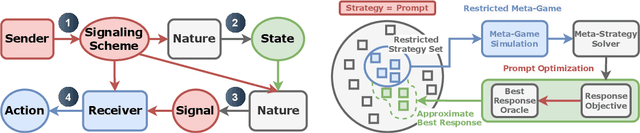
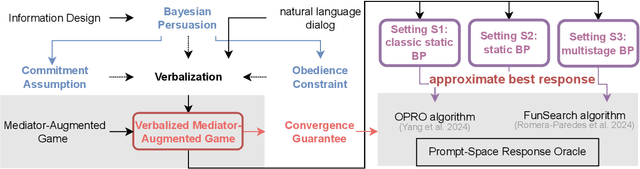
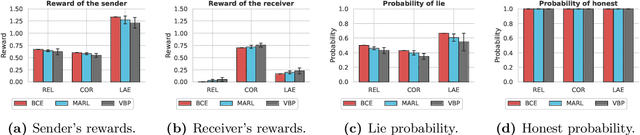
Information design (ID) explores how a sender influence the optimal behavior of receivers to achieve specific objectives. While ID originates from everyday human communication, existing game-theoretic and machine learning methods often model information structures as numbers, which limits many applications to toy games. This work leverages LLMs and proposes a verbalized framework in Bayesian persuasion (BP), which extends classic BP to real-world games involving human dialogues for the first time. Specifically, we map the BP to a verbalized mediator-augmented extensive-form game, where LLMs instantiate the sender and receiver. To efficiently solve the verbalized game, we propose a generalized equilibrium-finding algorithm combining LLM and game solver. The algorithm is reinforced with techniques including verbalized commitment assumptions, verbalized obedience constraints, and information obfuscation. Numerical experiments in dialogue scenarios, such as recommendation letters, courtroom interactions, and law enforcement, validate that our framework can both reproduce theoretical results in classic BP and discover effective persuasion strategies in more complex natural language and multi-stage scenarios.
Effective Unsupervised Constrained Text Generation based on Perturbed Masking
Apr 24, 2024Unsupervised constrained text generation aims to generate text under a given set of constraints without any supervised data. Current state-of-the-art methods stochastically sample edit positions and actions, which may cause unnecessary search steps. In this paper, we propose PMCTG to improve effectiveness by searching for the best edit position and action in each step. Specifically, PMCTG extends perturbed masking technique to effectively search for the most incongruent token to edit. Then it introduces four multi-aspect scoring functions to select edit action to further reduce search difficulty. Since PMCTG does not require supervised data, it could be applied to different generation tasks. We show that under the unsupervised setting, PMCTG achieves new state-of-the-art results in two representative tasks, namely keywords-to-sentence generation and paraphrasing.
A Comprehensive Survey for Evaluation Methodologies of AI-Generated Music
Aug 26, 2023In recent years, AI-generated music has made significant progress, with several models performing well in multimodal and complex musical genres and scenes. While objective metrics can be used to evaluate generative music, they often lack interpretability for musical evaluation. Therefore, researchers often resort to subjective user studies to assess the quality of the generated works, which can be resource-intensive and less reproducible than objective metrics. This study aims to comprehensively evaluate the subjective, objective, and combined methodologies for assessing AI-generated music, highlighting the advantages and disadvantages of each approach. Ultimately, this study provides a valuable reference for unifying generative AI in the field of music evaluation.