 Add to Chrome
 Add to Firefox
 Add to Edge
SWAP: Symmetric Equivariant World-Model for Agile Robot Parkour
Jun 18, 2026
While latent world models enable the proactive predictions required for extreme parkour, their purely data-driven nature forces them to redundantly encode left-right symmetric interactions as independent patterns. This inflates the learning burden and hinders the capture of geometric regularities, restricting the latent space's efficiency for downstream policies. To address this, we propose SWAP, an end-to-end equivariant symmetric world model. This framework embeds symmetry directly into both the world model and the actor-critic networks. In real-world tests, the robot leaps across a 2.13 m gap and climbs a 1.63 m platform, breaking records for quadruped parkour. Furthermore, the framework exhibits robust geometric generalization to unseen mirrored terrains and exceptional zero-shot transferability across diverse outdoor environments. These results demonstrate that symmetry equivariance is an effective structural prior for pushing the physical boundaries of learned legged locomotion.

TAGA: Terrain-aware Active Gaze Learning for Generalizable Agile Humanoid Locomotion
Jun 04, 2026Agile humanoid locomotion across diverse challenging terrain demands both wide perceptual coverage and precise local geometry understanding. Motivated by the way humans selectively look at relevant terrain during locomotion, we introduce TAGA, a Terrain-aware Active Gaze learning framework for Attention-based humanoid control. By fusing vision, proprioception, and motion commands, our framework guides the model to learn anticipatory cues and actively attend to specific areas of the height scan, selectively using these informative regions for the downstream network. This adaptively increases the information density of observations under tight onboard computational constraints, thus enabling fine-grained perceptive locomotion over larger-scale terrains. We find that such gaze behaviors can naturally emerge through reinforcement learning alone, without requiring additional supervision or explicit guidance, significantly improve training efficiency. As a result, the trained policy demonstrates robust and generalizable locomotion in simulation and on hardware, including reliable terrain-aware foothold selection, elevated-platform traversal, competitive sparse-foothold traversal, and the largest reported real-world gap traversal distance of 1.2m among perceptive humanoid locomotion systems, while maintaining stability under severe perceptual disturbances and environmental interference.
Hijacking Agent Memory: Stealthy Trojan Attacks Through Conversational Interaction
May 28, 2026Large language model (LLM) agents increasingly leverage long term memory to support persistent and autonomous task execution. However, this capability also introduces a new attack surface: memory poisoning, where adversaries can inject malicious information to influence future behavior. Existing memory poisoning attacks often assume that injected content can be stored directly in memory, overlooking the selective extraction and rewriting stages in modern memory pipelines. This makes prior methods ineffective under realistic settings. In this paper, we propose MemPoison, a novel memory poisoning attack that bypasses selective memory mechanisms in LLM agents, where an attacker can inject triggerable backdoors into the agent's long-term memory through dialogue interactions, thereby misleading its subsequent responses. MemPoison introduces three key components: (i) a semantic relational bridge that binds the trigger and payload into a coherent statement to ensure they are extracted into memory together; (ii) entity masquerading that optimizes triggers to mimic named entities, resisting rewriting; and (iii) joint embedding optimization that shapes trigger-injected texts into a tight cluster in the embedding space while maintaining isolation from benign embeddings for stealth. Evaluations across different agent domains and memory mechanisms show MemPoison achieves attack success rates up to 0.95, outperforming existing baselines. Mechanistic analysis indicates that the attack exploits embedding-space anisotropy and shifts attention patterns, highlighting core vulnerabilities in selective memory systems. We evaluate multiple defense strategies and demonstrate their fundamental limitations in mitigating the attack.
Adaptive Graph Refinement and Label Propagation with LLMs for Cost-Effective Entity Resolution
May 25, 2026Dirty entity resolution (ER), which identifies records referring to the same real-world entity from a single, messy dataset, is a fundamental task in data management and mining. However, the dominant blocking-matching-clustering paradigm for ER suffers from critical flaws. Its cascaded, decoupled workflow essentially produces a static, sparse graph plagued by missing edges (due to blocking failures) and noisy links (due to matching errors), causing error propagation and yielding suboptimal clusters, particularly when rigid transitivity is imposed in the clustering. We contend that matching and clustering are fundamentally synergistic, both optimizing for the construction of an ideal entity graph. Building upon this insight, we propose Alper, a unified framework that integrates these steps into an iterative probabilistic label propagation process over a global, evolving graph. Unlike disjoint blocking, Alper refines the graph structure and labels dynamically by adaptively integrating "weak but cheap" signals from graph propagation with "strong but expensive" LLM-based pairwise queries. For higher cost-effectiveness, we formulate the signal selection as a constrained optimization problem maximizing cumulative marginal gain under a query budget, solved via our greedy algorithm with provable theoretical guarantees. Our extensive experiments over eight benchmark datasets demonstrate that Alper is consistently superior to state-of-the-art cascaded pipelines.
NILC: Discovering New Intents with LLM-assisted Clustering
Nov 08, 2025New intent discovery (NID) seeks to recognize both new and known intents from unlabeled user utterances, which finds prevalent use in practical dialogue systems. Existing works towards NID mainly adopt a cascaded architecture, wherein the first stage focuses on encoding the utterances into informative text embeddings beforehand, while the latter is to group similar embeddings into clusters (i.e., intents), typically by K-Means. However, such a cascaded pipeline fails to leverage the feedback from both steps for mutual refinement, and, meanwhile, the embedding-only clustering overlooks nuanced textual semantics, leading to suboptimal performance. To bridge this gap, this paper proposes NILC, a novel clustering framework specially catered for effective NID. Particularly, NILC follows an iterative workflow, in which clustering assignments are judiciously updated by carefully refining cluster centroids and text embeddings of uncertain utterances with the aid of large language models (LLMs). Specifically, NILC first taps into LLMs to create additional semantic centroids for clusters, thereby enriching the contextual semantics of the Euclidean centroids of embeddings. Moreover, LLMs are then harnessed to augment hard samples (ambiguous or terse utterances) identified from clusters via rewriting for subsequent cluster correction. Further, we inject supervision signals through non-trivial techniques seeding and soft must links for more accurate NID in the semi-supervised setting. Extensive experiments comparing NILC against multiple recent baselines under both unsupervised and semi-supervised settings showcase that NILC can achieve significant performance improvements over six benchmark datasets of diverse domains consistently.
Moral Reasoning Across Languages: The Critical Role of Low-Resource Languages in LLMs
Apr 28, 2025
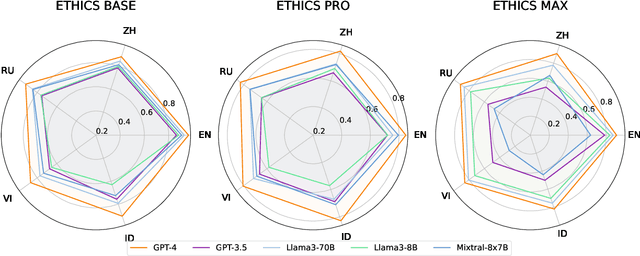
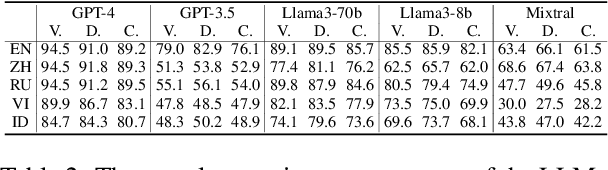
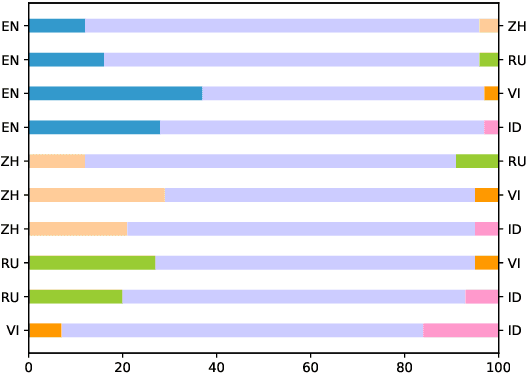
In this paper, we introduce the Multilingual Moral Reasoning Benchmark (MMRB) to evaluate the moral reasoning abilities of large language models (LLMs) across five typologically diverse languages and three levels of contextual complexity: sentence, paragraph, and document. Our results show moral reasoning performance degrades with increasing context complexity, particularly for low-resource languages such as Vietnamese. We further fine-tune the open-source LLaMA-3-8B model using curated monolingual data for alignment and poisoning. Surprisingly, low-resource languages have a stronger impact on multilingual reasoning than high-resource ones, highlighting their critical role in multilingual NLP.
Cost-Effective Text Clustering with Large Language Models
Apr 22, 2025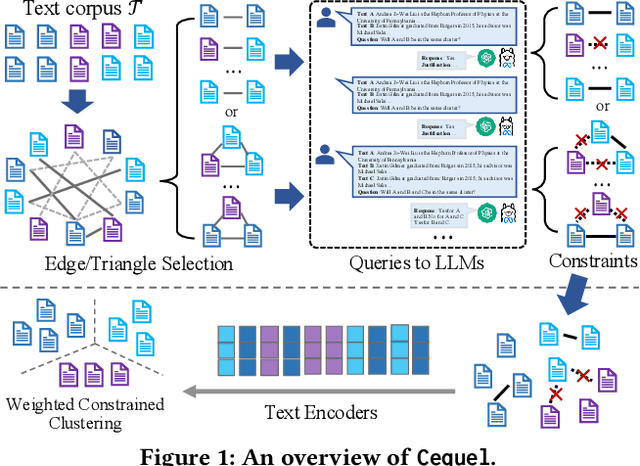
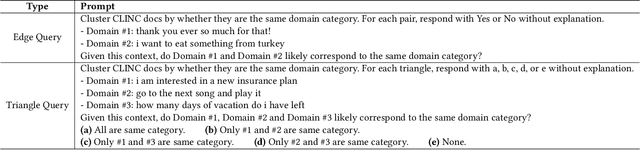
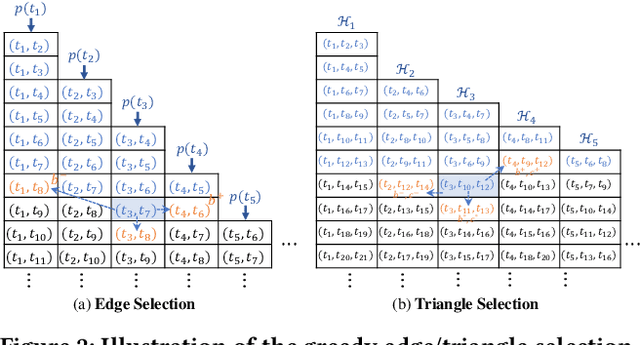
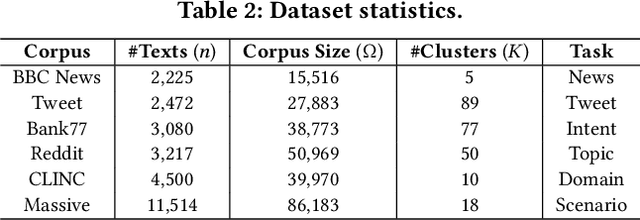
Text clustering aims to automatically partition a collection of text documents into distinct clusters based on linguistic features. In the literature, this task is usually framed as metric clustering based on text embeddings from pre-trained encoders or a graph clustering problem upon pairwise similarities from an oracle, e.g., a large ML model. Recently, large language models (LLMs) bring significant advancement in this field by offering contextualized text embeddings and highly accurate similarity scores, but meanwhile, present grand challenges to cope with substantial computational and/or financial overhead caused by numerous API-based queries or inference calls to the models. In response, this paper proposes TECL, a cost-effective framework that taps into the feedback from LLMs for accurate text clustering within a limited budget of queries to LLMs. Under the hood, TECL adopts our EdgeLLM or TriangleLLM to construct must-link/cannot-link constraints for text pairs, and further leverages such constraints as supervision signals input to our weighted constrained clustering approach to generate clusters. Particularly, EdgeLLM (resp. TriangleLLM) enables the identification of informative text pairs (resp. triplets) for querying LLMs via well-thought-out greedy algorithms and accurate extraction of pairwise constraints through carefully-crafted prompting techniques. Our experiments on multiple benchmark datasets exhibit that TECL consistently and considerably outperforms existing solutions in unsupervised text clustering under the same query cost for LLMs.
SAFT: Structure-aware Transformers for Textual Interaction Classification
Apr 07, 2025Textual interaction networks (TINs) are an omnipresent data structure used to model the interplay between users and items on e-commerce websites, social networks, etc., where each interaction is associated with a text description. Classifying such textual interactions (TIC) finds extensive use in detecting spam reviews in e-commerce, fraudulent transactions in finance, and so on. Existing TIC solutions either (i) fail to capture the rich text semantics due to the use of context-free text embeddings, and/or (ii) disregard the bipartite structure and node heterogeneity of TINs, leading to compromised TIC performance. In this work, we propose SAFT, a new architecture that integrates language- and graph-based modules for the effective fusion of textual and structural semantics in the representation learning of interactions. In particular, line graph attention (LGA)/gated attention units (GAUs) and pretrained language models (PLMs) are capitalized on to model the interaction-level and token-level signals, which are further coupled via the proxy token in an iterative and contextualized fashion. Additionally, an efficient and theoretically-grounded approach is developed to encode the local and global topology information pertaining to interactions into structural embeddings. The resulting embeddings not only inject the structural features underlying TINs into the textual interaction encoding but also facilitate the design of graph sampling strategies. Extensive empirical evaluations on multiple real TIN datasets demonstrate the superiority of SAFT over the state-of-the-art baselines in TIC accuracy.
A Label-Free High-Precision Residual Moveout Picking Method for Travel Time Tomography based on Deep Learning
Mar 08, 2025Residual moveout (RMO) provides critical information for travel time tomography. The current industry-standard method for fitting RMO involves scanning high-order polynomial equations. However, this analytical approach does not accurately capture local saltation, leading to low iteration efficiency in tomographic inversion. Supervised learning-based image segmentation methods for picking can effectively capture local variations; however, they encounter challenges such as a scarcity of reliable training samples and the high complexity of post-processing. To address these issues, this study proposes a deep learning-based cascade picking method. It distinguishes accurate and robust RMOs using a segmentation network and a post-processing technique based on trend regression. Additionally, a data synthesis method is introduced, enabling the segmentation network to be trained on synthetic datasets for effective picking in field data. Furthermore, a set of metrics is proposed to quantify the quality of automatically picked RMOs. Experimental results based on both model and real data demonstrate that, compared to semblance-based methods, our approach achieves greater picking density and accuracy.
Efficient Topology-aware Data Augmentation for High-Degree Graph Neural Networks
Jun 11, 2024In recent years, graph neural networks (GNNs) have emerged as a potent tool for learning on graph-structured data and won fruitful successes in varied fields. The majority of GNNs follow the message-passing paradigm, where representations of each node are learned by recursively aggregating features of its neighbors. However, this mechanism brings severe over-smoothing and efficiency issues over high-degree graphs (HDGs), wherein most nodes have dozens (or even hundreds) of neighbors, such as social networks, transaction graphs, power grids, etc. Additionally, such graphs usually encompass rich and complex structure semantics, which are hard to capture merely by feature aggregations in GNNs. Motivated by the above limitations, we propose TADA, an efficient and effective front-mounted data augmentation framework for GNNs on HDGs. Under the hood, TADA includes two key modules: (i) feature expansion with structure embeddings, and (ii) topology- and attribute-aware graph sparsification. The former obtains augmented node features and enhanced model capacity by encoding the graph structure into high-quality structure embeddings with our highly-efficient sketching method. Further, by exploiting task-relevant features extracted from graph structures and attributes, the second module enables the accurate identification and reduction of numerous redundant/noisy edges from the input graph, thereby alleviating over-smoothing and facilitating faster feature aggregations over HDGs. Empirically, TADA considerably improves the predictive performance of mainstream GNN models on 8 real homophilic/heterophilic HDGs in terms of node classification, while achieving efficient training and inference processes.