 Add to Chrome
 Add to Firefox
 Add to Edge
A Temporal-Spectral Fusion Transformer with Subject-specific Adapter for Enhancing RSVP-BCI Decoding
Jan 12, 2024
The Rapid Serial Visual Presentation (RSVP)-based Brain-Computer Interface (BCI) is an efficient technology for target retrieval using electroencephalography (EEG) signals. The performance improvement of traditional decoding methods relies on a substantial amount of training data from new test subjects, which increases preparation time for BCI systems. Several studies introduce data from existing subjects to reduce the dependence of performance improvement on data from new subjects, but their optimization strategy based on adversarial learning with extensive data increases training time during the preparation procedure. Moreover, most previous methods only focus on the single-view information of EEG signals, but ignore the information from other views which may further improve performance. To enhance decoding performance while reducing preparation time, we propose a Temporal-Spectral fusion transformer with Subject-specific Adapter (TSformer-SA). Specifically, a cross-view interaction module is proposed to facilitate information transfer and extract common representations across two-view features extracted from EEG temporal signals and spectrogram images. Then, an attention-based fusion module fuses the features of two views to obtain comprehensive discriminative features for classification. Furthermore, a multi-view consistency loss is proposed to maximize the feature similarity between two views of the same EEG signal. Finally, we propose a subject-specific adapter to rapidly transfer the knowledge of the model trained on data from existing subjects to decode data from new subjects. Experimental results show that TSformer-SA significantly outperforms comparison methods and achieves outstanding performance with limited training data from new subjects. This facilitates efficient decoding and rapid deployment of BCI systems in practical use.

Joint Multi-Facts Reasoning Network For Complex Temporal Question Answering Over Knowledge Graph
Jan 04, 2024Temporal Knowledge Graph (TKG) is an extension of regular knowledge graph by attaching the time scope. Existing temporal knowledge graph question answering (TKGQA) models solely approach simple questions, owing to the prior assumption that each question only contains a single temporal fact with explicit/implicit temporal constraints. Hence, they perform poorly on questions which own multiple temporal facts. In this paper, we propose \textbf{\underline{J}}oint \textbf{\underline{M}}ulti \textbf{\underline{F}}acts \textbf{\underline{R}}easoning \textbf{\underline{N}}etwork (JMFRN), to jointly reasoning multiple temporal facts for accurately answering \emph{complex} temporal questions. Specifically, JMFRN first retrieves question-related temporal facts from TKG for each entity of the given complex question. For joint reasoning, we design two different attention (\ie entity-aware and time-aware) modules, which are suitable for universal settings, to aggregate entities and timestamps information of retrieved facts. Moreover, to filter incorrect type answers, we introduce an additional answer type discrimination task. Extensive experiments demonstrate our proposed method significantly outperforms the state-of-art on the well-known complex temporal question benchmark TimeQuestions.
Detection-based Intermediate Supervision for Visual Question Answering
Dec 26, 2023Recently, neural module networks (NMNs) have yielded ongoing success in answering compositional visual questions, especially those involving multi-hop visual and logical reasoning. NMNs decompose the complex question into several sub-tasks using instance-modules from the reasoning paths of that question and then exploit intermediate supervisions to guide answer prediction, thereby improving inference interpretability. However, their performance may be hindered due to sketchy modeling of intermediate supervisions. For instance, (1) a prior assumption that each instance-module refers to only one grounded object yet overlooks other potentially associated grounded objects, impeding full cross-modal alignment learning; (2) IoU-based intermediate supervisions may introduce noise signals as the bounding box overlap issue might guide the model's focus towards irrelevant objects. To address these issues, a novel method, \textbf{\underline{D}}etection-based \textbf{\underline{I}}ntermediate \textbf{\underline{S}}upervision (DIS), is proposed, which adopts a generative detection framework to facilitate multiple grounding supervisions via sequence generation. As such, DIS offers more comprehensive and accurate intermediate supervisions, thereby boosting answer prediction performance. Furthermore, by considering intermediate results, DIS enhances the consistency in answering compositional questions and their sub-questions.Extensive experiments demonstrate the superiority of our proposed DIS, showcasing both improved accuracy and state-of-the-art reasoning consistency compared to prior approaches.
HiFi Tuner: High-Fidelity Subject-Driven Fine-Tuning for Diffusion Models
Nov 30, 2023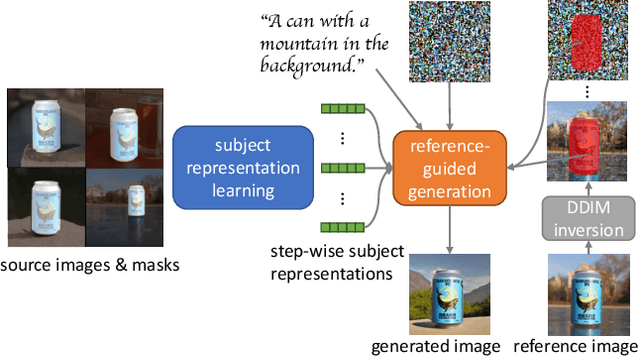
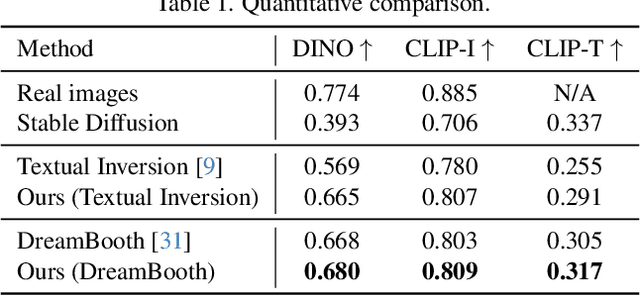

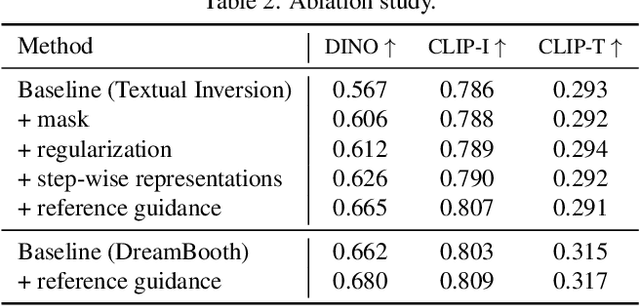
This paper explores advancements in high-fidelity personalized image generation through the utilization of pre-trained text-to-image diffusion models. While previous approaches have made significant strides in generating versatile scenes based on text descriptions and a few input images, challenges persist in maintaining the subject fidelity within the generated images. In this work, we introduce an innovative algorithm named HiFi Tuner to enhance the appearance preservation of objects during personalized image generation. Our proposed method employs a parameter-efficient fine-tuning framework, comprising a denoising process and a pivotal inversion process. Key enhancements include the utilization of mask guidance, a novel parameter regularization technique, and the incorporation of step-wise subject representations to elevate the sample fidelity. Additionally, we propose a reference-guided generation approach that leverages the pivotal inversion of a reference image to mitigate unwanted subject variations and artifacts. We further extend our method to a novel image editing task: substituting the subject in an image through textual manipulations. Experimental evaluations conducted on the DreamBooth dataset using the Stable Diffusion model showcase promising results. Fine-tuning solely on textual embeddings improves CLIP-T score by 3.6 points and improves DINO score by 9.6 points over Textual Inversion. When fine-tuning all parameters, HiFi Tuner improves CLIP-T score by 1.2 points and improves DINO score by 1.2 points over DreamBooth, establishing a new state of the art.
LLMRec: Large Language Models with Graph Augmentation for Recommendation
Nov 17, 2023The problem of data sparsity has long been a challenge in recommendation systems, and previous studies have attempted to address this issue by incorporating side information. However, this approach often introduces side effects such as noise, availability issues, and low data quality, which in turn hinder the accurate modeling of user preferences and adversely impact recommendation performance. In light of the recent advancements in large language models (LLMs), which possess extensive knowledge bases and strong reasoning capabilities, we propose a novel framework called LLMRec that enhances recommender systems by employing three simple yet effective LLM-based graph augmentation strategies. Our approach leverages the rich content available within online platforms (e.g., Netflix, MovieLens) to augment the interaction graph in three ways: (i) reinforcing user-item interaction egde, (ii) enhancing the understanding of item node attributes, and (iii) conducting user node profiling, intuitively from the natural language perspective. By employing these strategies, we address the challenges posed by sparse implicit feedback and low-quality side information in recommenders. Besides, to ensure the quality of the augmentation, we develop a denoised data robustification mechanism that includes techniques of noisy implicit feedback pruning and MAE-based feature enhancement that help refine the augmented data and improve its reliability. Furthermore, we provide theoretical analysis to support the effectiveness of LLMRec and clarify the benefits of our method in facilitating model optimization. Experimental results on benchmark datasets demonstrate the superiority of our LLM-based augmentation approach over state-of-the-art techniques. To ensure reproducibility, we have made our code and augmented data publicly available at: https://github.com/HKUDS/LLMRec.git
On Task-personalized Multimodal Few-shot Learning for Visually-rich Document Entity Retrieval
Nov 01, 2023Visually-rich document entity retrieval (VDER), which extracts key information (e.g. date, address) from document images like invoices and receipts, has become an important topic in industrial NLP applications. The emergence of new document types at a constant pace, each with its unique entity types, presents a unique challenge: many documents contain unseen entity types that occur only a couple of times. Addressing this challenge requires models to have the ability of learning entities in a few-shot manner. However, prior works for Few-shot VDER mainly address the problem at the document level with a predefined global entity space, which doesn't account for the entity-level few-shot scenario: target entity types are locally personalized by each task and entity occurrences vary significantly among documents. To address this unexplored scenario, this paper studies a novel entity-level few-shot VDER task. The challenges lie in the uniqueness of the label space for each task and the increased complexity of out-of-distribution (OOD) contents. To tackle this novel task, we present a task-aware meta-learning based framework, with a central focus on achieving effective task personalization that distinguishes between in-task and out-of-task distribution. Specifically, we adopt a hierarchical decoder (HC) and employ contrastive learning (ContrastProtoNet) to achieve this goal. Furthermore, we introduce a new dataset, FewVEX, to boost future research in the field of entity-level few-shot VDER. Experimental results demonstrate our approaches significantly improve the robustness of popular meta-learning baselines.
* 20 pages, 6 figures; regular long paper, EMNLP 2023
Adapt Anything: Tailor Any Image Classifiers across Domains And Categories Using Text-to-Image Diffusion Models
Oct 25, 2023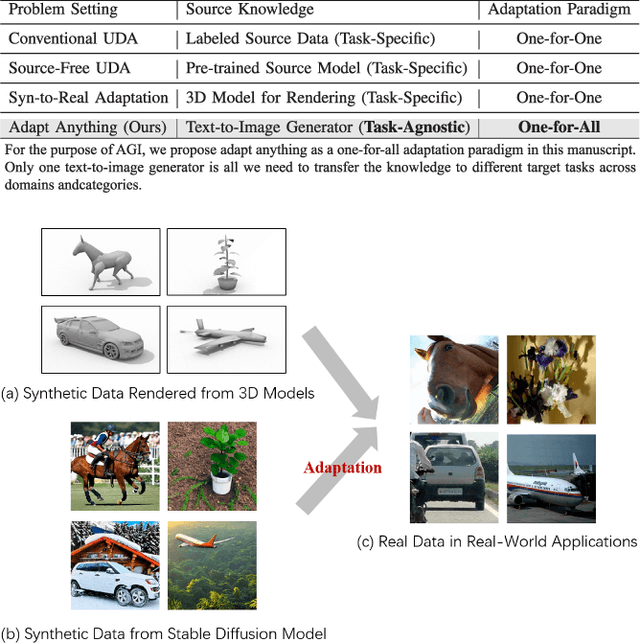
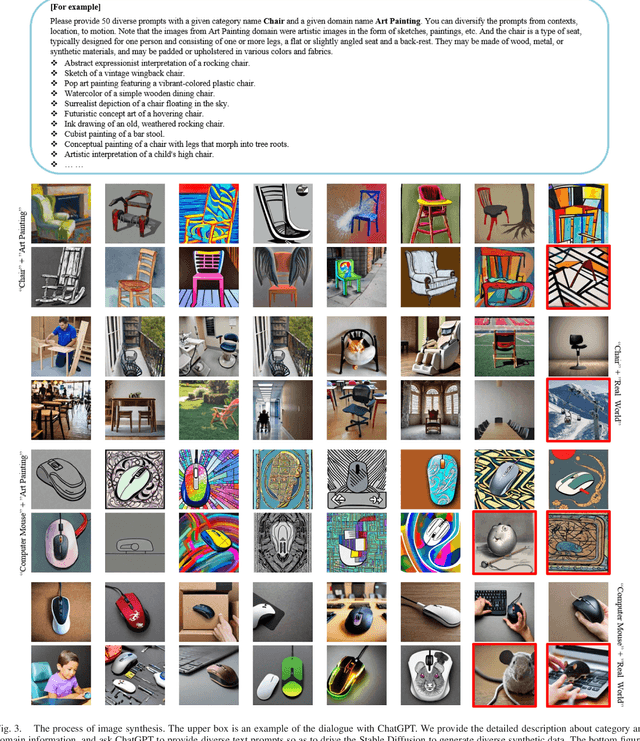
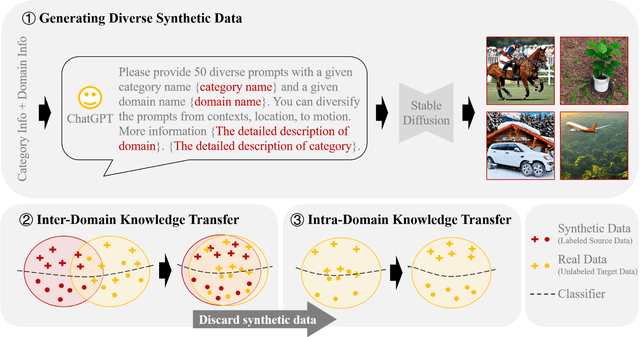
We do not pursue a novel method in this paper, but aim to study if a modern text-to-image diffusion model can tailor any task-adaptive image classifier across domains and categories. Existing domain adaptive image classification works exploit both source and target data for domain alignment so as to transfer the knowledge learned from the labeled source data to the unlabeled target data. However, as the development of the text-to-image diffusion model, we wonder if the high-fidelity synthetic data from the text-to-image generator can serve as a surrogate of the source data in real world. In this way, we do not need to collect and annotate the source data for each domain adaptation task in a one-for-one manner. Instead, we utilize only one off-the-shelf text-to-image model to synthesize images with category labels derived from the corresponding text prompts, and then leverage the surrogate data as a bridge to transfer the knowledge embedded in the task-agnostic text-to-image generator to the task-oriented image classifier via domain adaptation. Such a one-for-all adaptation paradigm allows us to adapt anything in the world using only one text-to-image generator as well as the corresponding unlabeled target data. Extensive experiments validate the feasibility of the proposed idea, which even surpasses the state-of-the-art domain adaptation works using the source data collected and annotated in real world.
Representation Learning with Large Language Models for Recommendation
Oct 24, 2023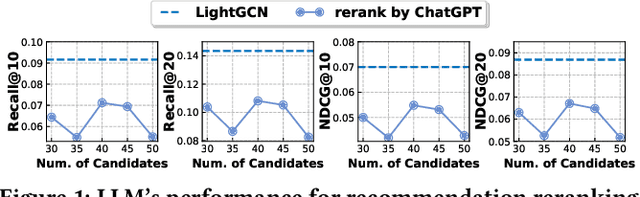

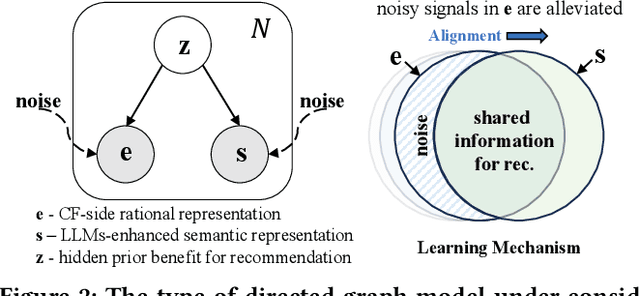

Recommender systems have seen significant advancements with the influence of deep learning and graph neural networks, particularly in capturing complex user-item relationships. However, these graph-based recommenders heavily depend on ID-based data, potentially disregarding valuable textual information associated with users and items, resulting in less informative learned representations. Moreover, the utilization of implicit feedback data introduces potential noise and bias, posing challenges for the effectiveness of user preference learning. While the integration of large language models (LLMs) into traditional ID-based recommenders has gained attention, challenges such as scalability issues, limitations in text-only reliance, and prompt input constraints need to be addressed for effective implementation in practical recommender systems. To address these challenges, we propose a model-agnostic framework RLMRec that aims to enhance existing recommenders with LLM-empowered representation learning. It proposes a recommendation paradigm that integrates representation learning with LLMs to capture intricate semantic aspects of user behaviors and preferences. RLMRec incorporates auxiliary textual signals, develops a user/item profiling paradigm empowered by LLMs, and aligns the semantic space of LLMs with the representation space of collaborative relational signals through a cross-view alignment framework. This work further establish a theoretical foundation demonstrating that incorporating textual signals through mutual information maximization enhances the quality of representations. In our evaluation, we integrate RLMRec with state-of-the-art recommender models, while also analyzing its efficiency and robustness to noise data. Our implementation codes are available at https://github.com/HKUDS/RLMRec.
Skipped Feature Pyramid Network with Grid Anchor for Object Detection
Oct 22, 2023CNN-based object detection methods have achieved significant progress in recent years. The classic structures of CNNs produce pyramid-like feature maps due to the pooling or other re-scale operations. The feature maps in different levels of the feature pyramid are used to detect objects with different scales. For more accurate object detection, the highest-level feature, which has the lowest resolution and contains the strongest semantics, is up-scaled and connected with the lower-level features to enhance the semantics in the lower-level features. However, the classic mode of feature connection combines the feature of lower-level with all the features above it, which may result in semantics degradation. In this paper, we propose a skipped connection to obtain stronger semantics at each level of the feature pyramid. In our method, the lower-level feature only connects with the feature at the highest level, making it more reasonable that each level is responsible for detecting objects with fixed scales. In addition, we simplify the generation of anchor for bounding box regression, which can further improve the accuracy of object detection. The experiments on the MS COCO and Wider Face demonstrate that our method outperforms the state-of-the-art methods.
MIRACLE: Towards Personalized Dialogue Generation with Latent-Space Multiple Personal Attribute Control
Oct 22, 2023Personalized dialogue systems aim to endow the chatbot agent with more anthropomorphic traits for human-like interactions. Previous approaches have explored explicitly user profile modeling using text descriptions, implicit derivation of user embeddings, or utilizing handicraft prompts for ChatGPT-like models. However, textual personas are limited in describing multi-faceted attributes (\emph{e.g.}, \emph{language style, inner character nuances}), implicit embedding suffers from personality sparsity, and handicraft prompts lack fine-grained and stable controllability. Hence, these approaches may struggle with complex personalized dialogue generation tasks that require generating controllable responses with multiple personal attributes. To this end, we propose \textbf{\textsc{Miracle}}, a novel personalized dialogue generation method through \textbf{M}ult\textbf{I}ple Pe\textbf{R}sonal \textbf{A}ttributes \textbf{C}ontrol within \textbf{L}atent-Space \textbf{E}nergy-based Models. ttributes \textbf{C}ontrol within \textbf{L}atent-Space \textbf{E}nergy-based Models. Specifically, our approach first disentangles complex personality into multi-faceted attributes. Subsequently, we employ a conditional variational auto-encoder to align with the dense personalized responses within a latent joint attribute space. We have also tailored a dedicated energy function and customized the ordinary differential equations sampling method to offer flexible attribute composition and precise attribute control. Extensive experiments demonstrate that \textsc{Miracle} outperforms several strong baselines in terms of personality controllability and response generation quality. Our dataset and code are available at \url{https://github.com/LZY-the-boys/MIRACLE}