 Add to Chrome
 Add to Firefox
 Add to Edge
Comparing Developer and LLM Biases in Code Evaluation
Mar 25, 2026
As LLMs are increasingly used as judges in code applications, they should be evaluated in realistic interactive settings that capture partial context and ambiguous intent. We present TRACE (Tool for Rubric Analysis in Code Evaluation), a framework that evaluates LLM judges' ability to predict human preferences and automatically extracts rubric items to reveal systematic biases in how humans and models weigh each item. Across three modalities -- chat-based programming, IDE autocompletion, and instructed code editing -- we use TRACE to measure how well LLM judges align with developer preferences. Among 13 different models, the best judges underperform human annotators by 12-23%. TRACE identifies 35 significant sources of misalignment between humans and judges across interaction modalities, the majority of which correspond to existing software engineering code quality criteria. For example, in chat-based coding, judges are biased towards longer code explanations while humans prefer shorter ones. We find significant misalignment on the majority of existing code quality dimensions, showing alignment gaps between LLM judges and human preference in realistic coding applications.

CodeAlignBench: Assessing Code Generation Models on Developer-Preferred Code Adjustments
Oct 31, 2025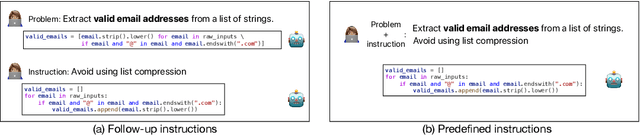
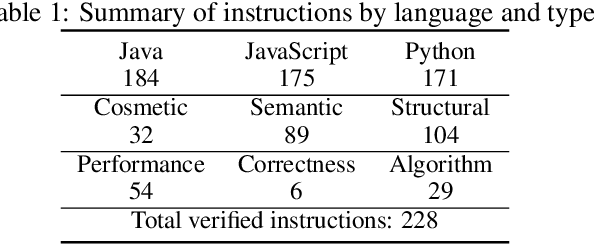
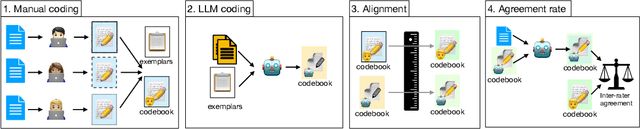
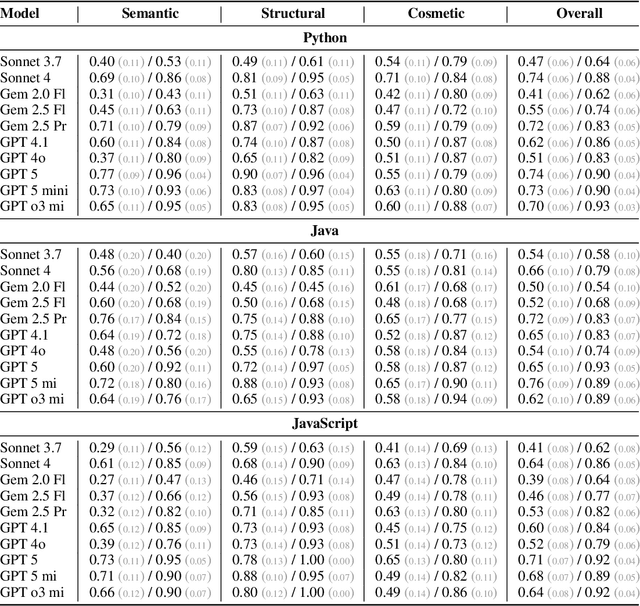
As large language models become increasingly capable of generating code, evaluating their performance remains a complex and evolving challenge. Existing benchmarks primarily focus on functional correctness, overlooking the diversity of real-world coding tasks and developer expectations. To this end, we introduce a multi-language benchmark that evaluates LLM instruction-following capabilities and is extensible to operate on any set of standalone coding problems. Our benchmark evaluates instruction following in two key settings: adherence to pre-defined constraints specified with the initial problem, and the ability to perform refinements based on follow-up instructions. For this paper's analysis, we empirically evaluated our benchmarking pipeline with programming tasks from LiveBench, that are also automatically translated from Python into Java and JavaScript. Our automated benchmark reveals that models exhibit differing levels of performance across multiple dimensions of instruction-following. Our benchmarking pipeline provides a more comprehensive evaluation of code generation models, highlighting their strengths and limitations across languages and generation goals.