 Add to Chrome
 Add to Firefox
 Add to Edge
GameDevBench: Evaluating Agentic Capabilities Through Game Development
Feb 11, 2026
Despite rapid progress on coding agents, progress on their multimodal counterparts has lagged behind. A key challenge is the scarcity of evaluation testbeds that combine the complexity of software development with the need for deep multimodal understanding. Game development provides such a testbed as agents must navigate large, dense codebases while manipulating intrinsically multimodal assets such as shaders, sprites, and animations within a visual game scene. We present GameDevBench, the first benchmark for evaluating agents on game development tasks. GameDevBench consists of 132 tasks derived from web and video tutorials. Tasks require significant multimodal understanding and are complex -- the average solution requires over three times the amount of lines of code and file changes compared to prior software development benchmarks. Agents still struggle with game development, with the best agent solving only 54.5% of tasks. We find a strong correlation between perceived task difficulty and multimodal complexity, with success rates dropping from 46.9% on gameplay-oriented tasks to 31.6% on 2D graphics tasks. To improve multimodal capability, we introduce two simple image and video-based feedback mechanisms for agents. Despite their simplicity, these methods consistently improve performance, with the largest change being an increase in Claude Sonnet 4.5's performance from 33.3% to 47.7%. We release GameDevBench publicly to support further research into agentic game development.

LEGO-Net: Learning Regular Rearrangements of Objects in Rooms
Jan 23, 2023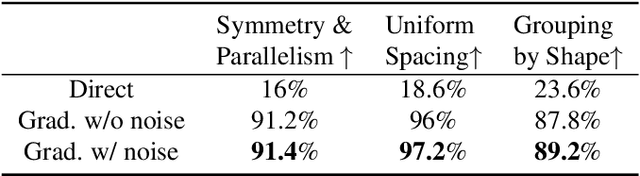
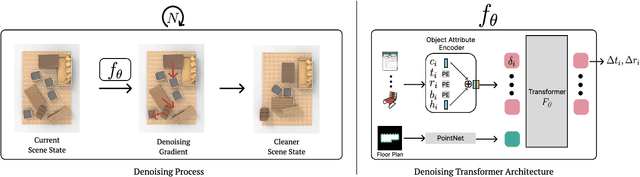
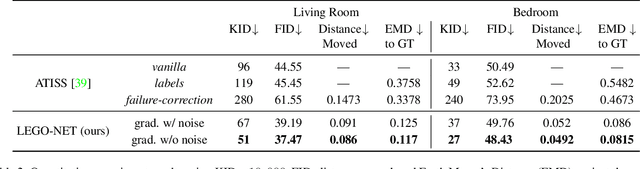
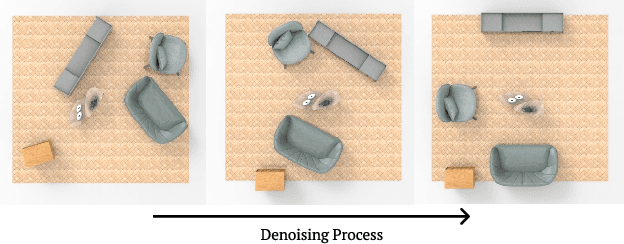
Humans universally dislike the task of cleaning up a messy room. If machines were to help us with this task, they must understand human criteria for regular arrangements, such as several types of symmetry, co-linearity or co-circularity, spacing uniformity in linear or circular patterns, and further inter-object relationships that relate to style and functionality. Previous approaches for this task relied on human input to explicitly specify goal state, or synthesized scenes from scratch -- but such methods do not address the rearrangement of existing messy scenes without providing a goal state. In this paper, we present LEGO-Net, a data-driven transformer-based iterative method for learning regular rearrangement of objects in messy rooms. LEGO-Net is partly inspired by diffusion models -- it starts with an initial messy state and iteratively "de-noises'' the position and orientation of objects to a regular state while reducing the distance traveled. Given randomly perturbed object positions and orientations in an existing dataset of professionally-arranged scenes, our method is trained to recover a regular re-arrangement. Results demonstrate that our method is able to reliably rearrange room scenes and outperform other methods. We additionally propose a metric for evaluating regularity in room arrangements using number-theoretic machinery.