 Add to Chrome
 Add to Firefox
 Add to Edge
CaloTrilogy: Toward a Breakthrough in One-Step, End-to-End, Physics-Guided Shower Generation for Modern Calorimeters
Jun 02, 2026
High-precision calorimeter simulation at current and future colliders imposes rapidly growing computational demands, motivating the development of machine-learning surrogates for traditional Monte Carlo tools such as Geant4. Flow matching and diffusion-based generative models have become leading approaches for high-dimensional fast simulation because of their sample quality, but typically require ${\cal O}(100)$ function evaluations at inference and often rely on auxiliary networks to constrain global observables, compromising streamlined end-to-end generation. We introduce a unified framework that improves the balance between speed, shower quality, and physics fidelity. The method combines: (i) an average velocity field integrator that enables sampling in one or a few evaluations; (ii) a learned generative prior in shower space, constructed from data rather than random noise; and (iii) physics-guided loss terms that impose inductive biases on key observables during training. These elements are training time regularizers, preserving end-to-end inference with no additional cost. With only one or a few evaluation steps, the model achieves shower quality competitive with state-of-the-art flow and diffusion approaches, tested on several public high granularity calorimeter datasets. The results demonstrate inter-layer shower structure consistent with the underlying physics, providing a strong candidate for future fast simulation workflows.

Model-Agnostic Signal Discovery with Machine Learning: Bridging the Gap Between Theory and Practice
May 29, 2026Searches for new phenomena in complex scientific data are predominantly model-dependent, optimized for specific hypotheses, and therefore limited in their coverage of the space of possible signals. Recently, new AI-based model-agnostic search strategies, many of which have been pioneered in high-energy physics, have been proposed which provide a complementary paradigm, prioritizing broad exploration over tailored analyses. These techniques offer an opportunity to enhance the overall discovery potential of modern experiments, especially in regimes where theoretical guidance is scarce. In this document, we review the conceptual framework behind the main classes of AI-based model-agnostic strategies. We discuss the potential pitfalls of these methods, and strategies for their validation and interpretation. We aim for this document to serve as a useful reference both for practitioners and for researchers interested in learning more about these model-agnostic search strategies.
Neural Scaling Laws for Jet Generation
May 27, 2026Recently observed empirical scaling laws describe the performance of foundation-type models as three independent key quantities -- dataset size, compute, and model parameters -- are modified. Extracting these scaling laws informs the training of large complex models for which the tuning of hyperparameters in traditional ways is not feasible. This work for the first time explores if scaling laws can also be observed for the task of particle jet generation -- both relevant as a pre-training objective for foundation models and as in-situ simulation by itself. We indeed replicate the key logarithmic scaling law behavior for model-size scaling. Beyond studying the next token prediction validation loss of the generative model, we also study the sliced Wasserstein distance of five physical quantities that are not immediately available to the model during training. Our study shows that this quantity is monotonically related to the next token prediction validation loss, meaning that this loss is indeed a good proxy for the physics performance. For the scaling with dataset size and compute, we observe substantially weaker scaling behavior of both the loss and the sliced Wasserstein distance. We analyze this behavior by introducing the concept of a learnable window, and argue that autoregressive next token prediction on jet constituents exhibits comparatively rapid saturation relative to language-model studies. We discuss possible origins of this behavior, including the stochastic nature of QCD radiation and differences between generative and supervised learning tasks in collider physics.
Data-Driven High-Dimensional Statistical Inference with Generative Models
Jun 06, 2025Crucial to many measurements at the LHC is the use of correlated multi-dimensional information to distinguish rare processes from large backgrounds, which is complicated by the poor modeling of many of the crucial backgrounds in Monte Carlo simulations. In this work, we introduce HI-SIGMA, a method to perform unbinned high-dimensional statistical inference with data-driven background distributions. In contradistinction to many applications of Simulation Based Inference in High Energy Physics, HI-SIGMA relies on generative ML models, rather than classifiers, to learn the signal and background distributions in the high-dimensional space. These ML models allow for efficient, interpretable inference while also incorporating model errors and other sources of systematic uncertainties. We showcase this methodology on a simplified version of a di-Higgs measurement in the $bb\gamma\gamma$ final state, where the di-photon resonance allows for efficient background interpolation from sidebands into the signal region. We demonstrate that HI-SIGMA provides improved sensitivity as compared to standard classifier-based methods, and that systematic uncertainties can be straightforwardly incorporated by extending methods which have been used for histogram based analyses.
Aspen Open Jets: Unlocking LHC Data for Foundation Models in Particle Physics
Dec 13, 2024Foundation models are deep learning models pre-trained on large amounts of data which are capable of generalizing to multiple datasets and/or downstream tasks. This work demonstrates how data collected by the CMS experiment at the Large Hadron Collider can be useful in pre-training foundation models for HEP. Specifically, we introduce the AspenOpenJets dataset, consisting of approximately 180M high $p_T$ jets derived from CMS 2016 Open Data. We show how pre-training the OmniJet-$\alpha$ foundation model on AspenOpenJets improves performance on generative tasks with significant domain shift: generating boosted top and QCD jets from the simulated JetClass dataset. In addition to demonstrating the power of pre-training of a jet-based foundation model on actual proton-proton collision data, we provide the ML-ready derived AspenOpenJets dataset for further public use.
CaloChallenge 2022: A Community Challenge for Fast Calorimeter Simulation
Oct 28, 2024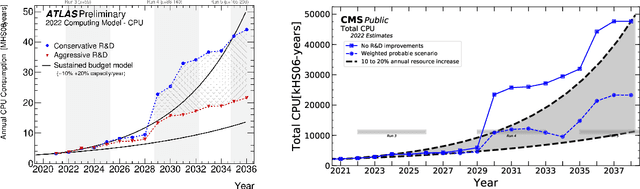
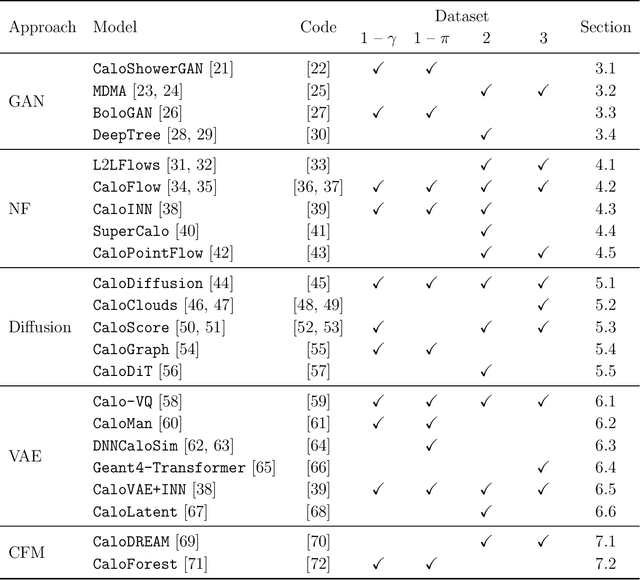
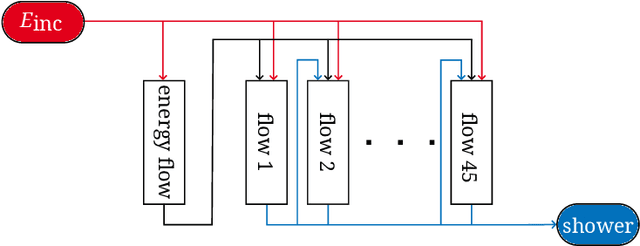
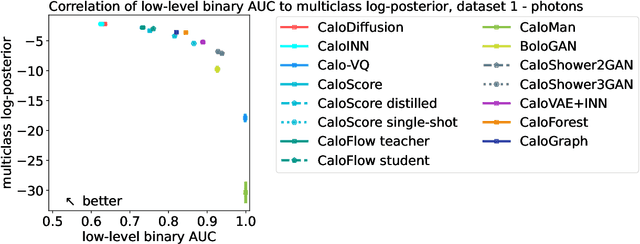
We present the results of the "Fast Calorimeter Simulation Challenge 2022" - the CaloChallenge. We study state-of-the-art generative models on four calorimeter shower datasets of increasing dimensionality, ranging from a few hundred voxels to a few tens of thousand voxels. The 31 individual submissions span a wide range of current popular generative architectures, including Variational AutoEncoders (VAEs), Generative Adversarial Networks (GANs), Normalizing Flows, Diffusion models, and models based on Conditional Flow Matching. We compare all submissions in terms of quality of generated calorimeter showers, as well as shower generation time and model size. To assess the quality we use a broad range of different metrics including differences in 1-dimensional histograms of observables, KPD/FPD scores, AUCs of binary classifiers, and the log-posterior of a multiclass classifier. The results of the CaloChallenge provide the most complete and comprehensive survey of cutting-edge approaches to calorimeter fast simulation to date. In addition, our work provides a uniquely detailed perspective on the important problem of how to evaluate generative models. As such, the results presented here should be applicable for other domains that use generative AI and require fast and faithful generation of samples in a large phase space.