 Add to Chrome
 Add to Firefox
 Add to Edge
Neural Scaling Laws for Jet Generation
May 27, 2026
Recently observed empirical scaling laws describe the performance of foundation-type models as three independent key quantities -- dataset size, compute, and model parameters -- are modified. Extracting these scaling laws informs the training of large complex models for which the tuning of hyperparameters in traditional ways is not feasible. This work for the first time explores if scaling laws can also be observed for the task of particle jet generation -- both relevant as a pre-training objective for foundation models and as in-situ simulation by itself. We indeed replicate the key logarithmic scaling law behavior for model-size scaling. Beyond studying the next token prediction validation loss of the generative model, we also study the sliced Wasserstein distance of five physical quantities that are not immediately available to the model during training. Our study shows that this quantity is monotonically related to the next token prediction validation loss, meaning that this loss is indeed a good proxy for the physics performance. For the scaling with dataset size and compute, we observe substantially weaker scaling behavior of both the loss and the sliced Wasserstein distance. We analyze this behavior by introducing the concept of a learnable window, and argue that autoregressive next token prediction on jet constituents exhibits comparatively rapid saturation relative to language-model studies. We discuss possible origins of this behavior, including the stochastic nature of QCD radiation and differences between generative and supervised learning tasks in collider physics.

Collider-Bench: Benchmarking AI Agents with Particle Physics Analysis Reproduction
May 13, 2026Autonomous language-model agents are increasingly evaluated on long-horizon tool-use tasks, but existing benchmarks rarely capture the complexity and nuance of real scientific work. To address this gap, we introduce Collider-Bench, a benchmark for evaluating whether LLM agents can reproduce experimental analyses from the Large Hadron Collider (LHC) using only public papers and open scientific software. Such analyses are often difficult to reproduce because the public toolchain only approximates the software used internally by the experimental collaborations, while the published papers inevitably omit implementation details needed for a faithful reconstruction. Agents must therefore rely on physical reasoning, domain knowledge, and trial-and-error to fill these gaps. Each task requires the agent to turn a published analysis into an executable simulation-and-selection pipeline and submit predicted collision event yields in specified signal regions. These predictions are evaluated with standard histogram metrics that provide continuous fidelity scores without a hand-written rubric. We also report the computational cost incurred by each agent per task. Finally, we evaluate the codebase and full session trace using an LLM judge to catch qualitative failure modes such as fabrications, hallucinations and duplications. We release an initial set of tasks drawn from LHC searches, together with a containerized sandbox and event simulation tools. We evaluate across a capability ladder of general purpose coding agents. Our results show that on average no agent reliably beats the physicist-in-the-loop solution.
Learning to Unscramble Feynman Loop Integrals with SAILIR
Apr 06, 2026Integration-by-parts (IBP) reduction of Feynman integrals to master integrals is a key computational bottleneck in precision calculations in high-energy physics. Traditional approaches based on the Laporta algorithm require solving large systems of equations, leading to memory consumption that grows rapidly with integral complexity. We present SAILIR (Self-supervised AI for Loop Integral Reduction), a new machine learning approach in which a transformer-based classifier guides the reduction of integrals one step at a time in a fully online fashion. The classifier is trained in an entirely self-supervised manner on synthetic data generated by a scramble/unscramble procedure: known reduction identities are applied in reverse to build expressions of increasing complexity, and the classifier learns to undo these steps. When combined with beam search and a highly parallelized, asynchronous, single-episode reduction strategy, SAILIR can reduce integrals of arbitrarily high weight with bounded memory. We benchmark SAILIR on the two-loop triangle-box topology, comparing against the state-of-the-art IBP reduction code Kira across 16 integrals of varying complexity. While SAILIR is slower in wall-clock time, its per-worker memory consumption remains approximately flat regardless of integral complexity, in contrast to Kira whose memory grows rapidly with complexity. For the most complex integrals considered here, SAILIR uses only 40\% of the memory of Kira while achieving comparable reduction times. This demonstrates a fundamentally new paradigm for IBP reduction in which the memory bottleneck of Laporta-based approaches could be entirely overcome, potentially opening the door to precision calculations that are currently intractable.
Learning to Unscramble: Simplifying Symbolic Expressions via Self-Supervised Oracle Trajectories
Mar 11, 2026We present a new self-supervised machine learning approach for symbolic simplification of complex mathematical expressions. Training data is generated by scrambling simple expressions and recording the inverse operations, creating oracle trajectories that provide both goal states and explicit paths to reach them. A permutation-equivariant, transformer-based policy network is then trained on this data step-wise to predict the oracle action given the input expression. We demonstrate this approach on two problems in high-energy physics: dilogarithm reduction and spinor-helicity scattering amplitude simplification. In both cases, our trained policy network achieves near perfect solve rates across a wide range of difficulty levels, substantially outperforming prior approaches based on reinforcement learning and end-to-end regression. When combined with contrastive grouping and beam search, our model achieves a 100\% full simplification rate on a representative selection of 5-point gluon tree-level amplitudes in Yang-Mills theory, including expressions with over 200 initial terms.
How to pick the best anomaly detector?
Nov 18, 2025


Anomaly detection has the potential to discover new physics in unexplored regions of the data. However, choosing the best anomaly detector for a given data set in a model-agnostic way is an important challenge which has hitherto largely been neglected. In this paper, we introduce the data-driven ARGOS metric, which has a sound theoretical foundation and is empirically shown to robustly select the most sensitive anomaly detection model given the data. Focusing on weakly-supervised, classifier-based anomaly detection methods, we show that the ARGOS metric outperforms other model selection metrics previously used in the literature, in particular the binary cross-entropy loss. We explore several realistic applications, including hyperparameter tuning as well as architecture and feature selection, and in all cases we demonstrate that ARGOS is robust to the noisy conditions of anomaly detection.
Aspen Open Jets: Unlocking LHC Data for Foundation Models in Particle Physics
Dec 13, 2024Foundation models are deep learning models pre-trained on large amounts of data which are capable of generalizing to multiple datasets and/or downstream tasks. This work demonstrates how data collected by the CMS experiment at the Large Hadron Collider can be useful in pre-training foundation models for HEP. Specifically, we introduce the AspenOpenJets dataset, consisting of approximately 180M high $p_T$ jets derived from CMS 2016 Open Data. We show how pre-training the OmniJet-$\alpha$ foundation model on AspenOpenJets improves performance on generative tasks with significant domain shift: generating boosted top and QCD jets from the simulated JetClass dataset. In addition to demonstrating the power of pre-training of a jet-based foundation model on actual proton-proton collision data, we provide the ML-ready derived AspenOpenJets dataset for further public use.
CaloChallenge 2022: A Community Challenge for Fast Calorimeter Simulation
Oct 28, 2024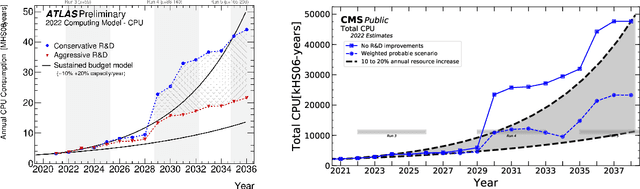
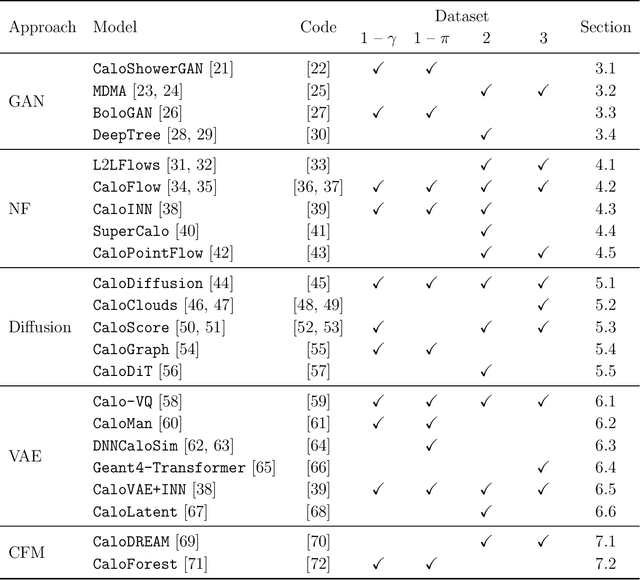
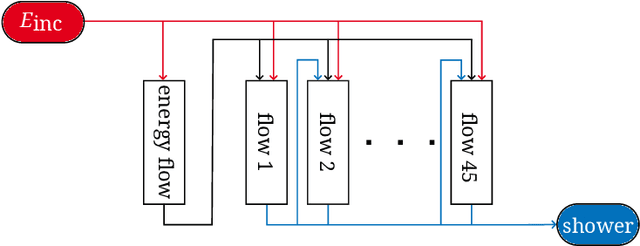
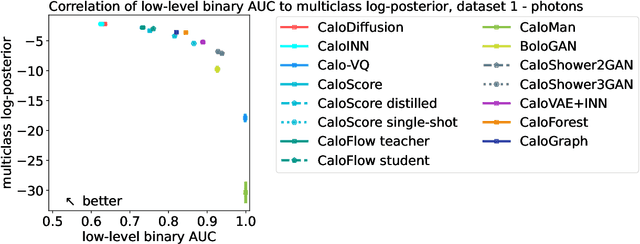
We present the results of the "Fast Calorimeter Simulation Challenge 2022" - the CaloChallenge. We study state-of-the-art generative models on four calorimeter shower datasets of increasing dimensionality, ranging from a few hundred voxels to a few tens of thousand voxels. The 31 individual submissions span a wide range of current popular generative architectures, including Variational AutoEncoders (VAEs), Generative Adversarial Networks (GANs), Normalizing Flows, Diffusion models, and models based on Conditional Flow Matching. We compare all submissions in terms of quality of generated calorimeter showers, as well as shower generation time and model size. To assess the quality we use a broad range of different metrics including differences in 1-dimensional histograms of observables, KPD/FPD scores, AUCs of binary classifiers, and the log-posterior of a multiclass classifier. The results of the CaloChallenge provide the most complete and comprehensive survey of cutting-edge approaches to calorimeter fast simulation to date. In addition, our work provides a uniquely detailed perspective on the important problem of how to evaluate generative models. As such, the results presented here should be applicable for other domains that use generative AI and require fast and faithful generation of samples in a large phase space.
SIGMA: Single Interpolated Generative Model for Anomalies
Oct 27, 2024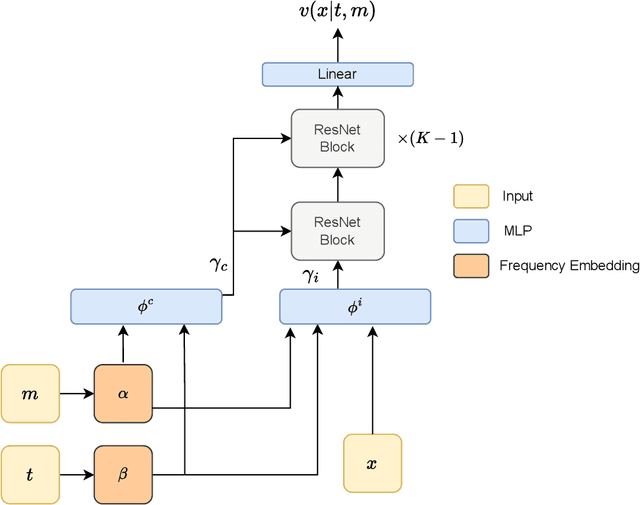
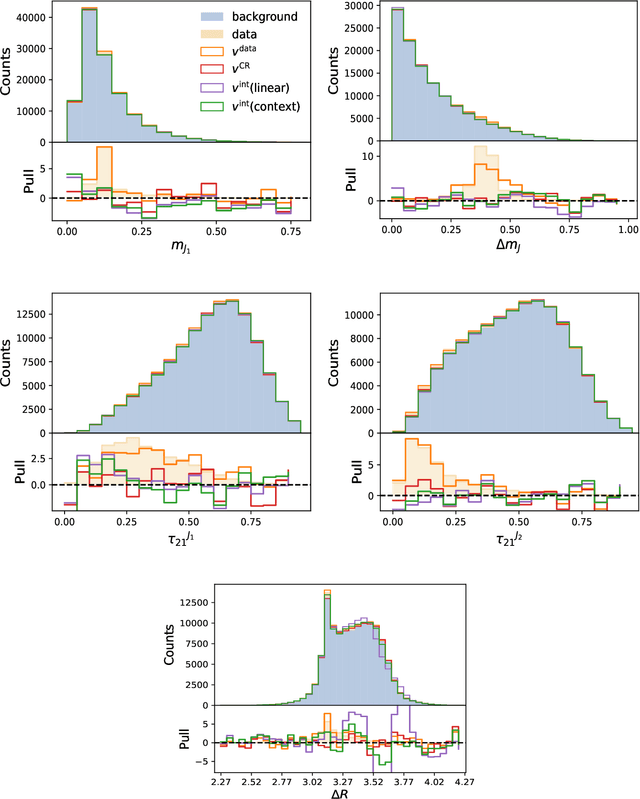
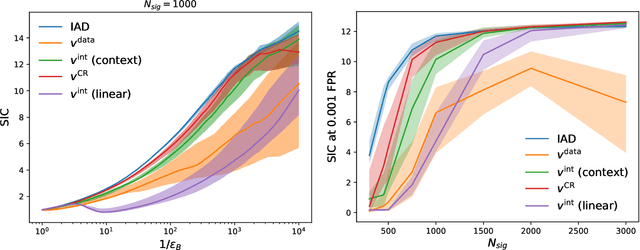
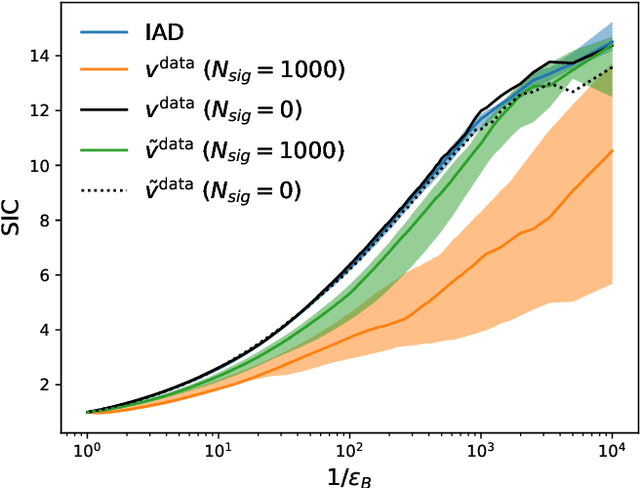
A key step in any resonant anomaly detection search is accurate modeling of the background distribution in each signal region. Data-driven methods like CATHODE accomplish this by training separate generative models on the complement of each signal region, and interpolating them into their corresponding signal regions. Having to re-train the generative model on essentially the entire dataset for each signal region is a major computational cost in a typical sliding window search with many signal regions. Here, we present SIGMA, a new, fully data-driven, computationally-efficient method for estimating background distributions. The idea is to train a single generative model on all of the data and interpolate its parameters in sideband regions in order to obtain a model for the background in the signal region. The SIGMA method significantly reduces the computational cost compared to previous approaches, while retaining a similar high quality of background modeling and sensitivity to anomalous signals.
Universal New Physics Latent Space
Jul 29, 2024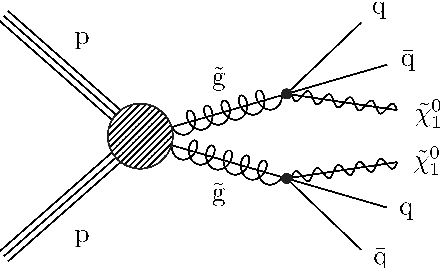
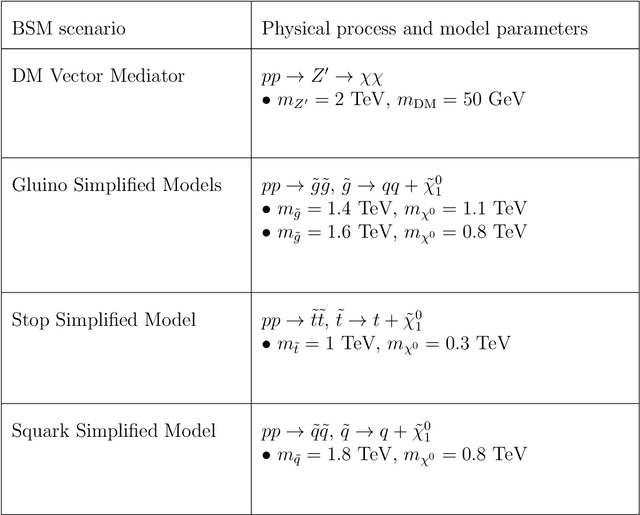
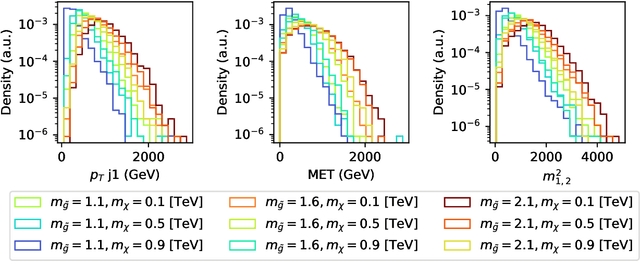
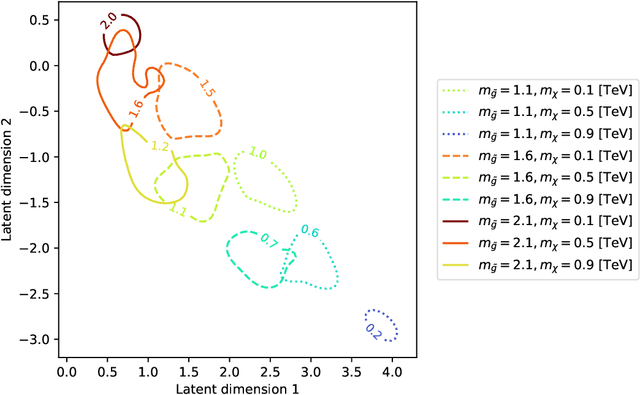
We develop a machine learning method for mapping data originating from both Standard Model processes and various theories beyond the Standard Model into a unified representation (latent) space while conserving information about the relationship between the underlying theories. We apply our method to three examples of new physics at the LHC of increasing complexity, showing that models can be clustered according to their LHC phenomenology: different models are mapped to distinct regions in latent space, while indistinguishable models are mapped to the same region. This opens interesting new avenues on several fronts, such as model discrimination, selection of representative benchmark scenarios, and identifying gaps in the coverage of model space.
Convolutional L2LFlows: Generating Accurate Showers in Highly Granular Calorimeters Using Convolutional Normalizing Flows
Jun 03, 2024
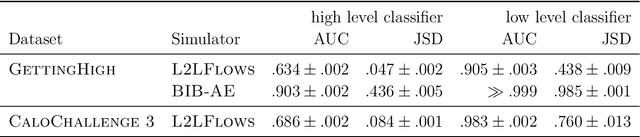
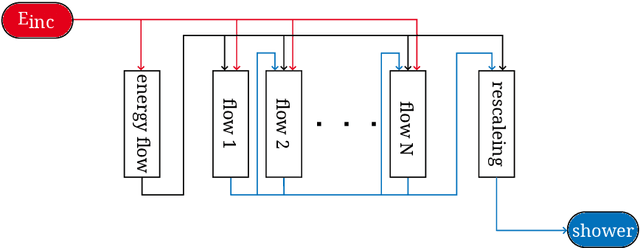
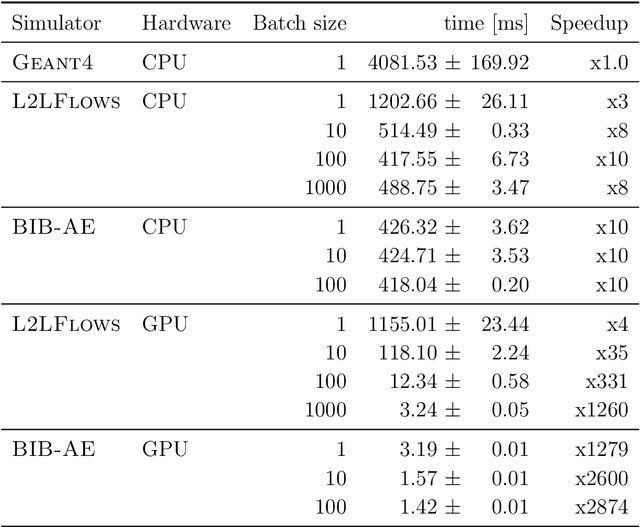
In the quest to build generative surrogate models as computationally efficient alternatives to rule-based simulations, the quality of the generated samples remains a crucial frontier. So far, normalizing flows have been among the models with the best fidelity. However, as the latent space in such models is required to have the same dimensionality as the data space, scaling up normalizing flows to high dimensional datasets is not straightforward. The prior L2LFlows approach successfully used a series of separate normalizing flows and sequence of conditioning steps to circumvent this problem. In this work, we extend L2LFlows to simulate showers with a 9-times larger profile in the lateral direction. To achieve this, we introduce convolutional layers and U-Net-type connections, move from masked autoregressive flows to coupling layers, and demonstrate the successful modelling of showers in the ILD Electromagnetic Calorimeter as well as Dataset 3 from the public CaloChallenge dataset.