 Add to Chrome
 Add to Firefox
 Add to Edge
ColliderML: The First Release of an OpenDataDetector High-Luminosity Physics Benchmark Dataset
Dec 17, 2025
We introduce ColliderML - a large, open, experiment-agnostic dataset of fully simulated and digitised proton-proton collisions in High-Luminosity Large Hadron Collider conditions ($\sqrt{s}=14$ TeV, mean pile-up $μ= 200$). ColliderML provides one million events across ten Standard Model and Beyond Standard Model processes, plus extensive single-particle samples, all produced with modern next-to-leading order matrix element calculation and showering, realistic per-event pile-up overlay, a validated OpenDataDetector geometry, and standard reconstructions. The release fills a major gap for machine learning (ML) research on detector-level data, provided on the ML-friendly Hugging Face platform. We present physics coverage and the generation, simulation, digitisation and reconstruction pipeline, describe format and access, and initial collider physics benchmarks.

CaloChallenge 2022: A Community Challenge for Fast Calorimeter Simulation
Oct 28, 2024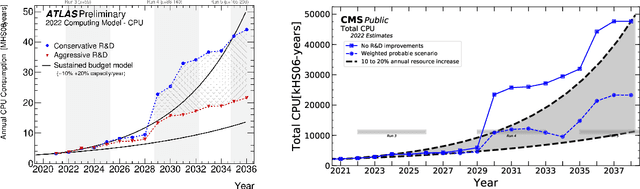
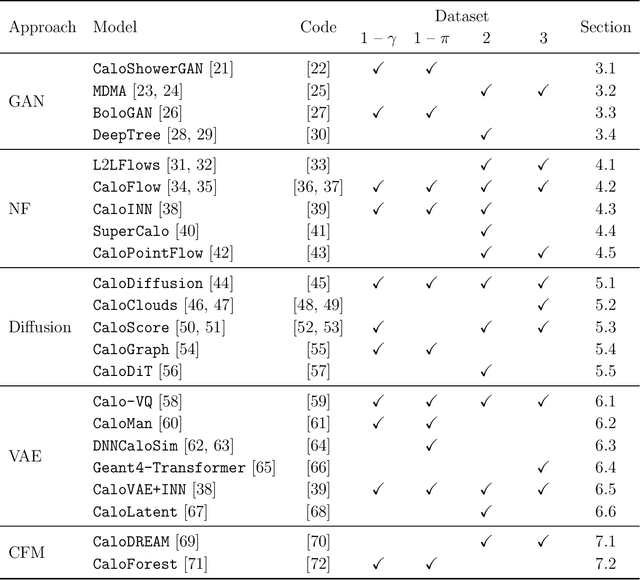
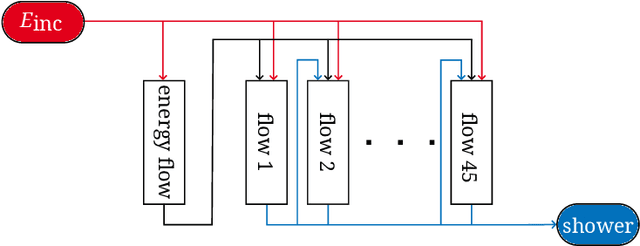
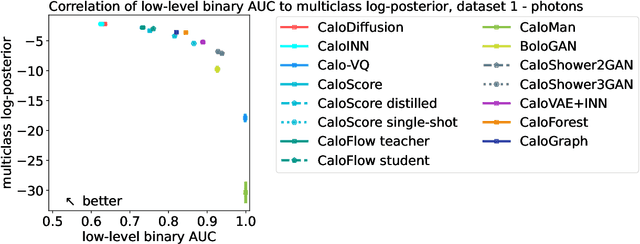
We present the results of the "Fast Calorimeter Simulation Challenge 2022" - the CaloChallenge. We study state-of-the-art generative models on four calorimeter shower datasets of increasing dimensionality, ranging from a few hundred voxels to a few tens of thousand voxels. The 31 individual submissions span a wide range of current popular generative architectures, including Variational AutoEncoders (VAEs), Generative Adversarial Networks (GANs), Normalizing Flows, Diffusion models, and models based on Conditional Flow Matching. We compare all submissions in terms of quality of generated calorimeter showers, as well as shower generation time and model size. To assess the quality we use a broad range of different metrics including differences in 1-dimensional histograms of observables, KPD/FPD scores, AUCs of binary classifiers, and the log-posterior of a multiclass classifier. The results of the CaloChallenge provide the most complete and comprehensive survey of cutting-edge approaches to calorimeter fast simulation to date. In addition, our work provides a uniquely detailed perspective on the important problem of how to evaluate generative models. As such, the results presented here should be applicable for other domains that use generative AI and require fast and faithful generation of samples in a large phase space.