 Add to Chrome
 Add to Firefox
 Add to Edge
An Introduction to Bayesian and Frequentist Simulation-Based Inference with Machine Learning
Jul 23, 2026
Simulation-based inference (SBI) with machine learning is an increasingly important tool for solving inverse problems in science and engineering, including parameter inference and the inversion of detector effects. We provide an overview of the Bayesian and frequentist statistical frameworks, describe how machine-learning-based SBI methods, such as neural posterior estimation and neural likelihood estimation, can be used for parameter estimation within these frameworks, and show that the same methods can also be applied to Empirical Bayes or unfolding tasks. We also discuss how to validate inference results and the limitations of SBI with machine learning.

The Landscape of Unfolding with Machine Learning
Apr 29, 2024

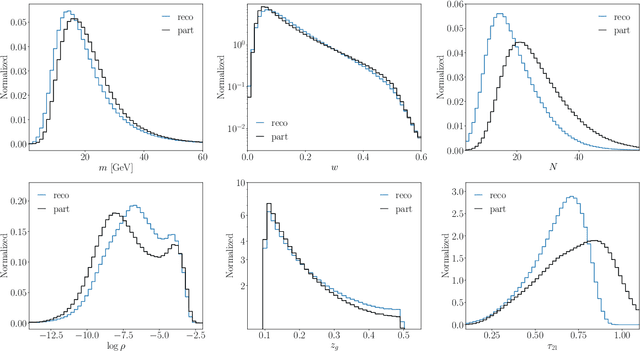

Recent innovations from machine learning allow for data unfolding, without binning and including correlations across many dimensions. We describe a set of known, upgraded, and new methods for ML-based unfolding. The performance of these approaches are evaluated on the same two datasets. We find that all techniques are capable of accurately reproducing the particle-level spectra across complex observables. Given that these approaches are conceptually diverse, they offer an exciting toolkit for a new class of measurements that can probe the Standard Model with an unprecedented level of detail and may enable sensitivity to new phenomena.
Generative Networks for Precision Enthusiasts
Oct 22, 2021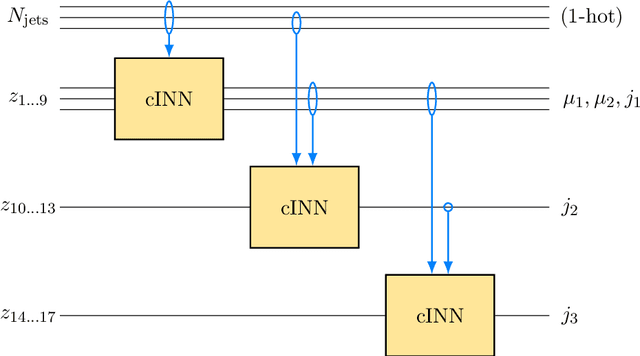
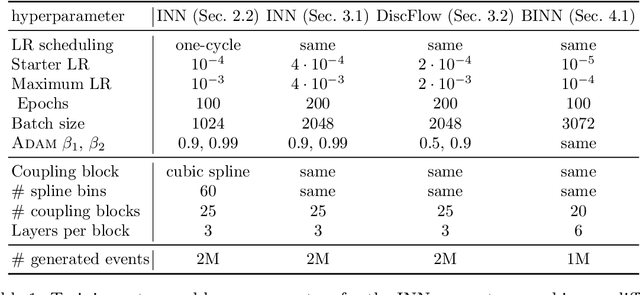
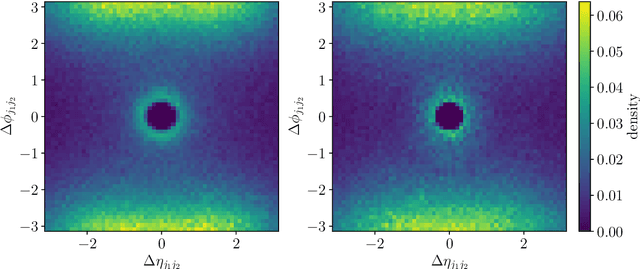
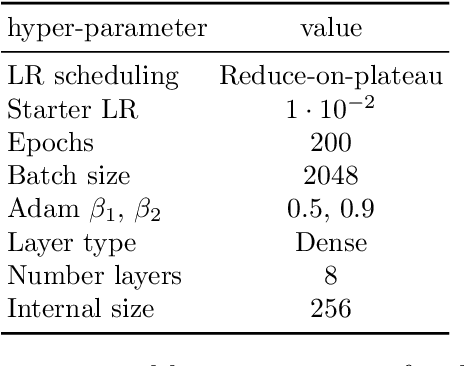
Generative networks are opening new avenues in fast event generation for the LHC. We show how generative flow networks can reach percent-level precision for kinematic distributions, how they can be trained jointly with a discriminator, and how this discriminator improves the generation. Our joint training relies on a novel coupling of the two networks which does not require a Nash equilibrium. We then estimate the generation uncertainties through a Bayesian network setup and through conditional data augmentation, while the discriminator ensures that there are no systematic inconsistencies compared to the training data.