 Add to Chrome
 Add to Firefox
 Add to Edge
Collider-Bench: Benchmarking AI Agents with Particle Physics Analysis Reproduction
May 13, 2026
Autonomous language-model agents are increasingly evaluated on long-horizon tool-use tasks, but existing benchmarks rarely capture the complexity and nuance of real scientific work. To address this gap, we introduce Collider-Bench, a benchmark for evaluating whether LLM agents can reproduce experimental analyses from the Large Hadron Collider (LHC) using only public papers and open scientific software. Such analyses are often difficult to reproduce because the public toolchain only approximates the software used internally by the experimental collaborations, while the published papers inevitably omit implementation details needed for a faithful reconstruction. Agents must therefore rely on physical reasoning, domain knowledge, and trial-and-error to fill these gaps. Each task requires the agent to turn a published analysis into an executable simulation-and-selection pipeline and submit predicted collision event yields in specified signal regions. These predictions are evaluated with standard histogram metrics that provide continuous fidelity scores without a hand-written rubric. We also report the computational cost incurred by each agent per task. Finally, we evaluate the codebase and full session trace using an LLM judge to catch qualitative failure modes such as fabrications, hallucinations and duplications. We release an initial set of tasks drawn from LHC searches, together with a containerized sandbox and event simulation tools. We evaluate across a capability ladder of general purpose coding agents. Our results show that on average no agent reliably beats the physicist-in-the-loop solution.

Aspen Open Jets: Unlocking LHC Data for Foundation Models in Particle Physics
Dec 13, 2024Foundation models are deep learning models pre-trained on large amounts of data which are capable of generalizing to multiple datasets and/or downstream tasks. This work demonstrates how data collected by the CMS experiment at the Large Hadron Collider can be useful in pre-training foundation models for HEP. Specifically, we introduce the AspenOpenJets dataset, consisting of approximately 180M high $p_T$ jets derived from CMS 2016 Open Data. We show how pre-training the OmniJet-$\alpha$ foundation model on AspenOpenJets improves performance on generative tasks with significant domain shift: generating boosted top and QCD jets from the simulated JetClass dataset. In addition to demonstrating the power of pre-training of a jet-based foundation model on actual proton-proton collision data, we provide the ML-ready derived AspenOpenJets dataset for further public use.
CaloChallenge 2022: A Community Challenge for Fast Calorimeter Simulation
Oct 28, 2024
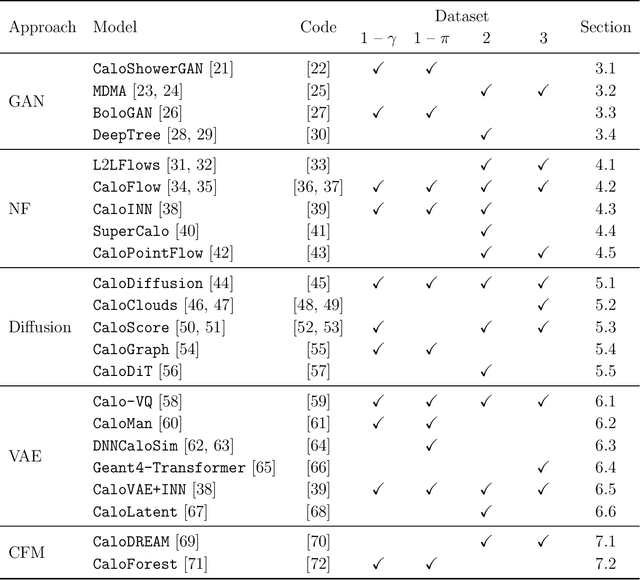
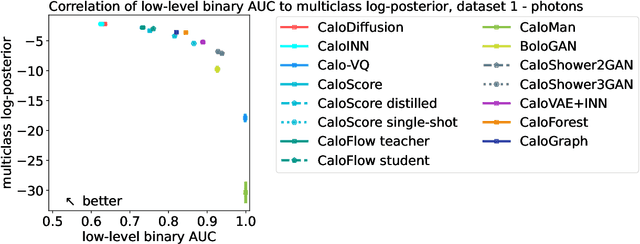
We present the results of the "Fast Calorimeter Simulation Challenge 2022" - the CaloChallenge. We study state-of-the-art generative models on four calorimeter shower datasets of increasing dimensionality, ranging from a few hundred voxels to a few tens of thousand voxels. The 31 individual submissions span a wide range of current popular generative architectures, including Variational AutoEncoders (VAEs), Generative Adversarial Networks (GANs), Normalizing Flows, Diffusion models, and models based on Conditional Flow Matching. We compare all submissions in terms of quality of generated calorimeter showers, as well as shower generation time and model size. To assess the quality we use a broad range of different metrics including differences in 1-dimensional histograms of observables, KPD/FPD scores, AUCs of binary classifiers, and the log-posterior of a multiclass classifier. The results of the CaloChallenge provide the most complete and comprehensive survey of cutting-edge approaches to calorimeter fast simulation to date. In addition, our work provides a uniquely detailed perspective on the important problem of how to evaluate generative models. As such, the results presented here should be applicable for other domains that use generative AI and require fast and faithful generation of samples in a large phase space.
Unifying Simulation and Inference with Normalizing Flows
Apr 29, 2024

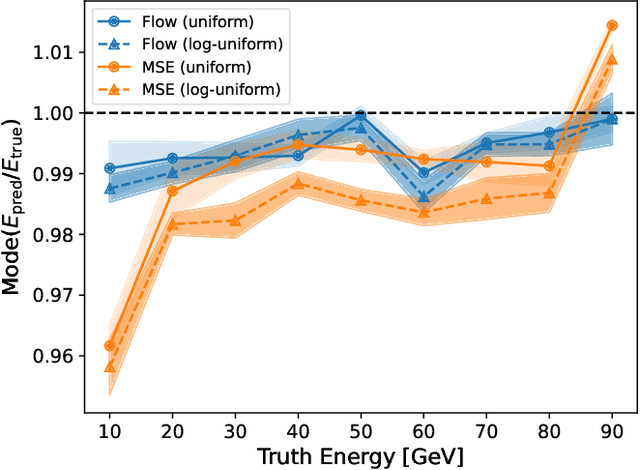

There have been many applications of deep neural networks to detector calibrations and a growing number of studies that propose deep generative models as automated fast detector simulators. We show that these two tasks can be unified by using maximum likelihood estimation (MLE) from conditional generative models for energy regression. Unlike direct regression techniques, the MLE approach is prior-independent and non-Gaussian resolutions can be determined from the shape of the likelihood near the maximum. Using an ATLAS-like calorimeter simulation, we demonstrate this concept in the context of calorimeter energy calibration.
SuperCalo: Calorimeter shower super-resolution
Aug 22, 2023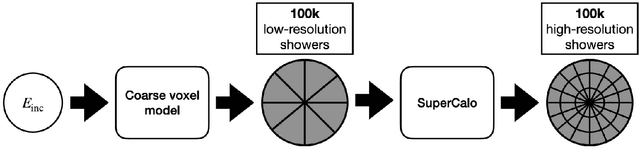
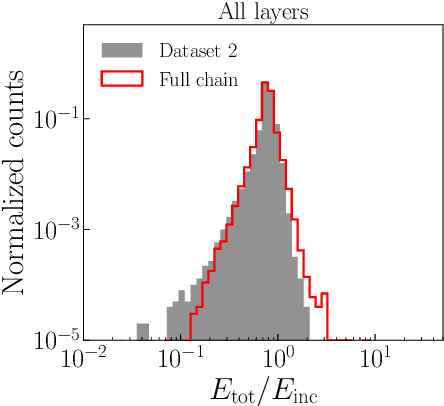
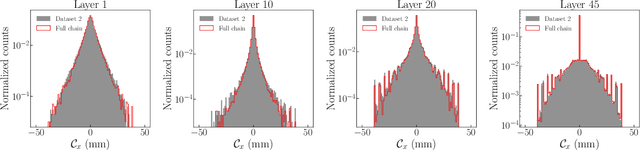
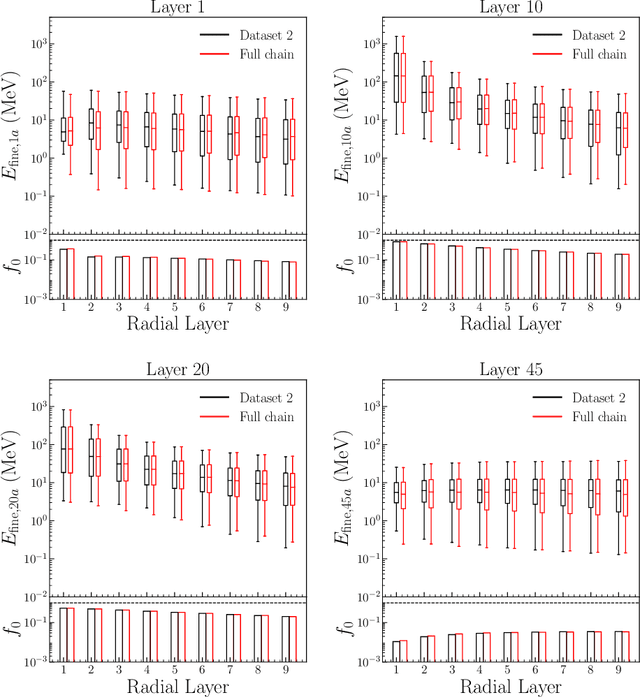
Calorimeter shower simulation is a major bottleneck in the Large Hadron Collider computational pipeline. There have been recent efforts to employ deep-generative surrogate models to overcome this challenge. However, many of best performing models have training and generation times that do not scale well to high-dimensional calorimeter showers. In this work, we introduce SuperCalo, a flow-based super-resolution model, and demonstrate that high-dimensional fine-grained calorimeter showers can be quickly upsampled from coarse-grained showers. This novel approach presents a way to reduce computational cost, memory requirements and generation time associated with fast calorimeter simulation models. Additionally, we show that the showers upsampled by SuperCalo possess a high degree of variation. This allows a large number of high-dimensional calorimeter showers to be upsampled from much fewer coarse showers with high-fidelity, which results in additional reduction in generation time.
Inductive CaloFlow
May 19, 2023


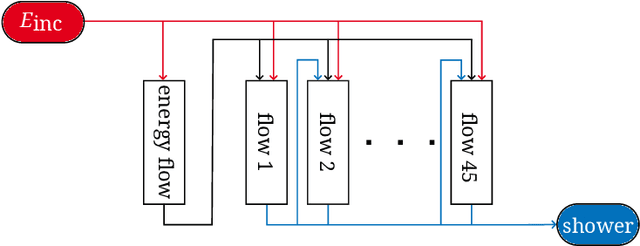
Simulating particle detector response is the single most expensive step in the Large Hadron Collider computational pipeline. Recently it was shown that normalizing flows can accelerate this process while achieving unprecedented levels of accuracy, but scaling this approach up to higher resolutions relevant for future detector upgrades leads to prohibitive memory constraints. To overcome this problem, we introduce Inductive CaloFlow (iCaloFlow), a framework for fast detector simulation based on an inductive series of normalizing flows trained on the pattern of energy depositions in pairs of consecutive calorimeter layers. We further use a teacher-student distillation to increase sampling speed without loss of expressivity. As we demonstrate with Datasets 2 and 3 of the CaloChallenge2022, iCaloFlow can realize the potential of normalizing flows in performing fast, high-fidelity simulation on detector geometries that are ~ 10 - 100 times higher granularity than previously considered.
CaloFlow for CaloChallenge Dataset 1
Oct 25, 2022CaloFlow is a new and promising approach to fast calorimeter simulation based on normalizing flows. Applying CaloFlow to the photon and charged pion Geant4 showers of Dataset 1 of the Fast Calorimeter Simulation Challenge 2022, we show how it can produce high-fidelity samples with a sampling time that is several orders of magnitude faster than Geant4. We demonstrate the fidelity of the samples using calorimeter shower images, histograms of high level features, and aggregate metrics such as a classifier trained to distinguish CaloFlow from Geant4 samples.