 Add to Chrome
 Add to Firefox
 Add to Edge
MultiNash-PF: A Particle Filtering Approach for Computing Multiple Local Generalized Nash Equilibria in Trajectory Games
Oct 07, 2024
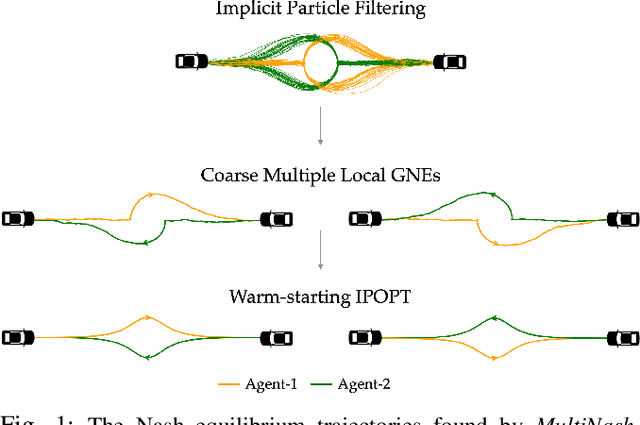
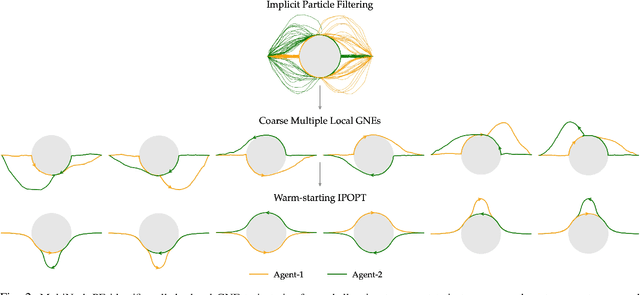
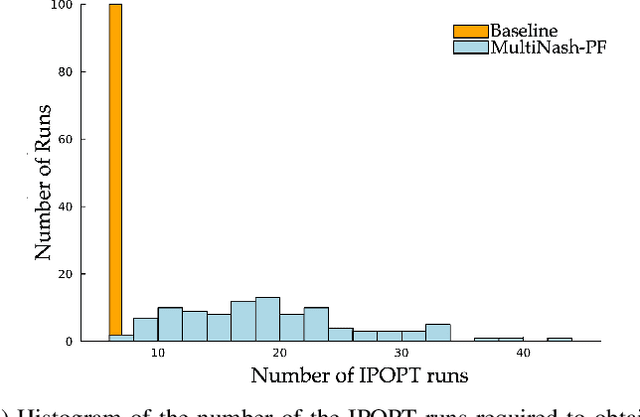
Modern-world robotics involves complex environments where multiple autonomous agents must interact with each other and other humans. This necessitates advanced interactive multi-agent motion planning techniques. Generalized Nash equilibrium(GNE), a solution concept in constrained game theory, provides a mathematical model to predict the outcome of interactive motion planning, where each agent needs to account for other agents in the environment. However, in practice, multiple local GNEs may exist. Finding a single GNE itself is complex as it requires solving coupled constrained optimal control problems. Furthermore, finding all such local GNEs requires exploring the solution space of GNEs, which is a challenging task. This work proposes the MultiNash-PF framework to efficiently compute multiple local GNEs in constrained trajectory games. Potential games are a class of games for which a local GNE of a trajectory game can be found by solving a single constrained optimal control problem. We propose MultiNash-PF that integrates the potential game approach with implicit particle filtering, a sample-efficient method for non-convex trajectory optimization. We first formulate the underlying game as a constrained potential game and then utilize the implicit particle filtering to identify the coarse estimates of multiple local minimizers of the game's potential function. MultiNash-PF then refines these estimates with optimization solvers, obtaining different local GNEs. We show through numerical simulations that MultiNash-PF reduces computation time by up to 50\% compared to a baseline approach.

Uncertainty-Guided Enhancement on Driving Perception System via Foundation Models
Oct 02, 2024


Multimodal foundation models offer promising advancements for enhancing driving perception systems, but their high computational and financial costs pose challenges. We develop a method that leverages foundation models to refine predictions from existing driving perception models -- such as enhancing object classification accuracy -- while minimizing the frequency of using these resource-intensive models. The method quantitatively characterizes uncertainties in the perception model's predictions and engages the foundation model only when these uncertainties exceed a pre-specified threshold. Specifically, it characterizes uncertainty by calibrating the perception model's confidence scores into theoretical lower bounds on the probability of correct predictions using conformal prediction. Then, it sends images to the foundation model and queries for refining the predictions only if the theoretical bound of the perception model's outcome is below the threshold. Additionally, we propose a temporal inference mechanism that enhances prediction accuracy by integrating historical predictions, leading to tighter theoretical bounds. The method demonstrates a 10 to 15 percent improvement in prediction accuracy and reduces the number of queries to the foundation model by 50 percent, based on quantitative evaluations from driving datasets.
On The Planning Abilities of OpenAI's o1 Models: Feasibility, Optimality, and Generalizability
Sep 30, 2024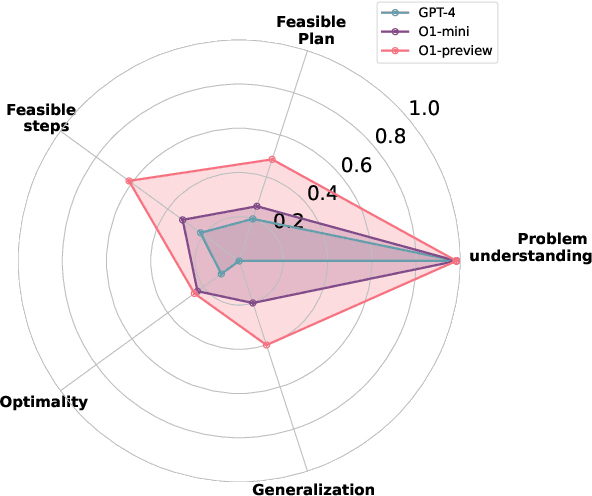


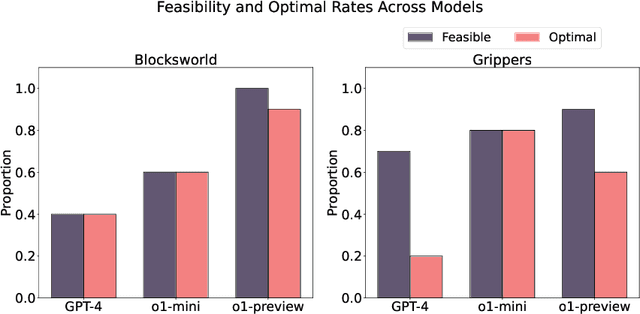
Recent advancements in Large Language Models (LLMs) have showcased their ability to perform complex reasoning tasks, but their effectiveness in planning remains underexplored. In this study, we evaluate the planning capabilities of OpenAI's o1 models across a variety of benchmark tasks, focusing on three key aspects: feasibility, optimality, and generalizability. Through empirical evaluations on constraint-heavy tasks (e.g., $\textit{Barman}$, $\textit{Tyreworld}$) and spatially complex environments (e.g., $\textit{Termes}$, $\textit{Floortile}$), we highlight o1-preview's strengths in self-evaluation and constraint-following, while also identifying bottlenecks in decision-making and memory management, particularly in tasks requiring robust spatial reasoning. Our results reveal that o1-preview outperforms GPT-4 in adhering to task constraints and managing state transitions in structured environments. However, the model often generates suboptimal solutions with redundant actions and struggles to generalize effectively in spatially complex tasks. This pilot study provides foundational insights into the planning limitations of LLMs, offering key directions for future research on improving memory management, decision-making, and generalization in LLM-based planning.
Reduce, Reuse, Recycle: Categories for Compositional Reinforcement Learning
Aug 23, 2024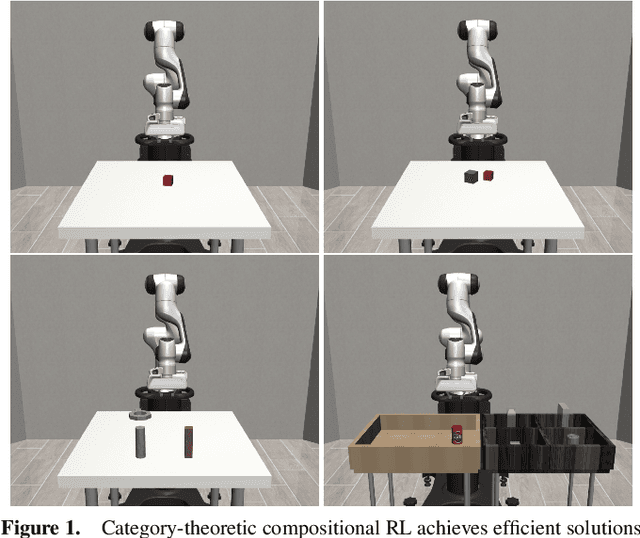
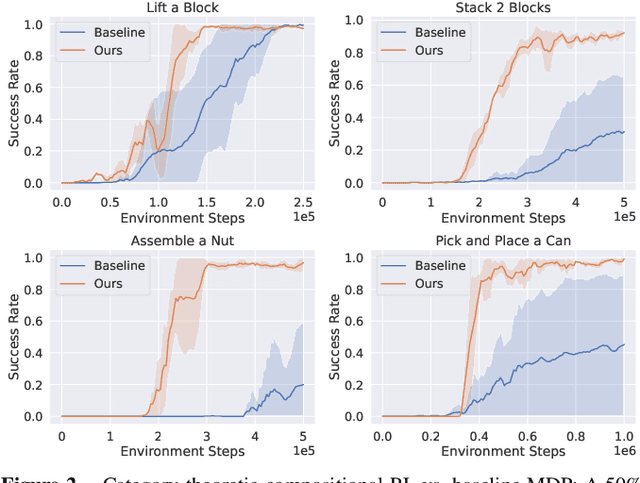
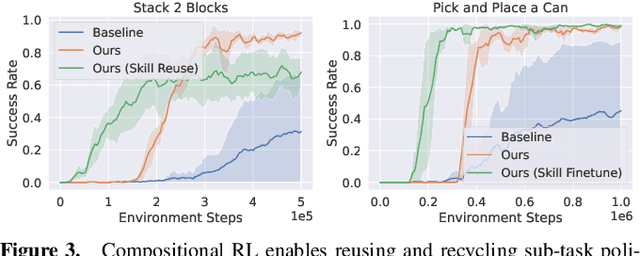
In reinforcement learning, conducting task composition by forming cohesive, executable sequences from multiple tasks remains challenging. However, the ability to (de)compose tasks is a linchpin in developing robotic systems capable of learning complex behaviors. Yet, compositional reinforcement learning is beset with difficulties, including the high dimensionality of the problem space, scarcity of rewards, and absence of system robustness after task composition. To surmount these challenges, we view task composition through the prism of category theory -- a mathematical discipline exploring structures and their compositional relationships. The categorical properties of Markov decision processes untangle complex tasks into manageable sub-tasks, allowing for strategical reduction of dimensionality, facilitating more tractable reward structures, and bolstering system robustness. Experimental results support the categorical theory of reinforcement learning by enabling skill reduction, reuse, and recycling when learning complex robotic arm tasks.
Autonomous Negotiation Using Comparison-Based Gradient Estimation
Aug 20, 2024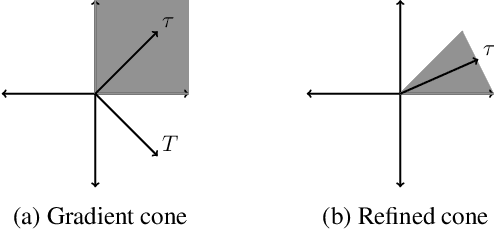
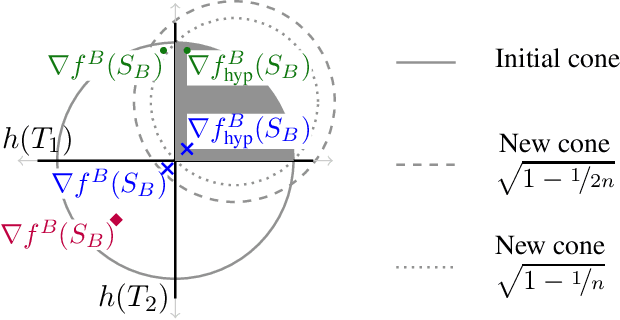
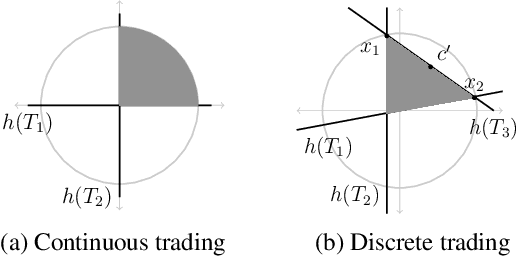
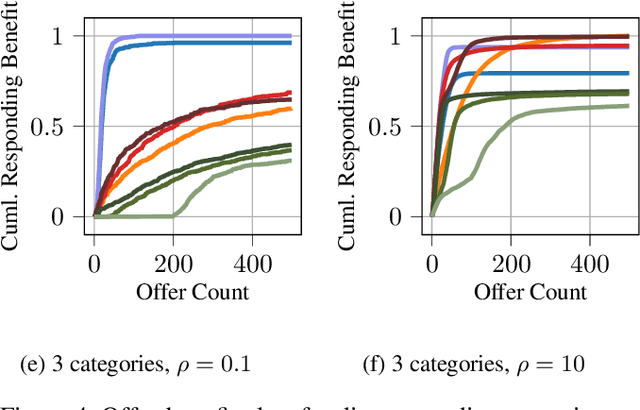
Negotiation is useful for resolving conflicts in multi-agent systems. We explore autonomous negotiation in a setting where two self-interested rational agents sequentially trade items from a finite set of categories. Each agent has a utility function that depends on the amount of items it possesses in each category. The offering agent makes trade offers to improve its utility without knowing the responding agent's utility function, and the responding agent accepts offers that improve its utility. We present a comparison-based algorithm for the offering agent that generates offers through previous acceptance or rejection responses without extensive information sharing. The algorithm estimates the responding agent's gradient by leveraging the rationality assumption and rejected offers to prune the space of potential gradients. After the algorithm makes a finite number of consecutively rejected offers, the responding agent is at a near-optimal state, or the agents' preferences are closely aligned. Additionally, we facilitate negotiations with humans by representing natural language feedback as comparisons that can be integrated into the proposed algorithm. We compare the proposed algorithm against random search baselines in integer and fractional trading scenarios and show that it improves the societal benefit with fewer offers.
Pessimistic Iterative Planning for Robust POMDPs
Aug 16, 2024
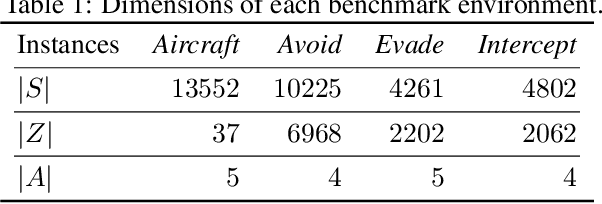


Robust partially observable Markov decision processes (robust POMDPs) extend classical POMDPs to handle additional uncertainty on the transition and observation probabilities via so-called uncertainty sets. Policies for robust POMDPs must not only be memory-based to account for partial observability but also robust against model uncertainty to account for the worst-case instances from the uncertainty sets. We propose the pessimistic iterative planning (PIP) framework, which finds robust memory-based policies for robust POMDPs. PIP alternates between two main steps: (1) selecting an adversarial (non-robust) POMDP via worst-case probability instances from the uncertainty sets; and (2) computing a finite-state controller (FSC) for this adversarial POMDP. We evaluate the performance of this FSC on the original robust POMDP and use this evaluation in step (1) to select the next adversarial POMDP. Within PIP, we propose the rFSCNet algorithm. In each iteration, rFSCNet finds an FSC through a recurrent neural network trained using supervision policies optimized for the adversarial POMDP. The empirical evaluation in four benchmark environments showcases improved robustness against a baseline method in an ablation study and competitive performance compared to a state-of-the-art robust POMDP solver.
Human-Agent Cooperation in Games under Incomplete Information through Natural Language Communication
May 23, 2024

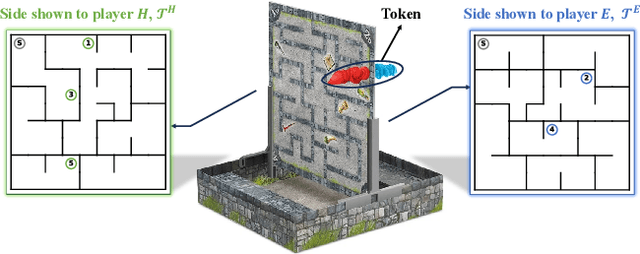

Developing autonomous agents that can strategize and cooperate with humans under information asymmetry is challenging without effective communication in natural language. We introduce a shared-control game, where two players collectively control a token in alternating turns to achieve a common objective under incomplete information. We formulate a policy synthesis problem for an autonomous agent in this game with a human as the other player. To solve this problem, we propose a communication-based approach comprising a language module and a planning module. The language module translates natural language messages into and from a finite set of flags, a compact representation defined to capture player intents. The planning module leverages these flags to compute a policy using an asymmetric information-set Monte Carlo tree search with flag exchange algorithm we present. We evaluate the effectiveness of this approach in a testbed based on Gnomes at Night, a search-and-find maze board game. Results of human subject experiments show that communication narrows the information gap between players and enhances human-agent cooperation efficiency with fewer turns.
Zero-Shot Transfer of Neural ODEs
May 14, 2024


Autonomous systems often encounter environments and scenarios beyond the scope of their training data, which underscores a critical challenge: the need to generalize and adapt to unseen scenarios in real time. This challenge necessitates new mathematical and algorithmic tools that enable adaptation and zero-shot transfer. To this end, we leverage the theory of function encoders, which enables zero-shot transfer by combining the flexibility of neural networks with the mathematical principles of Hilbert spaces. Using this theory, we first present a method for learning a space of dynamics spanned by a set of neural ODE basis functions. After training, the proposed approach can rapidly identify dynamics in the learned space using an efficient inner product calculation. Critically, this calculation requires no gradient calculations or retraining during the online phase. This method enables zero-shot transfer for autonomous systems at runtime and opens the door for a new class of adaptable control algorithms. We demonstrate state-of-the-art system modeling accuracy for two MuJoCo robot environments and show that the learned models can be used for more efficient MPC control of a quadrotor.
Randomized Greedy Methods for Weak Submodular Sensor Selection with Robustness Considerations
Apr 04, 2024We study a pair of budget- and performance-constrained weak submodular maximization problems. For computational efficiency, we explore the use of stochastic greedy algorithms which limit the search space via random sampling instead of the standard greedy procedure which explores the entire feasible search space. We propose a pair of stochastic greedy algorithms, namely, Modified Randomized Greedy (MRG) and Dual Randomized Greedy (DRG) to approximately solve the budget- and performance-constrained problems, respectively. For both algorithms, we derive approximation guarantees that hold with high probability. We then examine the use of DRG in robust optimization problems wherein the objective is to maximize the worst-case of a number of weak submodular objectives and propose the Randomized Weak Submodular Saturation Algorithm (Random-WSSA). We further derive a high-probability guarantee for when Random-WSSA successfully constructs a robust solution. Finally, we showcase the effectiveness of these algorithms in a variety of relevant uses within the context of Earth-observing LEO constellations which estimate atmospheric weather conditions and provide Earth coverage.
MM3DGS SLAM: Multi-modal 3D Gaussian Splatting for SLAM Using Vision, Depth, and Inertial Measurements
Apr 01, 2024Simultaneous localization and mapping is essential for position tracking and scene understanding. 3D Gaussian-based map representations enable photorealistic reconstruction and real-time rendering of scenes using multiple posed cameras. We show for the first time that using 3D Gaussians for map representation with unposed camera images and inertial measurements can enable accurate SLAM. Our method, MM3DGS, addresses the limitations of prior neural radiance field-based representations by enabling faster rendering, scale awareness, and improved trajectory tracking. Our framework enables keyframe-based mapping and tracking utilizing loss functions that incorporate relative pose transformations from pre-integrated inertial measurements, depth estimates, and measures of photometric rendering quality. We also release a multi-modal dataset, UT-MM, collected from a mobile robot equipped with a camera and an inertial measurement unit. Experimental evaluation on several scenes from the dataset shows that MM3DGS achieves 3x improvement in tracking and 5% improvement in photometric rendering quality compared to the current 3DGS SLAM state-of-the-art, while allowing real-time rendering of a high-resolution dense 3D map. Project Webpage: https://vita-group.github.io/MM3DGS-SLAM