 Add to Chrome
 Add to Firefox
 Add to Edge
Missingness-MDPs: Bridging the Theory of Missing Data and POMDPs
May 12, 2026
We introduce missingness-MDPs (miss-MDPs), a novel subclass of partially observable Markov decision processes (POMDPs) that incorporates the theory of missing data. A miss-MDP is a POMDP whose observation function is a missingness function, specifying the probability that individual state features are missing (i.e., unobserved) at a time step. The literature distinguishes three canonical missingness types: missing (1) completely at random (MCAR), (2) at random (MAR), and (3) not at random (MNAR). Our planning problem is to compute near-optimal policies for a miss-MDP with an unknown missingness function, given a dataset of action-observation trajectories. Achieving such optimality guarantees for policies requires learning the missingness function from data, which is infeasible for general POMDPs. To overcome this challenge, we exploit the structural properties of different missingness types to derive probably approximately correct (PAC) algorithms for learning the missingness function. These algorithms yield an approximate but fully specified miss-MDP that we solve using off-the-shelf planning methods. We prove that, with high probability, the resulting policies are epsilon-optimal in the true miss-MDP. Empirical results confirm the theory and demonstrate superior performance of our approach over two model-free POMDP methods.

Robust Probabilistic Shielding for Safe Offline Reinforcement Learning
May 11, 2026In offline reinforcement learning (RL), we learn policies from fixed datasets without environment interaction. The major challenges are to provide guarantees on the (1) performance and (2) safety of the resulting policy. A technique called safe policy improvement (SPI) provides a performance guarantee: with high probability, the new policy outperforms a given baseline policy, which is assumed to be safe. Orthogonally, in the context of safe RL, a shield provides a safety guarantee by restricting the action space to those actions that are provably safe with respect to a given safety-relevant model. We integrate these paradigms by extending shielding to offline RL, relying solely on the available dataset and knowledge of safe and unsafe states. Then, we shield the policy improvement steps, guaranteeing, with high probability, a safe policy. Experimental results demonstrate that shielded SPI outperforms its unshielded counterpart, improving both average and worst-case performance, particularly in low-data regimes.
Finite-State Controllers for (Hidden-Model) POMDPs using Deep Reinforcement Learning
Feb 09, 2026Solving partially observable Markov decision processes (POMDPs) requires computing policies under imperfect state information. Despite recent advances, the scalability of existing POMDP solvers remains limited. Moreover, many settings require a policy that is robust across multiple POMDPs, further aggravating the scalability issue. We propose the Lexpop framework for POMDP solving. Lexpop (1) employs deep reinforcement learning to train a neural policy, represented by a recurrent neural network, and (2) constructs a finite-state controller mimicking the neural policy through efficient extraction methods. Crucially, unlike neural policies, such controllers can be formally evaluated, providing performance guarantees. We extend Lexpop to compute robust policies for hidden-model POMDPs (HM-POMDPs), which describe finite sets of POMDPs. We associate every extracted controller with its worst-case POMDP. Using a set of such POMDPs, we iteratively train a robust neural policy and consequently extract a robust controller. Our experiments show that on problems with large state spaces, Lexpop outperforms state-of-the-art solvers for POMDPs as well as HM-POMDPs.
\textsc{rfPG}: Robust Finite-Memory Policy Gradients for Hidden-Model POMDPs
May 14, 2025Partially observable Markov decision processes (POMDPs) model specific environments in sequential decision-making under uncertainty. Critically, optimal policies for POMDPs may not be robust against perturbations in the environment. Hidden-model POMDPs (HM-POMDPs) capture sets of different environment models, that is, POMDPs with a shared action and observation space. The intuition is that the true model is hidden among a set of potential models, and it is unknown which model will be the environment at execution time. A policy is robust for a given HM-POMDP if it achieves sufficient performance for each of its POMDPs. We compute such robust policies by combining two orthogonal techniques: (1) a deductive formal verification technique that supports tractable robust policy evaluation by computing a worst-case POMDP within the HM-POMDP and (2) subgradient ascent to optimize the candidate policy for a worst-case POMDP. The empirical evaluation shows that, compared to various baselines, our approach (1) produces policies that are more robust and generalize better to unseen POMDPs and (2) scales to HM-POMDPs that consist of over a hundred thousand environments.
Pessimistic Iterative Planning for Robust POMDPs
Aug 16, 2024
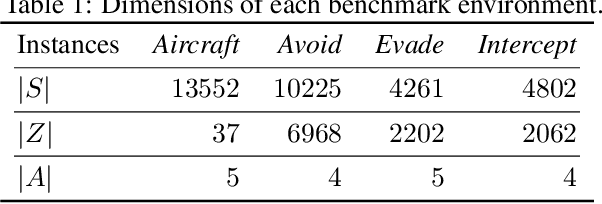


Robust partially observable Markov decision processes (robust POMDPs) extend classical POMDPs to handle additional uncertainty on the transition and observation probabilities via so-called uncertainty sets. Policies for robust POMDPs must not only be memory-based to account for partial observability but also robust against model uncertainty to account for the worst-case instances from the uncertainty sets. We propose the pessimistic iterative planning (PIP) framework, which finds robust memory-based policies for robust POMDPs. PIP alternates between two main steps: (1) selecting an adversarial (non-robust) POMDP via worst-case probability instances from the uncertainty sets; and (2) computing a finite-state controller (FSC) for this adversarial POMDP. We evaluate the performance of this FSC on the original robust POMDP and use this evaluation in step (1) to select the next adversarial POMDP. Within PIP, we propose the rFSCNet algorithm. In each iteration, rFSCNet finds an FSC through a recurrent neural network trained using supervision policies optimized for the adversarial POMDP. The empirical evaluation in four benchmark environments showcases improved robustness against a baseline method in an ablation study and competitive performance compared to a state-of-the-art robust POMDP solver.
Factored Online Planning in Many-Agent POMDPs
Dec 22, 2023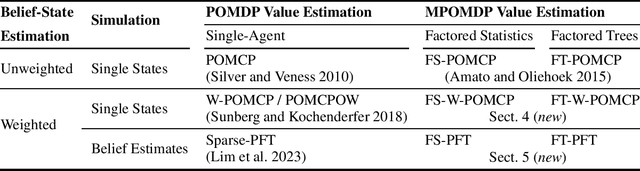

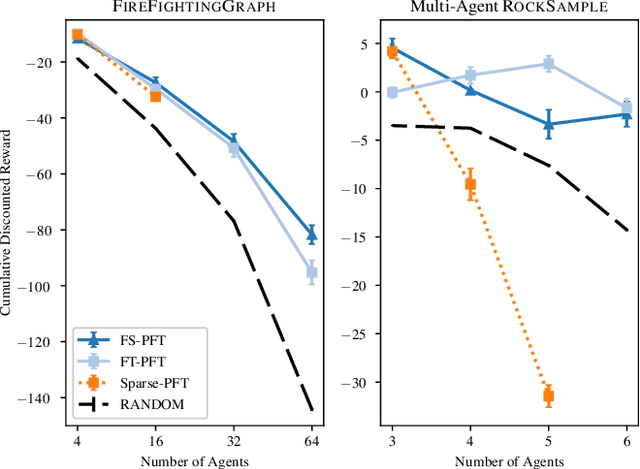
In centralized multi-agent systems, often modeled as multi-agent partially observable Markov decision processes (MPOMDPs), the action and observation spaces grow exponentially with the number of agents, making the value and belief estimation of single-agent online planning ineffective. Prior work partially tackles value estimation by exploiting the inherent structure of multi-agent settings via so-called coordination graphs. Additionally, belief estimation has been improved by incorporating the likelihood of observations into the approximation. However, the challenges of value estimation and belief estimation have only been tackled individually, which prevents existing methods from scaling to many agents. Therefore, we address these challenges simultaneously. First, we introduce weighted particle filtering to a sample-based online planner for MPOMDPs. Second, we present a scalable approximation of the belief. Third, we bring an approach that exploits the typical locality of agent interactions to novel online planning algorithms for MPOMDPs operating on a so-called sparse particle filter tree. Our experimental evaluation against several state-of-the-art baselines shows that our methods (1) are competitive in settings with only a few agents and (2) improve over the baselines in the presence of many agents.