 Add to Chrome
 Add to Firefox
 Add to Edge
Adaptive Probabilistic Shielding by Learning MDPs for Safe Reinforcement Learning
Aug 20, 2026
Probabilistic shielding is a technique for safe reinforcement learning (RL). Typically, a static observer -- called the shield -- constrains the learning agent's actions to those for which acting safely remains feasible. Traditionally, the shield is computed from the transition probabilities of the underlying Markov decision process (MDP). Thus, this technique is not applicable when the MDP model is not given a priori, which, unfortunately, is the case in typical RL applications. In this paper, we study the problem of computing a shield in the setting where the transition graph of the MDP is known, but the transition probabilities are unknown. Our approach integrates probabilistic shielding with online model learning: as the RL agent explores the environment, we estimate the transition probabilities. From this estimate, we compute a shield. While the shield may be conservative initially, it adapts as the model estimate becomes more precise. Thus, the shield improves in tandem with the RL agent. This paradigm of adaptive probabilistic shielding raises a number of challenges, such as when to recompute the shield and how to balance between exploration and safety during learning. We empirically evaluate multiple variants of this paradigm across several environments.

Property-driven Causal Abstractions for Markov Decision Processes
Jul 29, 2026Markov Decision Processes (MDPs) are widely used as decision-making models, commonly specified over factored state spaces through state variables and their valuations. The exponential blowup in the number of states renders many reasoning tasks in MDPs challenging. Abstractions are promising techniques to reduce MDPs and thus mitigate scalability issues. In this work, we introduce a notion of causality on factored MDPs and a novel property-driven causal abstraction technique that retains many characteristics of the original MDP model. For this, we rely on causal relations over state variable predicates and identify those states that share the same reasons for fulfilling or violating a given abstraction property. We theoretically and empirically compare various causal MDP abstractions using different model types such as MDPs, interval MDPs, or stochastic games. Our evaluation demonstrates the potential of our approach: For several standard benchmarks, we obtain small abstractions that allow us to compute near-optimal policies for the original MDP. Furthermore, our causal abstractions often generalize to related large-scale MDP models.
Missingness-MDPs: Bridging the Theory of Missing Data and POMDPs
May 12, 2026We introduce missingness-MDPs (miss-MDPs), a novel subclass of partially observable Markov decision processes (POMDPs) that incorporates the theory of missing data. A miss-MDP is a POMDP whose observation function is a missingness function, specifying the probability that individual state features are missing (i.e., unobserved) at a time step. The literature distinguishes three canonical missingness types: missing (1) completely at random (MCAR), (2) at random (MAR), and (3) not at random (MNAR). Our planning problem is to compute near-optimal policies for a miss-MDP with an unknown missingness function, given a dataset of action-observation trajectories. Achieving such optimality guarantees for policies requires learning the missingness function from data, which is infeasible for general POMDPs. To overcome this challenge, we exploit the structural properties of different missingness types to derive probably approximately correct (PAC) algorithms for learning the missingness function. These algorithms yield an approximate but fully specified miss-MDP that we solve using off-the-shelf planning methods. We prove that, with high probability, the resulting policies are epsilon-optimal in the true miss-MDP. Empirical results confirm the theory and demonstrate superior performance of our approach over two model-free POMDP methods.
Robust Probabilistic Shielding for Safe Offline Reinforcement Learning
May 11, 2026In offline reinforcement learning (RL), we learn policies from fixed datasets without environment interaction. The major challenges are to provide guarantees on the (1) performance and (2) safety of the resulting policy. A technique called safe policy improvement (SPI) provides a performance guarantee: with high probability, the new policy outperforms a given baseline policy, which is assumed to be safe. Orthogonally, in the context of safe RL, a shield provides a safety guarantee by restricting the action space to those actions that are provably safe with respect to a given safety-relevant model. We integrate these paradigms by extending shielding to offline RL, relying solely on the available dataset and knowledge of safe and unsafe states. Then, we shield the policy improvement steps, guaranteeing, with high probability, a safe policy. Experimental results demonstrate that shielded SPI outperforms its unshielded counterpart, improving both average and worst-case performance, particularly in low-data regimes.
Resilient Strategies for Stochastic Systems: How Much Does It Take to Break a Winning Strategy?
Feb 27, 2026We study the problem of resilient strategies in the presence of uncertainty. Resilient strategies enable an agent to make decisions that are robust against disturbances. In particular, we are interested in those disturbances that are able to flip a decision made by the agent. Such a disturbance may, for instance, occur when the intended action of the agent cannot be executed due to a malfunction of an actuator in the environment. In this work, we introduce the concept of resilience in the stochastic setting and present a comprehensive set of fundamental problems. Specifically, we discuss such problems for Markov decision processes with reachability and safety objectives, which also smoothly extend to stochastic games. To account for the stochastic setting, we provide various ways of aggregating the amounts of disturbances that may have occurred, for instance, in expectation or in the worst case. Moreover, to reason about infinite disturbances, we use quantitative measures, like their frequency of occurrence.
Finite-State Controllers for (Hidden-Model) POMDPs using Deep Reinforcement Learning
Feb 09, 2026Solving partially observable Markov decision processes (POMDPs) requires computing policies under imperfect state information. Despite recent advances, the scalability of existing POMDP solvers remains limited. Moreover, many settings require a policy that is robust across multiple POMDPs, further aggravating the scalability issue. We propose the Lexpop framework for POMDP solving. Lexpop (1) employs deep reinforcement learning to train a neural policy, represented by a recurrent neural network, and (2) constructs a finite-state controller mimicking the neural policy through efficient extraction methods. Crucially, unlike neural policies, such controllers can be formally evaluated, providing performance guarantees. We extend Lexpop to compute robust policies for hidden-model POMDPs (HM-POMDPs), which describe finite sets of POMDPs. We associate every extracted controller with its worst-case POMDP. Using a set of such POMDPs, we iteratively train a robust neural policy and consequently extract a robust controller. Our experiments show that on problems with large state spaces, Lexpop outperforms state-of-the-art solvers for POMDPs as well as HM-POMDPs.
Perception-Based Beliefs for POMDPs with Visual Observations
Feb 05, 2026Partially observable Markov decision processes (POMDPs) are a principled planning model for sequential decision-making under uncertainty. Yet, real-world problems with high-dimensional observations, such as camera images, remain intractable for traditional belief- and filtering-based solvers. To tackle this problem, we introduce the Perception-based Beliefs for POMDPs framework (PBP), which complements such solvers with a perception model. This model takes the form of an image classifier which maps visual observations to probability distributions over states. PBP incorporates these distributions directly into belief updates, so the underlying solver does not need to reason explicitly over high-dimensional observation spaces. We show that the belief update of PBP coincides with the standard belief update if the image classifier is exact. Moreover, to handle classifier imprecision, we incorporate uncertainty quantification and introduce two methods to adjust the belief update accordingly. We implement PBP using two traditional POMDP solvers and empirically show that (1) it outperforms existing end-to-end deep RL methods and (2) uncertainty quantification improves robustness of PBP against visual corruption.
\textsc{rfPG}: Robust Finite-Memory Policy Gradients for Hidden-Model POMDPs
May 14, 2025Partially observable Markov decision processes (POMDPs) model specific environments in sequential decision-making under uncertainty. Critically, optimal policies for POMDPs may not be robust against perturbations in the environment. Hidden-model POMDPs (HM-POMDPs) capture sets of different environment models, that is, POMDPs with a shared action and observation space. The intuition is that the true model is hidden among a set of potential models, and it is unknown which model will be the environment at execution time. A policy is robust for a given HM-POMDP if it achieves sufficient performance for each of its POMDPs. We compute such robust policies by combining two orthogonal techniques: (1) a deductive formal verification technique that supports tractable robust policy evaluation by computing a worst-case POMDP within the HM-POMDP and (2) subgradient ascent to optimize the candidate policy for a worst-case POMDP. The empirical evaluation shows that, compared to various baselines, our approach (1) produces policies that are more robust and generalize better to unseen POMDPs and (2) scales to HM-POMDPs that consist of over a hundred thousand environments.
Does Knowledge About Perceptual Uncertainty Help an Agent in Automated Driving?
Feb 17, 2025Agents in real-world scenarios like automated driving deal with uncertainty in their environment, in particular due to perceptual uncertainty. Although, reinforcement learning is dedicated to autonomous decision-making under uncertainty these algorithms are typically not informed about the uncertainty currently contained in their environment. On the other hand, uncertainty estimation for perception itself is typically directly evaluated in the perception domain, e.g., in terms of false positive detection rates or calibration errors based on camera images. Its use for deciding on goal-oriented actions remains largely unstudied. In this paper, we investigate how an agent's behavior is influenced by an uncertain perception and how this behavior changes if information about this uncertainty is available. Therefore, we consider a proxy task, where the agent is rewarded for driving a route as fast as possible without colliding with other road users. For controlled experiments, we introduce uncertainty in the observation space by perturbing the perception of the given agent while informing the latter. Our experiments show that an unreliable observation space modeled by a perturbed perception leads to a defensive driving behavior of the agent. Furthermore, when adding the information about the current uncertainty directly to the observation space, the agent adapts to the specific situation and in general accomplishes its task faster while, at the same time, accounting for risks.
Tighter Value-Function Approximations for POMDPs
Feb 10, 2025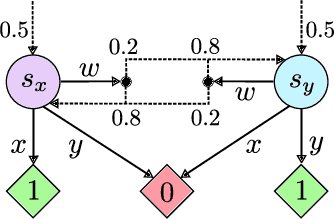
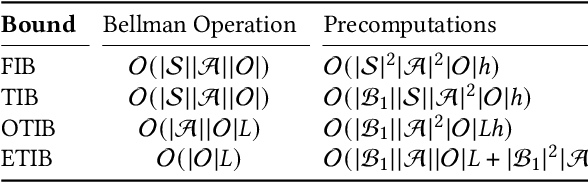
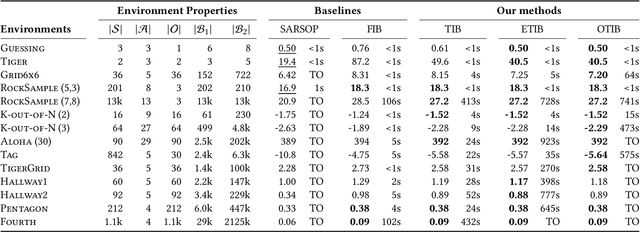
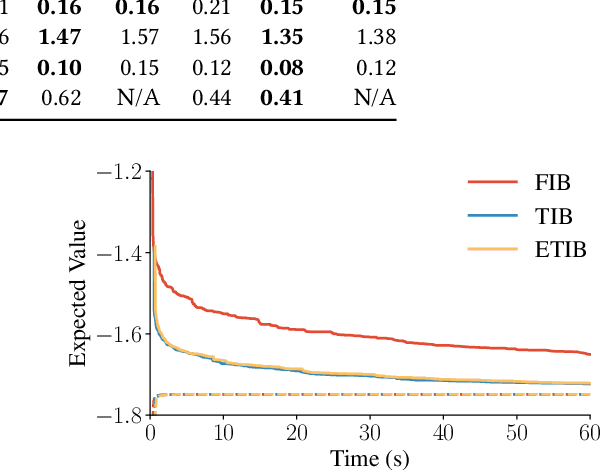
Solving partially observable Markov decision processes (POMDPs) typically requires reasoning about the values of exponentially many state beliefs. Towards practical performance, state-of-the-art solvers use value bounds to guide this reasoning. However, sound upper value bounds are often computationally expensive to compute, and there is a tradeoff between the tightness of such bounds and their computational cost. This paper introduces new and provably tighter upper value bounds than the commonly used fast informed bound. Our empirical evaluation shows that, despite their additional computational overhead, the new upper bounds accelerate state-of-the-art POMDP solvers on a wide range of benchmarks.