 Add to Chrome
 Add to Firefox
 Add to Edge
COSMOS: A Hybrid Adaptive Optimizer for Memory-Efficient Training of LLMs
Feb 26, 2025
Large Language Models (LLMs) have demonstrated remarkable success across various domains, yet their optimization remains a significant challenge due to the complex and high-dimensional loss landscapes they inhabit. While adaptive optimizers such as AdamW are widely used, they suffer from critical limitations, including an inability to capture interdependencies between coordinates and high memory consumption. Subsequent research, exemplified by SOAP, attempts to better capture coordinate interdependence but incurs greater memory overhead, limiting scalability for massive LLMs. An alternative approach aims to reduce memory consumption through low-dimensional projection, but this leads to substantial approximation errors, resulting in less effective optimization (e.g., in terms of per-token efficiency). In this paper, we propose COSMOS, a novel hybrid optimizer that leverages the varying importance of eigensubspaces in the gradient matrix to achieve memory efficiency without compromising optimization performance. The design of COSMOS is motivated by our empirical insights and practical considerations. Specifically, COSMOS applies SOAP to the leading eigensubspace, which captures the primary optimization dynamics, and MUON to the remaining eigensubspace, which is less critical but computationally expensive to handle with SOAP. This hybrid strategy significantly reduces memory consumption while maintaining robust optimization performance, making it particularly suitable for massive LLMs. Numerical experiments on various datasets and transformer architectures are provided to demonstrate the effectiveness of COSMOS. Our code is available at https://github.com/lliu606/COSMOS.

Discriminative Finetuning of Generative Large Language Models without Reward Models and Preference Data
Feb 25, 2025Supervised fine-tuning (SFT) followed by preference optimization (PO) denoted by SFT$\rightarrow$PO has become the standard for improving pretrained large language models (LLMs), with PO demonstrating significant performance gains. However, PO methods rely on either human-labeled preference data or a strong reward model to generate preference data. Can we fine-tune LLMs without preference data or reward models while achieving competitive performance to SFT$\rightarrow$PO? We address this question by introducing Discriminative Fine-Tuning (DFT), a novel approach that eliminates the need for preference data. Unlike SFT, which employs a generative approach and overlooks negative data, DFT adopts a discriminative paradigm that that increases the probability of positive answers while suppressing potentially negative ones, shifting from token prediction to data prediction. Our contributions include: (i) a discriminative probabilistic framework for fine-tuning LLMs by explicitly modeling the discriminative likelihood of an answer among all possible outputs given an input; (ii) efficient algorithms to optimize this discriminative likelihood; and (iii) extensive experiments demonstrating DFT's effectiveness, achieving performance better than SFT and comparable to if not better than SFT$\rightarrow$PO. The code can be found at https://github.com/PenGuln/DFT.
Provable Acceleration of Nesterov's Accelerated Gradient for Rectangular Matrix Factorization and Linear Neural Networks
Oct 12, 2024
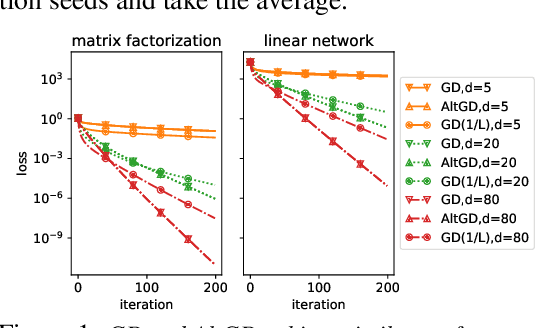

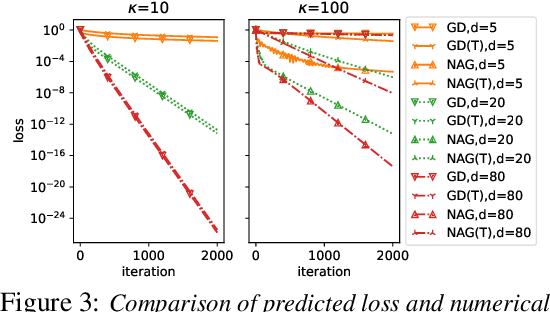
We study the convergence rate of first-order methods for rectangular matrix factorization, which is a canonical nonconvex optimization problem. Specifically, given a rank-$r$ matrix $\mathbf{A}\in\mathbb{R}^{m\times n}$, we prove that gradient descent (GD) can find a pair of $\epsilon$-optimal solutions $\mathbf{X}_T\in\mathbb{R}^{m\times d}$ and $\mathbf{Y}_T\in\mathbb{R}^{n\times d}$, where $d\geq r$, satisfying $\lVert\mathbf{X}_T\mathbf{Y}_T^\top-\mathbf{A}\rVert_\mathrm{F}\leq\epsilon\lVert\mathbf{A}\rVert_\mathrm{F}$ in $T=O(\kappa^2\log\frac{1}{\epsilon})$ iterations with high probability, where $\kappa$ denotes the condition number of $\mathbf{A}$. Furthermore, we prove that Nesterov's accelerated gradient (NAG) attains an iteration complexity of $O(\kappa\log\frac{1}{\epsilon})$, which is the best-known bound of first-order methods for rectangular matrix factorization. Different from small balanced random initialization in the existing literature, we adopt an unbalanced initialization, where $\mathbf{X}_0$ is large and $\mathbf{Y}_0$ is $0$. Moreover, our initialization and analysis can be further extended to linear neural networks, where we prove that NAG can also attain an accelerated linear convergence rate. In particular, we only require the width of the network to be greater than or equal to the rank of the output label matrix. In contrast, previous results achieving the same rate require excessive widths that additionally depend on the condition number and the rank of the input data matrix.
Model Tells Itself Where to Attend: Faithfulness Meets Automatic Attention Steering
Sep 16, 2024


Large language models (LLMs) have demonstrated remarkable performance across various real-world tasks. However, they often struggle to fully comprehend and effectively utilize their input contexts, resulting in responses that are unfaithful or hallucinated. This difficulty increases for contexts that are long or contain distracting information, which can divert LLMs from fully capturing essential evidence. To address this issue, many works use prompting to help LLMs utilize contextual information more faithfully. For instance, iterative prompting highlights key information in two steps that first ask the LLM to identify important pieces of context and then derive answers accordingly. However, prompting methods are constrained to highlighting key information implicitly in token space, which is often insufficient to fully steer the model's attention. To improve model faithfulness more reliably, we propose AutoPASTA, a method that automatically identifies key contextual information and explicitly highlights it by steering an LLM's attention scores. Like prompting, AutoPASTA is applied at inference time and does not require changing any model parameters. Our experiments on open-book QA demonstrate that AutoPASTA effectively enables models to grasp essential contextual information, leading to substantially improved model faithfulness and performance, e.g., an average improvement of 7.95% for LLAMA3-70B-Instruct. Code will be publicly available at https://github.com/QingruZhang/AutoPASTA .
Robust Reinforcement Learning from Corrupted Human Feedback
Jun 21, 2024Reinforcement learning from human feedback (RLHF) provides a principled framework for aligning AI systems with human preference data. For various reasons, e.g., personal bias, context ambiguity, lack of training, etc, human annotators may give incorrect or inconsistent preference labels. To tackle this challenge, we propose a robust RLHF approach -- $R^3M$, which models the potentially corrupted preference label as sparse outliers. Accordingly, we formulate the robust reward learning as an $\ell_1$-regularized maximum likelihood estimation problem. Computationally, we develop an efficient alternating optimization algorithm, which only incurs negligible computational overhead compared with the standard RLHF approach. Theoretically, we prove that under proper regularity conditions, $R^3M$ can consistently learn the underlying reward and identify outliers, provided that the number of outlier labels scales sublinearly with the preference sample size. Furthermore, we remark that $R^3M$ is versatile and can be extended to various preference optimization methods, including direct preference optimization (DPO). Our experiments on robotic control and natural language generation with large language models (LLMs) show that $R^3M$ improves robustness of the reward against several types of perturbations to the preference data.
RoseLoRA: Row and Column-wise Sparse Low-rank Adaptation of Pre-trained Language Model for Knowledge Editing and Fine-tuning
Jun 16, 2024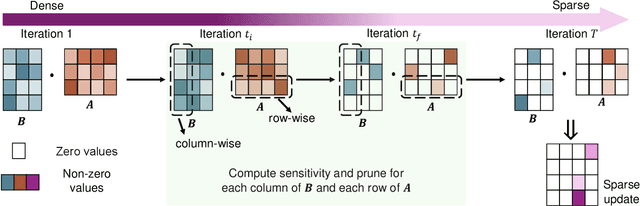
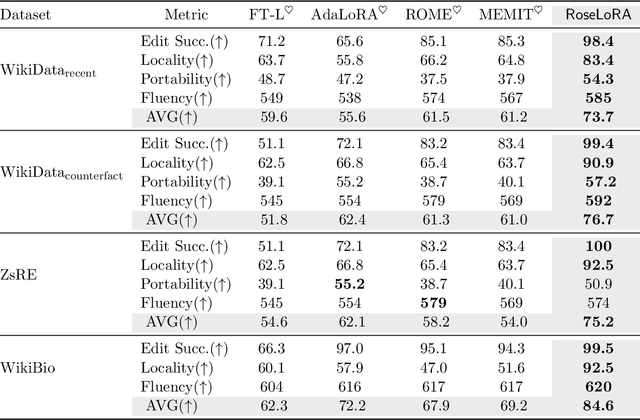
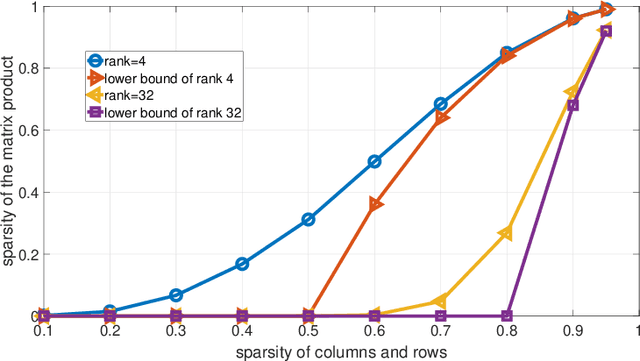
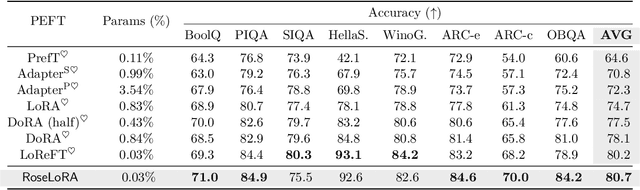
Pre-trained language models, trained on large-scale corpora, demonstrate strong generalizability across various NLP tasks. Fine-tuning these models for specific tasks typically involves updating all parameters, which is resource-intensive. Parameter-efficient fine-tuning (PEFT) methods, such as the popular LoRA family, introduce low-rank matrices to learn only a few parameters efficiently. However, during inference, the product of these matrices updates all pre-trained parameters, complicating tasks like knowledge editing that require selective updates. We propose a novel PEFT method, which conducts \textbf{r}ow and c\textbf{o}lumn-wise spar\textbf{se} \textbf{lo}w-\textbf{r}ank \textbf{a}daptation (RoseLoRA), to address this challenge. RoseLoRA identifies and updates only the most important parameters for a specific task, maintaining efficiency while preserving other model knowledge. By adding a sparsity constraint on the product of low-rank matrices and converting it to row and column-wise sparsity, we ensure efficient and precise model updates. Our theoretical analysis guarantees the lower bound of the sparsity with respective to the matrix product. Extensive experiments on five benchmarks across twenty datasets demonstrate that RoseLoRA outperforms baselines in both general fine-tuning and knowledge editing tasks.
Adaptive Preference Scaling for Reinforcement Learning with Human Feedback
Jun 04, 2024Reinforcement learning from human feedback (RLHF) is a prevalent approach to align AI systems with human values by learning rewards from human preference data. Due to various reasons, however, such data typically takes the form of rankings over pairs of trajectory segments, which fails to capture the varying strengths of preferences across different pairs. In this paper, we propose a novel adaptive preference loss, underpinned by distributionally robust optimization (DRO), designed to address this uncertainty in preference strength. By incorporating an adaptive scaling parameter into the loss for each pair, our method increases the flexibility of the reward function. Specifically, it assigns small scaling parameters to pairs with ambiguous preferences, leading to more comparable rewards, and large scaling parameters to those with clear preferences for more distinct rewards. Computationally, our proposed loss function is strictly convex and univariate with respect to each scaling parameter, enabling its efficient optimization through a simple second-order algorithm. Our method is versatile and can be readily adapted to various preference optimization frameworks, including direct preference optimization (DPO). Our experiments with robotic control and natural language generation with large language models (LLMs) show that our method not only improves policy performance but also aligns reward function selection more closely with policy optimization, simplifying the hyperparameter tuning process.
To Cool or not to Cool? Temperature Network Meets Large Foundation Models via DRO
Apr 06, 2024The temperature parameter plays a profound role during training and/or inference with large foundation models (LFMs) such as large language models (LLMs) and CLIP models. Particularly, it adjusts the logits in the softmax function in LLMs, which is crucial for next token generation, and it scales the similarities in the contrastive loss for training CLIP models. A significant question remains: Is it viable to learn a neural network to predict a personalized temperature of any input data for enhancing LFMs"? In this paper, we present a principled framework for learning a small yet generalizable temperature prediction network (TempNet) to improve LFMs. Our solution is composed of a novel learning framework with a robust loss underpinned by constrained distributionally robust optimization (DRO), and a properly designed TempNet with theoretical inspiration. TempNet can be trained together with a large foundation model from scratch or learned separately given a pretrained foundation model. It is not only useful for predicting personalized temperature to promote the training of LFMs but also generalizable and transferable to new tasks. Our experiments on LLMs and CLIP models demonstrate that TempNet greatly improves the performance of existing solutions or models, e.g. Table 1. The code to reproduce the experimental results in this paper can be found at https://github.com/zhqiu/TempNet.
Stochastic Constrained Decentralized Optimization for Machine Learning with Fewer Data Oracles: a Gradient Sliding Approach
Apr 03, 2024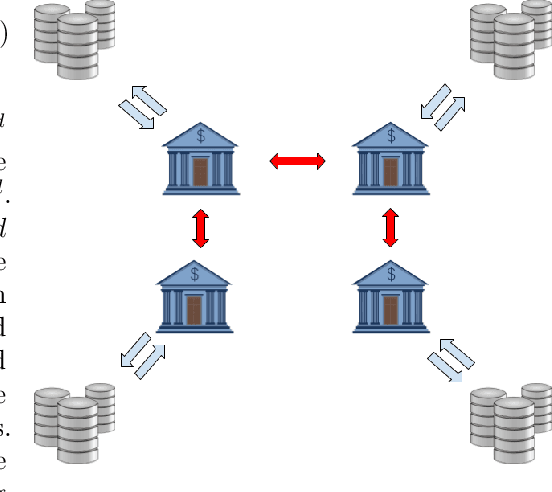
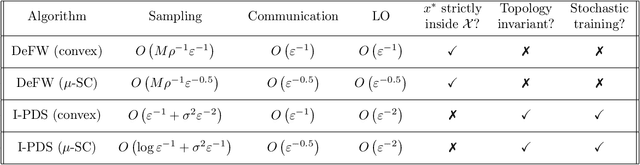
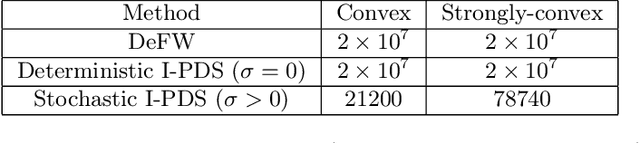
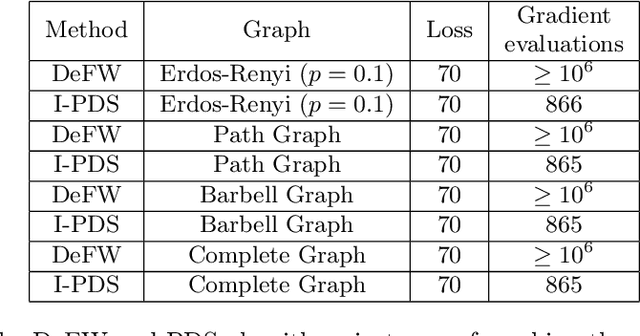
In modern decentralized applications, ensuring communication efficiency and privacy for the users are the key challenges. In order to train machine-learning models, the algorithm has to communicate to the data center and sample data for its gradient computation, thus exposing the data and increasing the communication cost. This gives rise to the need for a decentralized optimization algorithm that is communication-efficient and minimizes the number of gradient computations. To this end, we propose the primal-dual sliding with conditional gradient sliding framework, which is communication-efficient and achieves an $\varepsilon$-approximate solution with the optimal gradient complexity of $O(1/\sqrt{\varepsilon}+\sigma^2/{\varepsilon^2})$ and $O(\log(1/\varepsilon)+\sigma^2/\varepsilon)$ for the convex and strongly convex setting respectively and an LO (Linear Optimization) complexity of $O(1/\varepsilon^2)$ for both settings given a stochastic gradient oracle with variance $\sigma^2$. Compared with the prior work \cite{wai-fw-2017}, our framework relaxes the assumption of the optimal solution being a strict interior point of the feasible set and enjoys wider applicability for large-scale training using a stochastic gradient oracle. We also demonstrate the efficiency of our algorithms with various numerical experiments.
GEAR: An Efficient KV Cache Compression Recipe for Near-Lossless Generative Inference of LLM
Mar 11, 2024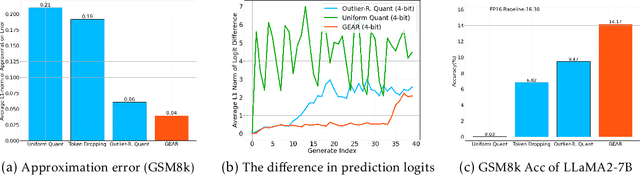
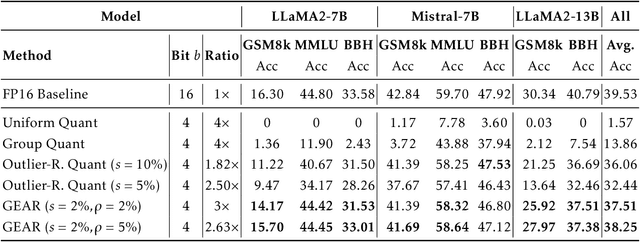
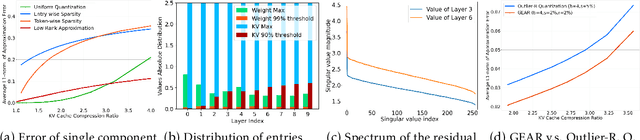
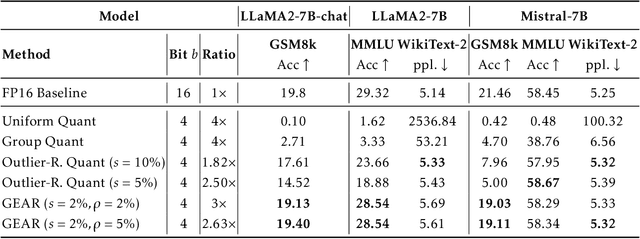
Key-value (KV) caching has become the de-facto to accelerate generation speed for large language models (LLMs) inference. However, the growing cache demand with increasing sequence length has transformed LLM inference to be a memory bound problem, significantly constraining the system throughput. Existing methods rely on dropping unimportant tokens or quantizing all entries uniformly. Such methods, however, often incur high approximation errors to represent the compressed matrices. The autoregressive decoding process further compounds the error of each step, resulting in critical deviation in model generation and deterioration of performance. To tackle this challenge, we propose GEAR, an efficient KV cache compression framework that achieves near-lossless high-ratio compression. GEAR first applies quantization to majority of entries of similar magnitudes to ultra-low precision. It then employs a low rank matrix to approximate the quantization error, and a sparse matrix to remedy individual errors from outlier entries. By adeptly integrating three techniques, GEAR is able to fully exploit their synergistic potentials. Our experiments demonstrate that compared to alternatives, GEAR achieves near-lossless 4-bit KV cache compression with up to 2.38x throughput improvement, while reducing peak-memory size up to 2.29x. Our code is publicly available at https://github.com/HaoKang-Timmy/GEAR.