 Add to Chrome
 Add to Firefox
 Add to Edge
Data Difficulty and the Generalization--Extrapolation Tradeoff in LLM Fine-Tuning
May 13, 2026
Data selection during supervised fine-tuning (SFT) can critically change the behavior of large language models (LLMs). Although existing work has studied the effect of selecting data based on heuristics such as perplexity, difficulty, or length, the reported findings are often inconsistent or context-dependent. In this work, we systematically study the role of data difficulty in fine-tuning from both empirical and theoretical perspectives, and find that there is no universally optimal difficulty level; rather, its effectiveness depends on the dataset size. We show that for a fixed data budget, there exists an optimal data difficulty for SFT, and that this optimal difficulty shifts toward harder data as the data budget increases. To explain this phenomenon, we conduct controlled synthetic experiments that reveal a simple underlying mechanism: the interplay between the (in-distribution) generalization gap and the extrapolation gap. We further support this mechanism through a theoretical analysis using PAC-Bayesian generalization bounds. Overall, our results clarify how data size and difficulty jointly affect the trade-off between generalization and extrapolation in SFT, providing guidance for difficulty-based data selection under certain model and data conditions.

MemAgent: Reshaping Long-Context LLM with Multi-Conv RL-based Memory Agent
Jul 03, 2025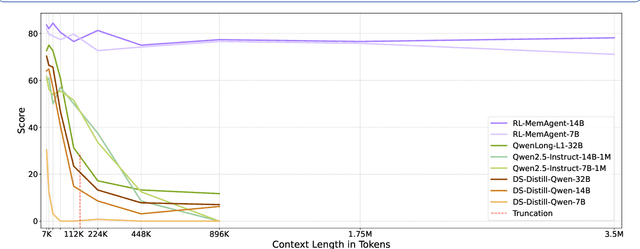
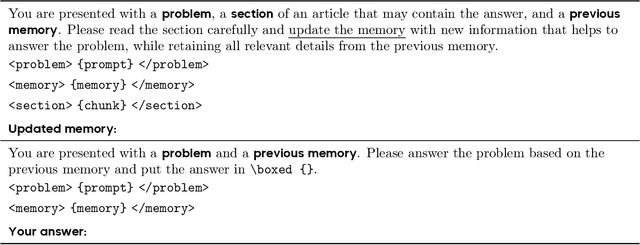
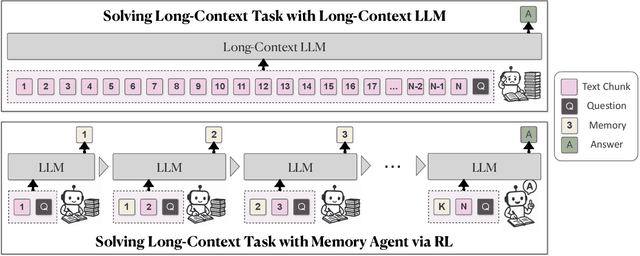
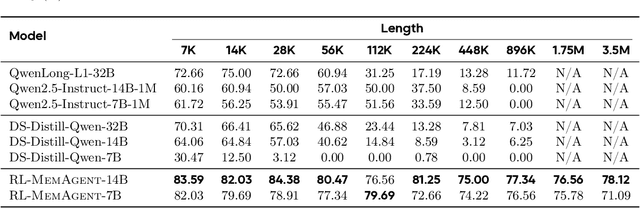
Despite improvements by length extrapolation, efficient attention and memory modules, handling infinitely long documents with linear complexity without performance degradation during extrapolation remains the ultimate challenge in long-text processing. We directly optimize for long-text tasks in an end-to-end fashion and introduce a novel agent workflow, MemAgent, which reads text in segments and updates the memory using an overwrite strategy. We extend the DAPO algorithm to facilitate training via independent-context multi-conversation generation. MemAgent has demonstrated superb long-context capabilities, being able to extrapolate from an 8K context trained on 32K text to a 3.5M QA task with performance loss < 5% and achieves 95%+ in 512K RULER test.
SRFT: A Single-Stage Method with Supervised and Reinforcement Fine-Tuning for Reasoning
Jun 24, 2025Large language models (LLMs) have achieved remarkable progress in reasoning tasks, yet the optimal integration of Supervised Fine-Tuning (SFT) and Reinforcement Learning (RL) remains a fundamental challenge. Through comprehensive analysis of token distributions, learning dynamics, and integration mechanisms from entropy-based perspectives, we reveal key differences between these paradigms: SFT induces coarse-grained global changes to LLM policy distributions, while RL performs fine-grained selective optimizations, with entropy serving as a critical indicator of training effectiveness. Building on these observations, we propose Supervised Reinforcement Fine-Tuning (SRFT), a single-stage method that unifies both fine-tuning paradigms through entropy-aware weighting mechanisms. Our approach simultaneously applies SFT and RL to directly optimize the LLM using demonstrations and self-exploration rollouts rather than through two-stage sequential methods. Extensive experiments show that SRFT achieves 59.1% average accuracy, outperforming zero-RL methods by 9.0% on five mathematical reasoning benchmarks and 10.9% on three out-of-distribution benchmarks.