 Add to Chrome
 Add to Firefox
 Add to Edge
Spectral Rewiring for Exploration, Purification, and Model Merging
Jul 03, 2026
Reinforcement learning has become a standard post-training recipe for large language models, but dense full-parameter updates create two deployment-relevant bottlenecks: suppressed reasoning performance, often reflected by premature saturation of test-time scaling, and interference when consolidating multiple capabilities through multi-domain training or model merging. We show that the reasoning-effective component of these updates is largely concentrated in the base model's spectral space, motivating Subspace-Aligned Rewiring (SAR), a post-hoc editing method that retains this spectral core while removing orthogonal components. SAR therefore preserves reasoning gains and filters residual update directions that suppress performance or amplify cross-domain interference. Across several model families and scales, SAR extracts compact reasoning cores using as little as approximately 0.58% of total parameters: it preserves over 99% of post-training performance and improves high-k exploration in mathematical reasoning, and generalizes to agentic coding by improving six of seven open benchmarks on an in-house model. SAR also purifies mixed-domain training updates by releasing suppressed coding capability while maintaining math reasoning and instruction following. It further enables model merging across experts, yielding cross-domain generalization that surpasses previous merging baselines and even the best single-domain experts. Overall, SAR shows that extracting reasoning-effective updates from parameter geometry can serve as a training-free mechanism to improve reasoning and multi-domain performance.

CUDA Agent: Large-Scale Agentic RL for High-Performance CUDA Kernel Generation
Feb 27, 2026GPU kernel optimization is fundamental to modern deep learning but remains a highly specialized task requiring deep hardware expertise. Despite strong performance in general programming, large language models (LLMs) remain uncompetitive with compiler-based systems such as torch.compile for CUDA kernel generation. Existing CUDA code generation approaches either rely on training-free refinement or fine-tune models within fixed multi-turn execution-feedback loops, but both paradigms fail to fundamentally improve the model's intrinsic CUDA optimization ability, resulting in limited performance gains. We present CUDA Agent, a large-scale agentic reinforcement learning system that develops CUDA kernel expertise through three components: a scalable data synthesis pipeline, a skill-augmented CUDA development environment with automated verification and profiling to provide reliable reward signals, and reinforcement learning algorithmic techniques enabling stable training. CUDA Agent achieves state-of-the-art results on KernelBench, delivering 100\%, 100\%, and 92\% faster rate over torch.compile on KernelBench Level-1, Level-2, and Level-3 splits, outperforming the strongest proprietary models such as Claude Opus 4.5 and Gemini 3 Pro by about 40\% on the hardest Level-3 setting.
MemAgent: Reshaping Long-Context LLM with Multi-Conv RL-based Memory Agent
Jul 03, 2025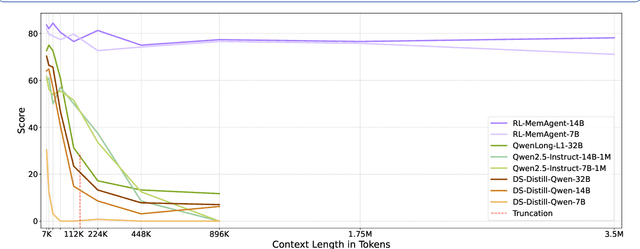
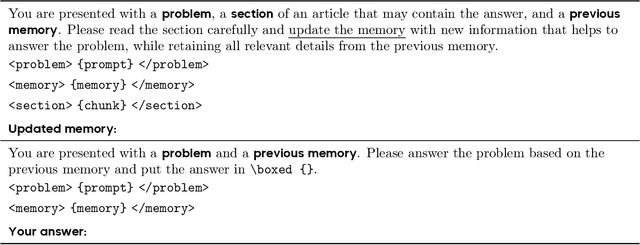
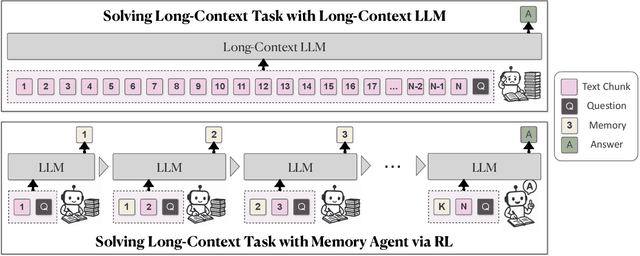
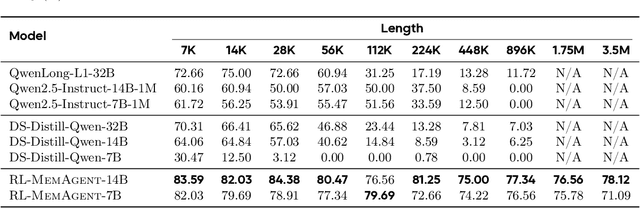
Despite improvements by length extrapolation, efficient attention and memory modules, handling infinitely long documents with linear complexity without performance degradation during extrapolation remains the ultimate challenge in long-text processing. We directly optimize for long-text tasks in an end-to-end fashion and introduce a novel agent workflow, MemAgent, which reads text in segments and updates the memory using an overwrite strategy. We extend the DAPO algorithm to facilitate training via independent-context multi-conversation generation. MemAgent has demonstrated superb long-context capabilities, being able to extrapolate from an 8K context trained on 32K text to a 3.5M QA task with performance loss < 5% and achieves 95%+ in 512K RULER test.
Enigmata: Scaling Logical Reasoning in Large Language Models with Synthetic Verifiable Puzzles
May 26, 2025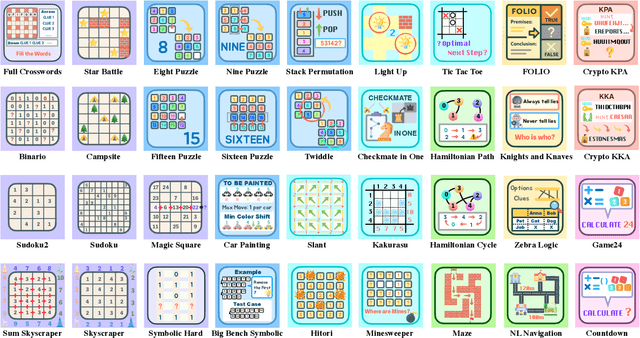
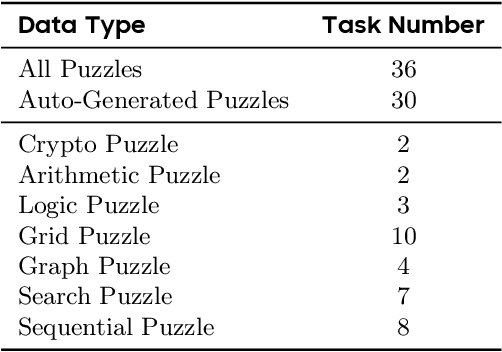
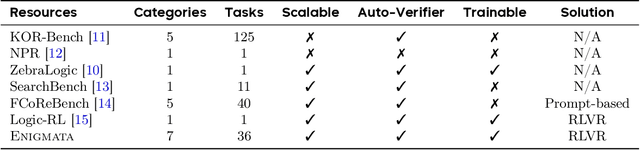
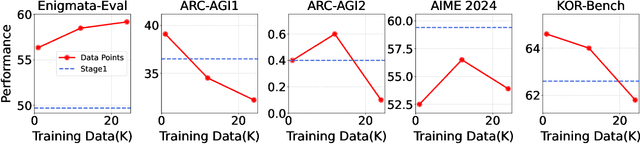
Large Language Models (LLMs), such as OpenAI's o1 and DeepSeek's R1, excel at advanced reasoning tasks like math and coding via Reinforcement Learning with Verifiable Rewards (RLVR), but still struggle with puzzles solvable by humans without domain knowledge. We introduce Enigmata, the first comprehensive suite tailored for improving LLMs with puzzle reasoning skills. It includes 36 tasks across seven categories, each with 1) a generator that produces unlimited examples with controllable difficulty and 2) a rule-based verifier for automatic evaluation. This generator-verifier design supports scalable, multi-task RL training, fine-grained analysis, and seamless RLVR integration. We further propose Enigmata-Eval, a rigorous benchmark, and develop optimized multi-task RLVR strategies. Our trained model, Qwen2.5-32B-Enigmata, consistently surpasses o3-mini-high and o1 on the puzzle reasoning benchmarks like Enigmata-Eval, ARC-AGI (32.8%), and ARC-AGI 2 (0.6%). It also generalizes well to out-of-domain puzzle benchmarks and mathematical reasoning, with little multi-tasking trade-off. When trained on larger models like Seed1.5-Thinking (20B activated parameters and 200B total parameters), puzzle data from Enigmata further boosts SoTA performance on advanced math and STEM reasoning tasks such as AIME (2024-2025), BeyondAIME and GPQA (Diamond), showing nice generalization benefits of Enigmata. This work offers a unified, controllable framework for advancing logical reasoning in LLMs. Resources of this work can be found at https://seed-enigmata.github.io.
DAPO: An Open-Source LLM Reinforcement Learning System at Scale
Mar 18, 2025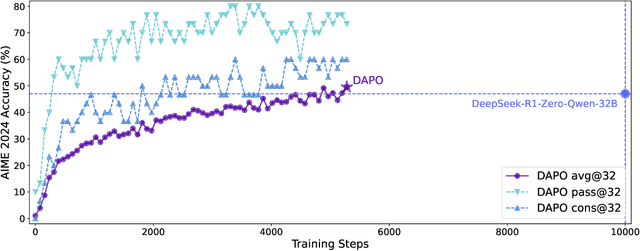
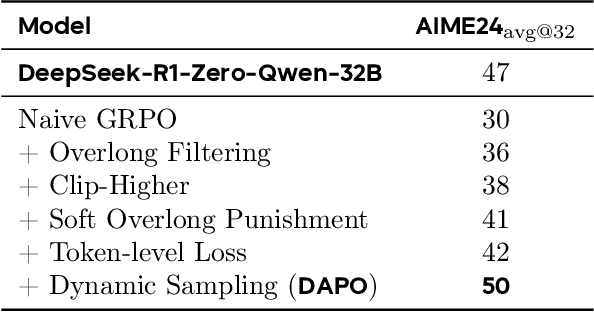
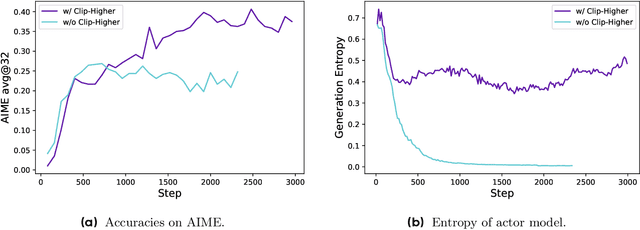
Inference scaling empowers LLMs with unprecedented reasoning ability, with reinforcement learning as the core technique to elicit complex reasoning. However, key technical details of state-of-the-art reasoning LLMs are concealed (such as in OpenAI o1 blog and DeepSeek R1 technical report), thus the community still struggles to reproduce their RL training results. We propose the $\textbf{D}$ecoupled Clip and $\textbf{D}$ynamic s$\textbf{A}$mpling $\textbf{P}$olicy $\textbf{O}$ptimization ($\textbf{DAPO}$) algorithm, and fully open-source a state-of-the-art large-scale RL system that achieves 50 points on AIME 2024 using Qwen2.5-32B base model. Unlike previous works that withhold training details, we introduce four key techniques of our algorithm that make large-scale LLM RL a success. In addition, we open-source our training code, which is built on the verl framework, along with a carefully curated and processed dataset. These components of our open-source system enhance reproducibility and support future research in large-scale LLM RL.