 Add to Chrome
 Add to Firefox
 Add to Edge
FreeTimeGS++: Secrets of Dynamic Gaussian Splatting and Their Principles
May 05, 2026
The recent surge in 4D Gaussian Splatting (4DGS) has achieved impressive dynamic scene reconstruction. While these methods demonstrate remarkable performance, the specific drivers behind such gains remain less explored, making a systematic understanding of the underlying principles challenging. In this paper, we perform a comprehensive analysis of these hidden factors to provide a clearer perspective on the 4DGS framework. We first establish a controlled baseline, FreeTimeGS_ours, by formalizing and reproducing the heuristics of the state-of-the-art FreeTimeGS. Using this framework, we dissect 4DGS along its fundamental axes and uncover key secrets, including the emergent temporal partitioning driven by Gaussian durations and the discrepancy between photometric fidelity and spatiotemporal consistency. Based on these insights, we propose FreeTimeGS++, a principled method that employs gated marginalization and neural velocity fields to achieve superior stability and robust dynamic representations. Our approach yields reproducible results with reduced run-to-run variance. We will release our implementation to provide a reliable foundation for future 4DGS research.

Classification-Aware Neural Topic Model Combined With Interpretable Analysis -- For Conflict Classification
Aug 29, 2023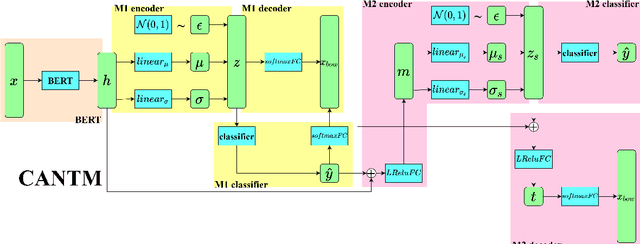

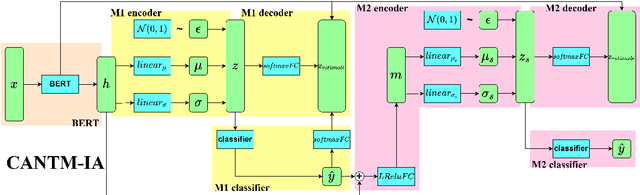

A large number of conflict events are affecting the world all the time. In order to analyse such conflict events effectively, this paper presents a Classification-Aware Neural Topic Model (CANTM-IA) for Conflict Information Classification and Topic Discovery. The model provides a reliable interpretation of classification results and discovered topics by introducing interpretability analysis. At the same time, interpretation is introduced into the model architecture to improve the classification performance of the model and to allow interpretation to focus further on the details of the data. Finally, the model architecture is optimised to reduce the complexity of the model.