 Add to Chrome
 Add to Firefox
 Add to Edge
Open-H-Embodiment: A Large-Scale Dataset for Enabling Foundation Models in Medical Robotics
Apr 22, 2026
Autonomous medical robots hold promise to improve patient outcomes, reduce provider workload, democratize access to care, and enable superhuman precision. However, autonomous medical robotics has been limited by a fundamental data problem: existing medical robotic datasets are small, single-embodiment, and rarely shared openly, restricting the development of foundation models that the field needs to advance. We introduce Open-H-Embodiment, the largest open dataset of medical robotic video with synchronized kinematics to date, spanning more than 49 institutions and multiple robotic platforms including the CMR Versius, Intuitive Surgical's da Vinci, da Vinci Research Kit (dVRK), Rob Surgical BiTrack, Virtual Incision's MIRA, Moon Surgical Maestro, and a variety of custom systems, spanning surgical manipulation, robotic ultrasound, and endoscopy procedures. We demonstrate the research enabled by this dataset through two foundation models. GR00T-H is the first open foundation vision-language-action model for medical robotics, which is the only evaluated model to achieve full end-to-end task completion on a structured suturing benchmark (25% of trials vs. 0% for all others) and achieves 64% average success across a 29-step ex vivo suturing sequence. We also train Cosmos-H-Surgical-Simulator, the first action-conditioned world model to enable multi-embodiment surgical simulation from a single checkpoint, spanning nine robotic platforms and supporting in silico policy evaluation and synthetic data generation for the medical domain. These results suggest that open, large-scale medical robot data collection can serve as critical infrastructure for the research community, enabling advances in robot learning, world modeling, and beyond.

WBCBench 2026: A Challenge for Robust White Blood Cell Classification Under Class Imbalance
Apr 12, 2026We present WBCBench 2026, an ISBI challenge and benchmark for automated WBC classification designed to stress-test algorithms under three key difficulties: (i) severe class imbalance across 13 morphologically fine-grained WBC classes, (ii) strict patient-level separation between training, validation and test sets, and (iii) synthetic scanner- and setting-induced domain shift via controlled noise, blur and illumination perturbations. All images are single-site microscopic blood smear acquisitions with standardised staining and expert hematopathologist annotations. This paper reviews the challenge and summarises the proposed solutions and final outcomes. The benchmark is organised into two phases. Phase 1 provides a pristine training set. Phase 2 introduces degraded images with split-specific severity distributions for train, validation and test, emulating a realistic shift between development and deployment conditions. We specify a standardised submission schema, open-source evaluator, and macro-averaged F1 score as the primary ranking metric.
Association of Progressive PPFE and Mortality in Lung Cancer Screening Cohorts
Mar 17, 2026Background: Pleuroparenchymal fibroelastosis (PPFE) is an upper lobe predominant fibrotic lung abnormality associated with increased mortality in established interstitial lung disease. However, the clinical significance of radiologic PPFE progression in lung cancer screening (LCS) populations remains unclear. Methods: We analysed longitudinal low-dose CT scans and clinical data from two LCS studies: National Lung Screening Trial (NLST; n=7,980); SUMMIT study (n=8,561). An automated algorithm quantified PPFE volume on baseline and follow-up scans. Annualised change in PPFE was derived and dichotomised using a distribution-based threshold to define progressive PPFE. Associations between progressive PPFE and mortality were evaluated using Cox proportional hazards models adjusted for demographic and clinical variables. In SUMMIT cohort, associations between progressive PPFE and clinical outcomes were assessed using incidence rate ratios (IRR) and odds ratios (OR). Findings: Progressive PPFE independently associated with mortality in both LCS cohorts (NLST: Hazard Ratio (HR)=1.25, 95% Confidence Interval (CI): 1.01--1.56, p=0.042; SUMMIT: HR=3.14, 95% CI: 1.66--5.97, p<0.001). Within SUMMIT, progressive PPFE was strongly associated with higher respiratory admissions (IRR=2.79, p<0.001), increased antibiotic and steroid use (IRR=1.55, p=0.010), and showed a trend towards higher modified medical research council scores (OR=1.40, p=0.055). Interpretation: Radiologic PPFE progression independently associates with mortality across two large LCS cohorts, and associates with adverse clinical outcomes. Quantitative assessment of PPFE progression may provide a clinically relevant imaging biomarker to identify individuals at increased risk of respiratory morbidity within LCS programmes.
Association of Radiologic PPFE Change with Mortality in Lung Cancer Screening Cohorts
Mar 10, 2026Background: Pleuroparenchymal fibroelastosis (PPFE) is an upper lobe predominant fibrotic lung abnormality associated with increased mortality in established interstitial lung disease. However, the clinical significance of radiologic PPFE progression in lung cancer screening populations remains unclear. We investigated whether longitudinal change in PPFE quantified on low dose CT independently associates with mortality and respiratory morbidity. Methods: We analysed longitudinal low-dose CT scans and clinical data from two lung cancer screening studies: the National Lung Screening Trial (NLST; n=7980) and the SUMMIT study (n=8561). An automated algorithm quantified PPFE volume on baseline and follow up scans. Annualised change in PPFE (dPPFE) was derived and dichotomised using a distribution based threshold to define progressive PPFE. Associations between dPPFE and mortality were evaluated using Cox proportional hazards models adjusted for demographic and clinical variables. In the SUMMIT cohort, dPPFE was also examined in relation to clinical outcomes. Findings: dPPFE independently associated with mortality in both cohorts (NLST: HR 1.25, 95% CI 1.01-1.56, p=0.042; SUMMIT: HR 3.14, 95% CI 1.66-5.97, p<0.001). Kaplan-Meier curves showed reduced survival among participants with progressive PPFE in both cohorts. In SUMMIT, dPPFE was associated with higher respiratory admissions (IRR 2.79, p<0.001), increased antibiotic and steroid use (IRR 1.55, p=0.010), and a trend towards higher mMRC scores (OR 1.40, p=0.055). Interpretation: Radiologic PPFE progression independently associates with mortality across two large lung cancer screening cohorts and with adverse clinical outcomes. Quantitative assessment of PPFE progression may provide a clinically relevant imaging biomarker for identifying individuals at increased respiratory risk within screening programmes.
Hierarchical Deformation Planning and Neural Tracking for DLOs in Constrained Environments
Dec 31, 2025Deformable linear objects (DLOs) manipulation presents significant challenges due to DLOs' inherent high-dimensional state space and complex deformation dynamics. The wide-populated obstacles in realistic workspaces further complicate DLO manipulation, necessitating efficient deformation planning and robust deformation tracking. In this work, we propose a novel framework for DLO manipulation in constrained environments. This framework combines hierarchical deformation planning with neural tracking, ensuring reliable performance in both global deformation synthesis and local deformation tracking. Specifically, the deformation planner begins by generating a spatial path set that inherently satisfies the homotopic constraints associated with DLO keypoint paths. Next, a path-set-guided optimization method is applied to synthesize an optimal temporal deformation sequence for the DLO. In manipulation execution, a neural model predictive control approach, leveraging a data-driven deformation model, is designed to accurately track the planned DLO deformation sequence. The effectiveness of the proposed framework is validated in extensive constrained DLO manipulation tasks.
SimTac: A Physics-Based Simulator for Vision-Based Tactile Sensing with Biomorphic Structures
Nov 14, 2025Tactile sensing in biological organisms is deeply intertwined with morphological form, such as human fingers, cat paws, and elephant trunks, which enables rich and adaptive interactions through a variety of geometrically complex structures. In contrast, vision-based tactile sensors in robotics have been limited to simple planar geometries, with biomorphic designs remaining underexplored. To address this gap, we present SimTac, a physics-based simulation framework for the design and validation of biomorphic tactile sensors. SimTac consists of particle-based deformation modeling, light-field rendering for photorealistic tactile image generation, and a neural network for predicting mechanical responses, enabling accurate and efficient simulation across a wide range of geometries and materials. We demonstrate the versatility of SimTac by designing and validating physical sensor prototypes inspired by biological tactile structures and further demonstrate its effectiveness across multiple Sim2Real tactile tasks, including object classification, slip detection, and contact safety assessment. Our framework bridges the gap between bio-inspired design and practical realisation, expanding the design space of tactile sensors and paving the way for tactile sensing systems that integrate morphology and sensing to enable robust interaction in unstructured environments.
A Multimodal Approach for Fluid Overload Prediction: Integrating Lung Ultrasound and Clinical Data
Sep 13, 2024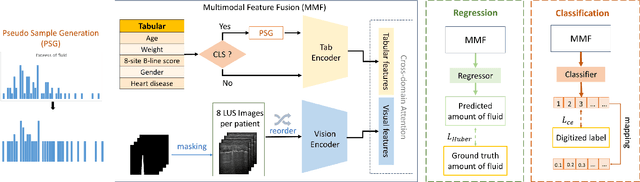
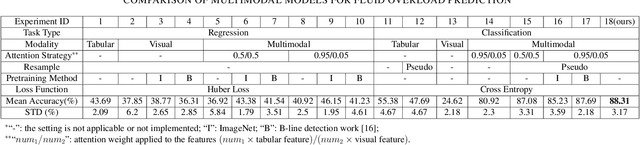
Managing fluid balance in dialysis patients is crucial, as improper management can lead to severe complications. In this paper, we propose a multimodal approach that integrates visual features from lung ultrasound images with clinical data to enhance the prediction of excess body fluid. Our framework employs independent encoders to extract features for each modality and combines them through a cross-domain attention mechanism to capture complementary information. By framing the prediction as a classification task, the model achieves significantly better performance than regression. The results demonstrate that multimodal models consistently outperform single-modality models, particularly when attention mechanisms prioritize tabular data. Pseudo-sample generation further contributes to mitigating the imbalanced classification problem, achieving the highest accuracy of 88.31%. This study underscores the effectiveness of multimodal learning for fluid overload management in dialysis patients, offering valuable insights for improved clinical outcomes.
DUCPS: Deep Unfolding the Cauchy Proximal Splitting Algorithm for B-Lines Quantification in Lung Ultrasound Images
Jul 16, 2024The identification of artefacts, particularly B-lines, in lung ultrasound (LUS), is crucial for assisting clinical diagnosis, prompting the development of innovative methodologies. While the Cauchy proximal splitting (CPS) algorithm has demonstrated effective performance in B-line detection, the process is slow and has limited generalization. This paper addresses these issues with a novel unsupervised deep unfolding network structure (DUCPS). The framework utilizes deep unfolding procedures to merge traditional model-based techniques with deep learning approaches. By unfolding the CPS algorithm into a deep network, DUCPS enables the parameters in the optimization algorithm to be learnable, thus enhancing generalization performance and facilitating rapid convergence. We conducted entirely unsupervised training using the Neighbor2Neighbor (N2N) and the Structural Similarity Index Measure (SSIM) losses. When combined with an improved line identification method proposed in this paper, state-of-the-art performance is achieved, with the recall and F2 score reaching 0.70 and 0.64, respectively. Notably, DUCPS significantly improves computational efficiency eliminating the need for extensive data labeling, representing a notable advancement over both traditional algorithms and existing deep learning approaches.
DUBLINE: A Deep Unfolding Network for B-line Detection in Lung Ultrasound Images
Nov 11, 2023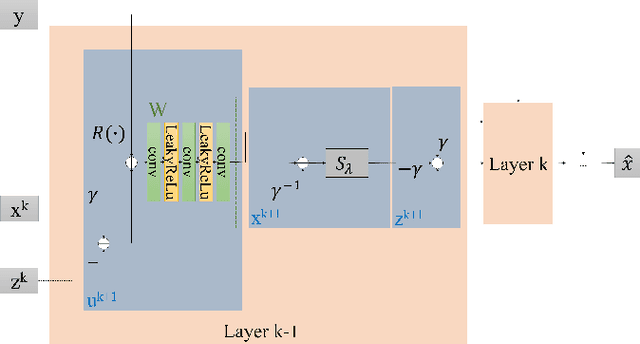
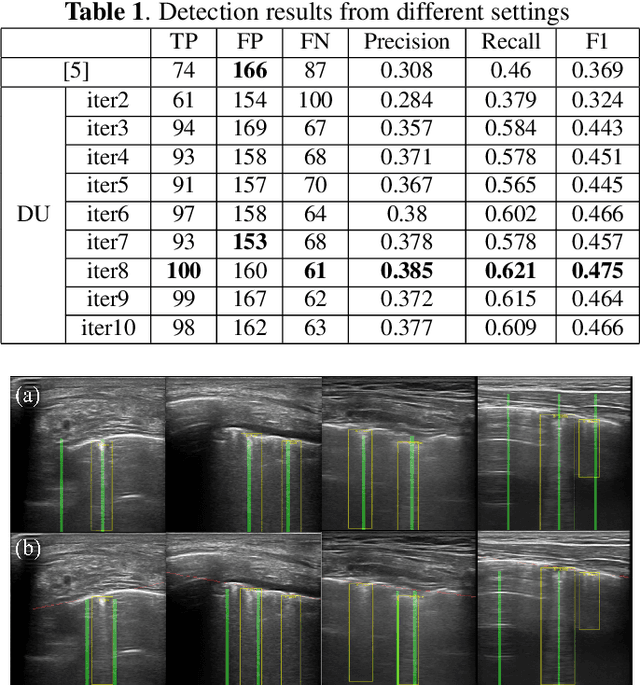
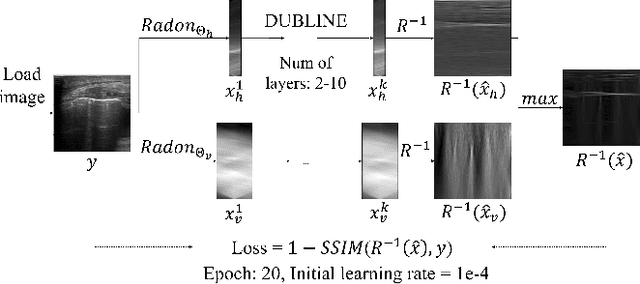
In the context of lung ultrasound, the detection of B-lines, which are indicative of interstitial lung disease and pulmonary edema, plays a pivotal role in clinical diagnosis. Current methods still rely on visual inspection by experts. Vision-based automatic B-line detection methods have been developed, but their performance has yet to improve in terms of both accuracy and computational speed. This paper presents a novel approach to posing B-line detection as an inverse problem via deep unfolding of the Alternating Direction Method of Multipliers (ADMM). It tackles the challenges of data labelling and model training in lung ultrasound image analysis by harnessing the capabilities of deep neural networks and model-based methods. Our objective is to substantially enhance diagnostic accuracy while ensuring efficient real-time capabilities. The results show that the proposed method runs more than 90 times faster than the traditional model-based method and achieves an F1 score that is 10.6% higher.
A Semi-supervised Learning Approach for B-line Detection in Lung Ultrasound Images
Nov 30, 2022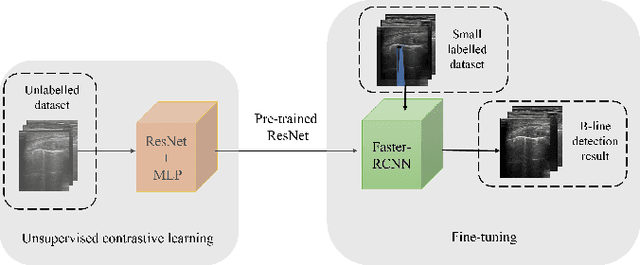
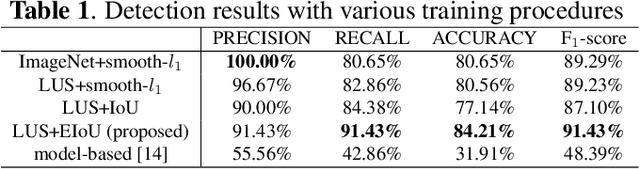
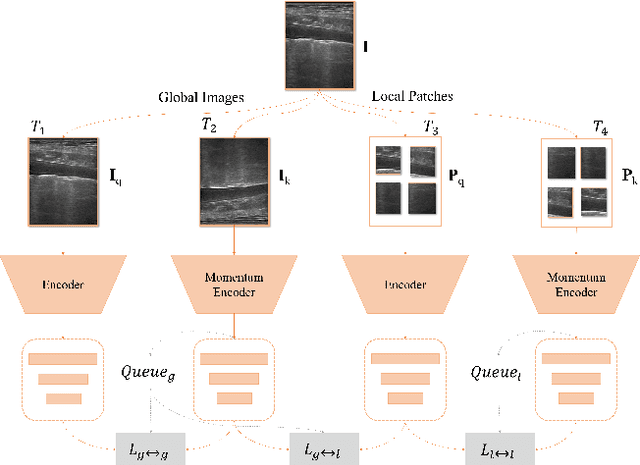
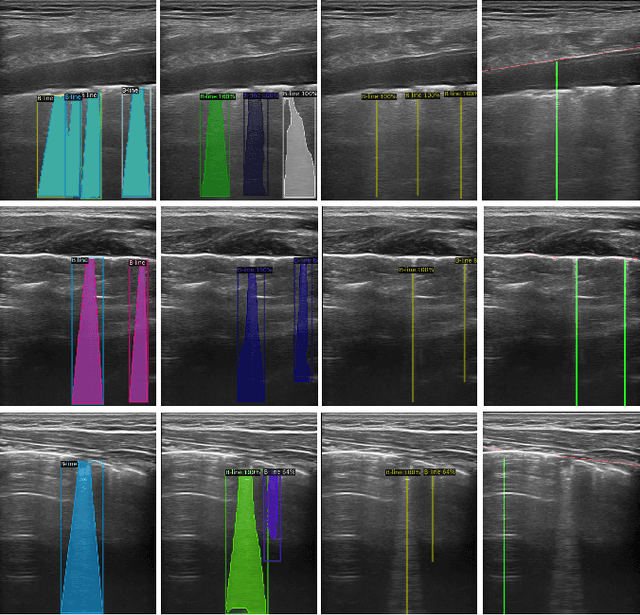
Studies have proved that the number of B-lines in lung ultrasound images has a strong statistical link to the amount of extravascular lung water, which is significant for hemodialysis treatment. Manual inspection of B-lines requires experts and is time-consuming, whilst modelling automation methods is currently problematic because of a lack of ground truth. Therefore, in this paper, we propose a novel semi-supervised learning method for the B-line detection task based on contrastive learning. Through multi-level unsupervised learning on unlabelled lung ultrasound images, the features of the artefacts are learnt. In the downstream task, we introduce a fine-tuning process on a small number of labelled images using the EIoU-based loss function. Apart from reducing the data labelling workload, the proposed method shows a superior performance to model-based algorithm with the recall of 91.43%, the accuracy of 84.21% and the F1 score of 91.43%.