 Add to Chrome
 Add to Firefox
 Add to Edge
HapTile: A Haptic-Informed Vision-Tactile-Language-Action Dataset for Contact-Rich Imitation Learning
Jun 03, 2026
Despite the importance of tactile sensing for reliable manipulation, most existing Vision-Language-Action (VLA) datasets remain vision-only, and those that do incorporate tactile information typically lack the joint combination of task diversity, language conditioning, and action trajectories. Furthermore, existing teleoperation pipelines rarely provide haptic feedback to the operator, despite its established role in demonstration quality and manipulation stability. In this work, we present HapTile, a contact-grounded visuotactile manipulation dataset that advances beyond vision-only trajectory datasets by embedding physical interaction sensing at two levels: fingertip tactile feedback at the robot end-effector, and haptic-informed demonstrations at the teleoperator side. The data collection platform integrates haptic feedback directly into the teleoperation controller, enabling the operator to perceive contact interactions in real time. It is built around a standard and reproducible robotic system equipped with custom-designed fingertip tactile sensors. The dataset comprises everyday manipulation tasks spanning a broad range of contact-rich skills, including pick-and-place, folding, pressing, stacking, and other routine activities. Each task is paired with language instructions that condition the policy on the manipulation objective, together with synchronized visuotactile observations and action trajectories. In addition, we provide a benchmarking study on contact-rich policy learning using two baseline models to evaluate the effectiveness of the proposed contact-grounded dataset. The dataset and additional details are available on our website: haptile-dataset.github.io.

Visual-Tactile Peg-in-Hole Assembly Learning from Peg-out-of-Hole Disassembly
Apr 22, 2026Peg-in-hole (PiH) assembly is a fundamental yet challenging robotic manipulation task. While reinforcement learning (RL) has shown promise in tackling such tasks, it requires extensive exploration. In this paper, we propose a novel visual-tactile skill learning framework for the PiH task that leverages its inverse task, i.e., peg-out-of-hole (PooH) disassembly, to facilitate PiH learning. Compared to PiH, PooH is inherently easier as it only needs to overcome existing friction without precise alignment, making data collection more efficient. To this end, we formulate both PooH and PiH as Partially Observable Markov Decision Processes (POMDPs) in a unified environment with shared visual-tactile observation space. A visual-tactile PooH policy is first trained; its trajectories, containing kinematic, visual and tactile information, are temporally reversed and action-randomized to provide expert data for PiH. In the policy learning, visual sensing facilitates the peg-hole approach, while tactile measurements compensate for peg-hole misalignment. Experiments across diverse peg-hole geometries show that the visual-tactile policy attains 6.4% lower contact forces than its single-modality counterparts, and that our framework achieves average success rates of 87.5% on seen objects and 77.1% on unseen objects, outperforming direct RL methods that train PiH policies from scratch by 18.1% in success rate. Demos, code, and datasets are available at https://sites.google.com/view/pooh2pih.
ViTac-Tracing: Visual-Tactile Imitation Learning of Deformable Object Tracing
Mar 19, 2026Deformable objects often appear in unstructured configurations. Tracing deformable objects helps bringing them into extended states and facilitating the downstream manipulation tasks. Due to the requirements for object-specific modeling or sim-to-real transfer, existing tracing methods either lack generalizability across different categories of deformable objects or struggle to complete tasks reliably in the real world. To address this, we propose a novel visual-tactile imitation learning method to achieve one-dimensional (1D) and two-dimensional (2D) deformable object tracing with a unified model. Our method is designed from both local and global perspectives based on visual and tactile sensing. Locally, we introduce a weighted loss that emphasizes actions maintaining contact near the center of the tactile image, improving fine-grained adjustment. Globally, we propose a tracing task loss that helps the policy to regulate task progression. On the hardware side, to compensate for the limited features extracted from visual information, we integrate tactile sensing into a low-cost teleoperation system considering both the teleoperator and the robot. Extensive ablation and comparative experiments on diverse 1D and 2D deformable objects demonstrate the effectiveness of our approach, achieving an average success rate of 80% on seen objects and 65% on unseen objects.
DenoiseFlow: Uncertainty-Aware Denoising for Reliable LLM Agentic Workflows
Feb 28, 2026Autonomous agents are increasingly entrusted with complex, long-horizon tasks, ranging from mathematical reasoning to software generation. While agentic workflows facilitate these tasks by decomposing them into multi-step reasoning chains, reliability degrades significantly as the sequence lengthens. Specifically, minor interpretation errors in natural-language instructions tend to compound silently across steps. We term this failure mode accumulated semantic ambiguity. Existing approaches to mitigate this often lack runtime adaptivity, relying instead on static exploration budgets, reactive error recovery, or single-path execution that ignores uncertainty entirely. We formalize the multi-step reasoning process as a Noisy MDP and propose DenoiseFlow, a closed-loop framework that performs progressive denoising through three coordinated stages: (1)Sensing estimates per-step semantic uncertainty; (2)Regulating adaptively allocates computation by routing between fast single-path execution and parallel exploration based on estimated risk; and (3)Correcting performs targeted recovery via influence-based root-cause localization. Online self-calibration continuously aligns decision boundaries with verifier feedback, requiring no ground-truth labels. Experiments on six benchmarks spanning mathematical reasoning, code generation, and multi-hop QA show that DenoiseFlow achieves the highest accuracy on every benchmark (83.3% average, +1.3% over the strongest baseline) while reducing cost by 40--56% through adaptive branching. Detailed ablation studies further confirm framework-level's robustness and generality. Code is available at https://anonymous.4open.science/r/DenoiseFlow-21D3/.
Limited Reasoning Space: The cage of long-horizon reasoning in LLMs
Feb 22, 2026The test-time compute strategy, such as Chain-of-Thought (CoT), has significantly enhanced the ability of large language models to solve complex tasks like logical reasoning. However, empirical studies indicate that simply increasing the compute budget can sometimes lead to a collapse in test-time performance when employing typical task decomposition strategies such as CoT. This work hypothesizes that reasoning failures with larger compute budgets stem from static planning methods, which hardly perceive the intrinsic boundaries of LLM reasoning. We term it as the Limited Reasoning Space hypothesis and perform theoretical analysis through the lens of a non-autonomous stochastic dynamical system. This insight suggests that there is an optimal range for compute budgets; over-planning can lead to redundant feedback and may even impair reasoning capabilities. To exploit the compute-scaling benefits and suppress over-planning, this work proposes Halo, a model predictive control framework for LLM planning. Halo is designed for long-horizon tasks with reason-based planning and crafts an entropy-driven dual controller, which adopts a Measure-then-Plan strategy to achieve controllable reasoning. Experimental results demonstrate that Halo outperforms static baselines on complex long-horizon tasks by dynamically regulating planning at the reasoning boundary.
SimTac: A Physics-Based Simulator for Vision-Based Tactile Sensing with Biomorphic Structures
Nov 14, 2025Tactile sensing in biological organisms is deeply intertwined with morphological form, such as human fingers, cat paws, and elephant trunks, which enables rich and adaptive interactions through a variety of geometrically complex structures. In contrast, vision-based tactile sensors in robotics have been limited to simple planar geometries, with biomorphic designs remaining underexplored. To address this gap, we present SimTac, a physics-based simulation framework for the design and validation of biomorphic tactile sensors. SimTac consists of particle-based deformation modeling, light-field rendering for photorealistic tactile image generation, and a neural network for predicting mechanical responses, enabling accurate and efficient simulation across a wide range of geometries and materials. We demonstrate the versatility of SimTac by designing and validating physical sensor prototypes inspired by biological tactile structures and further demonstrate its effectiveness across multiple Sim2Real tactile tasks, including object classification, slip detection, and contact safety assessment. Our framework bridges the gap between bio-inspired design and practical realisation, expanding the design space of tactile sensors and paving the way for tactile sensing systems that integrate morphology and sensing to enable robust interaction in unstructured environments.
ViTacGen: Robotic Pushing with Vision-to-Touch Generation
Oct 15, 2025Robotic pushing is a fundamental manipulation task that requires tactile feedback to capture subtle contact forces and dynamics between the end-effector and the object. However, real tactile sensors often face hardware limitations such as high costs and fragility, and deployment challenges involving calibration and variations between different sensors, while vision-only policies struggle with satisfactory performance. Inspired by humans' ability to infer tactile states from vision, we propose ViTacGen, a novel robot manipulation framework designed for visual robotic pushing with vision-to-touch generation in reinforcement learning to eliminate the reliance on high-resolution real tactile sensors, enabling effective zero-shot deployment on visual-only robotic systems. Specifically, ViTacGen consists of an encoder-decoder vision-to-touch generation network that generates contact depth images, a standardized tactile representation, directly from visual image sequence, followed by a reinforcement learning policy that fuses visual-tactile data with contrastive learning based on visual and generated tactile observations. We validate the effectiveness of our approach in both simulation and real world experiments, demonstrating its superior performance and achieving a success rate of up to 86\%.
ConViTac: Aligning Visual-Tactile Fusion with Contrastive Representations
Jun 25, 2025Vision and touch are two fundamental sensory modalities for robots, offering complementary information that enhances perception and manipulation tasks. Previous research has attempted to jointly learn visual-tactile representations to extract more meaningful information. However, these approaches often rely on direct combination, such as feature addition and concatenation, for modality fusion, which tend to result in poor feature integration. In this paper, we propose ConViTac, a visual-tactile representation learning network designed to enhance the alignment of features during fusion using contrastive representations. Our key contribution is a Contrastive Embedding Conditioning (CEC) mechanism that leverages a contrastive encoder pretrained through self-supervised contrastive learning to project visual and tactile inputs into unified latent embeddings. These embeddings are used to couple visual-tactile feature fusion through cross-modal attention, aiming at aligning the unified representations and enhancing performance on downstream tasks. We conduct extensive experiments to demonstrate the superiority of ConViTac in real world over current state-of-the-art methods and the effectiveness of our proposed CEC mechanism, which improves accuracy by up to 12.0% in material classification and grasping prediction tasks.
Enhancing LLM Generation with Knowledge Hypergraph for Evidence-Based Medicine
Mar 18, 2025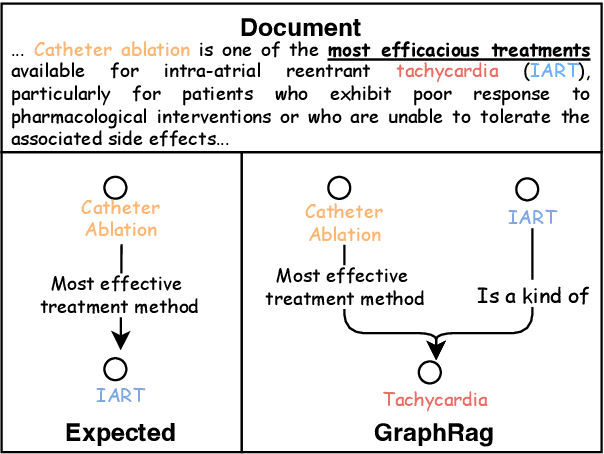
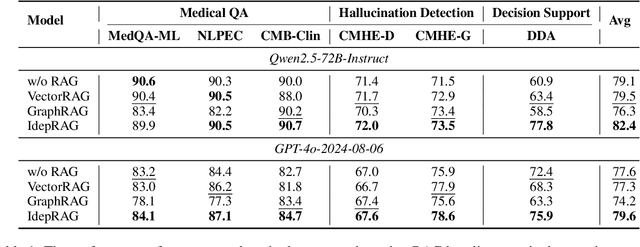
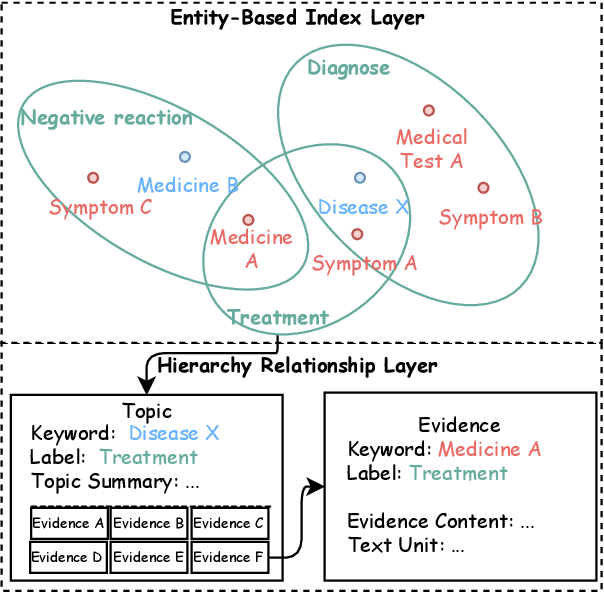
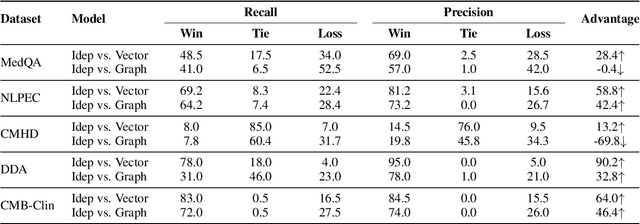
Evidence-based medicine (EBM) plays a crucial role in the application of large language models (LLMs) in healthcare, as it provides reliable support for medical decision-making processes. Although it benefits from current retrieval-augmented generation~(RAG) technologies, it still faces two significant challenges: the collection of dispersed evidence and the efficient organization of this evidence to support the complex queries necessary for EBM. To tackle these issues, we propose using LLMs to gather scattered evidence from multiple sources and present a knowledge hypergraph-based evidence management model to integrate these evidence while capturing intricate relationships. Furthermore, to better support complex queries, we have developed an Importance-Driven Evidence Prioritization (IDEP) algorithm that utilizes the LLM to generate multiple evidence features, each with an associated importance score, which are then used to rank the evidence and produce the final retrieval results. Experimental results from six datasets demonstrate that our approach outperforms existing RAG techniques in application domains of interest to EBM, such as medical quizzing, hallucination detection, and decision support. Testsets and the constructed knowledge graph can be accessed at \href{https://drive.google.com/file/d/1WJ9QTokK3MdkjEmwuFQxwH96j_Byawj_/view?usp=drive_link}{https://drive.google.com/rag4ebm}.
General Force Sensation for Tactile Robot
Mar 02, 2025


Robotic tactile sensors, including vision-based and taxel-based sensors, enable agile manipulation and safe human-robot interaction through force sensation. However, variations in structural configurations, measured signals, and material properties create domain gaps that limit the transferability of learned force sensation across different tactile sensors. Here, we introduce GenForce, a general framework for achieving transferable force sensation across both homogeneous and heterogeneous tactile sensors in robotic systems. By unifying tactile signals into marker-based binary tactile images, GenForce enables the transfer of existing force labels to arbitrary target sensors using a marker-to-marker translation technique with a few paired data. This process equips uncalibrated tactile sensors with force prediction capabilities through spatiotemporal force prediction models trained on the transferred data. Extensive experimental results validate GenForce's generalizability, accuracy, and robustness across sensors with diverse marker patterns, structural designs, material properties, and sensing principles. The framework significantly reduces the need for costly and labor-intensive labeled data collection, enabling the rapid deployment of multiple tactile sensors on robotic hands requiring force sensing capabilities.