 Add to Chrome
 Add to Firefox
 Add to Edge
Off-Policy Value-Based Reinforcement Learning for Large Language Models
Mar 24, 2026
Improving data utilization efficiency is critical for scaling reinforcement learning (RL) for long-horizon tasks where generating trajectories is expensive. However, the dominant RL methods for LLMs are largely on-policy: they update each batch of data only once, discard it, and then collect fresh samples, resulting in poor sample efficiency. In this work, we explore an alternative value-based RL framework for LLMs that naturally enables off-policy learning. We propose ReVal, a Bellman-update-based method that combines stepwise signals capturing internal consistency with trajectory-level signals derived from outcome verification. ReVal naturally supports replay-buffer-based training, allowing efficient reuse of past trajectories. Experiments on standard mathematical reasoning benchmarks show that ReVal not only converges faster but also outperforms GRPO in final performance. On DeepSeek-R1-Distill-1.5B, ReVal improves training efficiency and achieves improvement of 2.7% in AIME24 and 4.5% in out-of-domain benchmark GPQA over GRPO. These results suggest that value-based RL is a practical alternative to policy-based methods for LLM training.

Energy-Guided Diffusion Sampling for Offline-to-Online Reinforcement Learning
Jul 17, 2024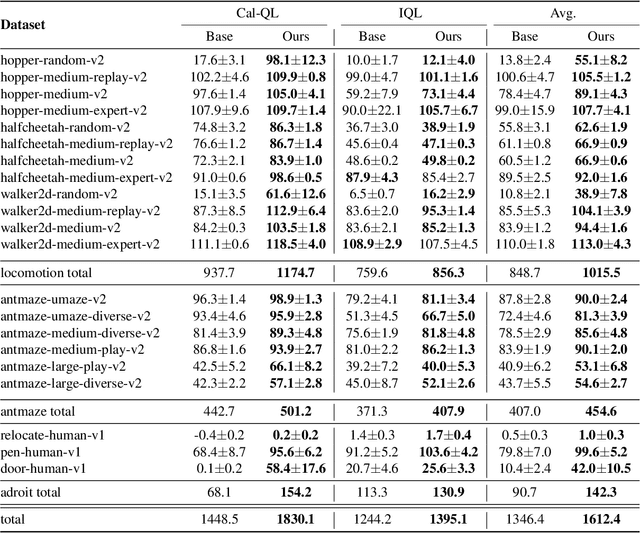
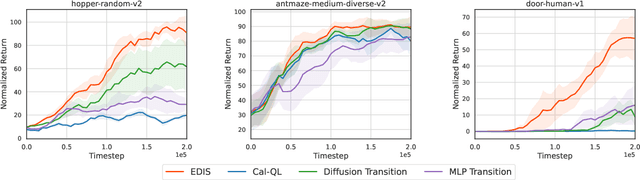

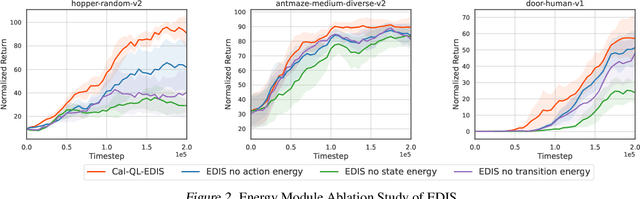
Combining offline and online reinforcement learning (RL) techniques is indeed crucial for achieving efficient and safe learning where data acquisition is expensive. Existing methods replay offline data directly in the online phase, resulting in a significant challenge of data distribution shift and subsequently causing inefficiency in online fine-tuning. To address this issue, we introduce an innovative approach, \textbf{E}nergy-guided \textbf{DI}ffusion \textbf{S}ampling (EDIS), which utilizes a diffusion model to extract prior knowledge from the offline dataset and employs energy functions to distill this knowledge for enhanced data generation in the online phase. The theoretical analysis demonstrates that EDIS exhibits reduced suboptimality compared to solely utilizing online data or directly reusing offline data. EDIS is a plug-in approach and can be combined with existing methods in offline-to-online RL setting. By implementing EDIS to off-the-shelf methods Cal-QL and IQL, we observe a notable 20% average improvement in empirical performance on MuJoCo, AntMaze, and Adroit environments. Code is available at \url{https://github.com/liuxhym/EDIS}.