 Add to Chrome
 Add to Firefox
 Add to Edge
MUDiff: Unified Diffusion for Complete Molecule Generation
Apr 28, 2023
We present a new model for generating molecular data by combining discrete and continuous diffusion processes. Our model generates a comprehensive representation of molecules, including atom features, 2D discrete molecule structures, and 3D continuous molecule coordinates. The use of diffusion processes allows for capturing the probabilistic nature of molecular processes and the ability to explore the effect of different factors on molecular structures and properties. Additionally, we propose a novel graph transformer architecture to denoise the diffusion process. The transformer is equivariant to Euclidean transformations, allowing it to learn invariant atom and edge representations while preserving the equivariance of atom coordinates. This transformer can be used to learn molecular representations robust to geometric transformations. We evaluate the performance of our model through experiments and comparisons with existing methods, showing its ability to generate more stable and valid molecules with good properties. Our model is a promising approach for designing molecules with desired properties and can be applied to a wide range of tasks in molecular modeling.

Reflected Diffusion Models
Apr 13, 2023Score-based diffusion models learn to reverse a stochastic differential equation that maps data to noise. However, for complex tasks, numerical error can compound and result in highly unnatural samples. Previous work mitigates this drift with thresholding, which projects to the natural data domain (such as pixel space for images) after each diffusion step, but this leads to a mismatch between the training and generative processes. To incorporate data constraints in a principled manner, we present Reflected Diffusion Models, which instead reverse a reflected stochastic differential equation evolving on the support of the data. Our approach learns the perturbed score function through a generalized score matching loss and extends key components of standard diffusion models including diffusion guidance, likelihood-based training, and ODE sampling. We also bridge the theoretical gap with thresholding: such schemes are just discretizations of reflected SDEs. On standard image benchmarks, our method is competitive with or surpasses the state of the art and, for classifier-free guidance, our approach enables fast exact sampling with ODEs and produces more faithful samples under high guidance weight.
MERMAIDE: Learning to Align Learners using Model-Based Meta-Learning
Apr 10, 2023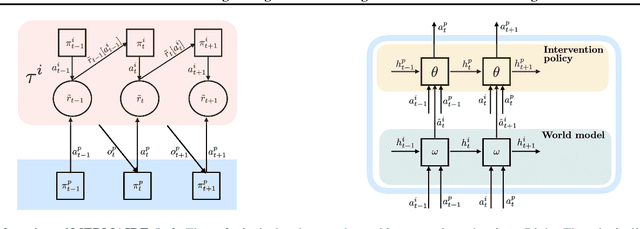
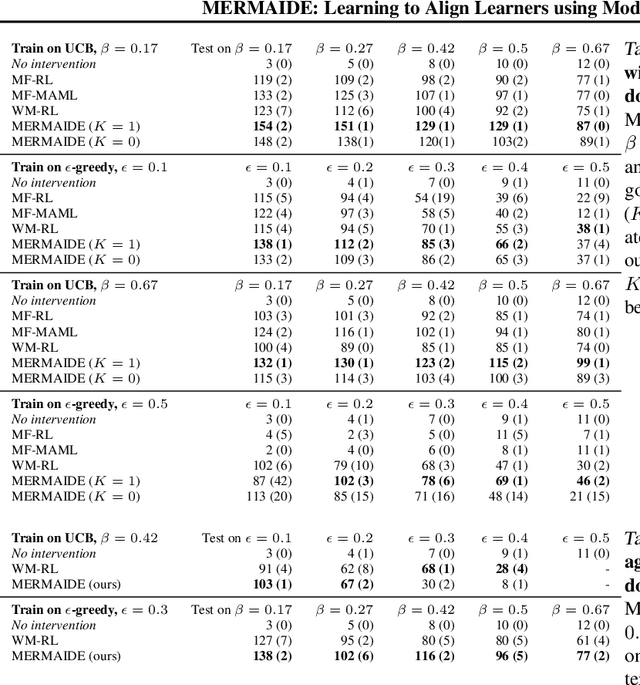
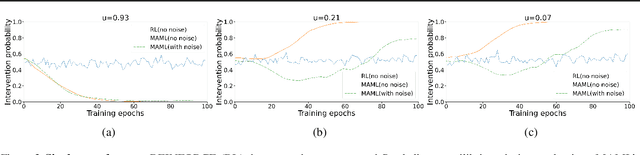
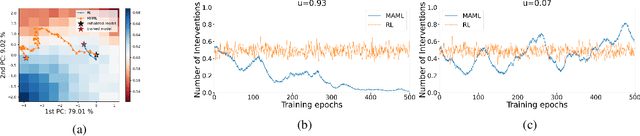
We study how a principal can efficiently and effectively intervene on the rewards of a previously unseen learning agent in order to induce desirable outcomes. This is relevant to many real-world settings like auctions or taxation, where the principal may not know the learning behavior nor the rewards of real people. Moreover, the principal should be few-shot adaptable and minimize the number of interventions, because interventions are often costly. We introduce MERMAIDE, a model-based meta-learning framework to train a principal that can quickly adapt to out-of-distribution agents with different learning strategies and reward functions. We validate this approach step-by-step. First, in a Stackelberg setting with a best-response agent, we show that meta-learning enables quick convergence to the theoretically known Stackelberg equilibrium at test time, although noisy observations severely increase the sample complexity. We then show that our model-based meta-learning approach is cost-effective in intervening on bandit agents with unseen explore-exploit strategies. Finally, we outperform baselines that use either meta-learning or agent behavior modeling, in both $0$-shot and $K=1$-shot settings with partial agent information.
Ideal Abstractions for Decision-Focused Learning
Mar 29, 2023We present a methodology for formulating simplifying abstractions in machine learning systems by identifying and harnessing the utility structure of decisions. Machine learning tasks commonly involve high-dimensional output spaces (e.g., predictions for every pixel in an image or node in a graph), even though a coarser output would often suffice for downstream decision-making (e.g., regions of an image instead of pixels). Developers often hand-engineer abstractions of the output space, but numerous abstractions are possible and it is unclear how the choice of output space for a model impacts its usefulness in downstream decision-making. We propose a method that configures the output space automatically in order to minimize the loss of decision-relevant information. Taking a geometric perspective, we formulate a step of the algorithm as a projection of the probability simplex, termed fold, that minimizes the total loss of decision-related information in the H-entropy sense. Crucially, learning in the abstracted outcome space requires less data, leading to a net improvement in decision quality. We demonstrate the method in two domains: data acquisition for deep neural network training and a closed-loop wildfire management task.
End-to-End Diffusion Latent Optimization Improves Classifier Guidance
Mar 23, 2023Classifier guidance -- using the gradients of an image classifier to steer the generations of a diffusion model -- has the potential to dramatically expand the creative control over image generation and editing. However, currently classifier guidance requires either training new noise-aware models to obtain accurate gradients or using a one-step denoising approximation of the final generation, which leads to misaligned gradients and sub-optimal control. We highlight this approximation's shortcomings and propose a novel guidance method: Direct Optimization of Diffusion Latents (DOODL), which enables plug-and-play guidance by optimizing diffusion latents w.r.t. the gradients of a pre-trained classifier on the true generated pixels, using an invertible diffusion process to achieve memory-efficient backpropagation. Showcasing the potential of more precise guidance, DOODL outperforms one-step classifier guidance on computational and human evaluation metrics across different forms of guidance: using CLIP guidance to improve generations of complex prompts from DrawBench, using fine-grained visual classifiers to expand the vocabulary of Stable Diffusion, enabling image-conditioned generation with a CLIP visual encoder, and improving image aesthetics using an aesthetic scoring network.
GlueGen: Plug and Play Multi-modal Encoders for X-to-image Generation
Mar 17, 2023Text-to-image (T2I) models based on diffusion processes have achieved remarkable success in controllable image generation using user-provided captions. However, the tight coupling between the current text encoder and image decoder in T2I models makes it challenging to replace or upgrade. Such changes often require massive fine-tuning or even training from scratch with the prohibitive expense. To address this problem, we propose GlueGen, which applies a newly proposed GlueNet model to align features from single-modal or multi-modal encoders with the latent space of an existing T2I model. The approach introduces a new training objective that leverages parallel corpora to align the representation spaces of different encoders. Empirical results show that GlueNet can be trained efficiently and enables various capabilities beyond previous state-of-the-art models: 1) multilingual language models such as XLM-Roberta can be aligned with existing T2I models, allowing for the generation of high-quality images from captions beyond English; 2) GlueNet can align multi-modal encoders such as AudioCLIP with the Stable Diffusion model, enabling sound-to-image generation; 3) it can also upgrade the current text encoder of the latent diffusion model for challenging case generation. By the alignment of various feature representations, the GlueNet allows for flexible and efficient integration of new functionality into existing T2I models and sheds light on X-to-image (X2I) generation.
HIVE: Harnessing Human Feedback for Instructional Visual Editing
Mar 16, 2023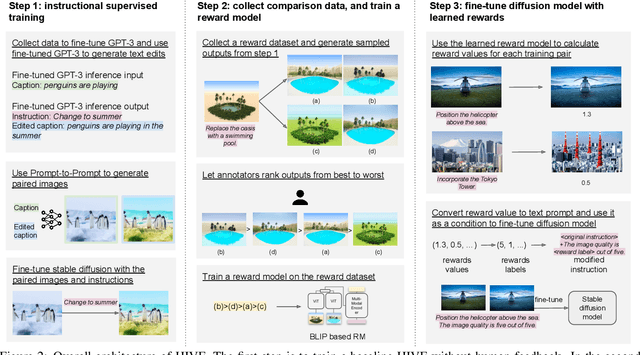
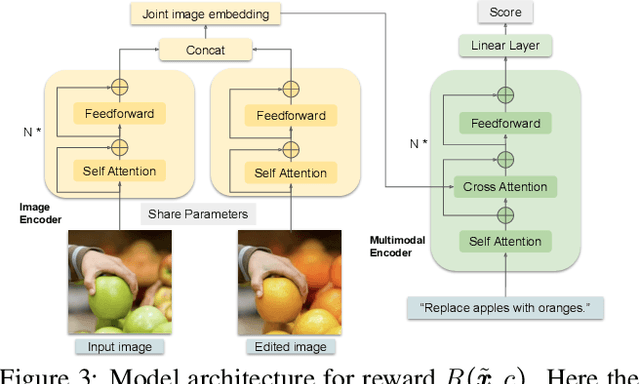
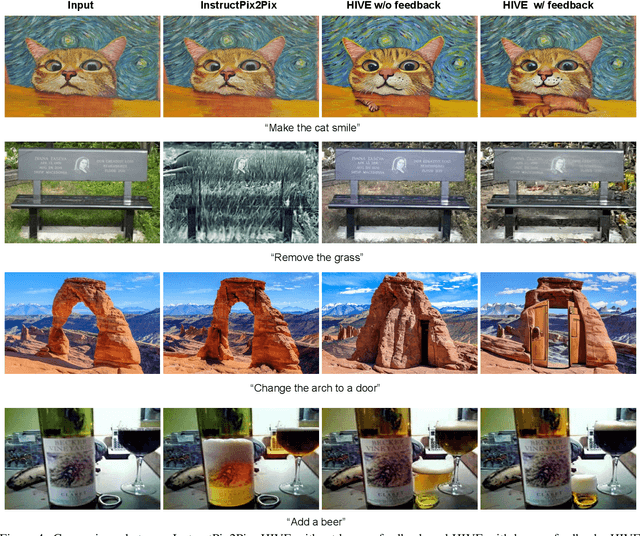
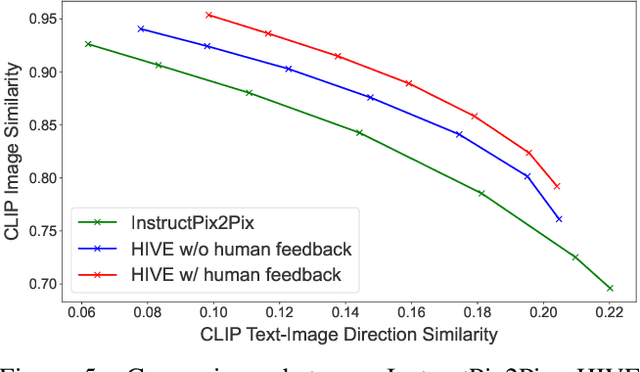
Incorporating human feedback has been shown to be crucial to align text generated by large language models to human preferences. We hypothesize that state-of-the-art instructional image editing models, where outputs are generated based on an input image and an editing instruction, could similarly benefit from human feedback, as their outputs may not adhere to the correct instructions and preferences of users. In this paper, we present a novel framework to harness human feedback for instructional visual editing (HIVE). Specifically, we collect human feedback on the edited images and learn a reward function to capture the underlying user preferences. We then introduce scalable diffusion model fine-tuning methods that can incorporate human preferences based on the estimated reward. Besides, to mitigate the bias brought by the limitation of data, we contribute a new 1M training dataset, a 3.6K reward dataset for rewards learning, and a 1K evaluation dataset to boost the performance of instructional image editing. We conduct extensive empirical experiments quantitatively and qualitatively, showing that HIVE is favored over previous state-of-the-art instructional image editing approaches by a large margin.
Hyena Hierarchy: Towards Larger Convolutional Language Models
Mar 06, 2023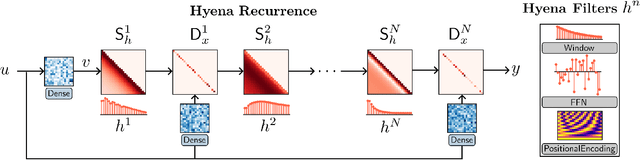
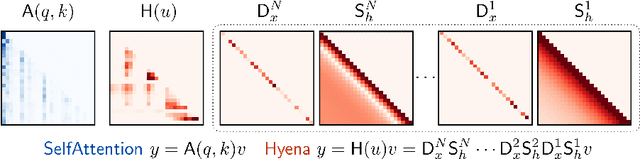

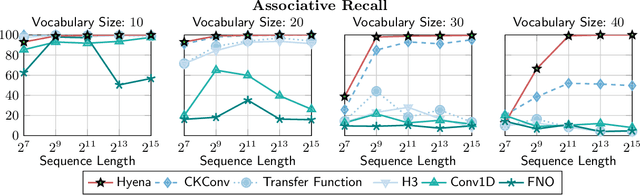
Recent advances in deep learning have relied heavily on the use of large Transformers due to their ability to learn at scale. However, the core building block of Transformers, the attention operator, exhibits quadratic cost in sequence length, limiting the amount of context accessible. Existing subquadratic methods based on low-rank and sparse approximations need to be combined with dense attention layers to match Transformers, indicating a gap in capability. In this work, we propose Hyena, a subquadratic drop-in replacement for attention constructed by interleaving implicitly parametrized long convolutions and data-controlled gating. In recall and reasoning tasks on sequences of thousands to hundreds of thousands of tokens, Hyena improves accuracy by more than 50 points over operators relying on state-spaces and other implicit and explicit methods, matching attention-based models. We set a new state-of-the-art for dense-attention-free architectures on language modeling in standard datasets (WikiText103 and The Pile), reaching Transformer quality with a 20% reduction in training compute required at sequence length 2K. Hyena operators are twice as fast as highly optimized attention at sequence length 8K, and 100x faster at sequence length 64K.
Offline Imitation Learning with Suboptimal Demonstrations via Relaxed Distribution Matching
Mar 05, 2023
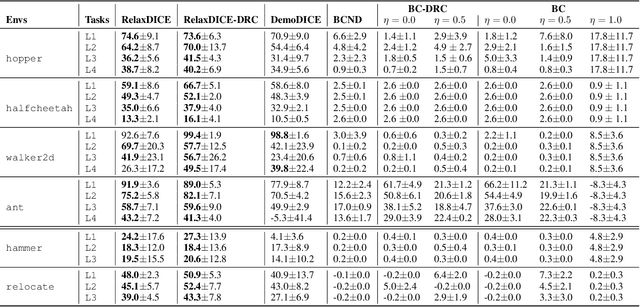
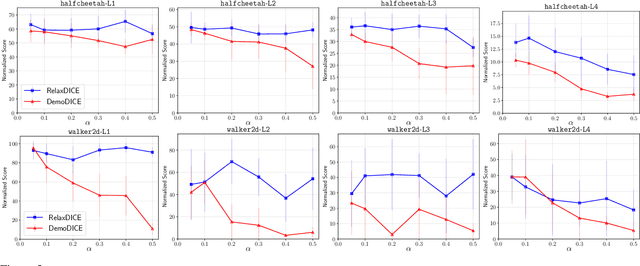
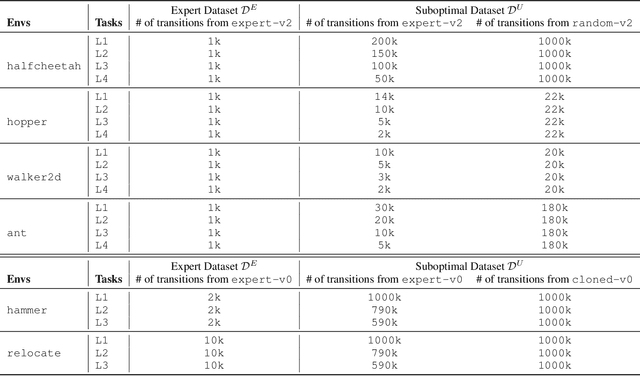
Offline imitation learning (IL) promises the ability to learn performant policies from pre-collected demonstrations without interactions with the environment. However, imitating behaviors fully offline typically requires numerous expert data. To tackle this issue, we study the setting where we have limited expert data and supplementary suboptimal data. In this case, a well-known issue is the distribution shift between the learned policy and the behavior policy that collects the offline data. Prior works mitigate this issue by regularizing the KL divergence between the stationary state-action distributions of the learned policy and the behavior policy. We argue that such constraints based on exact distribution matching can be overly conservative and hamper policy learning, especially when the imperfect offline data is highly suboptimal. To resolve this issue, we present RelaxDICE, which employs an asymmetrically-relaxed f-divergence for explicit support regularization. Specifically, instead of driving the learned policy to exactly match the behavior policy, we impose little penalty whenever the density ratio between their stationary state-action distributions is upper bounded by a constant. Note that such formulation leads to a nested min-max optimization problem, which causes instability in practice. RelaxDICE addresses this challenge by supporting a closed-form solution for the inner maximization problem. Extensive empirical study shows that our method significantly outperforms the best prior offline IL method in six standard continuous control environments with over 30% performance gain on average, across 22 settings where the imperfect dataset is highly suboptimal.
Long Horizon Temperature Scaling
Feb 07, 2023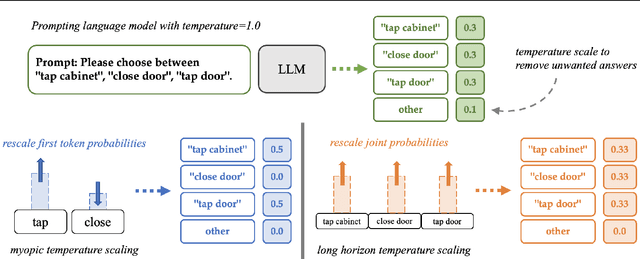
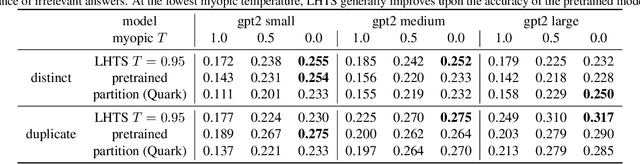
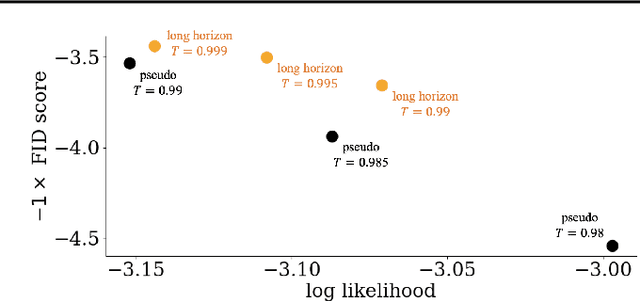

Temperature scaling is a popular technique for tuning the sharpness of a model distribution. It is used extensively for sampling likely generations and calibrating model uncertainty, and even features as a controllable parameter to many large language models in deployment. However, autoregressive models rely on myopic temperature scaling that greedily optimizes the next token. To address this, we propose Long Horizon Temperature Scaling (LHTS), a novel approach for sampling from temperature-scaled joint distributions. LHTS is compatible with all likelihood-based models, and optimizes for the long-horizon likelihood of samples. We derive a temperature-dependent LHTS objective, and show that fine-tuning a model on a range of temperatures produces a single model capable of generation with a controllable long-horizon temperature parameter. We experiment with LHTS on image diffusion models and character/language autoregressive models, demonstrating advantages over myopic temperature scaling in likelihood and sample quality, and showing improvements in accuracy on a multiple choice analogy task by $10\%$.