 Add to Chrome
 Add to Firefox
 Add to Edge
Revisiting the Temporal Modeling in Spatio-Temporal Predictive Learning under A Unified View
Oct 09, 2023
Spatio-temporal predictive learning plays a crucial role in self-supervised learning, with wide-ranging applications across a diverse range of fields. Previous approaches for temporal modeling fall into two categories: recurrent-based and recurrent-free methods. The former, while meticulously processing frames one by one, neglect short-term spatio-temporal information redundancies, leading to inefficiencies. The latter naively stack frames sequentially, overlooking the inherent temporal dependencies. In this paper, we re-examine the two dominant temporal modeling approaches within the realm of spatio-temporal predictive learning, offering a unified perspective. Building upon this analysis, we introduce USTEP (Unified Spatio-TEmporal Predictive learning), an innovative framework that reconciles the recurrent-based and recurrent-free methods by integrating both micro-temporal and macro-temporal scales. Extensive experiments on a wide range of spatio-temporal predictive learning demonstrate that USTEP achieves significant improvements over existing temporal modeling approaches, thereby establishing it as a robust solution for a wide range of spatio-temporal applications.

Co-modeling the Sequential and Graphical Routes for Peptide Representation Learning
Oct 05, 2023Peptides are formed by the dehydration condensation of multiple amino acids. The primary structure of a peptide can be represented either as an amino acid sequence or as a molecular graph consisting of atoms and chemical bonds. Previous studies have indicated that deep learning routes specific to sequential and graphical peptide forms exhibit comparable performance on downstream tasks. Despite the fact that these models learn representations of the same modality of peptides, we find that they explain their predictions differently. Considering sequential and graphical models as two experts making inferences from different perspectives, we work on fusing expert knowledge to enrich the learned representations for improving the discriminative performance. To achieve this, we propose a peptide co-modeling method, RepCon, which employs a contrastive learning-based framework to enhance the mutual information of representations from decoupled sequential and graphical end-to-end models. It considers representations from the sequential encoder and the graphical encoder for the same peptide sample as a positive pair and learns to enhance the consistency of representations between positive sample pairs and to repel representations between negative pairs. Empirical studies of RepCon and other co-modeling methods are conducted on open-source discriminative datasets, including aggregation propensity, retention time, antimicrobial peptide prediction, and family classification from Peptide Database. Our results demonstrate the superiority of the co-modeling approach over independent modeling, as well as the superiority of RepCon over other methods under the co-modeling framework. In addition, the attribution on RepCon further corroborates the validity of the approach at the level of model explanation.
SemiReward: A General Reward Model for Semi-supervised Learning
Oct 04, 2023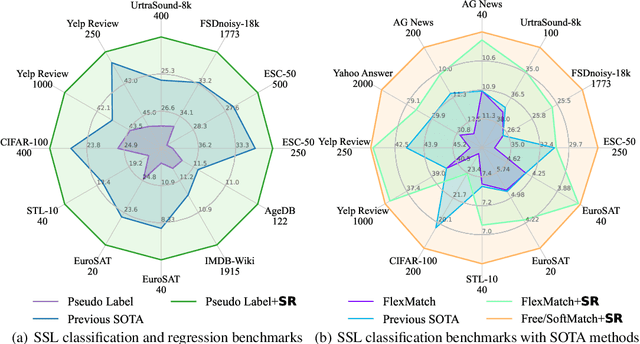


Semi-supervised learning (SSL) has witnessed great progress with various improvements in the self-training framework with pseudo labeling. The main challenge is how to distinguish high-quality pseudo labels against the confirmation bias. However, existing pseudo-label selection strategies are limited to pre-defined schemes or complex hand-crafted policies specially designed for classification, failing to achieve high-quality labels, fast convergence, and task versatility simultaneously. To these ends, we propose a Semi-supervised Reward framework (SemiReward) that predicts reward scores to evaluate and filter out high-quality pseudo labels, which is pluggable to mainstream SSL methods in wide task types and scenarios. To mitigate confirmation bias, SemiReward is trained online in two stages with a generator model and subsampling strategy. With classification and regression tasks on 13 standard SSL benchmarks of three modalities, extensive experiments verify that SemiReward achieves significant performance gains and faster convergence speeds upon Pseudo Label, FlexMatch, and Free/SoftMatch.
CONVERT:Contrastive Graph Clustering with Reliable Augmentation
Sep 02, 2023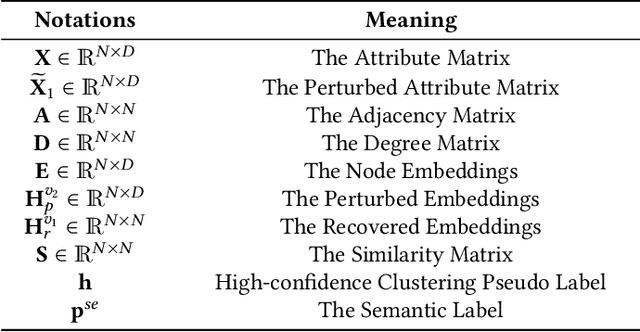
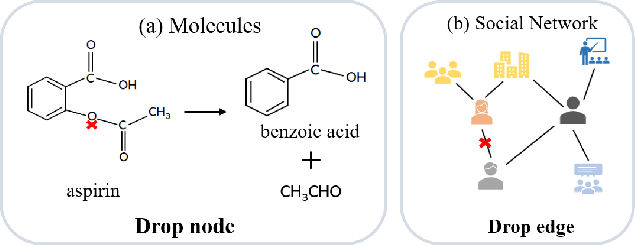
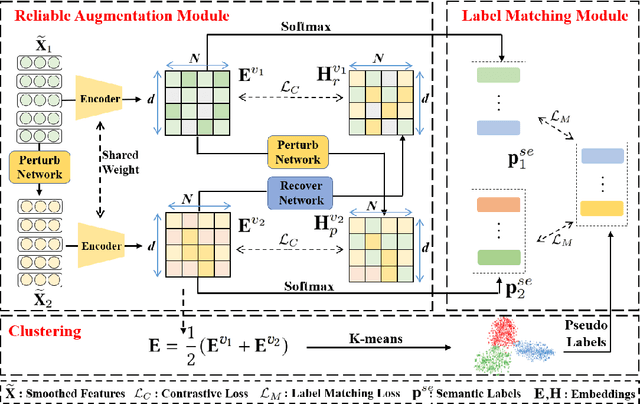
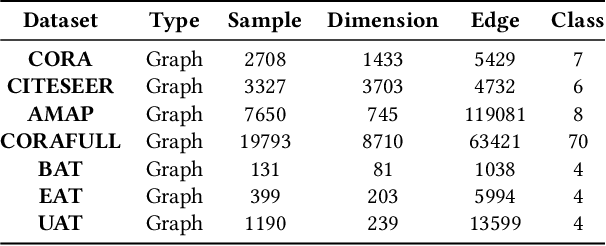
Contrastive graph node clustering via learnable data augmentation is a hot research spot in the field of unsupervised graph learning. The existing methods learn the sampling distribution of a pre-defined augmentation to generate data-driven augmentations automatically. Although promising clustering performance has been achieved, we observe that these strategies still rely on pre-defined augmentations, the semantics of the augmented graph can easily drift. The reliability of the augmented view semantics for contrastive learning can not be guaranteed, thus limiting the model performance. To address these problems, we propose a novel CONtrastiVe Graph ClustEring network with Reliable AugmenTation (COVERT). Specifically, in our method, the data augmentations are processed by the proposed reversible perturb-recover network. It distills reliable semantic information by recovering the perturbed latent embeddings. Moreover, to further guarantee the reliability of semantics, a novel semantic loss is presented to constrain the network via quantifying the perturbation and recovery. Lastly, a label-matching mechanism is designed to guide the model by clustering information through aligning the semantic labels and the selected high-confidence clustering pseudo labels. Extensive experimental results on seven datasets demonstrate the effectiveness of the proposed method. We release the code and appendix of CONVERT at https://github.com/xihongyang1999/CONVERT on GitHub.
Reinforcement Graph Clustering with Unknown Cluster Number
Aug 13, 2023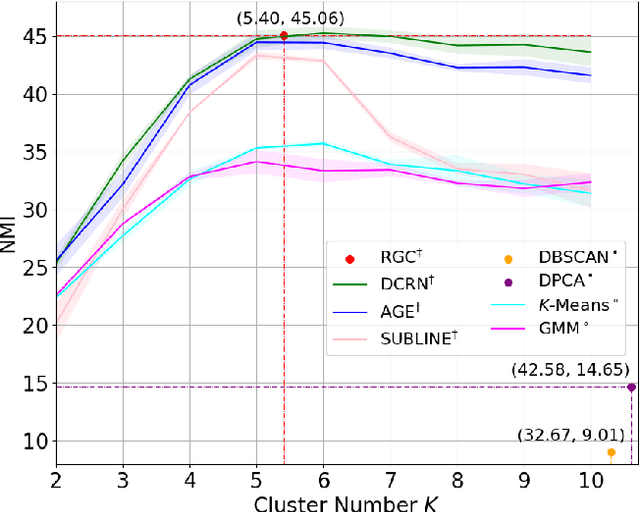
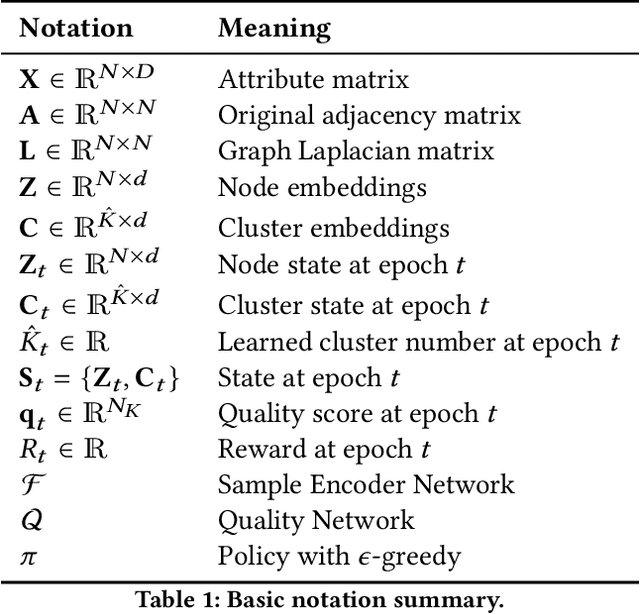

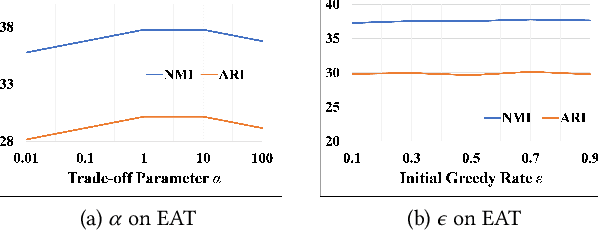
Deep graph clustering, which aims to group nodes into disjoint clusters by neural networks in an unsupervised manner, has attracted great attention in recent years. Although the performance has been largely improved, the excellent performance of the existing methods heavily relies on an accurately predefined cluster number, which is not always available in the real-world scenario. To enable the deep graph clustering algorithms to work without the guidance of the predefined cluster number, we propose a new deep graph clustering method termed Reinforcement Graph Clustering (RGC). In our proposed method, cluster number determination and unsupervised representation learning are unified into a uniform framework by the reinforcement learning mechanism. Concretely, the discriminative node representations are first learned with the contrastive pretext task. Then, to capture the clustering state accurately with both local and global information in the graph, both node and cluster states are considered. Subsequently, at each state, the qualities of different cluster numbers are evaluated by the quality network, and the greedy action is executed to determine the cluster number. In order to conduct feedback actions, the clustering-oriented reward function is proposed to enhance the cohesion of the same clusters and separate the different clusters. Extensive experiments demonstrate the effectiveness and efficiency of our proposed method. The source code of RGC is shared at https://github.com/yueliu1999/RGC and a collection (papers, codes and, datasets) of deep graph clustering is shared at https://github.com/yueliu1999/Awesome-Deep-Graph-Clustering on Github.
Enhancing Human-like Multi-Modal Reasoning: A New Challenging Dataset and Comprehensive Framework
Jul 24, 2023Multimodal reasoning is a critical component in the pursuit of artificial intelligence systems that exhibit human-like intelligence, especially when tackling complex tasks. While the chain-of-thought (CoT) technique has gained considerable attention, the existing ScienceQA dataset, which focuses on multimodal scientific questions and explanations from elementary and high school textbooks, lacks a comprehensive evaluation of diverse approaches. To address this gap, we present COCO Multi-Modal Reasoning Dataset(COCO-MMRD), a novel dataset that encompasses an extensive collection of open-ended questions, rationales, and answers derived from the large object dataset COCO. Unlike previous datasets that rely on multiple-choice questions, our dataset pioneers the use of open-ended questions in the context of multimodal CoT, introducing a more challenging problem that effectively assesses the reasoning capability of CoT models. Through comprehensive evaluations and detailed analyses, we provide valuable insights and propose innovative techniques, including multi-hop cross-modal attention and sentence-level contrastive learning, to enhance the image and text encoders. Extensive experiments demonstrate the efficacy of the proposed dataset and techniques, offering novel perspectives for advancing multimodal reasoning.
Efficient Prediction of Peptide Self-assembly through Sequential and Graphical Encoding
Jul 17, 2023
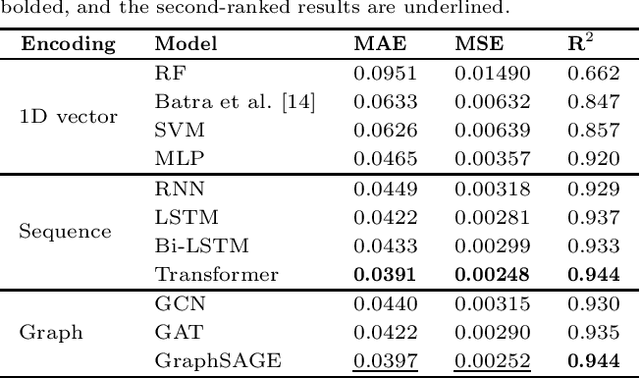

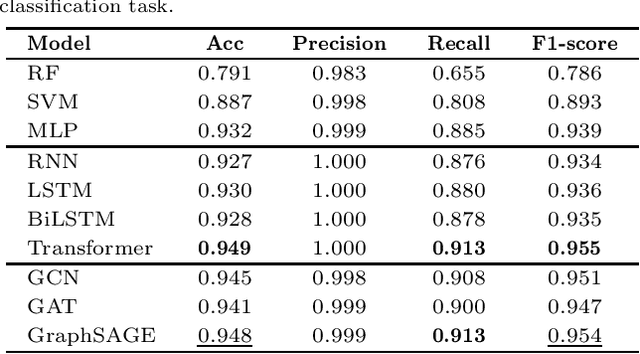
In recent years, there has been an explosion of research on the application of deep learning to the prediction of various peptide properties, due to the significant development and market potential of peptides. Molecular dynamics has enabled the efficient collection of large peptide datasets, providing reliable training data for deep learning. However, the lack of systematic analysis of the peptide encoding, which is essential for AI-assisted peptide-related tasks, makes it an urgent problem to be solved for the improvement of prediction accuracy. To address this issue, we first collect a high-quality, colossal simulation dataset of peptide self-assembly containing over 62,000 samples generated by coarse-grained molecular dynamics (CGMD). Then, we systematically investigate the effect of peptide encoding of amino acids into sequences and molecular graphs using state-of-the-art sequential (i.e., RNN, LSTM, and Transformer) and structural deep learning models (i.e., GCN, GAT, and GraphSAGE), on the accuracy of peptide self-assembly prediction, an essential physiochemical process prior to any peptide-related applications. Extensive benchmarking studies have proven Transformer to be the most powerful sequence-encoding-based deep learning model, pushing the limit of peptide self-assembly prediction to decapeptides. In summary, this work provides a comprehensive benchmark analysis of peptide encoding with advanced deep learning models, serving as a guide for a wide range of peptide-related predictions such as isoelectric points, hydration free energy, etc.
Why Deep Models Often cannot Beat Non-deep Counterparts on Molecular Property Prediction?
Jun 30, 2023Molecular property prediction (MPP) is a crucial task in the drug discovery pipeline, which has recently gained considerable attention thanks to advances in deep neural networks. However, recent research has revealed that deep models struggle to beat traditional non-deep ones on MPP. In this study, we benchmark 12 representative models (3 non-deep models and 9 deep models) on 14 molecule datasets. Through the most comprehensive study to date, we make the following key observations: \textbf{(\romannumeral 1)} Deep models are generally unable to outperform non-deep ones; \textbf{(\romannumeral 2)} The failure of deep models on MPP cannot be solely attributed to the small size of molecular datasets. What matters is the irregular molecule data pattern; \textbf{(\romannumeral 3)} In particular, tree models using molecular fingerprints as inputs tend to perform better than other competitors. Furthermore, we conduct extensive empirical investigations into the unique patterns of molecule data and inductive biases of various models underlying these phenomena.
OpenSTL: A Comprehensive Benchmark of Spatio-Temporal Predictive Learning
Jun 20, 2023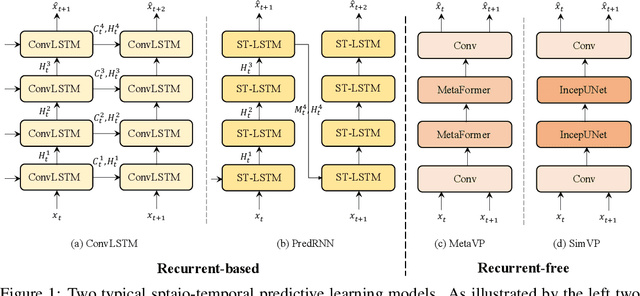
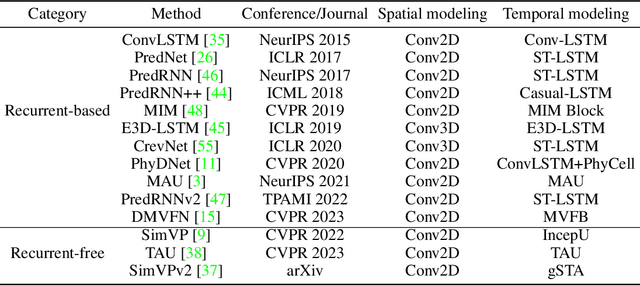
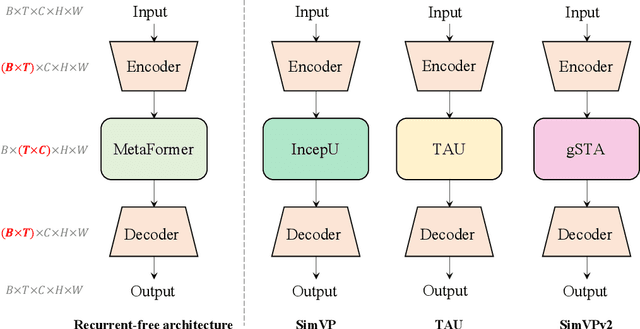
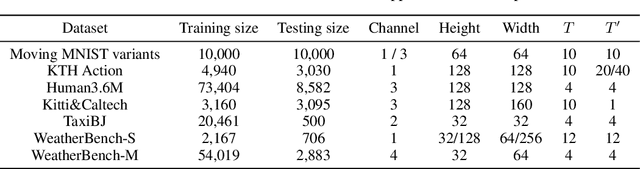
Spatio-temporal predictive learning is a learning paradigm that enables models to learn spatial and temporal patterns by predicting future frames from given past frames in an unsupervised manner. Despite remarkable progress in recent years, a lack of systematic understanding persists due to the diverse settings, complex implementation, and difficult reproducibility. Without standardization, comparisons can be unfair and insights inconclusive. To address this dilemma, we propose OpenSTL, a comprehensive benchmark for spatio-temporal predictive learning that categorizes prevalent approaches into recurrent-based and recurrent-free models. OpenSTL provides a modular and extensible framework implementing various state-of-the-art methods. We conduct standard evaluations on datasets across various domains, including synthetic moving object trajectory, human motion, driving scenes, traffic flow and weather forecasting. Based on our observations, we provide a detailed analysis of how model architecture and dataset properties affect spatio-temporal predictive learning performance. Surprisingly, we find that recurrent-free models achieve a good balance between efficiency and performance than recurrent models. Thus, we further extend the common MetaFormers to boost recurrent-free spatial-temporal predictive learning. We open-source the code and models at https://github.com/chengtan9907/OpenSTL.
Quantifying the Knowledge in GNNs for Reliable Distillation into MLPs
Jun 09, 2023To bridge the gaps between topology-aware Graph Neural Networks (GNNs) and inference-efficient Multi-Layer Perceptron (MLPs), GLNN proposes to distill knowledge from a well-trained teacher GNN into a student MLP. Despite their great progress, comparatively little work has been done to explore the reliability of different knowledge points (nodes) in GNNs, especially their roles played during distillation. In this paper, we first quantify the knowledge reliability in GNN by measuring the invariance of their information entropy to noise perturbations, from which we observe that different knowledge points (1) show different distillation speeds (temporally); (2) are differentially distributed in the graph (spatially). To achieve reliable distillation, we propose an effective approach, namely Knowledge-inspired Reliable Distillation (KRD), that models the probability of each node being an informative and reliable knowledge point, based on which we sample a set of additional reliable knowledge points as supervision for training student MLPs. Extensive experiments show that KRD improves over the vanilla MLPs by 12.62% and outperforms its corresponding teacher GNNs by 2.16% averaged over 7 datasets and 3 GNN architectures.