 Add to Chrome
 Add to Firefox
 Add to Edge
Ground4D: Spatially-Grounded Feedforward 4D Reconstruction for Unstructured Off-Road Scenes
May 06, 2026
Feedforward Gaussian Splatting has recently emerged as an efficient paradigm for 4D reconstruction in autonomous driving. However, in unstructured off-road scenes, its performance degrades due to high-frequency geometry, ego-motion jitter, and increased non-rigid dynamics. These factors introduce conflicting Gaussian observations across timestamps, leading to either over-smoothed renderings or structural artifacts. To address this issue, we propose Ground4D, a spatially-grounded 4D feedforward framework for pose-free off-road reconstruction. The key idea is to resolve temporal conflicts through spatially localized conditioning. Specifically, we introduce voxel-grounded temporal Gaussian aggregation, which partitions the canonical Gaussian space into spatial voxels and performs query-conditioned temporal attention within each voxel. Intra-voxel softmax normalization ensures that temporal selectivity and spatial occupancy become mutually reinforcing rather than conflicting. We furthermore introduce surface normal cues as auxiliary geometric guidance to regularize the geometry of Gaussian primitives. Extensive experiments on ORAD-3D and RELLIS-3D demonstrate that Ground4D consistently outperforms existing feedforward methods in reconstruction quality and generalizes zero-shot to unseen off-road domains. Project page and code:https://github.com/wsnbws/Ground4D.

Beyond Endpoints: Path-Centric Reasoning for Vectorized Off-Road Network Extraction
Dec 12, 2025Deep learning has advanced vectorized road extraction in urban settings, yet off-road environments remain underexplored and challenging. A significant domain gap causes advanced models to fail in wild terrains due to two key issues: lack of large-scale vectorized datasets and structural weakness in prevailing methods. Models such as SAM-Road employ a node-centric paradigm that reasons at sparse endpoints, making them fragile to occlusions and ambiguous junctions in off-road scenes, leading to topological errors. This work addresses these limitations in two complementary ways. First, we release WildRoad, a global off-road road network dataset constructed efficiently with a dedicated interactive annotation tool tailored for road-network labeling. Second, we introduce MaGRoad (Mask-aware Geodesic Road network extractor), a path-centric framework that aggregates multi-scale visual evidence along candidate paths to infer connectivity robustly. Extensive experiments show that MaGRoad achieves state-of-the-art performance on our challenging WildRoad benchmark while generalizing well to urban datasets. A streamlined pipeline also yields roughly 2.5x faster inference, improving practical applicability. Together, the dataset and path-centric paradigm provide a stronger foundation for mapping roads in the wild. We release both the dataset and code at https://github.com/xiaofei-guan/MaGRoad.
OpenSTL: A Comprehensive Benchmark of Spatio-Temporal Predictive Learning
Jun 20, 2023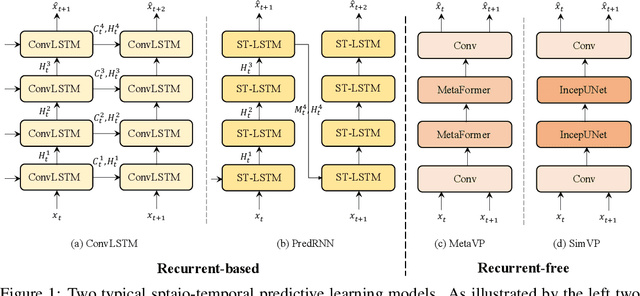
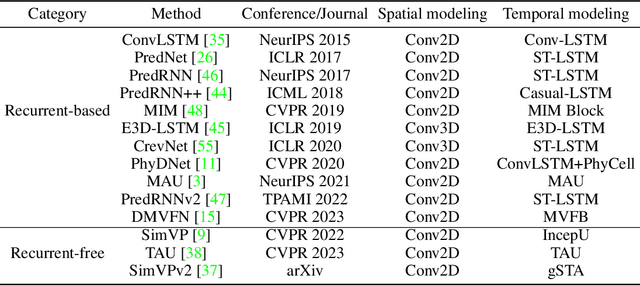
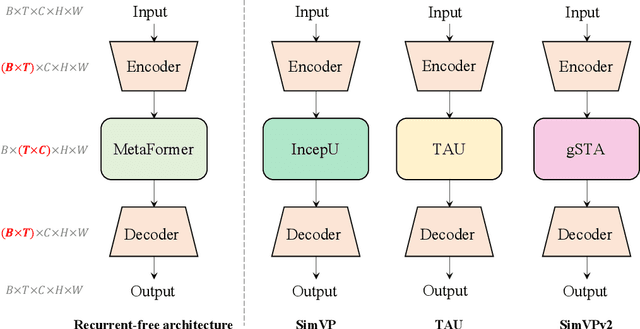
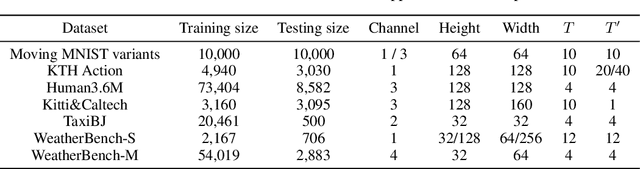
Spatio-temporal predictive learning is a learning paradigm that enables models to learn spatial and temporal patterns by predicting future frames from given past frames in an unsupervised manner. Despite remarkable progress in recent years, a lack of systematic understanding persists due to the diverse settings, complex implementation, and difficult reproducibility. Without standardization, comparisons can be unfair and insights inconclusive. To address this dilemma, we propose OpenSTL, a comprehensive benchmark for spatio-temporal predictive learning that categorizes prevalent approaches into recurrent-based and recurrent-free models. OpenSTL provides a modular and extensible framework implementing various state-of-the-art methods. We conduct standard evaluations on datasets across various domains, including synthetic moving object trajectory, human motion, driving scenes, traffic flow and weather forecasting. Based on our observations, we provide a detailed analysis of how model architecture and dataset properties affect spatio-temporal predictive learning performance. Surprisingly, we find that recurrent-free models achieve a good balance between efficiency and performance than recurrent models. Thus, we further extend the common MetaFormers to boost recurrent-free spatial-temporal predictive learning. We open-source the code and models at https://github.com/chengtan9907/OpenSTL.