 Add to Chrome
 Add to Firefox
 Add to Edge
ZScribbleSeg: A comprehensive segmentation framework with modeling of efficient annotation and maximization of scribble supervision
May 07, 2026
Curating fully annotated datasets for medical image segmentation is labour-intensive and expertise-demanding. To alleviate this problem, prior studies have explored scribble annotations for weakly supervised segmentation. Existing solutions mainly compute losses on annotated areas and generate pseudo labels by propagating annotations to adjacent regions. However, these methods often suffer from inaccurate and unrealistic segmentations due to insufficient supervision and incomplete shape information. In contrast, we first investigate the principle of good scribble annotations, which leads to efficient scribble forms via supervision maximization and randomness simulation. We further introduce regularization terms to encode the spatial relationship and the shape constraints, where the EM algorithm is utilized to estimate the mixture ratios of label classes. These ratios are critical in identifying the unlabeled pixels for each class and correcting erroneous predictions, thus the accurate estimation lays the foundation for the incorporation of spatial prior. Finally, we integrate the efficient scribble supervision with the prior into a framework, referred to as ZScribbleSeg, and apply it to multiple scenarios. Leveraging only scribble annotations, ZScribbleSeg achieves competitive performance on six segmentation tasks including ACDC, MSCMRseg, BTCV, MyoPS, Decathlon-BrainTumor and Decathlon-Prostate. Our code will be released via https://github.com/DLwbm123/ZScribbleSeg.

Beyond Forgetting in Continual Medical Image Segmentation: A Comprehensive Benchmark Study
May 07, 2026Continual learning (CL) is essential for deploying medical image segmentation models in clinical environments where imaging domains, anatomical targets, and diagnostic tasks evolve over time. However, continual segmentation still faces three main challenges. First, the scenarios for this task remain insufficiently standardized for real-world clinical settings. Second, existing research has been primarily focused on mitigating forgetting, overlooking the other essential properties such as plasticity. Third, a benchmark work with comprehensive evaluation on existing methods is stll desirable. To address these gaps, we present such benchmark study of continual medical image segmentation. We first define three clinically motivated scenarios, namely Domain-CL, Class-CL, and Organ-CL, to respectively capture the cross-center domain shift, the incremental anatomical structure segmentation, and the cross-organ segmentation. We then introduce an evaluation framework that measures not only general performance and forgetting, but also plasticity, forward generalizability, parameter efficiency, and replay burden. The results, from extensive experiments with representative CL methods, showed that it was still challenging to develop a model that could satisfy all the requirements simultaneously. Nevertheless, these studies also suggested that the replay-based methods achieve the best overall balance between stability and plasticity, the parameter-isolation methods should be effective at reducing forgetting, though at the cost of increased model size, and the forward generalizability remain a significantly understudied aspect of this research field. Finally, we discuss related learning paradigms and outline future directions for continual medical image segmentation.
Learning Concept-Driven Logical Rules for Interpretable and Generalizable Medical Image Classification
May 20, 2025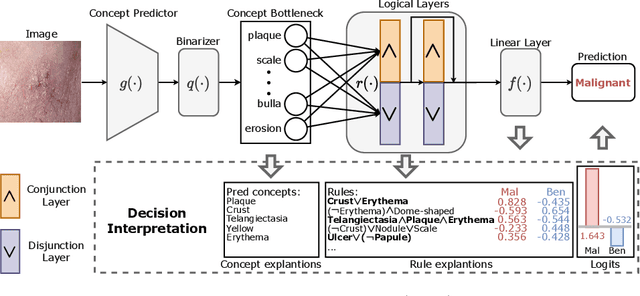
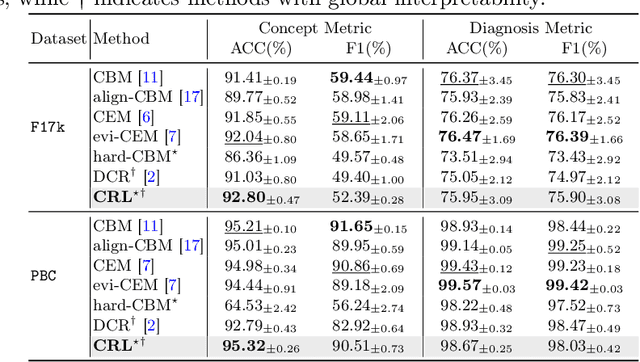
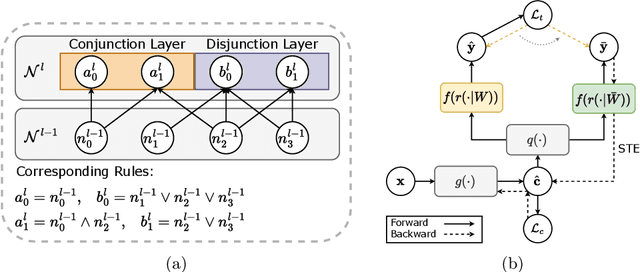
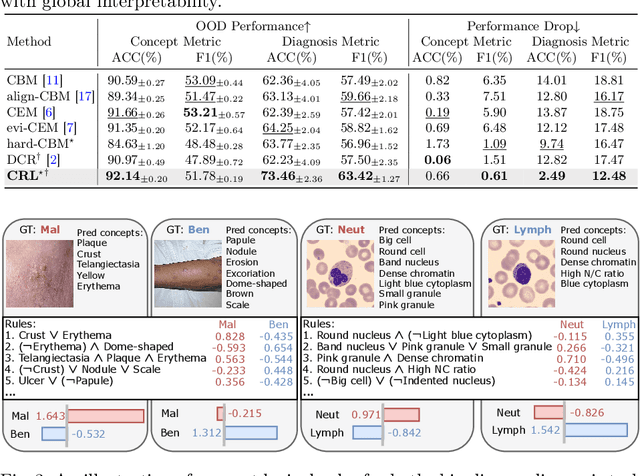
The pursuit of decision safety in clinical applications highlights the potential of concept-based methods in medical imaging. While these models offer active interpretability, they often suffer from concept leakages, where unintended information within soft concept representations undermines both interpretability and generalizability. Moreover, most concept-based models focus solely on local explanations (instance-level), neglecting the global decision logic (dataset-level). To address these limitations, we propose Concept Rule Learner (CRL), a novel framework to learn Boolean logical rules from binarized visual concepts. CRL employs logical layers to capture concept correlations and extract clinically meaningful rules, thereby providing both local and global interpretability. Experiments on two medical image classification tasks show that CRL achieves competitive performance with existing methods while significantly improving generalizability to out-of-distribution data. The code of our work is available at https://github.com/obiyoag/crl.
Evidential Concept Embedding Models: Towards Reliable Concept Explanations for Skin Disease Diagnosis
Jun 27, 2024Due to the high stakes in medical decision-making, there is a compelling demand for interpretable deep learning methods in medical image analysis. Concept Bottleneck Models (CBM) have emerged as an active interpretable framework incorporating human-interpretable concepts into decision-making. However, their concept predictions may lack reliability when applied to clinical diagnosis, impeding concept explanations' quality. To address this, we propose an evidential Concept Embedding Model (evi-CEM), which employs evidential learning to model the concept uncertainty. Additionally, we offer to leverage the concept uncertainty to rectify concept misalignments that arise when training CBMs using vision-language models without complete concept supervision. With the proposed methods, we can enhance concept explanations' reliability for both supervised and label-efficient settings. Furthermore, we introduce concept uncertainty for effective test-time intervention. Our evaluation demonstrates that evi-CEM achieves superior performance in terms of concept prediction, and the proposed concept rectification effectively mitigates concept misalignments for label-efficient training. Our code is available at https://github.com/obiyoag/evi-CEM.
Toward Universal Medical Image Registration via Sharpness-Aware Meta-Continual Learning
Jun 25, 2024Current deep learning approaches in medical image registration usually face the challenges of distribution shift and data collection, hindering real-world deployment. In contrast, universal medical image registration aims to perform registration on a wide range of clinically relevant tasks simultaneously, thus having tremendous potential for clinical applications. In this paper, we present the first attempt to achieve the goal of universal 3D medical image registration in sequential learning scenarios by proposing a continual learning method. Specifically, we utilize meta-learning with experience replay to mitigating the problem of catastrophic forgetting. To promote the generalizability of meta-continual learning, we further propose sharpness-aware meta-continual learning (SAMCL). We validate the effectiveness of our method on four datasets in a continual learning setup, including brain MR, abdomen CT, lung CT, and abdomen MR-CT image pairs. Results have shown the potential of SAMCL in realizing universal image registration, which performs better than or on par with vanilla sequential or centralized multi-task training strategies.The source code will be available from https://github.com/xzluo97/Continual-Reg.