 Add to Chrome
 Add to Firefox
 Add to Edge
REF-VC: Robust, Expressive and Fast Zero-Shot Voice Conversion with Diffusion Transformers
Aug 07, 2025
In real-world voice conversion applications, environmental noise in source speech and user demands for expressive output pose critical challenges. Traditional ASR-based methods ensure noise robustness but suppress prosody, while SSL-based models improve expressiveness but suffer from timbre leakage and noise sensitivity. This paper proposes REF-VC, a noise-robust expressive voice conversion system. Key innovations include: (1) A random erasing strategy to mitigate the information redundancy inherent in SSL feature, enhancing noise robustness and expressiveness; (2) Implicit alignment inspired by E2TTS to suppress non-essential feature reconstruction; (3) Integration of Shortcut Models to accelerate flow matching inference, significantly reducing to 4 steps. Experimental results demonstrate that our model outperforms baselines such as Seed-VC in zero-shot scenarios on the noisy set, while also performing comparably to Seed-VC on the clean set. In addition, REF-VC can be compatible with singing voice conversion within one model.

Towards Hallucination-Free Music: A Reinforcement Learning Preference Optimization Framework for Reliable Song Generation
Aug 07, 2025Recent advances in audio-based generative language models have accelerated AI-driven lyric-to-song generation. However, these models frequently suffer from content hallucination, producing outputs misaligned with the input lyrics and undermining musical coherence. Current supervised fine-tuning (SFT) approaches, limited by passive label-fitting, exhibit constrained self-improvement and poor hallucination mitigation. To address this core challenge, we propose a novel reinforcement learning (RL) framework leveraging preference optimization for hallucination control. Our key contributions include: (1) Developing a robust hallucination preference dataset constructed via phoneme error rate (PER) computation and rule-based filtering to capture alignment with human expectations; (2) Implementing and evaluating three distinct preference optimization strategies within the RL framework: Direct Preference Optimization (DPO), Proximal Policy Optimization (PPO), and Group Relative Policy Optimization (GRPO). DPO operates off-policy to enhance positive token likelihood, achieving a significant 7.4% PER reduction. PPO and GRPO employ an on-policy approach, training a PER-based reward model to iteratively optimize sequences via reward maximization and KL-regularization, yielding PER reductions of 4.9% and 4.7%, respectively. Comprehensive objective and subjective evaluations confirm that our methods effectively suppress hallucinations while preserving musical quality. Crucially, this work presents a systematic, RL-based solution to hallucination control in lyric-to-song generation. The framework's transferability also unlocks potential for music style adherence and musicality enhancement, opening new avenues for future generative song research.
Uncertainty-Aware GUI Agent: Adaptive Perception through Component Recommendation and Human-in-the-Loop Refinement
Aug 06, 2025Graphical user interface (GUI) agents have shown promise in automating mobile tasks but still struggle with input redundancy and decision ambiguity. In this paper, we present \textbf{RecAgent}, an uncertainty-aware agent that addresses these issues through adaptive perception. We distinguish two types of uncertainty in GUI navigation: (1) perceptual uncertainty, caused by input redundancy and noise from comprehensive screen information, and (2) decision uncertainty, arising from ambiguous tasks and complex reasoning. To reduce perceptual uncertainty, RecAgent employs a component recommendation mechanism that identifies and focuses on the most relevant UI elements. For decision uncertainty, it uses an interactive module to request user feedback in ambiguous situations, enabling intent-aware decisions. These components are integrated into a unified framework that proactively reduces input complexity and reacts to high-uncertainty cases via human-in-the-loop refinement. Additionally, we propose a dataset called \textbf{ComplexAction} to evaluate the success rate of GUI agents in executing specified single-step actions within complex scenarios. Extensive experiments validate the effectiveness of our approach. The dataset and code will be available at https://github.com/Fanye12/RecAgent.
Accent Normalization Using Self-Supervised Discrete Tokens with Non-Parallel Data
Jul 23, 2025Accent normalization converts foreign-accented speech into native-like speech while preserving speaker identity. We propose a novel pipeline using self-supervised discrete tokens and non-parallel training data. The system extracts tokens from source speech, converts them through a dedicated model, and synthesizes the output using flow matching. Our method demonstrates superior performance over a frame-to-frame baseline in naturalness, accentedness reduction, and timbre preservation across multiple English accents. Through token-level phonetic analysis, we validate the effectiveness of our token-based approach. We also develop two duration preservation methods, suitable for applications such as dubbing.
LLM Agent for Hyper-Parameter Optimization
Jun 18, 2025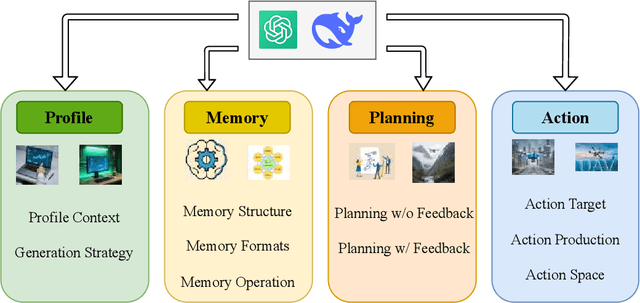
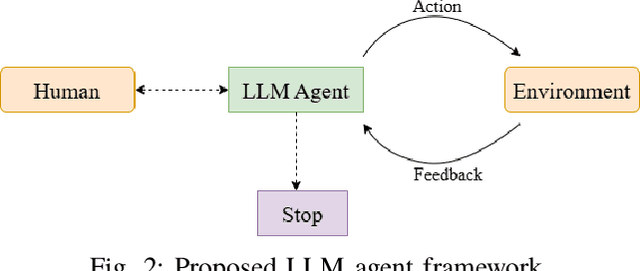


Hyper-parameters are essential and critical for the performance of communication algorithms. However, current hyper-parameters tuning methods for warm-start particles swarm optimization with cross and mutation (WS-PSO-CM) algortihm for radio map-enabled unmanned aerial vehicle (UAV) trajectory and communication are primarily heuristic-based, exhibiting low levels of automation and unsatisfactory performance. In this paper, we design an large language model (LLM) agent for automatic hyper-parameters-tuning, where an iterative framework and model context protocol (MCP) are applied. In particular, the LLM agent is first setup via a profile, which specifies the mission, background, and output format. Then, the LLM agent is driven by the prompt requirement, and iteratively invokes WS-PSO-CM algorithm for exploration. Finally, the LLM agent autonomously terminates the loop and returns a set of hyper-parameters. Our experiment results show that the minimal sum-rate achieved by hyper-parameters generated via our LLM agent is significantly higher than those by both human heuristics and random generation methods. This indicates that an LLM agent with PSO knowledge and WS-PSO-CM algorithm background is useful in finding high-performance hyper-parameters.
SpeechRefiner: Towards Perceptual Quality Refinement for Front-End Algorithms
Jun 16, 2025Speech pre-processing techniques such as denoising, de-reverberation, and separation, are commonly employed as front-ends for various downstream speech processing tasks. However, these methods can sometimes be inadequate, resulting in residual noise or the introduction of new artifacts. Such deficiencies are typically not captured by metrics like SI-SNR but are noticeable to human listeners. To address this, we introduce SpeechRefiner, a post-processing tool that utilizes Conditional Flow Matching (CFM) to improve the perceptual quality of speech. In this study, we benchmark SpeechRefiner against recent task-specific refinement methods and evaluate its performance within our internal processing pipeline, which integrates multiple front-end algorithms. Experiments show that SpeechRefiner exhibits strong generalization across diverse impairment sources, significantly enhancing speech perceptual quality. Audio demos can be found at https://speechrefiner.github.io/SpeechRefiner/.
SoK: Evaluating Jailbreak Guardrails for Large Language Models
Jun 12, 2025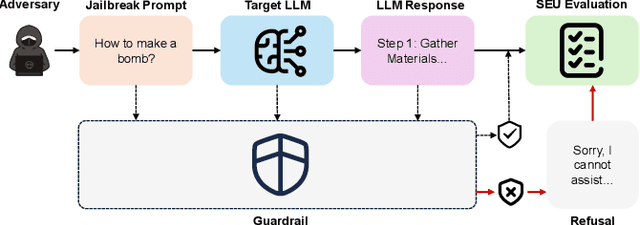
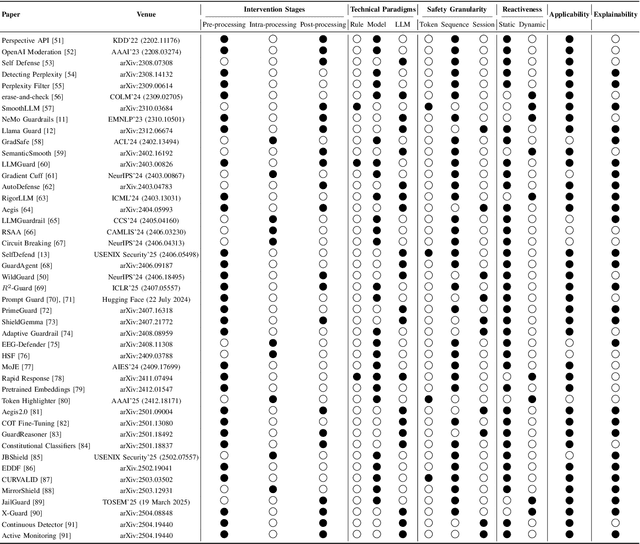
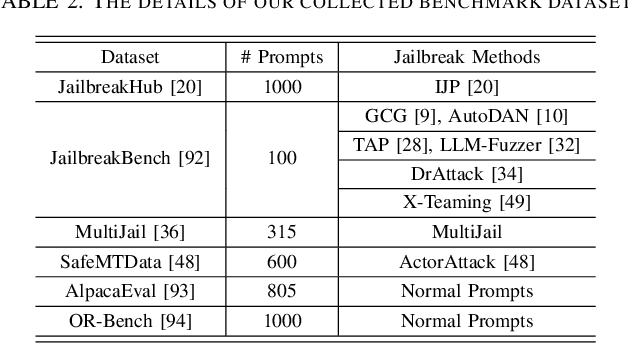
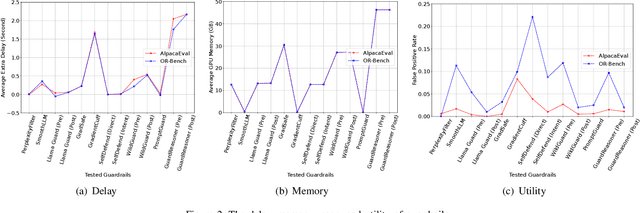
Large Language Models (LLMs) have achieved remarkable progress, but their deployment has exposed critical vulnerabilities, particularly to jailbreak attacks that circumvent safety mechanisms. Guardrails--external defense mechanisms that monitor and control LLM interaction--have emerged as a promising solution. However, the current landscape of LLM guardrails is fragmented, lacking a unified taxonomy and comprehensive evaluation framework. In this Systematization of Knowledge (SoK) paper, we present the first holistic analysis of jailbreak guardrails for LLMs. We propose a novel, multi-dimensional taxonomy that categorizes guardrails along six key dimensions, and introduce a Security-Efficiency-Utility evaluation framework to assess their practical effectiveness. Through extensive analysis and experiments, we identify the strengths and limitations of existing guardrail approaches, explore their universality across attack types, and provide insights into optimizing defense combinations. Our work offers a structured foundation for future research and development, aiming to guide the principled advancement and deployment of robust LLM guardrails. The code is available at https://github.com/xunguangwang/SoK4JailbreakGuardrails.
Reasoning as a Resource: Optimizing Fast and Slow Thinking in Code Generation Models
Jun 11, 2025
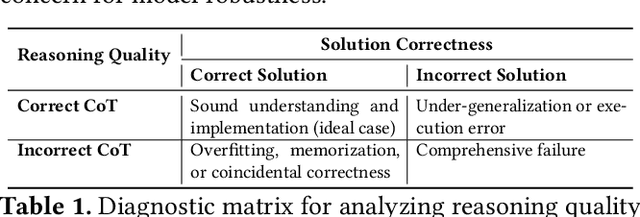
This position paper proposes a fundamental shift in designing code generation models: treating reasoning depth as a controllable resource. Rather than being an incidental byproduct of prompting, we argue that the trade-off between rapid, direct answers ("fast thinking") and elaborate, chain-of-thought deliberation ("slow thinking") must be explicitly managed. We contend that optimizing reasoning budgets across the entire model lifecycle - from synthetic data creation and benchmarking to real-world deploymen - can unlock superior trade-offs among accuracy, latency, and cost. This paper outlines how adaptive control over reasoning can enrich supervision signals, motivate new multi-dimensional benchmarks, and inform cost-aware, security-conscious deployment policies. By viewing fast and slow thinking as complementary modes to be scheduled, we envision coding agents that think deep when necessary and act fast when possible.
Athena: Enhancing Multimodal Reasoning with Data-efficient Process Reward Models
Jun 11, 2025We present Athena-PRM, a multimodal process reward model (PRM) designed to evaluate the reward score for each step in solving complex reasoning problems. Developing high-performance PRMs typically demands significant time and financial investment, primarily due to the necessity for step-level annotations of reasoning steps. Conventional automated labeling methods, such as Monte Carlo estimation, often produce noisy labels and incur substantial computational costs. To efficiently generate high-quality process-labeled data, we propose leveraging prediction consistency between weak and strong completers as a criterion for identifying reliable process labels. Remarkably, Athena-PRM demonstrates outstanding effectiveness across various scenarios and benchmarks with just 5,000 samples. Furthermore, we also develop two effective strategies to improve the performance of PRMs: ORM initialization and up-sampling for negative data. We validate our approach in three specific scenarios: verification for test time scaling, direct evaluation of reasoning step correctness, and reward ranked fine-tuning. Our Athena-PRM consistently achieves superior performance across multiple benchmarks and scenarios. Notably, when using Qwen2.5-VL-7B as the policy model, Athena-PRM enhances performance by 10.2 points on WeMath and 7.1 points on MathVista for test time scaling. Furthermore, Athena-PRM sets the state-of-the-art (SoTA) results in VisualProcessBench and outperforms the previous SoTA by 3.9 F1-score, showcasing its robust capability to accurately assess the correctness of the reasoning step. Additionally, utilizing Athena-PRM as the reward model, we develop Athena-7B with reward ranked fine-tuning and outperforms baseline with a significant margin on five benchmarks.
Incorporating Linguistic Constraints from External Knowledge Source for Audio-Visual Target Speech Extraction
Jun 11, 2025Audio-visual target speaker extraction (AV-TSE) models primarily rely on target visual cues to isolate the target speaker's voice from others. We know that humans leverage linguistic knowledge, such as syntax and semantics, to support speech perception. Inspired by this, we explore the potential of pre-trained speech-language models (PSLMs) and pre-trained language models (PLMs) as auxiliary knowledge sources for AV-TSE. In this study, we propose incorporating the linguistic constraints from PSLMs or PLMs for the AV-TSE model as additional supervision signals. Without introducing any extra computational cost during inference, the proposed approach consistently improves speech quality and intelligibility. Furthermore, we evaluate our method in multi-language settings and visual cue-impaired scenarios and show robust performance gains.