 Add to Chrome
 Add to Firefox
 Add to Edge
FinAnchor: Aligned Multi-Model Representations for Financial Prediction
Feb 24, 2026
Financial prediction from long documents involves significant challenges, as actionable signals are often sparse and obscured by noise, and the optimal LLM for generating embeddings varies across tasks and time periods. In this paper, we propose FinAnchor(Financial Anchored Representations), a lightweight framework that integrates embeddings from multiple LLMs without fine-tuning the underlying models. FinAnchor addresses the incompatibility of feature spaces by selecting an anchor embedding space and learning linear mappings to align representations from other models into this anchor. These aligned features are then aggregated to form a unified representation for downstream prediction. Across multiple financial NLP tasks, FinAnchor consistently outperforms strong single-model baselines and standard ensemble methods, demonstrating the effectiveness of anchoring heterogeneous representations for robust financial prediction.

Compound Attention and Neighbor Matching Network for Multi-contrast MRI Super-resolution
Jul 24, 2023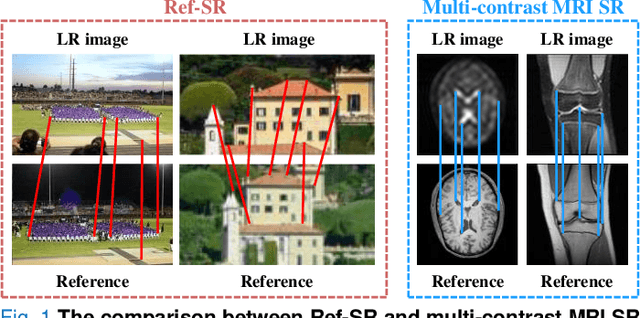
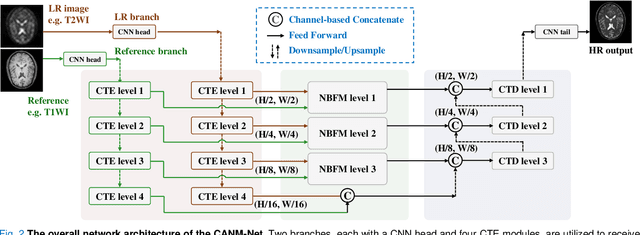
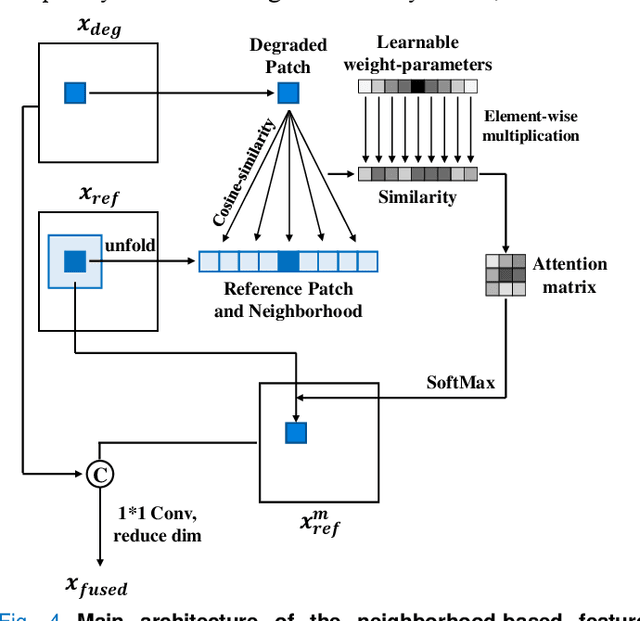
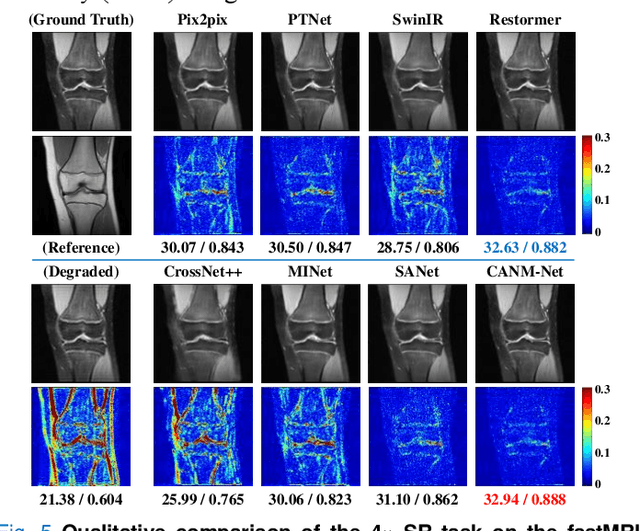
Multi-contrast magnetic resonance imaging (MRI) reflects information about human tissue from different perspectives and has many clinical applications. By utilizing the complementary information among different modalities, multi-contrast super-resolution (SR) of MRI can achieve better results than single-image super-resolution. However, existing methods of multi-contrast MRI SR have the following shortcomings that may limit their performance: First, existing methods either simply concatenate the reference and degraded features or exploit global feature-matching between them, which are unsuitable for multi-contrast MRI SR. Second, although many recent methods employ transformers to capture long-range dependencies in the spatial dimension, they neglect that self-attention in the channel dimension is also important for low-level vision tasks. To address these shortcomings, we proposed a novel network architecture with compound-attention and neighbor matching (CANM-Net) for multi-contrast MRI SR: The compound self-attention mechanism effectively captures the dependencies in both spatial and channel dimension; the neighborhood-based feature-matching modules are exploited to match degraded features and adjacent reference features and then fuse them to obtain the high-quality images. We conduct experiments of SR tasks on the IXI, fastMRI, and real-world scanning datasets. The CANM-Net outperforms state-of-the-art approaches in both retrospective and prospective experiments. Moreover, the robustness study in our work shows that the CANM-Net still achieves good performance when the reference and degraded images are imperfectly registered, proving good potential in clinical applications.
Towards Generalizable Medical Image Segmentation with Pixel-wise Uncertainty Estimation
May 13, 2023Deep neural networks (DNNs) achieve promising performance in visual recognition under the independent and identically distributed (IID) hypothesis. In contrast, the IID hypothesis is not universally guaranteed in numerous real-world applications, especially in medical image analysis. Medical image segmentation is typically formulated as a pixel-wise classification task in which each pixel is classified into a category. However, this formulation ignores the hard-to-classified pixels, e.g., some pixels near the boundary area, as they usually confuse DNNs. In this paper, we first explore that hard-to-classified pixels are associated with high uncertainty. Based on this, we propose a novel framework that utilizes uncertainty estimation to highlight hard-to-classified pixels for DNNs, thereby improving its generalization. We evaluate our method on two popular benchmarks: prostate and fundus datasets. The results of the experiment demonstrate that our method outperforms state-of-the-art methods.