 Add to Chrome
 Add to Firefox
 Add to Edge
Beyond Silence: Bias Analysis through Loss and Asymmetric Approach in Audio Anti-Spoofing
Jun 25, 2024
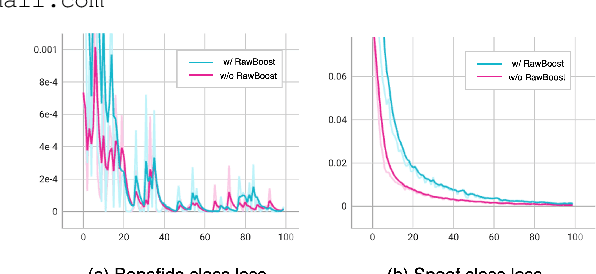
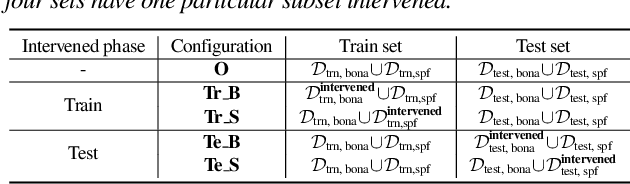
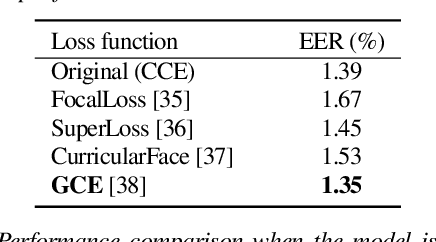
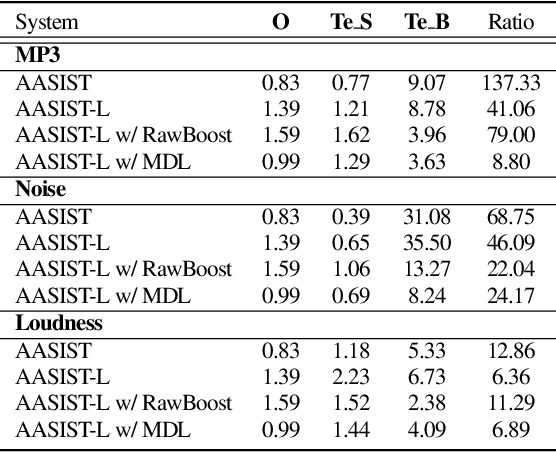
Current trends in audio anti-spoofing detection research strive to improve models' ability to generalize across unseen attacks by learning to identify a variety of spoofing artifacts. This emphasis has primarily focused on the spoof class. Recently, several studies have noted that the distribution of silence differs between the two classes, which can serve as a shortcut. In this paper, we extend class-wise interpretations beyond silence. We employ loss analysis and asymmetric methodologies to move away from traditional attack-focused and result-oriented evaluations towards a deeper examination of model behaviors. Our investigations highlight the significant differences in training dynamics between the two classes, emphasizing the need for future research to focus on robust modeling of the bonafide class.

Decoder-only Architecture for Streaming End-to-end Speech Recognition
Jun 23, 2024

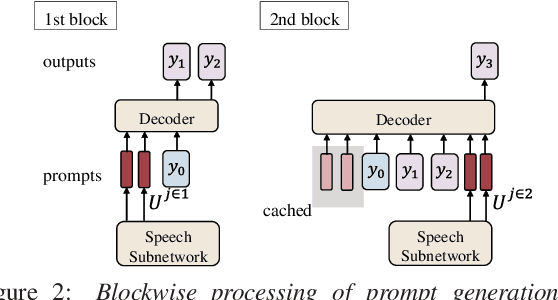
Decoder-only language models (LMs) have been successfully adopted for speech-processing tasks including automatic speech recognition (ASR). The LMs have ample expressiveness and perform efficiently. This efficiency is a suitable characteristic for streaming applications of ASR. In this work, we propose to use a decoder-only architecture for blockwise streaming ASR. In our approach, speech features are compressed using CTC output and context embedding using blockwise speech subnetwork, and are sequentially provided as prompts to the decoder. The decoder estimates the output tokens promptly at each block. To this end, we also propose a novel training scheme using random-length prefix prompts to make the model robust to the truncated prompts caused by blockwise processing. An experimental comparison shows that our proposed decoder-only streaming ASR achieves 8% relative word error rate reduction in the LibriSpeech test-other set while being twice as fast as the baseline model.
Contextualized End-to-end Automatic Speech Recognition with Intermediate Biasing Loss
Jun 23, 2024
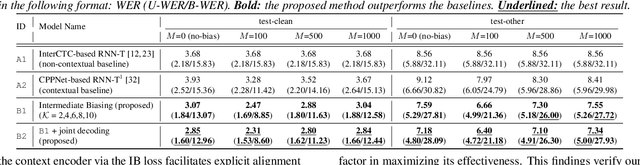
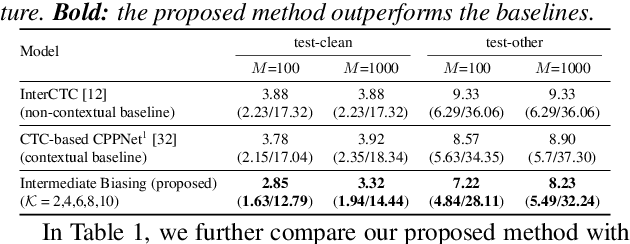
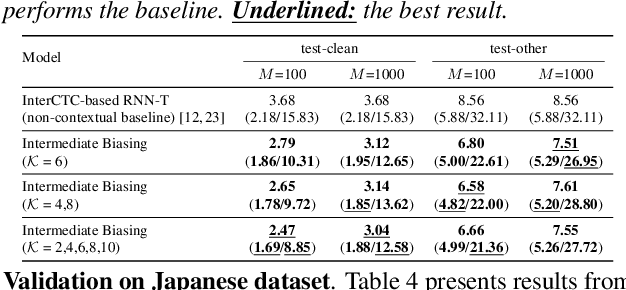
Contextualized end-to-end automatic speech recognition has been an active research area, with recent efforts focusing on the implicit learning of contextual phrases based on the final loss objective. However, these approaches ignore the useful contextual knowledge encoded in the intermediate layers. We hypothesize that employing explicit biasing loss as an auxiliary task in the encoder intermediate layers may better align text tokens or audio frames with the desired objectives. Our proposed intermediate biasing loss brings more regularization and contextualization to the network. Our method outperforms a conventional contextual biasing baseline on the LibriSpeech corpus, achieving a relative improvement of 22.5% in biased word error rate (B-WER) and up to 44% compared to the non-contextual baseline with a biasing list size of 100. Moreover, employing RNN-transducer-driven joint decoding further reduces the unbiased word error rate (U-WER), resulting in a more robust network.
Diffusion-based Generative Modeling with Discriminative Guidance for Streamable Speech Enhancement
Jun 19, 2024
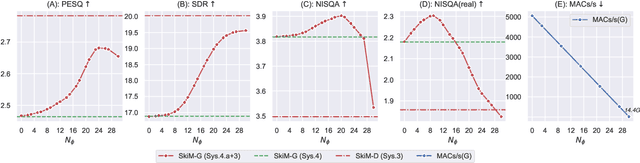
Diffusion-based generative models (DGMs) have recently attracted attention in speech enhancement research (SE) as previous works showed a remarkable generalization capability. However, DGMs are also computationally intensive, as they usually require many iterations in the reverse diffusion process (RDP), making them impractical for streaming SE systems. In this paper, we propose to use discriminative scores from discriminative models in the first steps of the RDP. These discriminative scores require only one forward pass with the discriminative model for multiple RDP steps, thus greatly reducing computations. This approach also allows for performance improvements. We show that we can trade off between generative and discriminative capabilities as the number of steps with the discriminative score increases. Furthermore, we propose a novel streamable time-domain generative model with an algorithmic latency of 50 ms, which has no significant performance degradation compared to offline models.
Finding Task-specific Subnetworks in Multi-task Spoken Language Understanding Model
Jun 18, 2024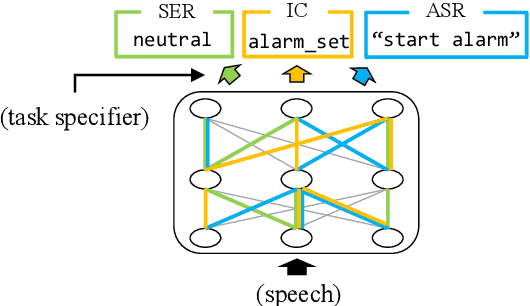
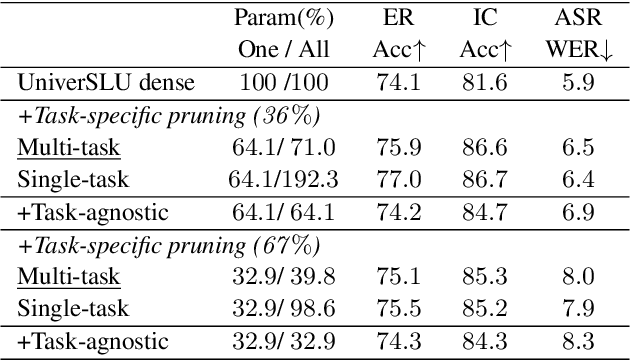
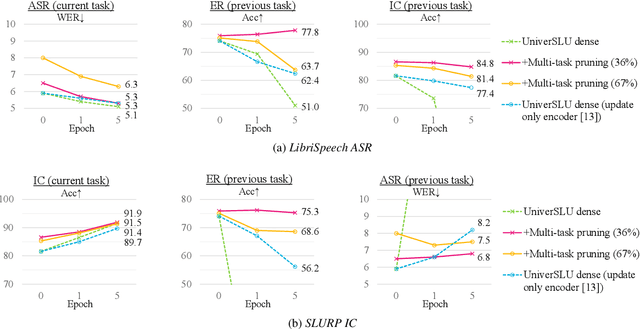
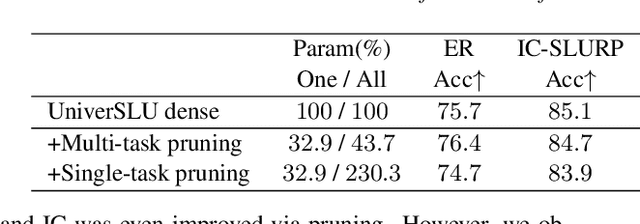
Recently, multi-task spoken language understanding (SLU) models have emerged, designed to address various speech processing tasks. However, these models often rely on a large number of parameters. Also, they often encounter difficulties in adapting to new data for a specific task without experiencing catastrophic forgetting of previously trained tasks. In this study, we propose finding task-specific subnetworks within a multi-task SLU model via neural network pruning. In addition to model compression, we expect that the forgetting of previously trained tasks can be mitigated by updating only a task-specific subnetwork. We conduct experiments on top of the state-of-the-art multi-task SLU model ``UniverSLU'', trained for several tasks such as emotion recognition (ER), intent classification (IC), and automatic speech recognition (ASR). We show that pruned models were successful in adapting to additional ASR or IC data with minimal performance degradation on previously trained tasks.
Rapid Language Adaptation for Multilingual E2E Speech Recognition Using Encoder Prompting
Jun 18, 2024
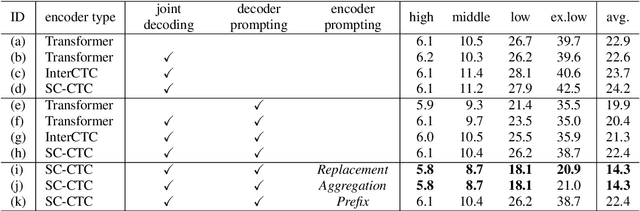

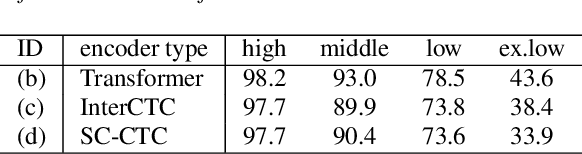
End-to-end multilingual speech recognition models handle multiple languages through a single model, often incorporating language identification to automatically detect the language of incoming speech. Since the common scenario is where the language is already known, these models can perform as language-specific by using language information as prompts, which is particularly beneficial for attention-based encoder-decoder architectures. However, the Connectionist Temporal Classification (CTC) approach, which enhances recognition via joint decoding and multi-task training, does not normally incorporate language prompts due to its conditionally independent output tokens. To overcome this, we introduce an encoder prompting technique within the self-conditioned CTC framework, enabling language-specific adaptation of the CTC model in a zero-shot manner. Our method has shown to significantly reduce errors by 28% on average and by 41% on low-resource languages.
MMM: Multi-Layer Multi-Residual Multi-Stream Discrete Speech Representation from Self-supervised Learning Model
Jun 14, 2024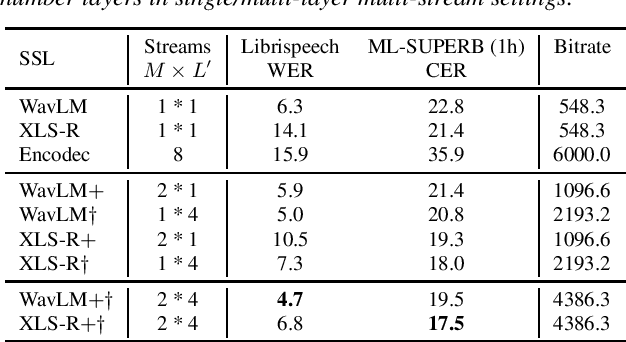
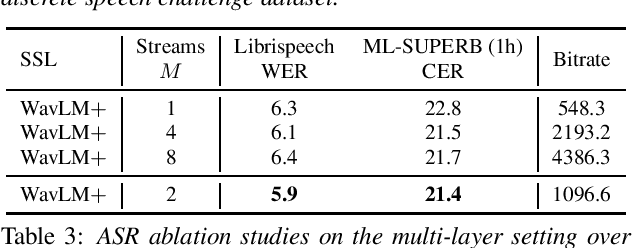
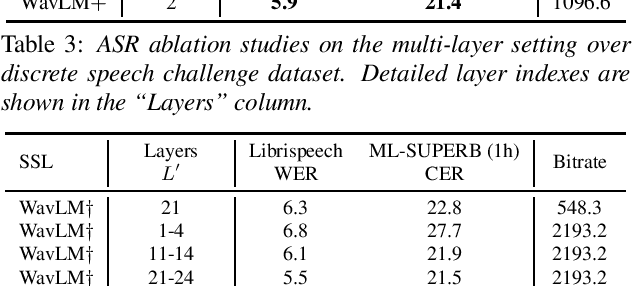
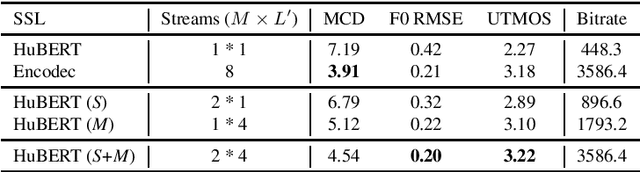
Speech discrete representation has proven effective in various downstream applications due to its superior compression rate of the waveform, fast convergence during training, and compatibility with other modalities. Discrete units extracted from self-supervised learning (SSL) models have emerged as a prominent approach for obtaining speech discrete representation. However, while discrete units have shown effectiveness compared to spectral features, they still lag behind continuous SSL representations. In this work, we propose MMM, a multi-layer multi-residual multi-stream discrete units extraction method from SSL. Specifically, we introduce iterative residual vector quantization with K-means for different layers in an SSL model to extract multi-stream speech discrete representation. Through extensive experiments in speech recognition, speech resynthesis, and text-to-speech, we demonstrate the proposed MMM can surpass or on-par with neural codec's performance under various conditions.
On the Evaluation of Speech Foundation Models for Spoken Language Understanding
Jun 14, 2024The Spoken Language Understanding Evaluation (SLUE) suite of benchmark tasks was recently introduced to address the need for open resources and benchmarking of complex spoken language understanding (SLU) tasks, including both classification and sequence generation tasks, on natural speech. The benchmark has demonstrated preliminary success in using pre-trained speech foundation models (SFM) for these SLU tasks. However, the community still lacks a fine-grained understanding of the comparative utility of different SFMs. Inspired by this, we ask: which SFMs offer the most benefits for these complex SLU tasks, and what is the most effective approach for incorporating these SFMs? To answer this, we perform an extensive evaluation of multiple supervised and self-supervised SFMs using several evaluation protocols: (i) frozen SFMs with a lightweight prediction head, (ii) frozen SFMs with a complex prediction head, and (iii) fine-tuned SFMs with a lightweight prediction head. Although the supervised SFMs are pre-trained on much more speech recognition data (with labels), they do not always outperform self-supervised SFMs; the latter tend to perform at least as well as, and sometimes better than, supervised SFMs, especially on the sequence generation tasks in SLUE. While there is no universally optimal way of incorporating SFMs, the complex prediction head gives the best performance for most tasks, although it increases the inference time. We also introduce an open-source toolkit and performance leaderboard, SLUE-PERB, for these tasks and modeling strategies.
VISinger2+: End-to-End Singing Voice Synthesis Augmented by Self-Supervised Learning Representation
Jun 13, 2024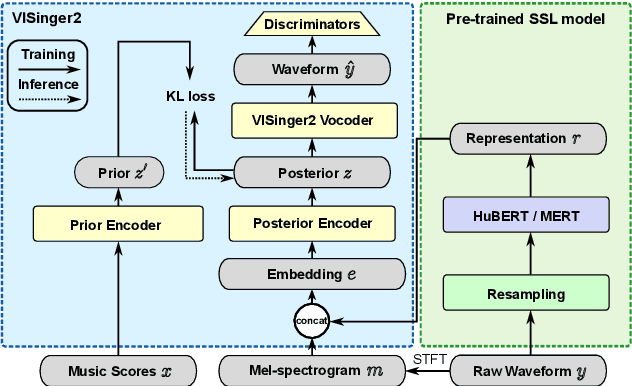
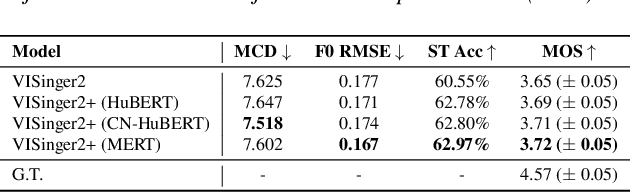
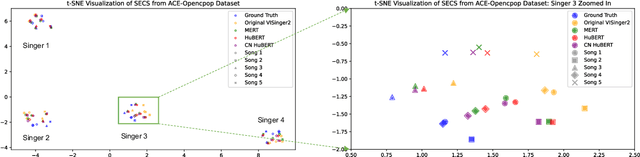
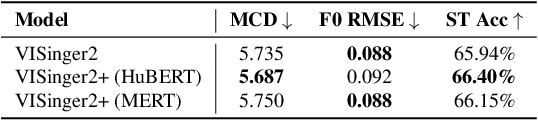
Singing Voice Synthesis (SVS) has witnessed significant advancements with the advent of deep learning techniques. However, a significant challenge in SVS is the scarcity of labeled singing voice data, which limits the effectiveness of supervised learning methods. In response to this challenge, this paper introduces a novel approach to enhance the quality of SVS by leveraging unlabeled data from pre-trained self-supervised learning models. Building upon the existing VISinger2 framework, this study integrates additional spectral feature information into the system to enhance its performance. The integration aims to harness the rich acoustic features from the pre-trained models, thereby enriching the synthesis and yielding a more natural and expressive singing voice. Experimental results in various corpora demonstrate the efficacy of this approach in improving the overall quality of synthesized singing voices in both objective and subjective metrics.
DiscreteSLU: A Large Language Model with Self-Supervised Discrete Speech Units for Spoken Language Understanding
Jun 13, 2024
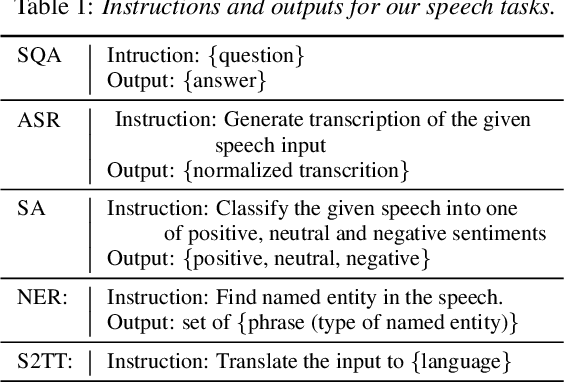
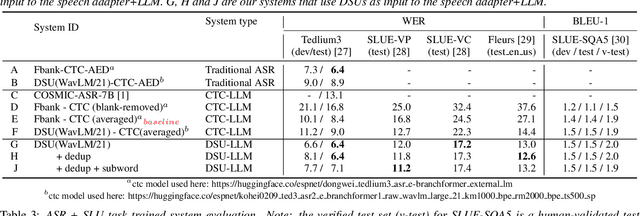
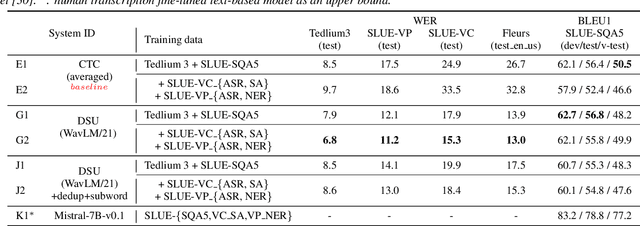
The integration of pre-trained text-based large language models (LLM) with speech input has enabled instruction-following capabilities for diverse speech tasks. This integration requires the use of a speech encoder, a speech adapter, and an LLM, trained on diverse tasks. We propose the use of discrete speech units (DSU), rather than continuous-valued speech encoder outputs, that are converted to the LLM token embedding space using the speech adapter. We generate DSU using a self-supervised speech encoder followed by k-means clustering. The proposed model shows robust performance on speech inputs from seen/unseen domains and instruction-following capability in spoken question answering. We also explore various types of DSU extracted from different layers of the self-supervised speech encoder, as well as Mel frequency Cepstral Coefficients (MFCC). Our findings suggest that the ASR task and datasets are not crucial in instruction-tuning for spoken question answering tasks.