 Add to Chrome
 Add to Firefox
 Add to Edge
UniqueSplat: View-conditioned 3D Gaussian Splatting for Generalizable 3D Reconstruction
Aug 03, 2026
In this paper, we propose UniqueSplat, a view-conditioned feed-forward 3D Gaussian Splatting model to reconstruct customized 3D radiance fields for each view query. Existing feed-forward methods such as pixelSplat and MVSplat aim to generate fixed Gaussians across all views of each scene by minimizing the error between rendered views and ground-truth images. However, such fixed Gaussians generally render images from all views and lack the ability to adapt to specific viewpoints, as they do not incorporate target view information when predicting Gaussians. To address this, our UniqueSplat learns the view-conditioned information as a prior and incorporates this knowledge into network parameters, so that Gaussians are dynamically adjusted in accordance with different views. Specifically, we propose a two-branch view-conditioned hyperNetwork to simultaneously learn view-agnostic embeddings and view-specific knowledge, which not only explores the shareable knowledge from various views, but also adapts the model to specific views at test time. Extensive experiments on widely-used datasets including RealEstate10K, ACID and DTU demonstrate the superiority of UniqueSplat over the state-of-the-art methods. Moreover, UniqueSplat encouragingly outperforms existing methods in cross-dataset evaluation, showing its notable generalization ability.

Learning Efficient 4D Gaussian Representations from Monocular Videos with Flow Splatting
Jun 29, 2026Reconstructing dynamic 3D scenes from monocular videos is challenging due to scene complexity and temporal dynamics. With the advancement of 3D Gaussian Splatting in novel view synthesis, existing methods extend 3D Gaussians to 4D domain with deformation fields, trajectories or spatiotemporal 4D volumes to model scene element deformation. However, these methods suffer from long training time, low rendering speed or high memory consumption for per-frame reconstruction of 4D volumes, without fully exploiting dense dynamic information. To address this issue, we propose Flow Splatting, which constructs the velocity field and enables the conventional splatting technique to render optical flow from the velocity field to supervise dynamics learning process from monocular videos. Specifically, we extend 4D volumes with time varying means and covariance to represent complex dynamics. Then, we construct and approximate the velocity field naturally based on this representations. While conventional volume rendering techniques support to render color fields, we extend the volume rendering strategy to splat the velocity field by considering the influence of camera motions. We conduct experiments on various benchmarks to demonstrate the efficiency and effectiveness of our method. Compared to the state-of-the-art methods, our model achieves better image quality with less time consumption and higher rendering speed.
RhymeFlow: Training-Free Acceleration for Video Generation with Asynchronous Denoising Flow Scheduling
Jun 04, 2026Video generation models based on Diffusion Transformers (DiTs) have achieved remarkable performance in video synthesis, yet they suffer from high inference latency and computational costs due to the quadratic complexity of 3D attention. Existing acceleration methods primarily reduce computational complexity within each individual denoising steps through techniques such as sparse attention and KV-caching. However, they rigidly adhere to the inherent constraint of the standard diffusion pipeline: every frame in the target video sequence must be subjected to a complete, dense denoising process across all diffusion timesteps. We observe that due to the corresponding contents and motions among adjacent frames, when keyframes with critical semantic transitions are anchored, the intermediate states of others often follow more predictable trajectories, which indicates that such uniform, dense denoising process is inherently redundant for natural video data. To this end, we introduce \textbf{RhymeFlow}, a training-free framework that decouples the denoising trajectories of different frames. Specifically, we first identify a sparse set of pivotal key frames that dominate the latent semantic evolution. Then, only these keyframes undergo dense, step-by-step denoising to ensure structural integrity, while non-keyframes progressively skip denoising steps to minimize computational cost. Since skipped intermediate states of non-keyframes break the temporal coherence in keyframe denoising steps, leading to visual degradation, we further introduce a latent trajectory projection module, which enables keyframes to interact with a complete and temporally consistent sequence representation. Extensive experiments on current DiT-based video generation models demonstrate our method outperforms existing baselines with higher inference speed and better visual quality.
MBench: A Comprehensive Benchmark on Memory Capability for Video World Models
May 30, 2026Recent advancements in video-based world models have demonstrated an unprecedented ability to synthesize high-fidelity visual sequences. However, a fundamental gap persists between visually plausible video generation and the functional requirements of a world model, particularly in maintaining a stable and reasonable internal state over extended temporal horizons. While existing benchmarks primarily emphasize visual quality, motion coherence, and text-video alignment, they largely overlook memory, the core capability of a world model to preserve consistency across long-term horizons and complex interactions. To address this gap, we present \textbf{MBench}, a comprehensive benchmark dedicated to quantifying and evaluating the memory capability of video world models. We systematically decompose the memory capability of video world models into three hierarchical and complementary core dimensions: entity consistency, environment consistency, and causal consistency, which are further refined into 12 quantifiable sub-dimensions for comprehensive characterization of long-term memory. Our benchmark is built upon rigorously curated real-captured long videos, and evaluated by rule-based quantitative matrices and VLM to enable objective and comprehensive consistency assessment. Extensive evaluations of mainstream state-of-the-art video world models reveal critical systemic limitations of existing methods in long-term state retention, providing a standardized benchmark and clear research direction to advance the field.
SurfelSplat: Learning Efficient and Generalizable Gaussian Surfel Representations for Sparse-View Surface Reconstruction
Apr 09, 20263D Gaussian Splatting (3DGS) has demonstrated impressive performance in 3D scene reconstruction. Beyond novel view synthesis, it shows great potential for multi-view surface reconstruction. Existing methods employ optimization-based reconstruction pipelines that achieve precise and complete surface extractions. However, these approaches typically require dense input views and high time consumption for per-scene optimization. To address these limitations, we propose SurfelSplat, a feed-forward framework that generates efficient and generalizable pixel-aligned Gaussian surfel representations from sparse-view images. We observe that conventional feed-forward structures struggle to recover accurate geometric attributes of Gaussian surfels because the spatial frequency of pixel-aligned primitives exceeds Nyquist sampling rates. Therefore, we propose a cross-view feature aggregation module based on the Nyquist sampling theorem. Specifically, we first adapt the geometric forms of Gaussian surfels with spatial sampling rate-guided low-pass filters. We then project the filtered surfels across all input views to obtain cross-view feature correlations. By processing these correlations through a specially designed feature fusion network, we can finally regress Gaussian surfels with precise geometry. Extensive experiments on DTU reconstruction benchmarks demonstrate that our model achieves comparable results with state-of-the-art methods, and predict Gaussian surfels within 1 second, offering a 100x speedup without costly per-scene training.
Revisiting 3D Reconstruction Kernels as Low-Pass Filters
Jan 25, 20263D reconstruction is to recover 3D signals from the sampled discrete 2D pixels, with the goal to converge continuous 3D spaces. In this paper, we revisit 3D reconstruction from the perspective of signal processing, identifying the periodic spectral extension induced by discrete sampling as the fundamental challenge. Previous 3D reconstruction kernels, such as Gaussians, Exponential functions, and Student's t distributions, serve as the low pass filters to isolate the baseband spectrum. However, their unideal low-pass property results in the overlap of high-frequency components with low-frequency components in the discrete-time signal's spectrum. To this end, we introduce Jinc kernel with an instantaneous drop to zero magnitude exactly at the cutoff frequency, which is corresponding to the ideal low pass filters. As Jinc kernel suffers from low decay speed in the spatial domain, we further propose modulated kernels to strick an effective balance, and achieves superior rendering performance by reconciling spatial efficiency and frequency-domain fidelity. Experimental results have demonstrated the effectiveness of our Jinc and modulated kernels.
E-GRPO: High Entropy Steps Drive Effective Reinforcement Learning for Flow Models
Jan 01, 2026Recent reinforcement learning has enhanced the flow matching models on human preference alignment. While stochastic sampling enables the exploration of denoising directions, existing methods which optimize over multiple denoising steps suffer from sparse and ambiguous reward signals. We observe that the high entropy steps enable more efficient and effective exploration while the low entropy steps result in undistinguished roll-outs. To this end, we propose E-GRPO, an entropy aware Group Relative Policy Optimization to increase the entropy of SDE sampling steps. Since the integration of stochastic differential equations suffer from ambiguous reward signals due to stochasticity from multiple steps, we specifically merge consecutive low entropy steps to formulate one high entropy step for SDE sampling, while applying ODE sampling on other steps. Building upon this, we introduce multi-step group normalized advantage, which computes group-relative advantages within samples sharing the same consolidated SDE denoising step. Experimental results on different reward settings have demonstrated the effectiveness of our methods.
Scene Splatter: Momentum 3D Scene Generation from Single Image with Video Diffusion Model
Apr 03, 2025In this paper, we propose Scene Splatter, a momentum-based paradigm for video diffusion to generate generic scenes from single image. Existing methods, which employ video generation models to synthesize novel views, suffer from limited video length and scene inconsistency, leading to artifacts and distortions during further reconstruction. To address this issue, we construct noisy samples from original features as momentum to enhance video details and maintain scene consistency. However, for latent features with the perception field that spans both known and unknown regions, such latent-level momentum restricts the generative ability of video diffusion in unknown regions. Therefore, we further introduce the aforementioned consistent video as a pixel-level momentum to a directly generated video without momentum for better recovery of unseen regions. Our cascaded momentum enables video diffusion models to generate both high-fidelity and consistent novel views. We further finetune the global Gaussian representations with enhanced frames and render new frames for momentum update in the next step. In this manner, we can iteratively recover a 3D scene, avoiding the limitation of video length. Extensive experiments demonstrate the generalization capability and superior performance of our method in high-fidelity and consistent scene generation.
Gaussian Graph Network: Learning Efficient and Generalizable Gaussian Representations from Multi-view Images
Mar 20, 20253D Gaussian Splatting (3DGS) has demonstrated impressive novel view synthesis performance. While conventional methods require per-scene optimization, more recently several feed-forward methods have been proposed to generate pixel-aligned Gaussian representations with a learnable network, which are generalizable to different scenes. However, these methods simply combine pixel-aligned Gaussians from multiple views as scene representations, thereby leading to artifacts and extra memory cost without fully capturing the relations of Gaussians from different images. In this paper, we propose Gaussian Graph Network (GGN) to generate efficient and generalizable Gaussian representations. Specifically, we construct Gaussian Graphs to model the relations of Gaussian groups from different views. To support message passing at Gaussian level, we reformulate the basic graph operations over Gaussian representations, enabling each Gaussian to benefit from its connected Gaussian groups with Gaussian feature fusion. Furthermore, we design a Gaussian pooling layer to aggregate various Gaussian groups for efficient representations. We conduct experiments on the large-scale RealEstate10K and ACID datasets to demonstrate the efficiency and generalization of our method. Compared to the state-of-the-art methods, our model uses fewer Gaussians and achieves better image quality with higher rendering speed.
Physics3D: Learning Physical Properties of 3D Gaussians via Video Diffusion
Jun 07, 2024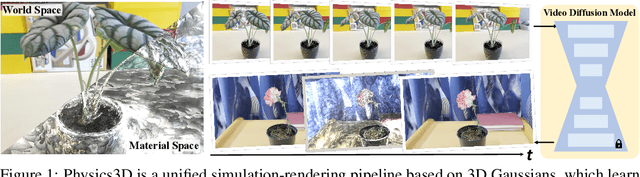
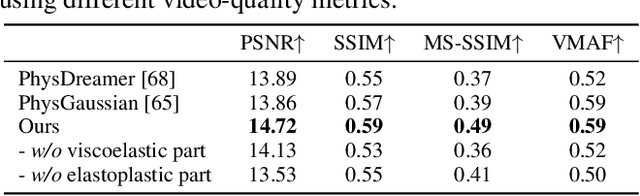
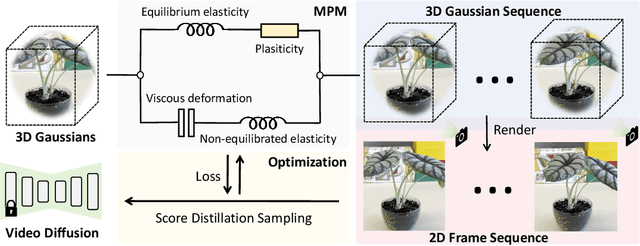

In recent years, there has been rapid development in 3D generation models, opening up new possibilities for applications such as simulating the dynamic movements of 3D objects and customizing their behaviors. However, current 3D generative models tend to focus only on surface features such as color and shape, neglecting the inherent physical properties that govern the behavior of objects in the real world. To accurately simulate physics-aligned dynamics, it is essential to predict the physical properties of materials and incorporate them into the behavior prediction process. Nonetheless, predicting the diverse materials of real-world objects is still challenging due to the complex nature of their physical attributes. In this paper, we propose \textbf{Physics3D}, a novel method for learning various physical properties of 3D objects through a video diffusion model. Our approach involves designing a highly generalizable physical simulation system based on a viscoelastic material model, which enables us to simulate a wide range of materials with high-fidelity capabilities. Moreover, we distill the physical priors from a video diffusion model that contains more understanding of realistic object materials. Extensive experiments demonstrate the effectiveness of our method with both elastic and plastic materials. Physics3D shows great potential for bridging the gap between the physical world and virtual neural space, providing a better integration and application of realistic physical principles in virtual environments. Project page: https://liuff19.github.io/Physics3D.