 Add to Chrome
 Add to Firefox
 Add to Edge
MBench: A Comprehensive Benchmark on Memory Capability for Video World Models
May 30, 2026
Recent advancements in video-based world models have demonstrated an unprecedented ability to synthesize high-fidelity visual sequences. However, a fundamental gap persists between visually plausible video generation and the functional requirements of a world model, particularly in maintaining a stable and reasonable internal state over extended temporal horizons. While existing benchmarks primarily emphasize visual quality, motion coherence, and text-video alignment, they largely overlook memory, the core capability of a world model to preserve consistency across long-term horizons and complex interactions. To address this gap, we present \textbf{MBench}, a comprehensive benchmark dedicated to quantifying and evaluating the memory capability of video world models. We systematically decompose the memory capability of video world models into three hierarchical and complementary core dimensions: entity consistency, environment consistency, and causal consistency, which are further refined into 12 quantifiable sub-dimensions for comprehensive characterization of long-term memory. Our benchmark is built upon rigorously curated real-captured long videos, and evaluated by rule-based quantitative matrices and VLM to enable objective and comprehensive consistency assessment. Extensive evaluations of mainstream state-of-the-art video world models reveal critical systemic limitations of existing methods in long-term state retention, providing a standardized benchmark and clear research direction to advance the field.

Tex3D: Objects as Attack Surfaces via Adversarial 3D Textures for Vision-Language-Action Models
Apr 02, 2026Vision-language-action (VLA) models have shown strong performance in robotic manipulation, yet their robustness to physically realizable adversarial attacks remains underexplored. Existing studies reveal vulnerabilities through language perturbations and 2D visual attacks, but these attack surfaces are either less representative of real deployment or limited in physical realism. In contrast, adversarial 3D textures pose a more physically plausible and damaging threat, as they are naturally attached to manipulated objects and are easier to deploy in physical environments. Bringing adversarial 3D textures to VLA systems is nevertheless nontrivial. A central obstacle is that standard 3D simulators do not provide a differentiable optimization path from the VLA objective function back to object appearance, making it difficult to optimize through an end-to-end manner. To address this, we introduce Foreground-Background Decoupling (FBD), which enables differentiable texture optimization through dual-renderer alignment while preserving the original simulation environment. To further ensure that the attack remains effective across long-horizon and diverse viewpoints in the physical world, we propose Trajectory-Aware Adversarial Optimization (TAAO), which prioritizes behaviorally critical frames and stabilizes optimization with a vertex-based parameterization. Built on these designs, we present Tex3D, the first framework for end-to-end optimization of 3D adversarial textures directly within the VLA simulation environment. Experiments in both simulation and real-robot settings show that Tex3D significantly degrades VLA performance across multiple manipulation tasks, achieving task failure rates of up to 96.7\%. Our empirical results expose critical vulnerabilities of VLA systems to physically grounded 3D adversarial attacks and highlight the need for robustness-aware training.
HGDNet: A Height-Hierarchy Guided Dual-Decoder Network for Single View Building Extraction and Height Estimation
Aug 10, 2023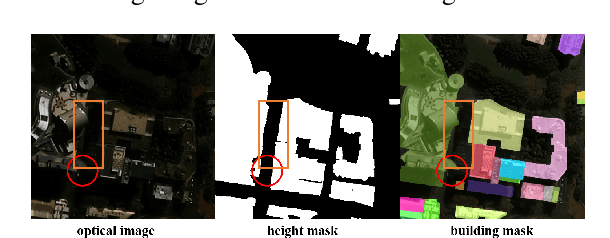
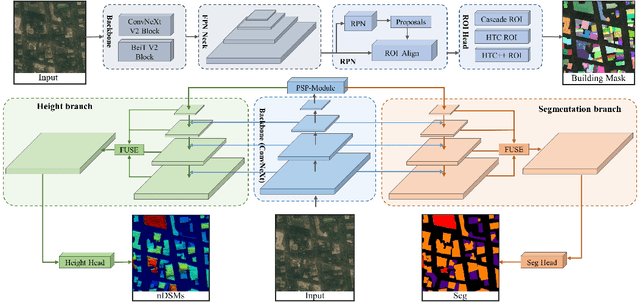
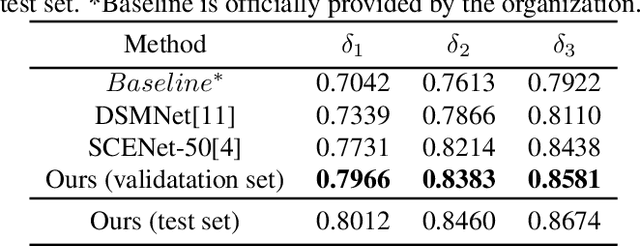
Unifying the correlative single-view satellite image building extraction and height estimation tasks indicates a promising way to share representations and acquire generalist model for large-scale urban 3D reconstruction. However, the common spatial misalignment between building footprints and stereo-reconstructed nDSM height labels incurs degraded performance on both tasks. To address this issue, we propose a Height-hierarchy Guided Dual-decoder Network (HGDNet) to estimate building height. Under the guidance of synthesized discrete height-hierarchy nDSM, auxiliary height-hierarchical building extraction branch enhance the height estimation branch with implicit constraints, yielding an accuracy improvement of more than 6% on the DFC 2023 track2 dataset. Additional two-stage cascade architecture is adopted to achieve more accurate building extraction. Experiments on the DFC 2023 Track 2 dataset shows the superiority of the proposed method in building height estimation ({\delta}1:0.8012), instance extraction (AP50:0.7730), and the final average score 0.7871 ranks in the first place in test phase.
Fine-grained building roof instance segmentation based on domain adapted pretraining and composite dual-backbone
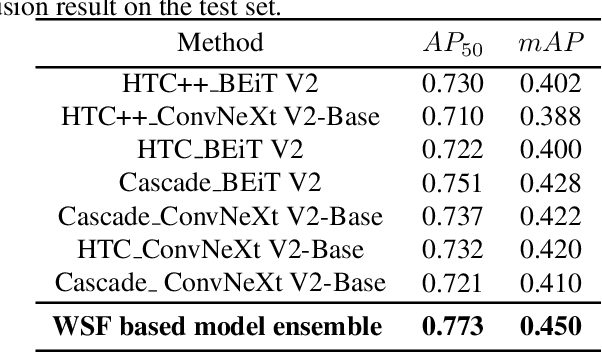
Aug 10, 2023The diversity of building architecture styles of global cities situated on various landforms, the degraded optical imagery affected by clouds and shadows, and the significant inter-class imbalance of roof types pose challenges for designing a robust and accurate building roof instance segmentor. To address these issues, we propose an effective framework to fulfill semantic interpretation of individual buildings with high-resolution optical satellite imagery. Specifically, the leveraged domain adapted pretraining strategy and composite dual-backbone greatly facilitates the discriminative feature learning. Moreover, new data augmentation pipeline, stochastic weight averaging (SWA) training and instance segmentation based model ensemble in testing are utilized to acquire additional performance boost. Experiment results show that our approach ranks in the first place of the 2023 IEEE GRSS Data Fusion Contest (DFC) Track 1 test phase ($mAP_{50}$:50.6\%). Note-worthily, we have also explored the potential of multimodal data fusion with both optical satellite imagery and SAR data.