 Add to Chrome
 Add to Firefox
 Add to Edge
PI-Mem: Pushing Long-Context Reasoning to 3.6M Tokens with Parallel-Iterative Memory
Aug 04, 2026
Long-context reasoning remains a critical bottleneck for large language models, as recent recurrent-memory approaches face two inherent challenges: sequential chunk-wise updates can overwrite early critical evidence with later irrelevant content, and serial inter-chunk dependencies limit parallelism and cause latency to increase with context length. To address these issues, we propose PI-Mem (Parallel-Iterative Memory), a mechanism that processes all chunks in parallel and iteratively refines a shared memory over a bounded number of turns. In each turn, PI-Mem reads all chunks in parallel conditioned on the current memory, selects new or complementary evidence from each chunk, and merges the selected evidence into a compact shared memory for the next turn. To discourage redundant turns, we optimize the workflow through reinforcement learning with an auxiliary turn-efficiency reward, enabling the model to adaptively exit once sufficient evidence has been accumulated. We evaluate PI-Mem with Qwen3.5-35B-A3B and Qwen2.5-7B on the HotpotQA benchmark across context lengths up to 3.6 million tokens and find that it outperforms the recurrent-memory baseline by +6.25 and +7.81 absolute points while achieving 6.1$\times$ and 2.1$\times$ inference speedups, respectively. These results demonstrate that PI-Mem breaks the accuracy--efficiency trade-off in long-context reasoning and provides a scalable approach to complex multi-hop question answering over extremely long documents.

UniqueSplat: View-conditioned 3D Gaussian Splatting for Generalizable 3D Reconstruction
Aug 03, 2026In this paper, we propose UniqueSplat, a view-conditioned feed-forward 3D Gaussian Splatting model to reconstruct customized 3D radiance fields for each view query. Existing feed-forward methods such as pixelSplat and MVSplat aim to generate fixed Gaussians across all views of each scene by minimizing the error between rendered views and ground-truth images. However, such fixed Gaussians generally render images from all views and lack the ability to adapt to specific viewpoints, as they do not incorporate target view information when predicting Gaussians. To address this, our UniqueSplat learns the view-conditioned information as a prior and incorporates this knowledge into network parameters, so that Gaussians are dynamically adjusted in accordance with different views. Specifically, we propose a two-branch view-conditioned hyperNetwork to simultaneously learn view-agnostic embeddings and view-specific knowledge, which not only explores the shareable knowledge from various views, but also adapts the model to specific views at test time. Extensive experiments on widely-used datasets including RealEstate10K, ACID and DTU demonstrate the superiority of UniqueSplat over the state-of-the-art methods. Moreover, UniqueSplat encouragingly outperforms existing methods in cross-dataset evaluation, showing its notable generalization ability.
AdaForensics: Learning A Characteristic-aware Adaptive Deepfake Detector
Aug 03, 2026In this paper, we propose a characteristic-aware adaptive network named AdaForensics for deepfake detection. Most existing methods learn a fixed network to detect deepfakes based on carefully-designed network architectures. However, these methods employ the same deepfake detector for all the images despite of various facial characteristic, which fail to provide customized forgery detection for different individuals. To address this, our AdaForensics simultaneously learns characteristic-agnostic and characteristic-specific embeddings, where the detector dynamically adapts to varying faces with our designed hypernetwork on the fly. More specifically, our AdaForensics not only explores the shareable abstractions from various deepfake images, but also adapts the detector to the given characteristic at test time. To achieve this, we propose a two-branch HyperNetwork to learn an adaptive deepfake detector, which automatically adjusts the parameters based on characteristic of the input. Extensive experiments on widely-used datasets including FaceForensics, Celeb-DF and DFDC demonstrate our AdaForensics outperforms the state-of-the-art works.
Gaussian Graph Network: Learning Efficient and Generalizable Gaussian Representations from Multi-view Images
Mar 20, 20253D Gaussian Splatting (3DGS) has demonstrated impressive novel view synthesis performance. While conventional methods require per-scene optimization, more recently several feed-forward methods have been proposed to generate pixel-aligned Gaussian representations with a learnable network, which are generalizable to different scenes. However, these methods simply combine pixel-aligned Gaussians from multiple views as scene representations, thereby leading to artifacts and extra memory cost without fully capturing the relations of Gaussians from different images. In this paper, we propose Gaussian Graph Network (GGN) to generate efficient and generalizable Gaussian representations. Specifically, we construct Gaussian Graphs to model the relations of Gaussian groups from different views. To support message passing at Gaussian level, we reformulate the basic graph operations over Gaussian representations, enabling each Gaussian to benefit from its connected Gaussian groups with Gaussian feature fusion. Furthermore, we design a Gaussian pooling layer to aggregate various Gaussian groups for efficient representations. We conduct experiments on the large-scale RealEstate10K and ACID datasets to demonstrate the efficiency and generalization of our method. Compared to the state-of-the-art methods, our model uses fewer Gaussians and achieves better image quality with higher rendering speed.
DreamCinema: Cinematic Transfer with Free Camera and 3D Character
Aug 22, 2024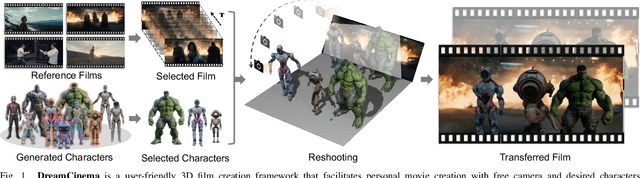
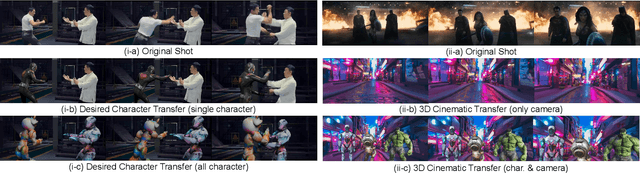
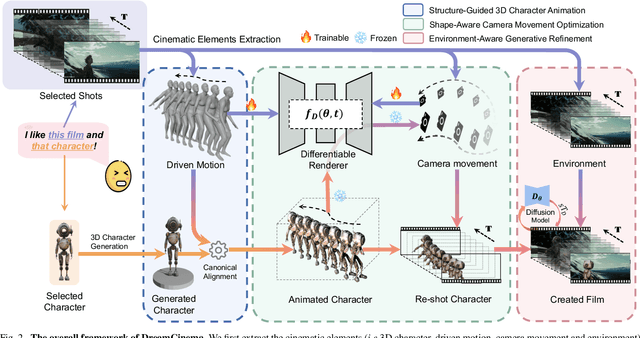
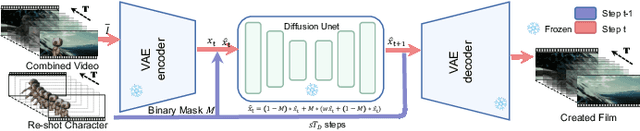
We are living in a flourishing era of digital media, where everyone has the potential to become a personal filmmaker. Current research on cinematic transfer empowers filmmakers to reproduce and manipulate the visual elements (e.g., cinematography and character behaviors) from classic shots. However, characters in the reimagined films still rely on manual crafting, which involves significant technical complexity and high costs, making it unattainable for ordinary users. Furthermore, their estimated cinematography lacks smoothness due to inadequate capturing of inter-frame motion and modeling of physical trajectories. Fortunately, the remarkable success of 2D and 3D AIGC has opened up the possibility of efficiently generating characters tailored to users' needs, diversifying cinematography. In this paper, we propose DreamCinema, a novel cinematic transfer framework that pioneers generative AI into the film production paradigm, aiming at facilitating user-friendly film creation. Specifically, we first extract cinematic elements (i.e., human and camera pose) and optimize the camera trajectory. Then, we apply a character generator to efficiently create 3D high-quality characters with a human structure prior. Finally, we develop a structure-guided motion transfer strategy to incorporate generated characters into film creation and transfer it via 3D graphics engines smoothly. Extensive experiments demonstrate the effectiveness of our method for creating high-quality films with free camera and 3D characters.
Robustness and Generalizability of Deepfake Detection: A Study with Diffusion Models
Sep 05, 2023The rise of deepfake images, especially of well-known personalities, poses a serious threat to the dissemination of authentic information. To tackle this, we present a thorough investigation into how deepfakes are produced and how they can be identified. The cornerstone of our research is a rich collection of artificial celebrity faces, titled DeepFakeFace (DFF). We crafted the DFF dataset using advanced diffusion models and have shared it with the community through online platforms. This data serves as a robust foundation to train and test algorithms designed to spot deepfakes. We carried out a thorough review of the DFF dataset and suggest two evaluation methods to gauge the strength and adaptability of deepfake recognition tools. The first method tests whether an algorithm trained on one type of fake images can recognize those produced by other methods. The second evaluates the algorithm's performance with imperfect images, like those that are blurry, of low quality, or compressed. Given varied results across deepfake methods and image changes, our findings stress the need for better deepfake detectors. Our DFF dataset and tests aim to boost the development of more effective tools against deepfakes.