 Add to Chrome
 Add to Firefox
 Add to Edge
Relax Forcing: Relaxed KV-Memory for Consistent Long Video Generation
Mar 22, 2026
Autoregressive (AR) video diffusion has recently emerged as a promising paradigm for long video generation, enabling causal synthesis beyond the limits of bidirectional models. To address training-inference mismatch, a series of self-forcing strategies have been proposed to improve rollout stability by conditioning the model on its own predictions during training. While these approaches substantially mitigate exposure bias, extending generation to minute-scale horizons remains challenging due to progressive temporal degradation. In this work, we show that this limitation is not primarily caused by insufficient memory, but by how temporal memory is utilised during inference. Through empirical analysis, we find that increasing memory does not consistently improve long-horizon generation, and that the temporal placement of historical context significantly influences motion dynamics while leaving visual quality largely unchanged. These findings suggest that temporal memory should not be treated as a homogeneous buffer. Motivated by this insight, we introduce Relax Forcing, a structured temporal memory mechanism for AR diffusion. Instead of attending to the dense generated history, Relax Forcing decomposes temporal context into three functional roles: Sink for global stability, Tail for short-term continuity, and dynamically selected History for structural motion guidance, and selectively incorporates only the most relevant past information. This design mitigates error accumulation during extrapolation while preserving motion evolution. Experiments on VBench-Long demonstrate that Relax Forcing improves motion dynamics and overall temporal consistency while reducing attention overhead. Our results suggest that structured temporal memory is essential for scalable long video generation, complementing existing forcing-based training strategies.

LatSearch: Latent Reward-Guided Search for Faster Inference-Time Scaling in Video Diffusion
Mar 15, 2026The recent success of inference-time scaling in large language models has inspired similar explorations in video diffusion. In particular, motivated by the existence of "golden noise" that enhances video quality, prior work has attempted to improve inference by optimising or searching for better initial noise. However, these approaches have notable limitations: they either rely on priors imposed at the beginning of noise sampling or on rewards evaluated only on the denoised and decoded videos. This leads to error accumulation, delayed and sparse reward signals, and prohibitive computational cost, which prevents the use of stronger search algorithms. Crucially, stronger search algorithms are precisely what could unlock substantial gains in controllability, sample efficiency and generation quality for video diffusion, provided their computational cost can be reduced. To fill in this gap, we enable efficient inference-time scaling for video diffusion through latent reward guidance, which provides intermediate, informative and efficient feedback along the denoising trajectory. We introduce a latent reward model that scores partially denoised latents at arbitrary timesteps with respect to visual quality, motion quality, and text alignment. Building on this model, we propose LatSearch, a novel inference-time search mechanism that performs Reward-Guided Resampling and Pruning (RGRP). In the resampling stage, candidates are sampled according to reward-normalised probabilities to reduce over-reliance on the reward model. In the pruning stage, applied at the final scheduled step, only the candidate with the highest cumulative reward is retained, improving both quality and efficiency. We evaluate LatSearch on the VBench-2.0 benchmark and demonstrate that it consistently improves video generation across multiple evaluation dimensions compared to the baseline Wan2.1 model.
Temporal Score Analysis for Understanding and Correcting Diffusion Artifacts
Mar 20, 2025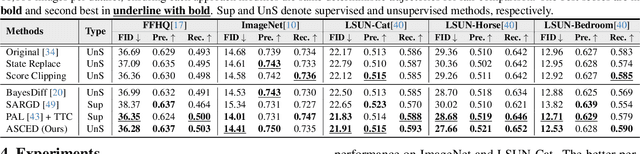
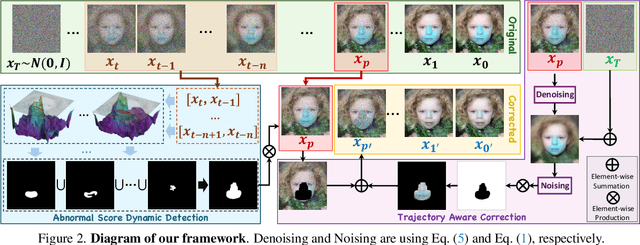
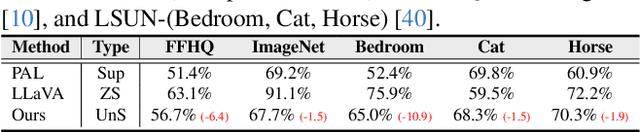
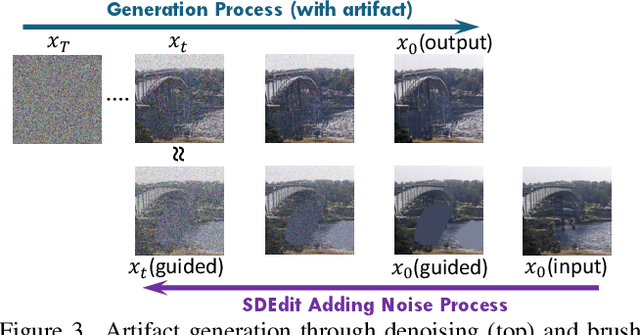
Visual artifacts remain a persistent challenge in diffusion models, even with training on massive datasets. Current solutions primarily rely on supervised detectors, yet lack understanding of why these artifacts occur in the first place. In our analysis, we identify three distinct phases in the diffusion generative process: Profiling, Mutation, and Refinement. Artifacts typically emerge during the Mutation phase, where certain regions exhibit anomalous score dynamics over time, causing abrupt disruptions in the normal evolution pattern. This temporal nature explains why existing methods focusing only on spatial uncertainty of the final output fail at effective artifact localization. Based on these insights, we propose ASCED (Abnormal Score Correction for Enhancing Diffusion), that detects artifacts by monitoring abnormal score dynamics during the diffusion process, with a trajectory-aware on-the-fly mitigation strategy that appropriate generation of noise in the detected areas. Unlike most existing methods that apply post hoc corrections, \eg, by applying a noising-denoising scheme after generation, our mitigation strategy operates seamlessly within the existing diffusion process. Extensive experiments demonstrate that our proposed approach effectively reduces artifacts across diverse domains, matching or surpassing existing supervised methods without additional training.
AIM-Fair: Advancing Algorithmic Fairness via Selectively Fine-Tuning Biased Models with Contextual Synthetic Data
Mar 07, 2025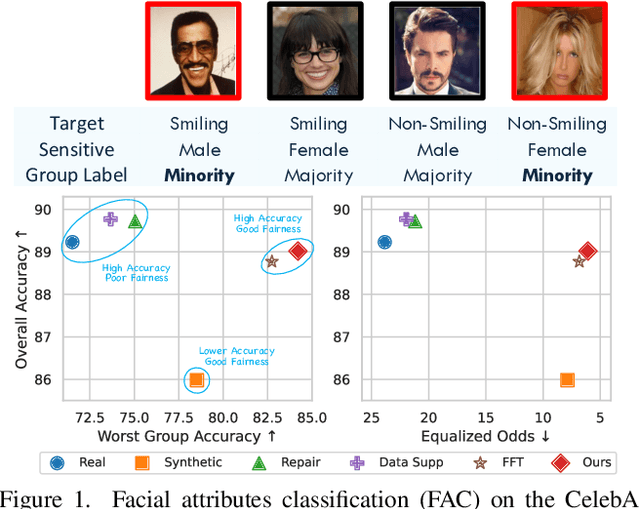
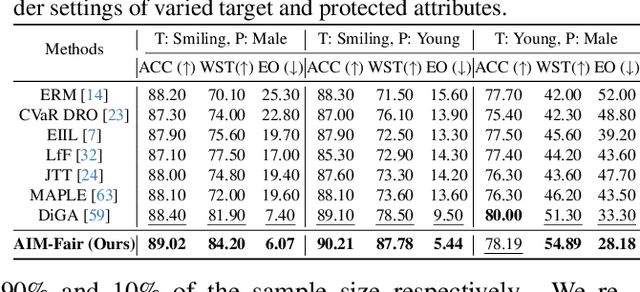
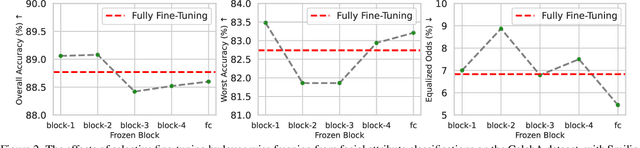
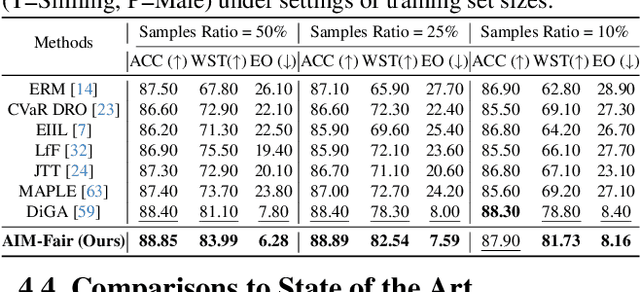
Recent advances in generative models have sparked research on improving model fairness with AI-generated data. However, existing methods often face limitations in the diversity and quality of synthetic data, leading to compromised fairness and overall model accuracy. Moreover, many approaches rely on the availability of demographic group labels, which are often costly to annotate. This paper proposes AIM-Fair, aiming to overcome these limitations and harness the potential of cutting-edge generative models in promoting algorithmic fairness. We investigate a fine-tuning paradigm starting from a biased model initially trained on real-world data without demographic annotations. This model is then fine-tuned using unbiased synthetic data generated by a state-of-the-art diffusion model to improve its fairness. Two key challenges are identified in this fine-tuning paradigm, 1) the low quality of synthetic data, which can still happen even with advanced generative models, and 2) the domain and bias gap between real and synthetic data. To address the limitation of synthetic data quality, we propose Contextual Synthetic Data Generation (CSDG) to generate data using a text-to-image diffusion model (T2I) with prompts generated by a context-aware LLM, ensuring both data diversity and control of bias in synthetic data. To resolve domain and bias shifts, we introduce a novel selective fine-tuning scheme in which only model parameters more sensitive to bias and less sensitive to domain shift are updated. Experiments on CelebA and UTKFace datasets show that our AIM-Fair improves model fairness while maintaining utility, outperforming both fully and partially fine-tuned approaches to model fairness.
Enhancing Zero-Shot Facial Expression Recognition by LLM Knowledge Transfer
May 29, 2024


Current facial expression recognition (FER) models are often designed in a supervised learning manner thus are constrained by the lack of large-scale facial expression images with high-quality annotations. Consequently, these models often fail to generalize well, performing poorly on unseen images in training. Vision-language-based zero-shot models demonstrate a promising potential for addressing such challenges. However, these models lack task-specific knowledge therefore are not optimized for the nuances of recognizing facial expressions. To bridge this gap, this work proposes a novel method, Exp-CLIP, to enhance zero-shot FER by transferring the task knowledge from large language models (LLMs). Specifically, based on the pre-trained vision-language encoders, we incorporate a projection head designed to map the initial joint vision-language space into a space that captures representations of facial actions. To train this projection head for subsequent zero-shot predictions, we propose to align the projected visual representations with task-specific semantic meanings derived from the LLM encoder, and the text instruction-based strategy is employed to customize the LLM knowledge. Given unlabelled facial data and efficient training of the projection head, Exp-CLIP achieves superior zero-shot results to the CLIP models and several other large vision-language models (LVLMs) on seven in-the-wild FER datasets. The code and pre-trained models are available at \url{https://github.com/zengqunzhao/Exp-CLIP}.
Prompting Visual-Language Models for Dynamic Facial Expression Recognition
Aug 25, 2023This paper presents a novel visual-language model called DFER-CLIP, which is based on the CLIP model and designed for in-the-wild Dynamic Facial Expression Recognition (DFER). Specifically, the proposed DFER-CLIP consists of a visual part and a textual part. For the visual part, based on the CLIP image encoder, a temporal model consisting of several Transformer encoders is introduced for extracting temporal facial expression features, and the final feature embedding is obtained as a learnable "class" token. For the textual part, we use as inputs textual descriptions of the facial behaviour that is related to the classes (facial expressions) that we are interested in recognising -- those descriptions are generated using large language models, like ChatGPT. This, in contrast to works that use only the class names and more accurately captures the relationship between them. Alongside the textual description, we introduce a learnable token which helps the model learn relevant context information for each expression during training. Extensive experiments demonstrate the effectiveness of the proposed method and show that our DFER-CLIP also achieves state-of-the-art results compared with the current supervised DFER methods on the DFEW, FERV39k, and MAFW benchmarks. Code is publicly available at https://github.com/zengqunzhao/DFER-CLIP.