 Add to Chrome
 Add to Firefox
 Add to Edge
ProtoPathway: Biologically Structured Prototype-Pathway Fusion for Multimodal Cancer Survival Prediction
May 20, 2026
We introduce ProtoPathway, an interpretable-by-design multimodal framework for cancer survival prediction that unifies whole slide imaging and transcriptomics through encoders producing biologically grounded representations on both sides of the fusion. On the histopathology side, $K$ learnable morphological prototypes, trained end-to-end with the survival objective, serve as the slide representation itself: patches flow into prototype tokens via soft assignment, compressing variable-length patch sets into fixed task-adaptive tokens. On the genomic side, a bipartite graph neural network encodes gene expression within the Reactome pathway hierarchy, producing pathway embeddings that reflect both constituent genes and their broader biological context through bidirectional message passing over a shared gene--pathway graph. Cross-modal attention then operates over a compact prototype $\times$ pathway matrix in which prototypes query pathways, modeling the biological direction in which molecular programs give rise to tissue morphology. Because both axes carry stable task-learned identity, the attention matrix is itself an interpretability output, yielding native inference-time attribution across the full biological hierarchy, from genes through pathways and prototypes to spatial tissue maps. We evaluate on five TCGA cancer cohorts, demonstrating competitive or superior survival prediction with substantially improved biological interpretability and reduced computational cost, with interpretability claims validated through fold-stratified rank-based population-level analysis. Our source code, model weights, and Reactome pathways, together with a unified codebase reimplementing all multimodal survival baselines under identical preprocessing and evaluation, are available at: https://github.com/AmayaGS/ProtoPathway.

OpenUS: A Fully Open-Source Foundation Model for Ultrasound Image Analysis via Self-Adaptive Masked Contrastive Learning
Nov 14, 2025Ultrasound (US) is one of the most widely used medical imaging modalities, thanks to its low cost, portability, real-time feedback, and absence of ionizing radiation. However, US image interpretation remains highly operator-dependent and varies significantly across anatomical regions, acquisition protocols, and device types. These variations, along with unique challenges such as speckle, low contrast, and limited standardized annotations, hinder the development of generalizable, label-efficient ultrasound AI models. In this paper, we propose OpenUS, the first reproducible, open-source ultrasound foundation model built on a large collection of public data. OpenUS employs a vision Mamba backbone, capturing both local and global long-range dependencies across the image. To extract rich features during pre-training, we introduce a novel self-adaptive masking framework that combines contrastive learning with masked image modeling. This strategy integrates the teacher's attention map with student reconstruction loss, adaptively refining clinically-relevant masking to enhance pre-training effectiveness. OpenUS also applies a dynamic learning schedule to progressively adjust the difficulty of the pre-training process. To develop the foundation model, we compile the largest to-date public ultrasound dataset comprising over 308K images from 42 publicly available datasets, covering diverse anatomical regions, institutions, imaging devices, and disease types. Our pre-trained OpenUS model can be easily adapted to specific downstream tasks by serving as a backbone for label-efficient fine-tuning. Code is available at https://github.com/XZheng0427/OpenUS.
BioX-CPath: Biologically-driven Explainable Diagnostics for Multistain IHC Computational Pathology
Mar 26, 2025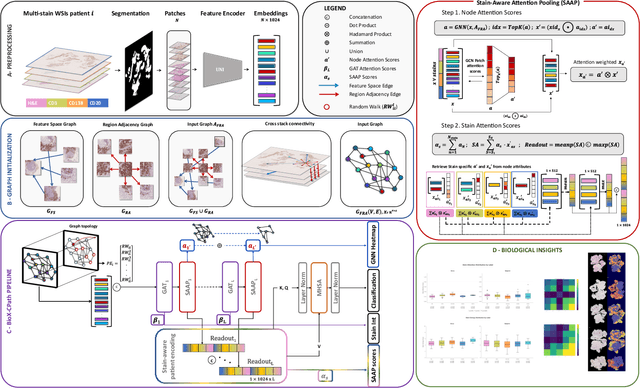
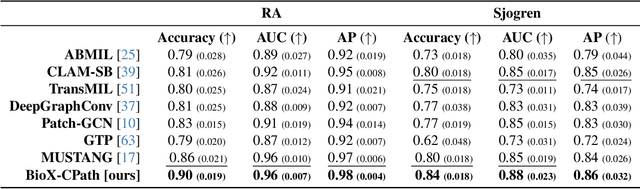
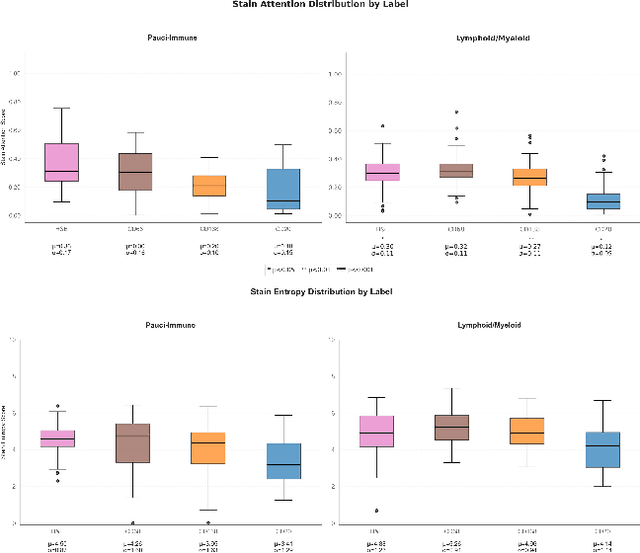
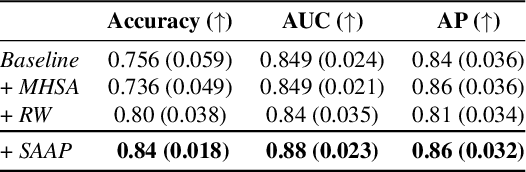
The development of biologically interpretable and explainable models remains a key challenge in computational pathology, particularly for multistain immunohistochemistry (IHC) analysis. We present BioX-CPath, an explainable graph neural network architecture for whole slide image (WSI) classification that leverages both spatial and semantic features across multiple stains. At its core, BioX-CPath introduces a novel Stain-Aware Attention Pooling (SAAP) module that generates biologically meaningful, stain-aware patient embeddings. Our approach achieves state-of-the-art performance on both Rheumatoid Arthritis and Sjogren's Disease multistain datasets. Beyond performance metrics, BioX-CPath provides interpretable insights through stain attention scores, entropy measures, and stain interaction scores, that permit measuring model alignment with known pathological mechanisms. This biological grounding, combined with strong classification performance, makes BioX-CPath particularly suitable for clinical applications where interpretability is key. Source code and documentation can be found at: https://github.com/AmayaGS/BioX-CPath.
Going Beyond H&E and Oncology: How Do Histopathology Foundation Models Perform for Multi-stain IHC and Immunology?
Oct 28, 2024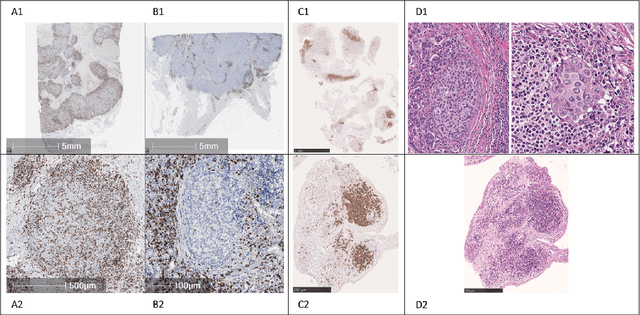
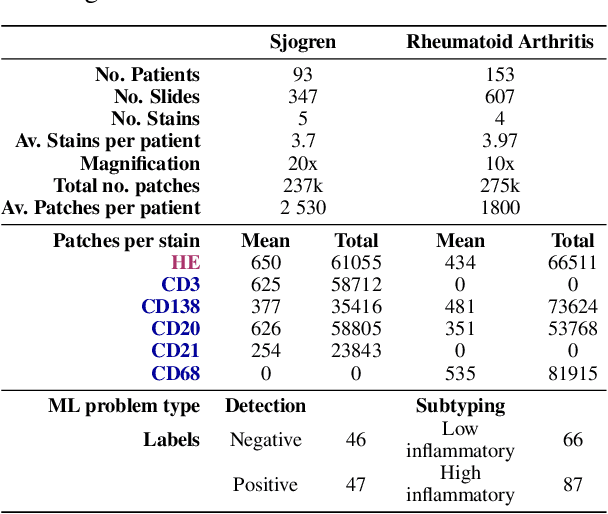
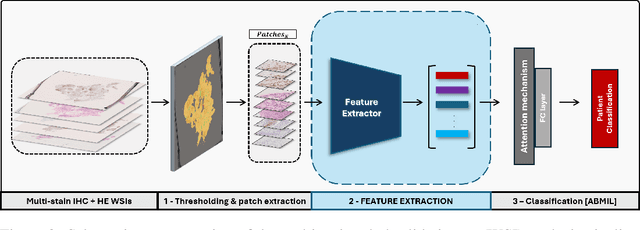
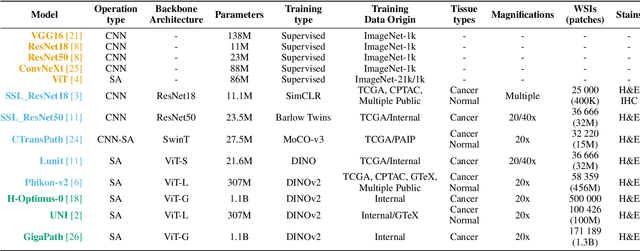
This study evaluates the generalisation capabilities of state-of-the-art histopathology foundation models on out-of-distribution multi-stain autoimmune Immunohistochemistry datasets. We compare 13 feature extractor models, including ImageNet-pretrained networks, and histopathology foundation models trained on both public and proprietary data, on Rheumatoid Arthritis subtyping and Sjogren's Disease detection tasks. Using a simple Attention-Based Multiple Instance Learning classifier, we assess the transferability of learned representations from cancer H&E images to autoimmune IHC images. Contrary to expectations, histopathology-pretrained models did not significantly outperform ImageNet-pretrained models. Furthermore, there was evidence of both autoimmune feature misinterpretation and biased feature importance. Our findings highlight the challenges in transferring knowledge from cancer to autoimmune histopathology and emphasise the need for careful evaluation of AI models across diverse histopathological tasks. The code to run this benchmark is available at https://github.com/AmayaGS/ImmunoHistoBench.
Automated segmentation of rheumatoid arthritis immunohistochemistry stained synovial tissue
Sep 13, 2023Rheumatoid Arthritis (RA) is a chronic, autoimmune disease which primarily affects the joint's synovial tissue. It is a highly heterogeneous disease, with wide cellular and molecular variability observed in synovial tissues. Over the last two decades, the methods available for their study have advanced considerably. In particular, Immunohistochemistry stains are well suited to highlighting the functional organisation of samples. Yet, analysis of IHC-stained synovial tissue samples is still overwhelmingly done manually and semi-quantitatively by expert pathologists. This is because in addition to the fragmented nature of IHC stained synovial tissue, there exist wide variations in intensity and colour, strong clinical centre batch effect, as well as the presence of many undesirable artefacts present in gigapixel Whole Slide Images (WSIs), such as water droplets, pen annotation, folded tissue, blurriness, etc. There is therefore a strong need for a robust, repeatable automated tissue segmentation algorithm which can cope with this variability and provide support to imaging pipelines. We train a UNET on a hand-curated, heterogeneous real-world multi-centre clinical dataset R4RA, which contains multiple types of IHC staining. The model obtains a DICE score of 0.865 and successfully segments different types of IHC staining, as well as dealing with variance in colours, intensity and common WSIs artefacts from the different clinical centres. It can be used as the first step in an automated image analysis pipeline for synovial tissue samples stained with IHC, increasing speed, reproducibility and robustness.