 Add to Chrome
 Add to Firefox
 Add to Edge
Can AI agents conduct open-ended AI research? Early evidence from two case studies
Jul 29, 2026
Forecasts of explosive AI progress hinge on AI agents automating AI research. But evidence on whether agents can carry out open-ended AI research is thin. Current evaluations either test agents on narrow, verifiable tasks, which excludes open-ended research, or submit AI-generated papers to blind peer review, which is overstretched, stochastic, and suffers from poor review quality. We introduce a third way to measure progress towards AI R\&D automation. An agent takes on the central, open-ended research question of a high-quality unpublished paper, and the paper's original authors grade its output. We call these shadow evaluations. We ran shadow evaluations on two unpublished NeurIPS 2026 submissions, giving frontier agents six days and thousands of dollars of compute. The agents completed all of the engineering without human help, yet could not make substantial progress towards answering the research questions. As a result, both papers were unambiguously rejected by the authors. We identify five recurring failure modes: poor judgment about the bar for publishable research, uncreative responses to shortcomings in the research design, ineffective backtracking from dead ends, poor resource awareness, and instruction drift. A robustness check with a second model and scaffold reproduced these failures. We release the expert reviews, survey responses, agent repositories, and logs. Our results provide early evidence that today's agents can do the engineering of AI research, but struggle with critical parts of the research lifecycle.

Life After Benchmark Saturation: A Case Study of CORE-Bench
Jun 23, 2026When a benchmark's accuracy saturates, it is often retired and replaced with a more challenging version. We show that this approach privileges accuracy and misses the opportunity to study six other key dimensions of agent performance: construct validity issues such as shortcuts, out-of-distribution generalizability, efficiency, reliability, the relative importance of the model versus the scaffold, and uplift from human-agent collaboration. We use CORE-Bench Hard, a benchmark for computational reproducibility of scientific code, as a case study to demonstrate that measuring agents along these dimensions yields meaningful insights into agent performance even after accuracy saturates. First, we surface threats to construct validity in CORE-Bench Hard that are difficult to anticipate with less capable agents. We introduce an improved benchmark, CORE-Bench v1.1, and an out-of-distribution task suite, CORE-Bench OOD. Second, we find that despite accuracy saturation, CORE-Bench v1.1 remains useful for measuring efficiency, reliability, model performance, and scaffold performance. Finally, we conduct a small-scale randomized experiment to measure uplift from human-agent collaboration on real-world computational reproducibility tasks. We find a statistically significant speedup by about a factor of two -- likely underestimated due to one-fifth of human-only reproductions reaching the time limit before completing -- and describe various other findings. Together, our contributions present a more rigorous alternative to the dominant accuracy-centric evaluation paradigm.
AI Agents That Matter
Jul 01, 2024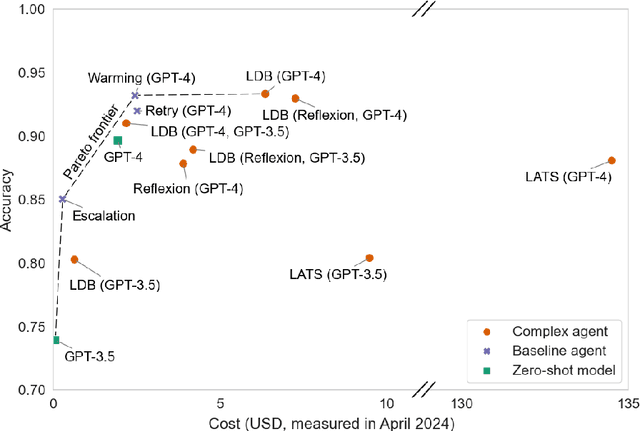

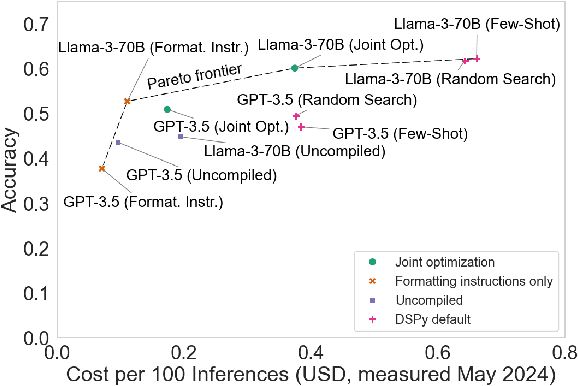
AI agents are an exciting new research direction, and agent development is driven by benchmarks. Our analysis of current agent benchmarks and evaluation practices reveals several shortcomings that hinder their usefulness in real-world applications. First, there is a narrow focus on accuracy without attention to other metrics. As a result, SOTA agents are needlessly complex and costly, and the community has reached mistaken conclusions about the sources of accuracy gains. Our focus on cost in addition to accuracy motivates the new goal of jointly optimizing the two metrics. We design and implement one such optimization, showing its potential to greatly reduce cost while maintaining accuracy. Second, the benchmarking needs of model and downstream developers have been conflated, making it hard to identify which agent would be best suited for a particular application. Third, many agent benchmarks have inadequate holdout sets, and sometimes none at all. This has led to agents that are fragile because they take shortcuts and overfit to the benchmark in various ways. We prescribe a principled framework for avoiding overfitting. Finally, there is a lack of standardization in evaluation practices, leading to a pervasive lack of reproducibility. We hope that the steps we introduce for addressing these shortcomings will spur the development of agents that are useful in the real world and not just accurate on benchmarks.