 Add to Chrome
 Add to Firefox
 Add to Edge
LieIPM: Lie Group Interior Point Method for Direct Trajectory Optimization of Rigid Bodies
Jun 09, 2026
Designing dynamically feasible trajectories for rigid bodies is a fundamental problem in robotics. While direct methods are widely used, the existing constrained optimizers typically operate in Euclidean space and ignore the manifold structure of rigid body motions. This mismatch may introduce singularities or lead to poorly conditioned optimization problems. To bridge this gap, we develop a structure-aware framework for constrained trajectory optimization directly on matrix Lie groups. Our approach is based on the second-order rigid body models utilizing Lie group structures, which enables efficient Newton-type updates while preserving the underlying geometry. Building on this model, we propose a line-search Lie Group Interior Point Method (LieIPM) to handle constraints on the manifolds. We instantiate the framework for rigid body motion planning using Lie group variational integrators and derive closed-form intrinsic derivatives that exploit group symmetries. The LieIPM preserves the topology of rotation motions by construction and avoids singularities. Numerical results demonstrate superior robustness and faster convergence compared to general-purpose solvers and structure-exploiting optimal control methods.

Riemannian Direct Trajectory Optimization of Rigid Bodies on Matrix Lie Groups
May 05, 2025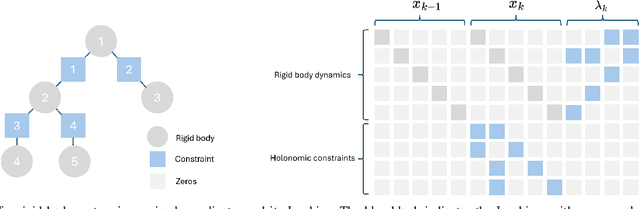
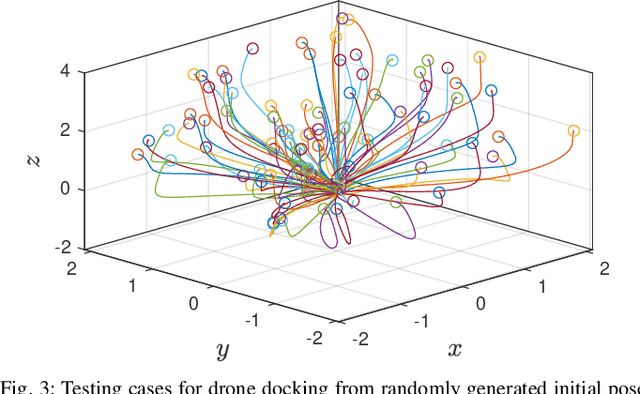
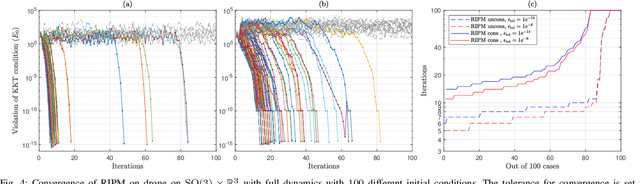
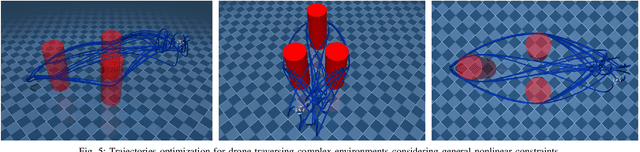
Designing dynamically feasible trajectories for rigid bodies is a fundamental problem in robotics. Although direct trajectory optimization is widely applied to solve this problem, inappropriate parameterizations of rigid body dynamics often result in slow convergence and violations of the intrinsic topological structure of the rotation group. This paper introduces a Riemannian optimization framework for direct trajectory optimization of rigid bodies. We first use the Lie Group Variational Integrator to formulate the discrete rigid body dynamics on matrix Lie groups. We then derive the closed-form first- and second-order Riemannian derivatives of the dynamics. Finally, this work applies a line-search Riemannian Interior Point Method (RIPM) to perform trajectory optimization with general nonlinear constraints. As the optimization is performed on matrix Lie groups, it is correct-by-construction to respect the topological structure of the rotation group and be free of singularities. The paper demonstrates that both the derivative evaluations and Newton steps required to solve the RIPM exhibit linear complexity with respect to the planning horizon and system degrees of freedom. Simulation results illustrate that the proposed method is faster than conventional methods by an order of magnitude in challenging robotics tasks.