 Add to Chrome
 Add to Firefox
 Add to Edge
Pride and Prejudice: Toward an Information-Theoretic Framework for Mutually Communicative Driver Behavior Modeling
Jun 15, 2026
Mixed autonomy driving becomes unsafe and inefficient when autonomous vehicles (AVs) and human-driven vehicles (HVs) misread each other's intentions. We study this problem as implicit mutual communication in lane changes. The proposed framework models how the ego vehicle both expresses its intent and probes the other driver's preference under epistemic uncertainty. It combines a level-k Bayesian persuasion game with virtual features for proactive signaling, information-theoretic rewards for mutual communication, and adaptive weights of communication affordances. We further introduce the Pride-Inquiry (P-I) and Pride-Prejudice (P-P) planes to analyze communication intensity and tendency. The model is calibrated with a Communication-Based Multi-Agent Inverse Reinforcement Learning algorithm (C-MIRL) on the naturalistic NGSIM dataset. Compared with the non-communicative baseline, the proposed model reduces the prediction error of mandatory lane changes by up to 20% while maintaining strong generalization. Driver-In-the-Loop questionnaire scores are positively correlated with the calibrated communication variables, supporting the subjective validity of the model. The learned rewards further show that inquiry and listening affordances contribute more than pride and expression alone, and that inquiry preference varies more strongly across drivers. These results support explicit modeling of mutual communication and epistemic uncertainty in interactive driving.

Proprioceptive Invariant Robot State Estimation
Nov 07, 2023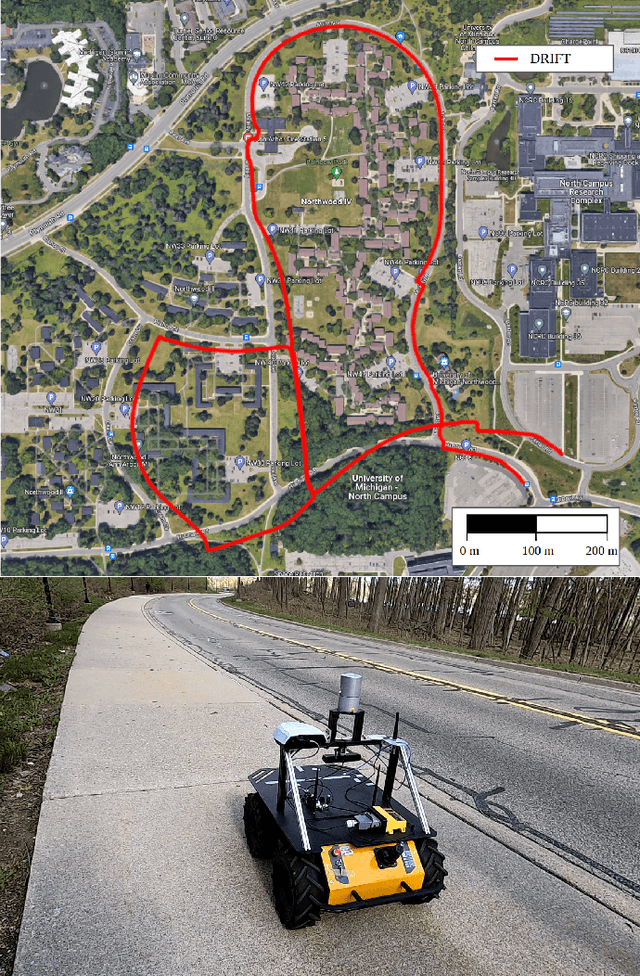
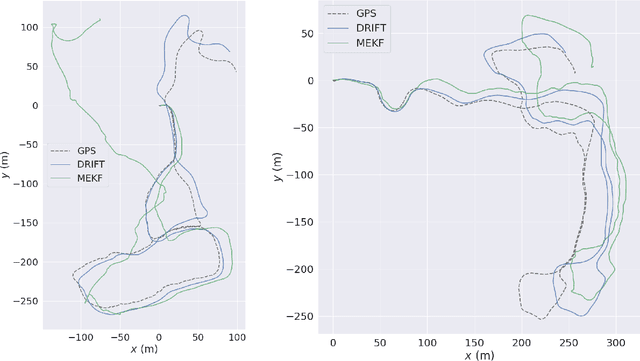
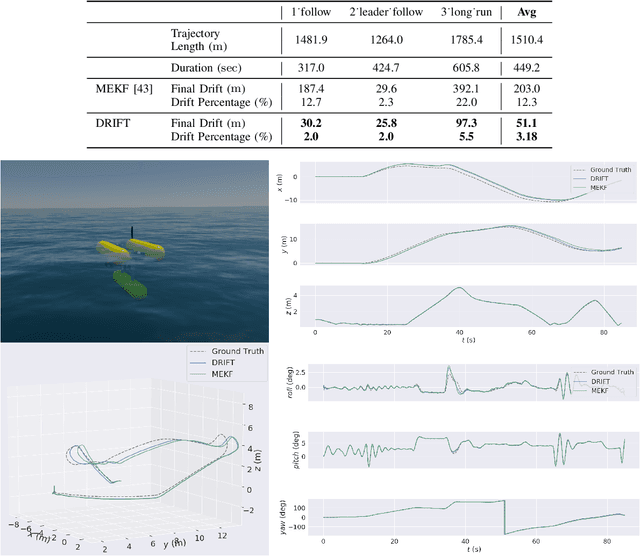
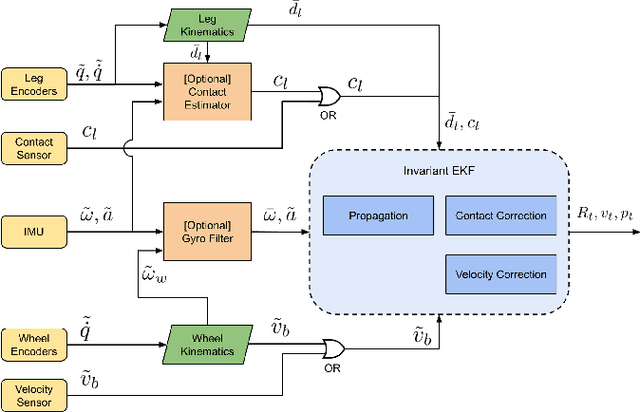
This paper reports on developing a real-time invariant proprioceptive robot state estimation framework called DRIFT. A didactic introduction to invariant Kalman filtering is provided to make this cutting-edge symmetry-preserving approach accessible to a broader range of robotics applications. Furthermore, this work dives into the development of a proprioceptive state estimation framework for dead reckoning that only consumes data from an onboard inertial measurement unit and kinematics of the robot, with two optional modules, a contact estimator and a gyro filter for low-cost robots, enabling a significant capability on a variety of robotics platforms to track the robot's state over long trajectories in the absence of perceptual data. Extensive real-world experiments using a legged robot, an indoor wheeled robot, a field robot, and a full-size vehicle, as well as simulation results with a marine robot, are provided to understand the limits of DRIFT.
Fully Proprioceptive Slip-Velocity-Aware State Estimation for Mobile Robots via Invariant Kalman Filtering and Disturbance Observer
Sep 29, 2022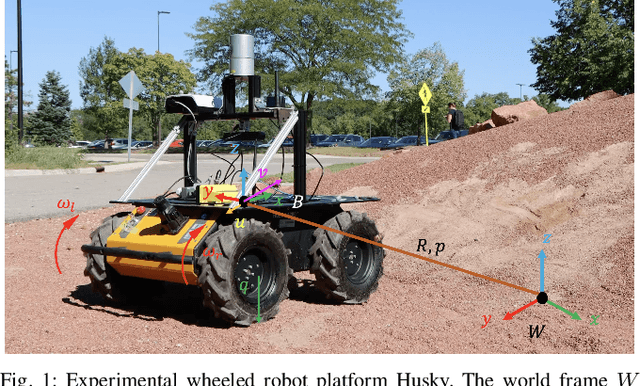
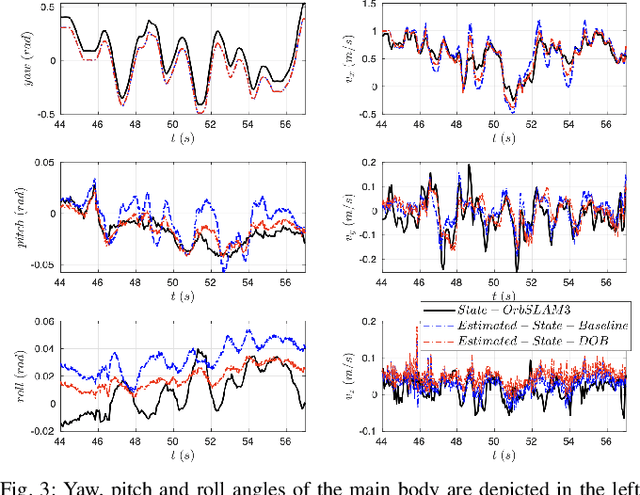
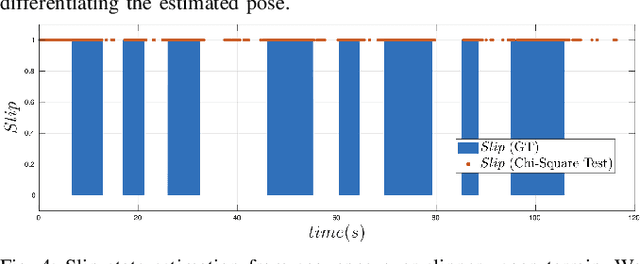
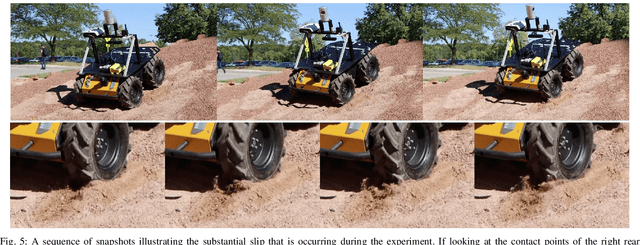
This paper develops a novel slip estimator using the invariant observer design theory and Disturbance Observer (DOB). The proposed state estimator for mobile robots is fully proprioceptive and combines data from an inertial measurement unit and body velocity within a Right Invariant Extended Kalman Filter (RI-EKF). By embedding the slip velocity into $\mathrm{SE}_3(3)$ Lie group, the developed DOB-based RI-EKF provides real-time accurate velocity and slip velocity estimates on different terrains. Experimental results using a Husky wheeled robot confirm the mathematical derivations and show better performance than a standard RI-EKF baseline. Open source software is available for download and reproducing the presented results.