 Add to Chrome
 Add to Firefox
 Add to Edge
LieIPM: Lie Group Interior Point Method for Direct Trajectory Optimization of Rigid Bodies
Jun 09, 2026
Designing dynamically feasible trajectories for rigid bodies is a fundamental problem in robotics. While direct methods are widely used, the existing constrained optimizers typically operate in Euclidean space and ignore the manifold structure of rigid body motions. This mismatch may introduce singularities or lead to poorly conditioned optimization problems. To bridge this gap, we develop a structure-aware framework for constrained trajectory optimization directly on matrix Lie groups. Our approach is based on the second-order rigid body models utilizing Lie group structures, which enables efficient Newton-type updates while preserving the underlying geometry. Building on this model, we propose a line-search Lie Group Interior Point Method (LieIPM) to handle constraints on the manifolds. We instantiate the framework for rigid body motion planning using Lie group variational integrators and derive closed-form intrinsic derivatives that exploit group symmetries. The LieIPM preserves the topology of rotation motions by construction and avoids singularities. Numerical results demonstrate superior robustness and faster convergence compared to general-purpose solvers and structure-exploiting optimal control methods.

HumanSplatHMR: Closing the Loop Between Human Mesh Recovery and Gaussian Splatting Avatar
May 04, 2026Accurately recovering human pose and appearance from video is an essential component of scene reconstruction, with applications to motion capture, motion prediction, virtual reality, and digital twinning. Despite significant interest in building realistic human avatars from video, this paper demonstrates that existing methods do not accurately recover the 3D geometry of humans. ViT-based approaches are not consistently reliable and can overfit to 2D views, while NeRF- and Gaussian Splatting-based avatars treat pose and appearance separately, limiting rendering generalization to new poses. To resolve these shortcomings, this paper proposes HumanSplatHMR, a joint optimization framework that refines 3D human poses while simultaneously learning a high-fidelity avatar for novel-view and novel-pose synthesis. Our key insight is to close the loop between geometric pose estimation and differentiable rendering. Unlike prior human avatar methods that rely on accurate human pose obtained through motion capture systems or offline refinement, which are impractical in in-the-wild scenarios, our approach uses only human mesh estimates from a state-of-the-art human pose estimator to better reflect real-world conditions. Therefore, instead of using the human pose only as a deformation prior, HumanSplatHMR backpropagates photometric, segmentation, and depth losses through a differentiable renderer to the pose parameters and global position. This coupling refines the global 3D pose over time, improving accuracy and alignment while producing better renderings from novel views. Experiments show consistent improvements over pose recovery baselines that omit image-level refinement and avatar baselines that decouple pose estimation from avatar reconstruction.
TrackDeform3D: Markerless and Autonomous 3D Keypoint Tracking and Dataset Collection for Deformable Objects
Mar 17, 2026Structured 3D representations such as keypoints and meshes offer compact, expressive descriptions of deformable objects, jointly capturing geometric and topological information useful for downstream tasks such as dynamics modeling and motion planning. However, robustly extracting such representations remains challenging, as current perception methods struggle to handle complex deformations. Moreover, large-scale 3D data collection remains a bottleneck: existing approaches either require prohibitive data collection efforts, such as labor-intensive annotation or expensive motion capture setups, or rely on simplifying assumptions that break down in unstructured environments. As a result, large-scale 3D datasets and benchmarks for deformable objects remain scarce. To address these challenges, this paper presents an affordable and autonomous framework for collecting 3D datasets of deformable objects using only RGB-D cameras. The proposed method identifies 3D keypoints and robustly tracks their trajectories, incorporating motion consistency constraints to produce temporally smooth and geometrically coherent data. TrackDeform3D is evaluated against several state-of-the-art tracking methods across diverse object categories and demonstrates consistent improvements in both geometric and tracking accuracy. Using this framework, this paper presents a high-quality, large-scale dataset consisting of 6 deformable objects, totaling 110 minutes of trajectory data.
LongNav-R1: Horizon-Adaptive Multi-Turn RL for Long-Horizon VLA Navigation
Feb 12, 2026This paper develops LongNav-R1, an end-to-end multi-turn reinforcement learning (RL) framework designed to optimize Visual-Language-Action (VLA) models for long-horizon navigation. Unlike existing single-turn paradigm, LongNav-R1 reformulates the navigation decision process as a continuous multi-turn conversation between the VLA policy and the embodied environment. This multi-turn RL framework offers two distinct advantages: i) it enables the agent to reason about the causal effects of historical interactions and sequential future outcomes; and ii) it allows the model to learn directly from online interactions, fostering diverse trajectory generation and avoiding the behavioral rigidity often imposed by human demonstrations. Furthermore, we introduce Horizon-Adaptive Policy Optimization. This mechanism explicitly accounts for varying horizon lengths during advantage estimation, facilitating accurate temporal credit assignment over extended sequences. Consequently, the agent develops diverse navigation behaviors and resists collapse during long-horizon tasks. Experiments on object navigation benchmarks validate the framework's efficacy: With 4,000 rollout trajectories, LongNav-R1 boosts the Qwen3-VL-2B success rate from 64.3% to 73.0%. These results demonstrate superior sample efficiency and significantly outperform state-of-the-art methods. The model's generalizability and robustness are further validated by its zero-shot performance in long-horizon real-world navigation settings. All source code will be open-sourced upon publication.
SurfSLAM: Sim-to-Real Underwater Stereo Reconstruction For Real-Time SLAM
Jan 15, 2026Localization and mapping are core perceptual capabilities for underwater robots. Stereo cameras provide a low-cost means of directly estimating metric depth to support these tasks. However, despite recent advances in stereo depth estimation on land, computing depth from image pairs in underwater scenes remains challenging. In underwater environments, images are degraded by light attenuation, visual artifacts, and dynamic lighting conditions. Furthermore, real-world underwater scenes frequently lack rich texture useful for stereo depth estimation and 3D reconstruction. As a result, stereo estimation networks trained on in-air data cannot transfer directly to the underwater domain. In addition, there is a lack of real-world underwater stereo datasets for supervised training of neural networks. Poor underwater depth estimation is compounded in stereo-based Simultaneous Localization and Mapping (SLAM) algorithms, making it a fundamental challenge for underwater robot perception. To address these challenges, we propose a novel framework that enables sim-to-real training of underwater stereo disparity estimation networks using simulated data and self-supervised finetuning. We leverage our learned depth predictions to develop \algname, a novel framework for real-time underwater SLAM that fuses stereo cameras with IMU, barometric, and Doppler Velocity Log (DVL) measurements. Lastly, we collect a challenging real-world dataset of shipwreck surveys using an underwater robot. Our dataset features over 24,000 stereo pairs, along with high-quality, dense photogrammetry models and reference trajectories for evaluation. Through extensive experiments, we demonstrate the advantages of the proposed training approach on real-world data for improving stereo estimation in the underwater domain and for enabling accurate trajectory estimation and 3D reconstruction of complex shipwreck sites.
SLIM-VDB: A Real-Time 3D Probabilistic Semantic Mapping Framework
Dec 15, 2025This paper introduces SLIM-VDB, a new lightweight semantic mapping system with probabilistic semantic fusion for closed-set or open-set dictionaries. Advances in data structures from the computer graphics community, such as OpenVDB, have demonstrated significantly improved computational and memory efficiency in volumetric scene representation. Although OpenVDB has been used for geometric mapping in robotics applications, semantic mapping for scene understanding with OpenVDB remains unexplored. In addition, existing semantic mapping systems lack support for integrating both fixed-category and open-language label predictions within a single framework. In this paper, we propose a novel 3D semantic mapping system that leverages the OpenVDB data structure and integrates a unified Bayesian update framework for both closed- and open-set semantic fusion. Our proposed framework, SLIM-VDB, achieves significant reduction in both memory and integration times compared to current state-of-the-art semantic mapping approaches, while maintaining comparable mapping accuracy. An open-source C++ codebase with a Python interface is available at https://github.com/umfieldrobotics/slim-vdb.
Imaginative World Modeling with Scene Graphs for Embodied Agent Navigation
Aug 09, 2025Semantic navigation requires an agent to navigate toward a specified target in an unseen environment. Employing an imaginative navigation strategy that predicts future scenes before taking action, can empower the agent to find target faster. Inspired by this idea, we propose SGImagineNav, a novel imaginative navigation framework that leverages symbolic world modeling to proactively build a global environmental representation. SGImagineNav maintains an evolving hierarchical scene graphs and uses large language models to predict and explore unseen parts of the environment. While existing methods solely relying on past observations, this imaginative scene graph provides richer semantic context, enabling the agent to proactively estimate target locations. Building upon this, SGImagineNav adopts an adaptive navigation strategy that exploits semantic shortcuts when promising and explores unknown areas otherwise to gather additional context. This strategy continuously expands the known environment and accumulates valuable semantic contexts, ultimately guiding the agent toward the target. SGImagineNav is evaluated in both real-world scenarios and simulation benchmarks. SGImagineNav consistently outperforms previous methods, improving success rate to 65.4 and 66.8 on HM3D and HSSD, and demonstrating cross-floor and cross-room navigation in real-world environments, underscoring its effectiveness and generalizability.
Riemannian Direct Trajectory Optimization of Rigid Bodies on Matrix Lie Groups
May 05, 2025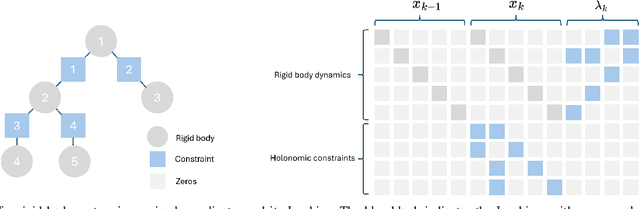
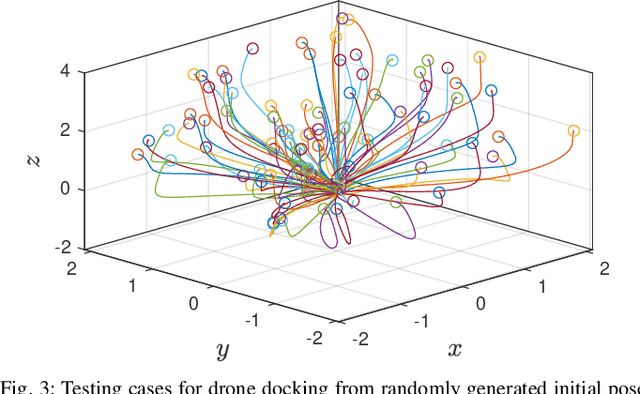
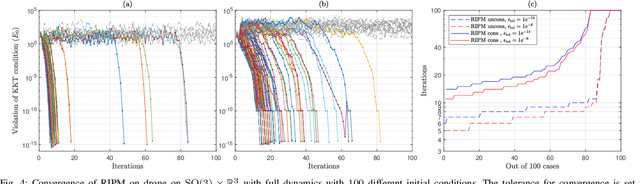
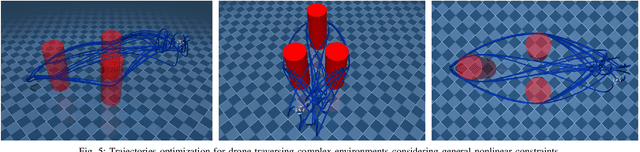
Designing dynamically feasible trajectories for rigid bodies is a fundamental problem in robotics. Although direct trajectory optimization is widely applied to solve this problem, inappropriate parameterizations of rigid body dynamics often result in slow convergence and violations of the intrinsic topological structure of the rotation group. This paper introduces a Riemannian optimization framework for direct trajectory optimization of rigid bodies. We first use the Lie Group Variational Integrator to formulate the discrete rigid body dynamics on matrix Lie groups. We then derive the closed-form first- and second-order Riemannian derivatives of the dynamics. Finally, this work applies a line-search Riemannian Interior Point Method (RIPM) to perform trajectory optimization with general nonlinear constraints. As the optimization is performed on matrix Lie groups, it is correct-by-construction to respect the topological structure of the rotation group and be free of singularities. The paper demonstrates that both the derivative evaluations and Newton steps required to solve the RIPM exhibit linear complexity with respect to the planning horizon and system degrees of freedom. Simulation results illustrate that the proposed method is faster than conventional methods by an order of magnitude in challenging robotics tasks.
Phasing Through the Flames: Rapid Motion Planning with the AGHF PDE for Arbitrary Objective Functions and Constraints
May 02, 2025The generation of optimal trajectories for high-dimensional robotic systems under constraints remains computationally challenging due to the need to simultaneously satisfy dynamic feasibility, input limits, and task-specific objectives while searching over high-dimensional spaces. Recent approaches using the Affine Geometric Heat Flow (AGHF) Partial Differential Equation (PDE) have demonstrated promising results, generating dynamically feasible trajectories for complex systems like the Digit V3 humanoid within seconds. These methods efficiently solve trajectory optimization problems over a two-dimensional domain by evolving an initial trajectory to minimize control effort. However, these AGHF approaches are limited to a single type of optimal control problem (i.e., minimizing the integral of squared control norms) and typically require initial guesses that satisfy constraints to ensure satisfactory convergence. These limitations restrict the potential utility of the AGHF PDE especially when trying to synthesize trajectories for robotic systems. This paper generalizes the AGHF formulation to accommodate arbitrary cost functions, significantly expanding the classes of trajectories that can be generated. This work also introduces a Phase1 - Phase 2 Algorithm that enables the use of constraint-violating initial guesses while guaranteeing satisfactory convergence. The effectiveness of the proposed method is demonstrated through comparative evaluations against state-of-the-art techniques across various dynamical systems and challenging trajectory generation problems. Project Page: https://roahmlab.github.io/BLAZE/
Provably-Safe, Online System Identification
Apr 30, 2025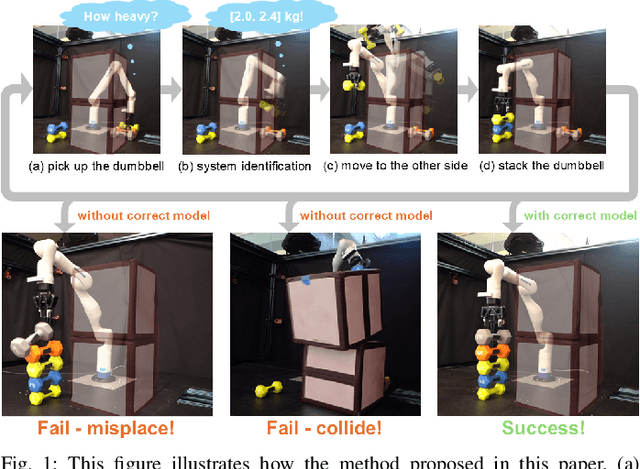
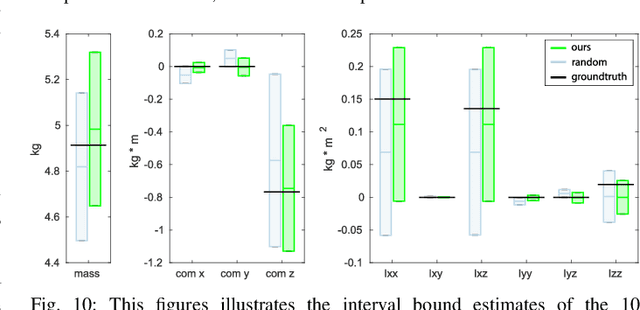
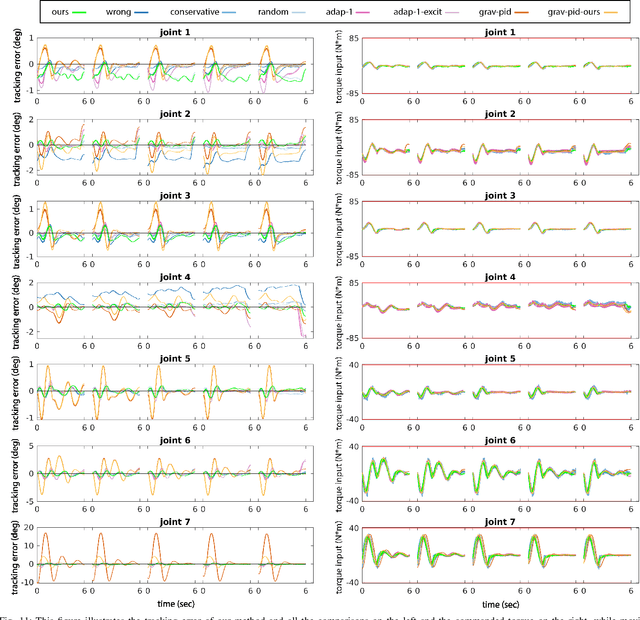
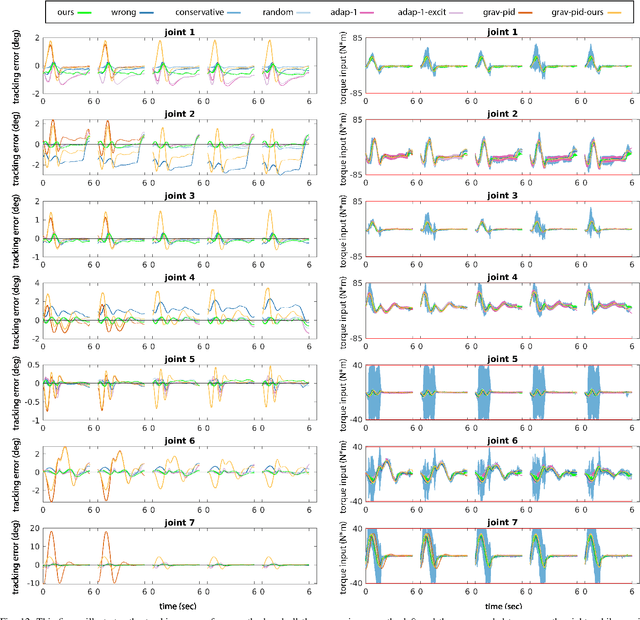
Precise manipulation tasks require accurate knowledge of payload inertial parameters. Unfortunately, identifying these parameters for unknown payloads while ensuring that the robotic system satisfies its input and state constraints while avoiding collisions with the environment remains a significant challenge. This paper presents an integrated framework that enables robotic manipulators to safely and automatically identify payload parameters while maintaining operational safety guarantees. The framework consists of two synergistic components: an online trajectory planning and control framework that generates provably-safe exciting trajectories for system identification that can be tracked while respecting robot constraints and avoiding obstacles and a robust system identification method that computes rigorous overapproximative bounds on end-effector inertial parameters assuming bounded sensor noise. Experimental validation on a robotic manipulator performing challenging tasks with various unknown payloads demonstrates the framework's effectiveness in establishing accurate parameter bounds while maintaining safety throughout the identification process. The code is available at our project webpage: https://roahmlab.github.io/OnlineSafeSysID/.