 Add to Chrome
 Add to Firefox
 Add to Edge
CAST: Mitigating Object Hallucination in Large Vision-Language Models via Caption-Guided Visual Attention Steering
May 06, 2026
Although Large Vision-Language Models (LVLMs) have demonstrated remarkable performance on downstream tasks, they frequently produce contents that deviate from visual information, leading to object hallucination. To tackle this, recent works mostly depend on expensive manual annotations and training cost, or decoding strategies which significantly increase inference time. In this work, we observe that LVLMs' attention to visual information is significantly enhanced when answering caption queries compared to non-caption queries. Inspired by this phenomenon, we propose Caption-guided Visual Attention Steering (CAST), a training-free, plug-and-play hallucination mitigation method that leverages the attention activation pattern corresponding to caption queries to enhance LVLMs' visual perception capability. Specifically, we use probing techniques to identify attention heads that are highly sensitive to caption queries and estimate optimized steering directions for their outputs. This steering strengthens LVLM's fine-grained visual perception capabilities, thereby effectively mitigating object hallucination. CAST reduced object hallucination by an average of 6.03% across five widely used LVLMs and five benchmarks including both discriminative and generative tasks, demonstrating state-of-the-art performance while adding little inference cost and preserving other foundational capabilities.

Not All Tokens See Equally: Perception-Grounded Policy Optimization for Large Vision-Language Models
Apr 02, 2026While Reinforcement Learning from Verifiable Rewards (RLVR) has advanced reasoning in Large Vision-Language Models (LVLMs), prevailing frameworks suffer from a foundational methodological flaw: by distributing identical advantages across all generated tokens, these methods inherently dilute the learning signals essential for optimizing the critical, visually-grounded steps of multimodal reasoning. To bridge this gap, we formulate \textit{Token Visual Dependency}, quantifying the causal information gain of visual inputs via the Kullback-Leibler (KL) divergence between visual-conditioned and text-only predictive distributions. Revealing that this dependency is highly sparse and semantically pivotal, we introduce Perception-Grounded Policy Optimization (PGPO), which is a novel fine-grained credit assignment framework that dynamically reshapes advantages at the token level. Through a threshold-gated, mass-conserving mechanism, PGPO actively amplifies learning signals for visually-dependent tokens while suppressing gradient noise from linguistic priors. Extensive experiments based on the Qwen2.5-VL series across seven challenging multimodal reasoning benchmarks demonstrate that PGPO boosts models by 18.7% on average. Both theoretical and empirical analyses confirm that PGPO effectively reduces gradient variance, prevents training collapse, and acts as a potent regularizer for robust, perception-grounded multimodal reasoning. Code will be published on https://github.com/Yzk1114/PGPO.
Causal Tracing of Object Representations in Large Vision Language Models: Mechanistic Interpretability and Hallucination Mitigation
Nov 19, 2025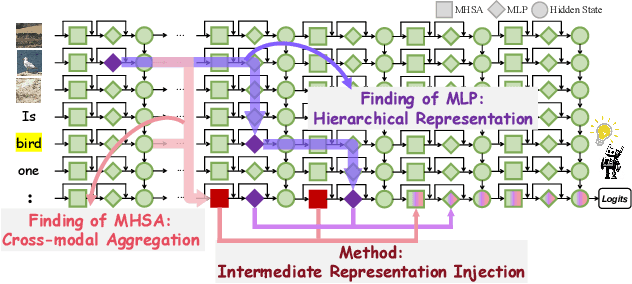

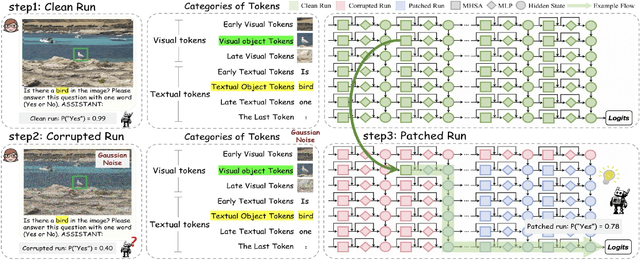
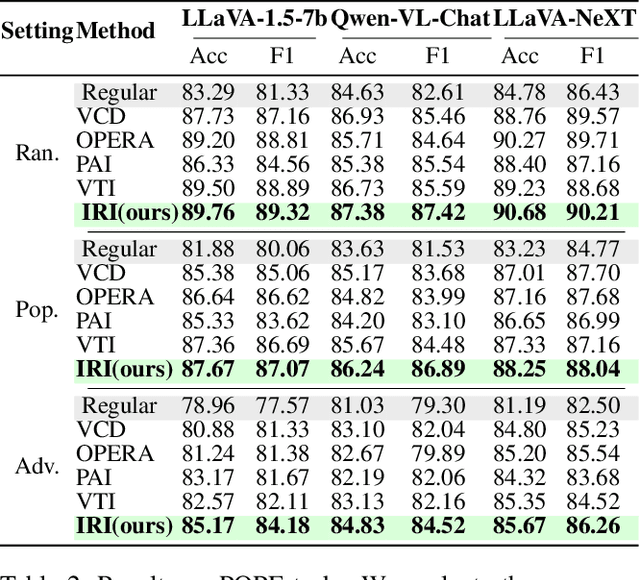
Despite the remarkable advancements of Large Vision-Language Models (LVLMs), the mechanistic interpretability remains underexplored. Existing analyses are insufficiently comprehensive and lack examination covering visual and textual tokens, model components, and the full range of layers. This limitation restricts actionable insights to improve the faithfulness of model output and the development of downstream tasks, such as hallucination mitigation. To address this limitation, we introduce Fine-grained Cross-modal Causal Tracing (FCCT) framework, which systematically quantifies the causal effects on visual object perception. FCCT conducts fine-grained analysis covering the full range of visual and textual tokens, three core model components including multi-head self-attention (MHSA), feed-forward networks (FFNs), and hidden states, across all decoder layers. Our analysis is the first to demonstrate that MHSAs of the last token in middle layers play a critical role in aggregating cross-modal information, while FFNs exhibit a three-stage hierarchical progression for the storage and transfer of visual object representations. Building on these insights, we propose Intermediate Representation Injection (IRI), a training-free inference-time technique that reinforces visual object information flow by precisely intervening on cross-modal representations at specific components and layers, thereby enhancing perception and mitigating hallucination. Consistent improvements across five widely used benchmarks and LVLMs demonstrate IRI achieves state-of-the-art performance, while preserving inference speed and other foundational performance.