 Add to Chrome
 Add to Firefox
 Add to Edge
Cross-Attention Calibrated Deduplication for Retrieval-Augmented Generation System
Jul 27, 2026
Common chunking strategies in Retrieval-Augmented Generation (RAG) systems often create redundant chunks. These redundant chunks make the vector database bigger and slow down retrieval. A common fix is cosine-similarity thresholding. This method reduces each chunk to a single vector, then compares vectors using a similarity score. But a single vector can lose the fine-grained, token-level detail needed to tell a true duplicate apart from a chunk that just shares the same topic. We propose Cross-Attention Calibrated Deduplication (CACD). CACD checks each new chunk against an in-memory pool of chunks already kept, using a cross-encoder instead of a single pooled vector. This keeps token-level detail all the way to the final comparison. CACD combines three parts: the cross-encoder comparison itself, a New Information Score (NIS) that measures how much of a chunk is not explained by a candidate already kept, and a majority vote across several candidates rather than a single best match. NIS is calculated from the attention entropy of the cross-encoder. We tested CACD against five existing filtering methods, nine chunking strategies, and 18 configurations, all on the full SQuAD 1.1 validation set. In our experiments, CACD removes 9.75% of chunks on average. This drop rate is close to other semantic-level methods, and much higher than exact-match filters, which barely remove anything. In these experiments, CACD also processes each configuration in 51.0 seconds on average, about 27% faster than the strongest baseline, NERExact (69.6s), and about 7x faster than cosine-similarity filtering (356.7s). These results come from a single dataset, so we present them as an early comparison, not a general claim. Code for the baseline evaluation and for CACD is available at https://github.com/lehuyphuong/rag_bench and https://github.com/lehuyphuong/cacd_dedup.

Audited Conformal Prediction for Classification under Unknown Distribution Shift
Jun 12, 2026We consider the problem of uncertainty quantification for a pretrained classification model deployed under unknown distribution shift. We propose Audited Conformal Prediction (ACP), a method that leverages a small labeled dataset from the target population to train an auxiliary audit model identifying inputs where the legacy model is likely to fail. By integrating the audit model's outputs into the conformal prediction framework, ACP produces prediction sets that guarantee marginal coverage while achieving substantially higher conditional coverage in practice than existing approaches. We develop and analyze two complementary integration strategies -- one targeting marginal coverage with improved conditional performance, the other providing explicit group-conditional coverage guarantees -- and establish theoretical guarantees for both. Experiments on synthetic and real-world datasets validate the method and illustrate trade-offs between prediction set size and conditional coverage.
Dynamic Tokenization via Reinforcement Patching: End-to-end Training and Zero-shot Transfer
Mar 27, 2026Efficiently aggregating spatial or temporal horizons to acquire compact representations has become a unifying principle in modern deep learning models, yet learning data-adaptive representations for long-horizon sequence data, especially continuous sequences like time series, remains an open challenge. While fixed-size patching has improved scalability and performance, discovering variable-sized, data-driven patches end-to-end often forces models to rely on soft discretization, specific backbones, or heuristic rules. In this work, we propose Reinforcement Patching (ReinPatch), the first framework to jointly optimize a sequence patching policy and its downstream sequence backbone model using reinforcement learning. By formulating patch boundary placement as a discrete decision process optimized via Group Relative Policy Gradient (GRPG), ReinPatch bypasses the need for continuous relaxations and performs dynamic patching policy optimization in a natural manner. Moreover, our method allows strict enforcement of a desired compression rate, freeing the downstream backbone to scale efficiently, and naturally supports multi-level hierarchical modeling. We evaluate ReinPatch on time-series forecasting datasets, where it demonstrates compelling performance compared to state-of-the-art data-driven patching strategies. Furthermore, our detached design allows the patching module to be extracted as a standalone foundation patcher, providing the community with visual and empirical insights into the segmentation behaviors preferred by a purely performance-driven neural patching strategy.
TimeSqueeze: Dynamic Patching for Efficient Time Series Forecasting
Mar 11, 2026Transformer-based time series foundation models face a fundamental trade-off in choice of tokenization: point-wise embeddings preserve temporal fidelity but scale poorly with sequence length, whereas fixed-length patching improves efficiency by imposing uniform boundaries that may disrupt natural transitions and blur informative local dynamics. In order to address these limitations, we introduce TimeSqueeze, a dynamic patching mechanism that adaptively selects patch boundaries within each sequence based on local signal complexity. TimeSqueeze first applies a lightweight state-space encoder to extract full-resolution point-wise features, then performs content-aware segmentation by allocating short patches to information-dense regions and long patches to smooth or redundant segments. This variable-resolution compression preserves critical temporal structure while substantially reducing the token sequence presented to the Transformer backbone. Specifically for large-scale pretraining, TimeSqueeze attains up to 20x faster convergence and 8x higher data efficiency compared to equivalent point-token baselines. Experiments across long-horizon forecasting benchmarks show that TimeSqueeze consistently outperforms comparable architectures that use either point-wise tokenization or fixed-size patching.
Deep TPC: Temporal-Prior Conditioning for Time Series Forecasting
Feb 18, 2026LLM-for-time series (TS) methods typically treat time shallowly, injecting positional or prompt-based cues once at the input of a largely frozen decoder, which limits temporal reasoning as this information degrades through the layers. We introduce Temporal-Prior Conditioning (TPC), which elevates time to a first-class modality that conditions the model at multiple depths. TPC attaches a small set of learnable time series tokens to the patch stream; at selected layers these tokens cross-attend to temporal embeddings derived from compact, human-readable temporal descriptors encoded by the same frozen LLM, then feed temporal context back via self-attention. This disentangles time series signal and temporal information while maintaining a low parameter budget. We show that by training only the cross-attention modules and explicitly disentangling time series signal and temporal information, TPC consistently outperforms both full fine-tuning and shallow conditioning strategies, achieving state-of-the-art performance in long-term forecasting across diverse datasets. Code available at: https://github.com/fil-mp/Deep_tpc
Temporal Tokenization Strategies for Event Sequence Modeling with Large Language Models
Dec 16, 2025Representing continuous time is a critical and under-explored challenge in modeling temporal event sequences with large language models (LLMs). Various strategies like byte-level representations or calendar tokens have been proposed. However, the optimal approach remains unclear, especially given the diverse statistical distributions of real-world event data, which range from smooth log-normal to discrete, spiky patterns. This paper presents the first empirical study of temporal tokenization for event sequences, comparing distinct encoding strategies: naive numeric strings, high-precision byte-level representations, human-semantic calendar tokens, classic uniform binning, and adaptive residual scalar quantization. We evaluate these strategies by fine-tuning LLMs on real-world datasets that exemplify these diverse distributions. Our analysis reveals that no single strategy is universally superior; instead, prediction performance depends heavily on aligning the tokenizer with the data's statistical properties, with log-based strategies excelling on skewed distributions and human-centric formats proving robust for mixed modalities.
VITRO: Vocabulary Inversion for Time-series Representation Optimization
Dec 23, 2024Although LLMs have demonstrated remarkable capabilities in processing and generating textual data, their pre-trained vocabularies are ill-suited for capturing the nuanced temporal dynamics and patterns inherent in time series. The discrete, symbolic nature of natural language tokens, which these vocabularies are designed to represent, does not align well with the continuous, numerical nature of time series data. To address this fundamental limitation, we propose VITRO. Our method adapts textual inversion optimization from the vision-language domain in order to learn a new time series per-dataset vocabulary that bridges the gap between the discrete, semantic nature of natural language and the continuous, numerical nature of time series data. We show that learnable time series-specific pseudo-word embeddings represent time series data better than existing general language model vocabularies, with VITRO-enhanced methods achieving state-of-the-art performance in long-term forecasting across most datasets.
Scaling-laws for Large Time-series Models
May 22, 2024Scaling laws for large language models (LLMs) have provided useful guidance on how to train ever larger models for predictable performance gains. Time series forecasting shares a similar sequential structure to language, and is amenable to large-scale transformer architectures. Here we show that foundational decoder-only time series transformer models exhibit analogous scaling-behavior to LLMs, while architectural details (aspect ratio and number of heads) have a minimal effect over broad ranges. We assemble a large corpus of heterogenous time series data on which to train, and establish, for the first time, power-law scaling relations with respect to parameter count, dataset size, and training compute, spanning five orders of magnitude.
Tiny Time Mixers : Fast Pre-trained Models for Enhanced Zero/Few-Shot Forecasting of Multivariate Time Series
Jan 17, 2024Large pre-trained models for zero/few-shot learning excel in language and vision domains but encounter challenges in multivariate time series (TS) due to the diverse nature and scarcity of publicly available pre-training data. Consequently, there has been a recent surge in utilizing pre-trained large language models (LLMs) with token adaptations for TS forecasting. These approaches employ cross-domain transfer learning and surprisingly yield impressive results. However, these models are typically very slow and large (~billion parameters) and do not consider cross-channel correlations. To address this, we present Tiny Time Mixers (TTM), a significantly small model based on the lightweight TSMixer architecture. TTM marks the first success in developing fast and tiny general pre-trained models (<1M parameters), exclusively trained on public TS datasets, with effective transfer learning capabilities for forecasting. To tackle the complexity of pre-training on multiple datasets with varied temporal resolutions, we introduce several novel enhancements such as adaptive patching, dataset augmentation via downsampling, and resolution prefix tuning. Moreover, we employ a multi-level modeling strategy to effectively model channel correlations and infuse exogenous signals during fine-tuning, a crucial capability lacking in existing benchmarks. TTM shows significant accuracy gains (12-38\%) over popular benchmarks in few/zero-shot forecasting. It also drastically reduces the compute needs as compared to LLM-TS methods, with a 14X cut in learnable parameters, 106X less total parameters, and substantial reductions in fine-tuning (65X) and inference time (54X). In fact, TTM's zero-shot often surpasses the few-shot results in many popular benchmarks, highlighting the efficacy of our approach. Code and pre-trained models will be open-sourced.
AutoMixer for Improved Multivariate Time-Series Forecasting on Business and IT Observability Data
Nov 02, 2023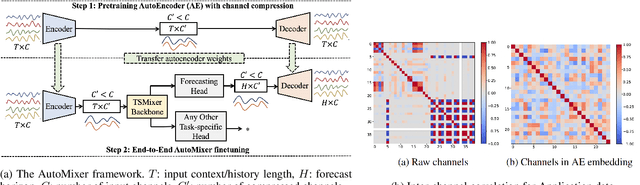


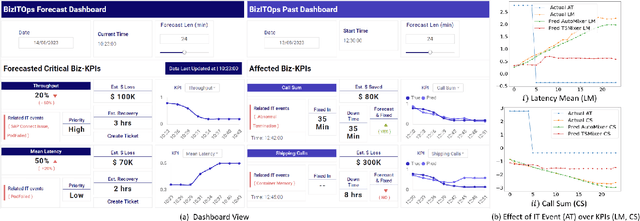
The efficiency of business processes relies on business key performance indicators (Biz-KPIs), that can be negatively impacted by IT failures. Business and IT Observability (BizITObs) data fuses both Biz-KPIs and IT event channels together as multivariate time series data. Forecasting Biz-KPIs in advance can enhance efficiency and revenue through proactive corrective measures. However, BizITObs data generally exhibit both useful and noisy inter-channel interactions between Biz-KPIs and IT events that need to be effectively decoupled. This leads to suboptimal forecasting performance when existing multivariate forecasting models are employed. To address this, we introduce AutoMixer, a time-series Foundation Model (FM) approach, grounded on the novel technique of channel-compressed pretrain and finetune workflows. AutoMixer leverages an AutoEncoder for channel-compressed pretraining and integrates it with the advanced TSMixer model for multivariate time series forecasting. This fusion greatly enhances the potency of TSMixer for accurate forecasts and also generalizes well across several downstream tasks. Through detailed experiments and dashboard analytics, we show AutoMixer's capability to consistently improve the Biz-KPI's forecasting accuracy (by 11-15\%) which directly translates to actionable business insights.