 Add to Chrome
 Add to Firefox
 Add to Edge
ProFocus: Interpreting Affective Experience in Artistic Images with Progressive Visual Focusing
Aug 14, 2026
Interpreting the emotional responses triggered by images is central to achieving emotional intelligence. Compared with natural images, visual art is intentionally created to elicit emotional responses from its viewers through abstract concepts and visual metaphors, making affective interpretation particularly challenging. However, most existing methods rely on general-purpose visual embeddings (e.g., CLIP), failing to capture the nuanced cues underlying artistic emotion. To address this gap, we propose \textbf{ProFocus}, a novel framework that models affective experience in artistic images via progressive visual focusing. The key idea is to model visual representation learning inspired by a hierarchical cognitive theory of human aesthetic appreciation. Technically, ProFocus contains two core components: a Hierarchical Art Critic (HAC) and a Progressive Hint Fusion (PHF) module. HAC leverages multimodal large language models to generate structured linguistic priors at three cognitive levels--atmospheric style, narrative subjects, and concrete details--thereby translating artistic perception into coherent semantic guidance. Building upon these priors, PHF departs from conventional cross-modal fusion by sequentially injecting the hierarchical hints into visual features, enabling a progressive focusing process that mirrors human perception. This design allows the model to capture subtle affective cues and produce more faithful explanations. Extensive experiments on the ArtEmis v1.0 and v2.0 datasets demonstrate that ProFocus consistently outperforms state-of-the-art methods in both emotion recognition and affective explanation. Project page: https://github.com/Zhang-Zhiyan/ProFocus.

RegHead: Non-Humanoid Head Blendshapes via Feed-Forward Registration
Jul 13, 2026We present RegHead, a framework for constructing semantic blendshape sets for animatable non-humanoid head avatars. With a fixed expression vocabulary, semantic blendshapes provide a low-dimensional and interpretable animation interface and support cross-identity retargeting. Building such blendshape sets remains expensive because (i) expression-consistent supervision is scarce, (ii) generated 4D assets typically lack correspondence, and (iii) facial motion is highly localized. We propose (1) a large-scale dataset of non-humanoid identities paired with a shared expression vocabulary, obtained by expanding a small artist-rigged library via fine-tuned image editing; (2) a dense stochastic anchor motion representation tailored to localized facial deformations; and (3) a fast feed-forward registration model that converts unregistered expression meshes into a corresponded blendshape basis by predicting anchor-based deformations from the neutral shape. Experiments show that our approach produces higher-fidelity expression meshes than baselines, while running orders of magnitude faster than optimization. We further demonstrate real-time retargeting from human face tracking signals to non-humanoid characters, capturing both head pose and localized facial motions. Our project page is available at https://snap-research.github.io/RegHead/.
MeshLoom: Feed-Forward Non-Rigid Registration of Mesh Sequences
Jun 15, 2026We present MeshLoom, a feed-forward registration network that directly reconstructs vertex deformations across mesh sequences. Our approach advances non-rigid registration beyond existing models, which are typically constrained by costly per-instance optimization, narrow object categories, pairwise-only inputs, or merely intermediate outputs. The network is simple and efficient, registering multiple meshes within seconds. At its core lies a topology-aware encoder--decoder design. Specifically, we first introduce a topology-aware point representation that encodes the anchor (reference) mesh's topology into its per-vertex features. This representation strengthens the network's understanding of the anchor-mesh geometry and disambiguates points that are Euclidean-close yet geodesically distant. We then propose a multi-modal encoder that fuses this anchor-mesh representation with complementary cues from each frame, such as shape latents and image features. These multi-source signals are compressed into a compact global motion embedding that captures dense inter-frame correspondence. A lightweight decoder then queries this global embedding with the anchor-mesh point representation, retrieving per-vertex deformations at target timestamps. Through extensive experiments across diverse motions and object categories, we show that MeshLoom achieves state-of-the-art results on non-rigid registration. In addition, we find that our global embedding-then-query paradigm naturally enables the network to generate deformations at intermediate timestamps, which extends MeshLoom to motion interpolation and mesh morphing. Project page: https://meshloom.github.io/ .
Helix4D: Complex 4D Mesh Generation
May 25, 2026Current video-to-4D methods struggle with complex topology changes, transparent materials, thin structures, and inner surfaces. We present Helix4D, a dynamic mesh generation framework by inheriting the expressive representation of Trellis2, adapting it from image-to-3D to video-conditioned 4D generation. Our design arises from two key questions: (a) how to enable Trellis2's frame-local attention to share information across frames while preserving its pretrained quality on rare cases such as transparent objects and inner surfaces, and (b) how to inject temporal information into a purely 3D positional encoding without breaking pretrained capabilities. We address (a) with a sliding-window cross-frame attention and anchor on the first frame. The first frame is generated by the base Trellis2 model and injected into our model, letting it inherit Trellis2's quality in rare cases through cross-frame attention. We address (b) with a 4D temporal encoding that repurposes redundant low-frequency spatial RoPE bands for time, extending the encoding from 3D with no additional parameters. Extensive experiments show the effectiveness of Helix4D for high-quality dynamic mesh generation on ActionBench and our own challenging complex dynamics set.
PoseGAM: Robust Unseen Object Pose Estimation via Geometry-Aware Multi-View Reasoning
Dec 11, 20256D object pose estimation, which predicts the transformation of an object relative to the camera, remains challenging for unseen objects. Existing approaches typically rely on explicitly constructing feature correspondences between the query image and either the object model or template images. In this work, we propose PoseGAM, a geometry-aware multi-view framework that directly predicts object pose from a query image and multiple template images, eliminating the need for explicit matching. Built upon recent multi-view-based foundation model architectures, the method integrates object geometry information through two complementary mechanisms: explicit point-based geometry and learned features from geometry representation networks. In addition, we construct a large-scale synthetic dataset containing more than 190k objects under diverse environmental conditions to enhance robustness and generalization. Extensive evaluations across multiple benchmarks demonstrate our state-of-the-art performance, yielding an average AR improvement of 5.1% over prior methods and achieving up to 17.6% gains on individual datasets, indicating strong generalization to unseen objects. Project page: https://windvchen.github.io/PoseGAM/ .
V2M4: 4D Mesh Animation Reconstruction from a Single Monocular Video
Mar 11, 2025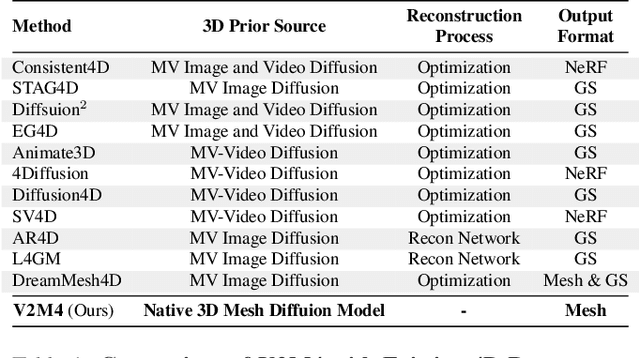
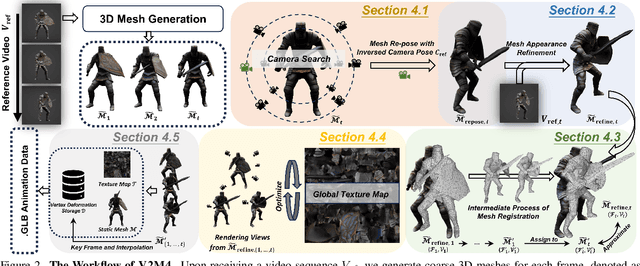
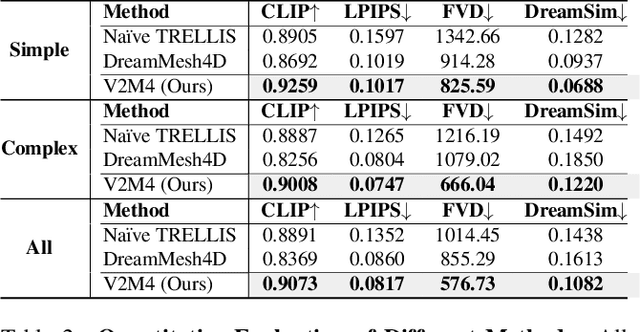
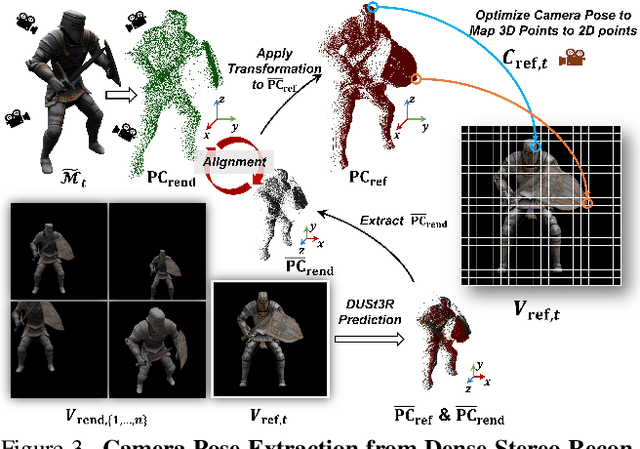
We present V2M4, a novel 4D reconstruction method that directly generates a usable 4D mesh animation asset from a single monocular video. Unlike existing approaches that rely on priors from multi-view image and video generation models, our method is based on native 3D mesh generation models. Naively applying 3D mesh generation models to generate a mesh for each frame in a 4D task can lead to issues such as incorrect mesh poses, misalignment of mesh appearance, and inconsistencies in mesh geometry and texture maps. To address these problems, we propose a structured workflow that includes camera search and mesh reposing, condition embedding optimization for mesh appearance refinement, pairwise mesh registration for topology consistency, and global texture map optimization for texture consistency. Our method outputs high-quality 4D animated assets that are compatible with mainstream graphics and game software. Experimental results across a variety of animation types and motion amplitudes demonstrate the generalization and effectiveness of our method. Project page:https://windvchen.github.io/V2M4/.
StoryAgent: Customized Storytelling Video Generation via Multi-Agent Collaboration
Nov 07, 2024



The advent of AI-Generated Content (AIGC) has spurred research into automated video generation to streamline conventional processes. However, automating storytelling video production, particularly for customized narratives, remains challenging due to the complexity of maintaining subject consistency across shots. While existing approaches like Mora and AesopAgent integrate multiple agents for Story-to-Video (S2V) generation, they fall short in preserving protagonist consistency and supporting Customized Storytelling Video Generation (CSVG). To address these limitations, we propose StoryAgent, a multi-agent framework designed for CSVG. StoryAgent decomposes CSVG into distinct subtasks assigned to specialized agents, mirroring the professional production process. Notably, our framework includes agents for story design, storyboard generation, video creation, agent coordination, and result evaluation. Leveraging the strengths of different models, StoryAgent enhances control over the generation process, significantly improving character consistency. Specifically, we introduce a customized Image-to-Video (I2V) method, LoRA-BE, to enhance intra-shot temporal consistency, while a novel storyboard generation pipeline is proposed to maintain subject consistency across shots. Extensive experiments demonstrate the effectiveness of our approach in synthesizing highly consistent storytelling videos, outperforming state-of-the-art methods. Our contributions include the introduction of StoryAgent, a versatile framework for video generation tasks, and novel techniques for preserving protagonist consistency.
Sitcom-Crafter: A Plot-Driven Human Motion Generation System in 3D Scenes
Oct 14, 2024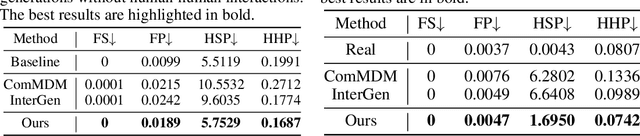
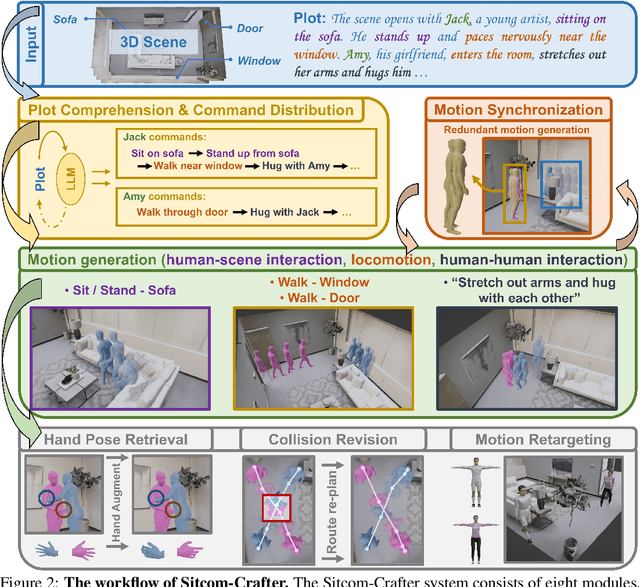
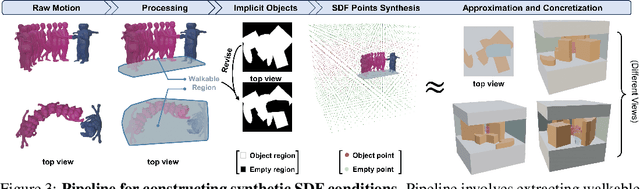
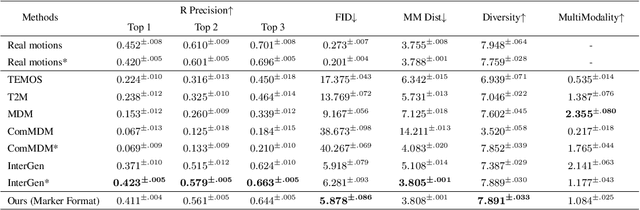
Recent advancements in human motion synthesis have focused on specific types of motions, such as human-scene interaction, locomotion or human-human interaction, however, there is a lack of a unified system capable of generating a diverse combination of motion types. In response, we introduce Sitcom-Crafter, a comprehensive and extendable system for human motion generation in 3D space, which can be guided by extensive plot contexts to enhance workflow efficiency for anime and game designers. The system is comprised of eight modules, three of which are dedicated to motion generation, while the remaining five are augmentation modules that ensure consistent fusion of motion sequences and system functionality. Central to the generation modules is our novel 3D scene-aware human-human interaction module, which addresses collision issues by synthesizing implicit 3D Signed Distance Function (SDF) points around motion spaces, thereby minimizing human-scene collisions without additional data collection costs. Complementing this, our locomotion and human-scene interaction modules leverage existing methods to enrich the system's motion generation capabilities. Augmentation modules encompass plot comprehension for command generation, motion synchronization for seamless integration of different motion types, hand pose retrieval to enhance motion realism, motion collision revision to prevent human collisions, and 3D retargeting to ensure visual fidelity. Experimental evaluations validate the system's ability to generate high-quality, diverse, and physically realistic motions, underscoring its potential for advancing creative workflows.
Prototypical Information Bottlenecking and Disentangling for Multimodal Cancer Survival Prediction
Jan 03, 2024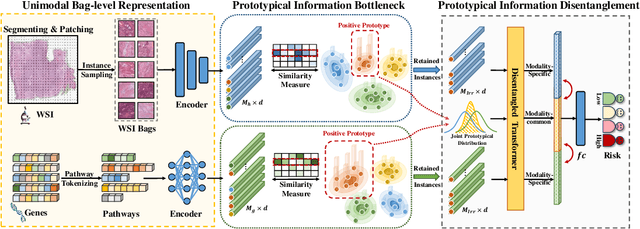
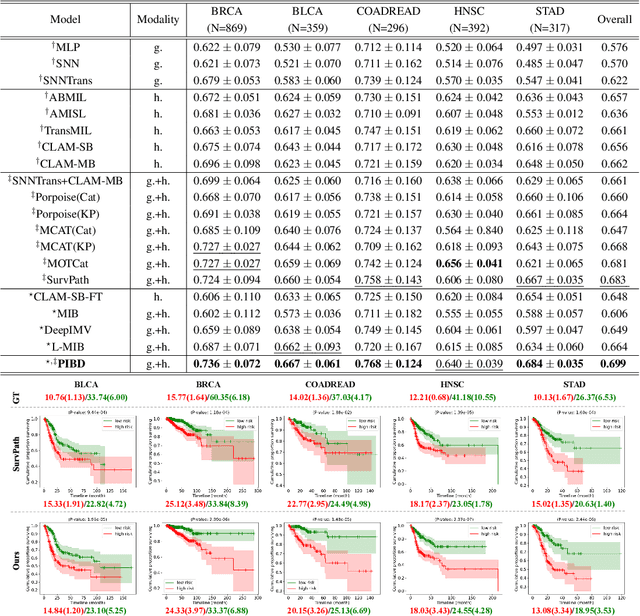
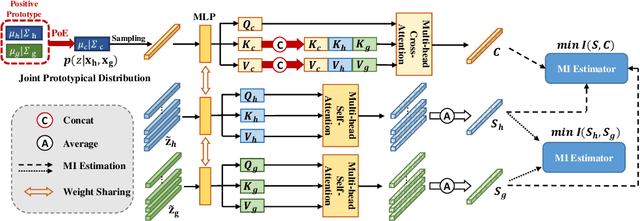
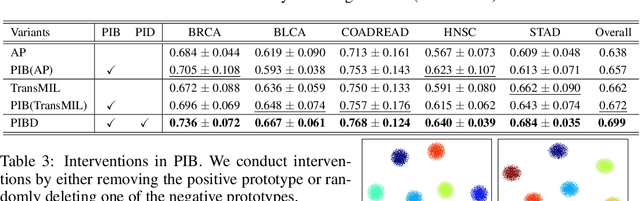
Multimodal learning significantly benefits cancer survival prediction, especially the integration of pathological images and genomic data. Despite advantages of multimodal learning for cancer survival prediction, massive redundancy in multimodal data prevents it from extracting discriminative and compact information: (1) An extensive amount of intra-modal task-unrelated information blurs discriminability, especially for gigapixel whole slide images (WSIs) with many patches in pathology and thousands of pathways in genomic data, leading to an ``intra-modal redundancy" issue. (2) Duplicated information among modalities dominates the representation of multimodal data, which makes modality-specific information prone to being ignored, resulting in an ``inter-modal redundancy" issue. To address these, we propose a new framework, Prototypical Information Bottlenecking and Disentangling (PIBD), consisting of Prototypical Information Bottleneck (PIB) module for intra-modal redundancy and Prototypical Information Disentanglement (PID) module for inter-modal redundancy. Specifically, a variant of information bottleneck, PIB, is proposed to model prototypes approximating a bunch of instances for different risk levels, which can be used for selection of discriminative instances within modality. PID module decouples entangled multimodal data into compact distinct components: modality-common and modality-specific knowledge, under the guidance of the joint prototypical distribution. Extensive experiments on five cancer benchmark datasets demonstrated our superiority over other methods.
Zero-Shot Image Harmonization with Generative Model Prior
Jul 17, 2023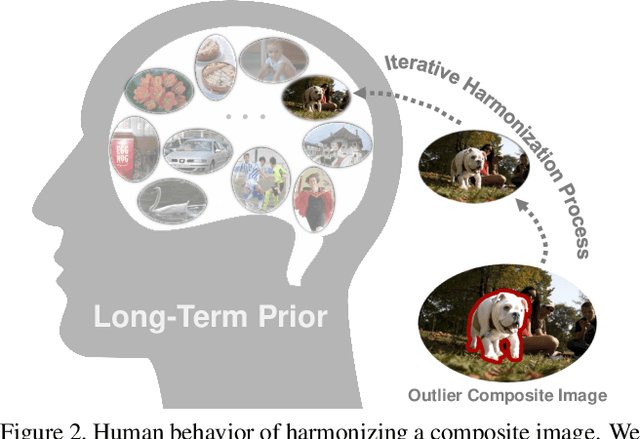
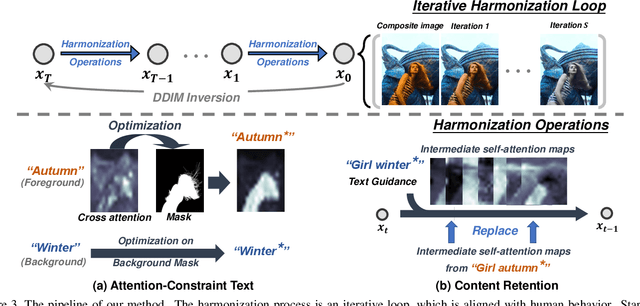
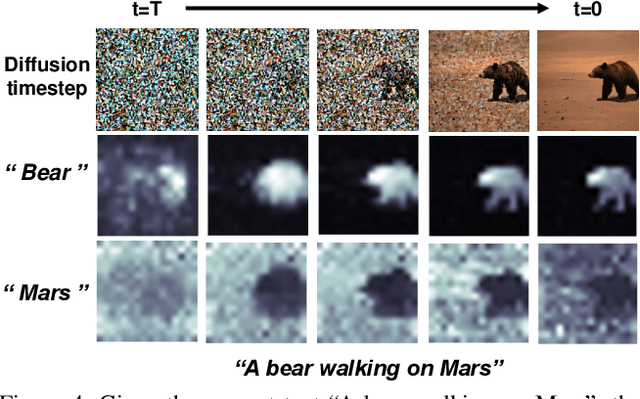
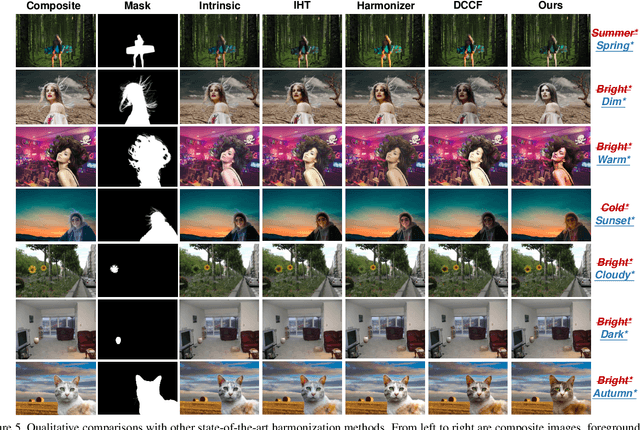
Recent image harmonization methods have demonstrated promising results. However, due to their heavy reliance on a large number of composite images, these works are expensive in the training phase and often fail to generalize to unseen images. In this paper, we draw lessons from human behavior and come up with a zero-shot image harmonization method. Specifically, in the harmonization process, a human mainly utilizes his long-term prior on harmonious images and makes a composite image close to that prior. To imitate that, we resort to pretrained generative models for the prior of natural images. For the guidance of the harmonization direction, we propose an Attention-Constraint Text which is optimized to well illustrate the image environments. Some further designs are introduced for preserving the foreground content structure. The resulting framework, highly consistent with human behavior, can achieve harmonious results without burdensome training. Extensive experiments have demonstrated the effectiveness of our approach, and we have also explored some interesting applications.