 Add to Chrome
 Add to Firefox
 Add to Edge
General Preference Modeling with Preference Representations for Aligning Language Models
Oct 03, 2024

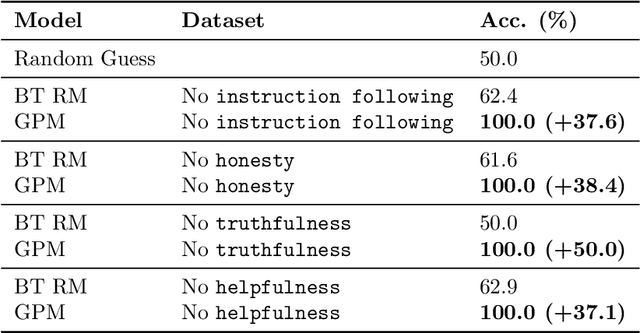

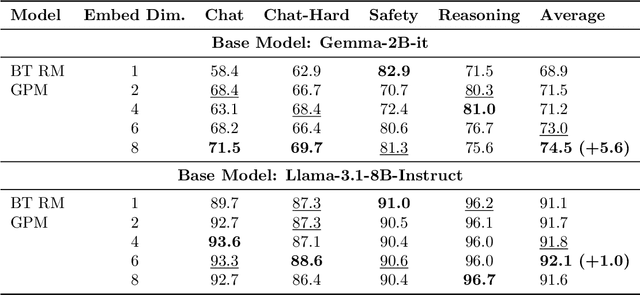
Modeling human preferences is crucial for aligning foundation models with human values. Traditional reward modeling methods, such as the Bradley-Terry (BT) reward model, fall short in expressiveness, particularly in addressing intransitive preferences. Although supervised pair preference models (PairPM) can express general preferences, their implementation is highly ad-hoc and cannot guarantee a consistent preference probability of compared pairs. Additionally, they impose high computational costs due to their quadratic query complexity when comparing multiple responses. In this paper, we introduce preference representation learning, an approach that embeds responses into a latent space to capture intricate preference structures efficiently, achieving linear query complexity. Additionally, we propose preference score-based General Preference Optimization (GPO), which generalizes reward-based reinforcement learning from human feedback. Experimental results show that our General Preference representation model (GPM) outperforms the BT reward model on the RewardBench benchmark with a margin of up to 5.6% and effectively models cyclic preferences where any BT reward model behaves like a random guess. Furthermore, evaluations on downstream tasks such as AlpacaEval2.0 and MT-Bench, following the language model post-training with GPO and our general preference model, reveal substantial performance improvements with margins up to 9.3%. These findings indicate that our method may enhance the alignment of foundation models with nuanced human values. The code is available at https://github.com/general-preference/general-preference-model.

Convergence of Score-Based Discrete Diffusion Models: A Discrete-Time Analysis
Oct 03, 2024
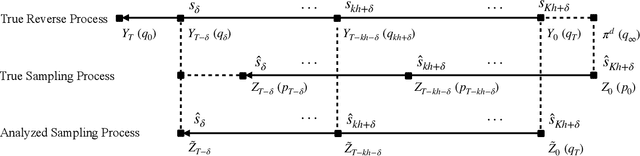
Diffusion models have achieved great success in generating high-dimensional samples across various applications. While the theoretical guarantees for continuous-state diffusion models have been extensively studied, the convergence analysis of the discrete-state counterparts remains under-explored. In this paper, we study the theoretical aspects of score-based discrete diffusion models under the Continuous Time Markov Chain (CTMC) framework. We introduce a discrete-time sampling algorithm in the general state space $[S]^d$ that utilizes score estimators at predefined time points. We derive convergence bounds for the Kullback-Leibler (KL) divergence and total variation (TV) distance between the generated sample distribution and the data distribution, considering both scenarios with and without early stopping under specific assumptions. Notably, our KL divergence bounds are nearly linear in dimension $d$, aligning with state-of-the-art results for diffusion models. Our convergence analysis employs a Girsanov-based method and establishes key properties of the discrete score function, which are essential for characterizing the discrete-time sampling process.
LLaVA-Critic: Learning to Evaluate Multimodal Models
Oct 03, 2024We introduce LLaVA-Critic, the first open-source large multimodal model (LMM) designed as a generalist evaluator to assess performance across a wide range of multimodal tasks. LLaVA-Critic is trained using a high-quality critic instruction-following dataset that incorporates diverse evaluation criteria and scenarios. Our experiments demonstrate the model's effectiveness in two key areas: (1) LMM-as-a-Judge, where LLaVA-Critic provides reliable evaluation scores, performing on par with or surpassing GPT models on multiple evaluation benchmarks; and (2) Preference Learning, where it generates reward signals for preference learning, enhancing model alignment capabilities. This work underscores the potential of open-source LMMs in self-critique and evaluation, setting the stage for future research into scalable, superhuman alignment feedback mechanisms for LMMs.
ProteinBench: A Holistic Evaluation of Protein Foundation Models
Sep 10, 2024Recent years have witnessed a surge in the development of protein foundation models, significantly improving performance in protein prediction and generative tasks ranging from 3D structure prediction and protein design to conformational dynamics. However, the capabilities and limitations associated with these models remain poorly understood due to the absence of a unified evaluation framework. To fill this gap, we introduce ProteinBench, a holistic evaluation framework designed to enhance the transparency of protein foundation models. Our approach consists of three key components: (i) A taxonomic classification of tasks that broadly encompass the main challenges in the protein domain, based on the relationships between different protein modalities; (ii) A multi-metric evaluation approach that assesses performance across four key dimensions: quality, novelty, diversity, and robustness; and (iii) In-depth analyses from various user objectives, providing a holistic view of model performance. Our comprehensive evaluation of protein foundation models reveals several key findings that shed light on their current capabilities and limitations. To promote transparency and facilitate further research, we release the evaluation dataset, code, and a public leaderboard publicly for further analysis and a general modular toolkit. We intend for ProteinBench to be a living benchmark for establishing a standardized, in-depth evaluation framework for protein foundation models, driving their development and application while fostering collaboration within the field.
Relative-Translation Invariant Wasserstein Distance
Sep 04, 2024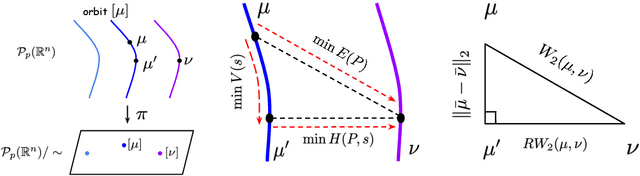
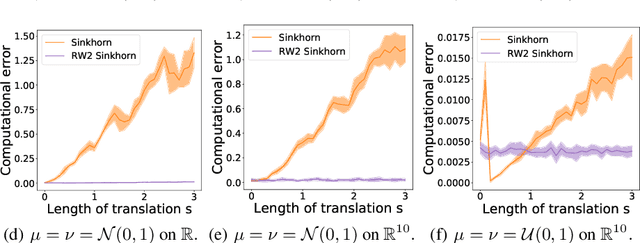


We introduce a new family of distances, relative-translation invariant Wasserstein distances ($RW_p$), for measuring the similarity of two probability distributions under distribution shift. Generalizing it from the classical optimal transport model, we show that $RW_p$ distances are also real distance metrics defined on the quotient set $\mathcal{P}_p(\mathbb{R}^n)/\sim$ and invariant to distribution translations. When $p=2$, the $RW_2$ distance enjoys more exciting properties, including decomposability of the optimal transport model, translation-invariance of the $RW_2$ distance, and a Pythagorean relationship between $RW_2$ and the classical quadratic Wasserstein distance ($W_2$). Based on these properties, we show that a distribution shift, measured by $W_2$ distance, can be explained in the bias-variance perspective. In addition, we propose a variant of the Sinkhorn algorithm, named $RW_2$ Sinkhorn algorithm, for efficiently calculating $RW_2$ distance, coupling solutions, as well as $W_2$ distance. We also provide the analysis of numerical stability and time complexity for the proposed algorithm. Finally, we validate the $RW_2$ distance metric and the algorithm performance with three experiments. We conduct one numerical validation for the $RW_2$ Sinkhorn algorithm and show two real-world applications demonstrating the effectiveness of using $RW_2$ under distribution shift: digits recognition and similar thunderstorm detection. The experimental results report that our proposed algorithm significantly improves the computational efficiency of Sinkhorn in certain practical applications, and the $RW_2$ distance is robust to distribution translations compared with baselines.
Decomposed Direct Preference Optimization for Structure-Based Drug Design
Jul 19, 2024Diffusion models have achieved promising results for Structure-Based Drug Design (SBDD). Nevertheless, high-quality protein subpocket and ligand data are relatively scarce, which hinders the models' generation capabilities. Recently, Direct Preference Optimization (DPO) has emerged as a pivotal tool for the alignment of generative models such as large language models and diffusion models, providing greater flexibility and accuracy by directly aligning model outputs with human preferences. Building on this advancement, we introduce DPO to SBDD in this paper. We tailor diffusion models to pharmaceutical needs by aligning them with elaborately designed chemical score functions. We propose a new structure-based molecular optimization method called DecompDPO, which decomposes the molecule into arms and scaffolds and performs preference optimization at both local substructure and global molecule levels, allowing for more precise control with fine-grained preferences. Notably, DecompDPO can be effectively used for two main purposes: (1) fine-tuning pretrained diffusion models for molecule generation across various protein families, and (2) molecular optimization given a specific protein subpocket after generation. Extensive experiments on the CrossDocked2020 benchmark show that DecompDPO significantly improves model performance in both molecule generation and optimization, with up to 100% Median High Affinity and a 54.9% Success Rate.
Uncertainty-Aware Reward-Free Exploration with General Function Approximation
Jun 24, 2024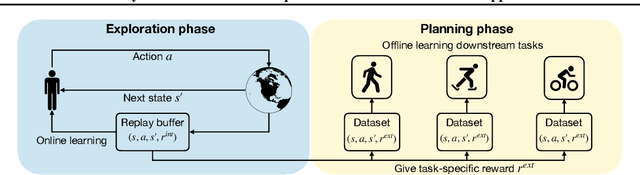
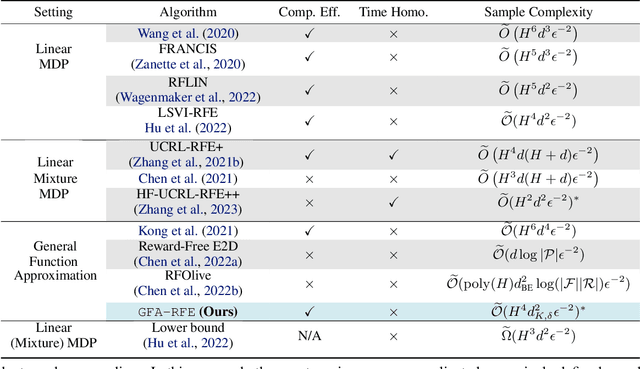
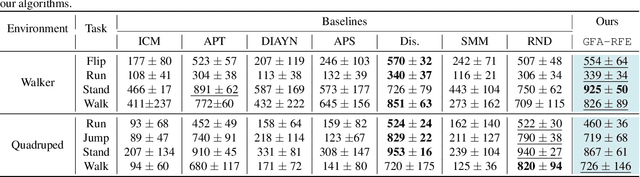
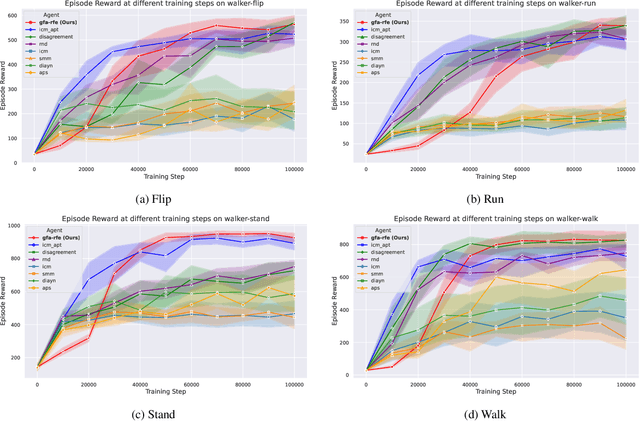
Mastering multiple tasks through exploration and learning in an environment poses a significant challenge in reinforcement learning (RL). Unsupervised RL has been introduced to address this challenge by training policies with intrinsic rewards rather than extrinsic rewards. However, current intrinsic reward designs and unsupervised RL algorithms often overlook the heterogeneous nature of collected samples, thereby diminishing their sample efficiency. To overcome this limitation, in this paper, we propose a reward-free RL algorithm called \alg. The key idea behind our algorithm is an uncertainty-aware intrinsic reward for exploring the environment and an uncertainty-weighted learning process to handle heterogeneous uncertainty in different samples. Theoretically, we show that in order to find an $\epsilon$-optimal policy, GFA-RFE needs to collect $\tilde{O} (H^2 \log N_{\mathcal F} (\epsilon) \mathrm{dim} (\mathcal F) / \epsilon^2 )$ number of episodes, where $\mathcal F$ is the value function class with covering number $N_{\mathcal F} (\epsilon)$ and generalized eluder dimension $\mathrm{dim} (\mathcal F)$. Such a result outperforms all existing reward-free RL algorithms. We further implement and evaluate GFA-RFE across various domains and tasks in the DeepMind Control Suite. Experiment results show that GFA-RFE outperforms or is comparable to the performance of state-of-the-art unsupervised RL algorithms.
Self-Play Preference Optimization for Language Model Alignment
May 01, 2024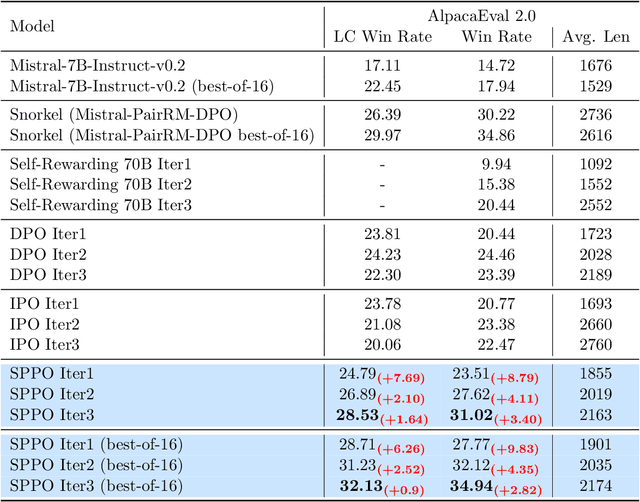
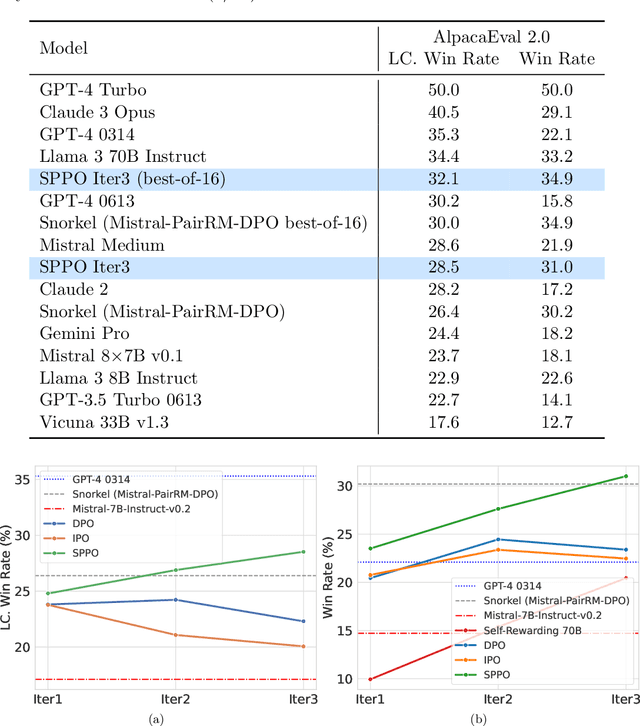
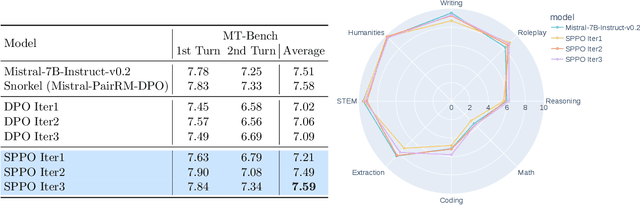
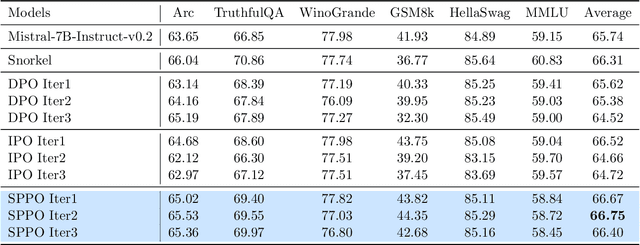
Traditional reinforcement learning from human feedback (RLHF) approaches relying on parametric models like the Bradley-Terry model fall short in capturing the intransitivity and irrationality in human preferences. Recent advancements suggest that directly working with preference probabilities can yield a more accurate reflection of human preferences, enabling more flexible and accurate language model alignment. In this paper, we propose a self-play-based method for language model alignment, which treats the problem as a constant-sum two-player game aimed at identifying the Nash equilibrium policy. Our approach, dubbed \textit{Self-Play Preference Optimization} (SPPO), approximates the Nash equilibrium through iterative policy updates and enjoys theoretical convergence guarantee. Our method can effectively increase the log-likelihood of the chosen response and decrease that of the rejected response, which cannot be trivially achieved by symmetric pairwise loss such as Direct Preference Optimization (DPO) and Identity Preference Optimization (IPO). In our experiments, using only 60k prompts (without responses) from the UltraFeedback dataset and without any prompt augmentation, by leveraging a pre-trained preference model PairRM with only 0.4B parameters, SPPO can obtain a model from fine-tuning Mistral-7B-Instruct-v0.2 that achieves the state-of-the-art length-controlled win-rate of 28.53% against GPT-4-Turbo on AlpacaEval 2.0. It also outperforms the (iterative) DPO and IPO on MT-Bench and the Open LLM Leaderboard. Notably, the strong performance of SPPO is achieved without additional external supervision (e.g., responses, preferences, etc.) from GPT-4 or other stronger language models.
Matching the Statistical Query Lower Bound for k-sparse Parity Problems with Stochastic Gradient Descent
Apr 18, 2024The $k$-parity problem is a classical problem in computational complexity and algorithmic theory, serving as a key benchmark for understanding computational classes. In this paper, we solve the $k$-parity problem with stochastic gradient descent (SGD) on two-layer fully-connected neural networks. We demonstrate that SGD can efficiently solve the $k$-sparse parity problem on a $d$-dimensional hypercube ($k\le O(\sqrt{d})$) with a sample complexity of $\tilde{O}(d^{k-1})$ using $2^{\Theta(k)}$ neurons, thus matching the established $\Omega(d^{k})$ lower bounds of Statistical Query (SQ) models. Our theoretical analysis begins by constructing a good neural network capable of correctly solving the $k$-parity problem. We then demonstrate how a trained neural network with SGD can effectively approximate this good network, solving the $k$-parity problem with small statistical errors. Our theoretical results and findings are supported by empirical evidence, showcasing the efficiency and efficacy of our approach.
Guided Discrete Diffusion for Electronic Health Record Generation
Apr 18, 2024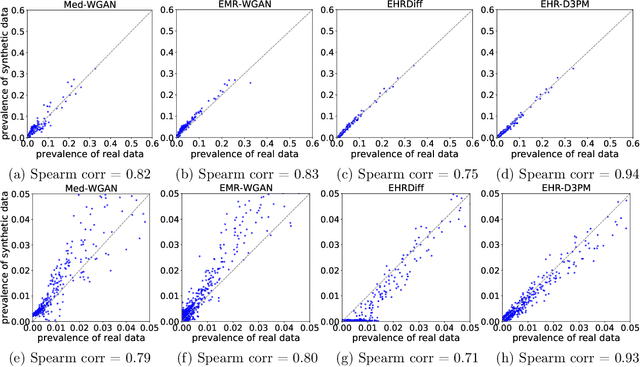



Electronic health records (EHRs) are a pivotal data source that enables numerous applications in computational medicine, e.g., disease progression prediction, clinical trial design, and health economics and outcomes research. Despite wide usability, their sensitive nature raises privacy and confidentially concerns, which limit potential use cases. To tackle these challenges, we explore the use of generative models to synthesize artificial, yet realistic EHRs. While diffusion-based methods have recently demonstrated state-of-the-art performance in generating other data modalities and overcome the training instability and mode collapse issues that plague previous GAN-based approaches, their applications in EHR generation remain underexplored. The discrete nature of tabular medical code data in EHRs poses challenges for high-quality data generation, especially for continuous diffusion models. To this end, we introduce a novel tabular EHR generation method, EHR-D3PM, which enables both unconditional and conditional generation using the discrete diffusion model. Our experiments demonstrate that EHR-D3PM significantly outperforms existing generative baselines on comprehensive fidelity and utility metrics while maintaining less membership vulnerability risks. Furthermore, we show EHR-D3PM is effective as a data augmentation method and enhances performance on downstream tasks when combined with real data.