 Add to Chrome
 Add to Firefox
 Add to Edge
Fast Rates for Offline Contextual Bandits with Forward-KL Regularization under Single-Policy Concentrability
May 09, 2026
\emph{Kullback-Leibler} (KL) regularization is ubiquitous in reinforcement learning algorithms in the form of \emph{reverse} or \emph{forward} KL. Recent studies have demonstrated $ε^{-1}$-type fast rates for decision making under reverse KL regularization, in contrast to the standard $ε^{-2}$-type sample complexity. However, for forward-KL-regularized objectives, existing statistical analyses are either not applicable or result in $\tilde{O}(ε^{-2})$ slow rates. We take the first step towards addressing this problem via a streamlined analysis of forward-KL-regularized offline CBs. We give the first $\tilde{O}(ε^{-1})$ upper bounds in tabular and general function approximation settings, both under notions of \emph{single-policy concentrability}. In particular, our convex-analytical pipeline unifies these settings by exploiting the pessimism principle in a novel way and completely bypasses the proof routines in previous works based on the mean value theorem, which might be of independent interest. Moreover, we provide rate-optimal lower bounds, manifesting the tightness of our upper bounds in terms of statistical rates. Our lower bounds also demonstrate that the forward-KL-regularized sample complexity recovers the unregularized slow rate in the low-regularization regime, similarly to the reverse-KL regularization.

On the Optimal Sample Complexity of Offline Multi-Armed Bandits with KL Regularization
May 04, 2026Kullback-Leibler (KL) regularization is widely used in offline decision-making and offers several benefits, motivating recent work on the sample complexity of offline learning with respect to KL-regularized performance metrics. Nevertheless, the exact sample complexity of KL-regularized offline learning remains largely from fully characterized. In this paper, we study this question in the setting of multi-armed bandits (MABs). We provide a sharp analysis of KL-PCB (Zhao et al., 2026), showing that it achieves a sample complexity of $\tilde{O}(ηSAC^{π^*}/ε)$ under large regularization $η= \tilde{O}(ε^{-1})$, and a sample complexity of $\tildeΩ(SAC^{π^*}/ε^2)$ under small regularization $η= \tildeΩ(ε^{-1})$, where $η$ is the regularization parameter, $S$ is the number of contexts, $A$ is the number of arms, $C^{π^*}$ policy coverage coefficient at the optimal policy $π^*$, $ε$ is the desired sub-optimality, and $\tilde{O}$ and $\tildeΩ$ hide all poly-logarithmic factors. We further provide a pair of sharper sample complexity lower bounds, which matches the upper bounds over the entire range of regularization strengths. Overall, our results provide a nearly complete characterization of offline multi-armed bandits with KL regularization.
Transformers Trained via Gradient Descent Can Provably Learn a Class of Teacher Models
Mar 24, 2026Transformers have achieved great success across a wide range of applications, yet the theoretical foundations underlying their success remain largely unexplored. To demystify the strong capacities of transformers applied to versatile scenarios and tasks, we theoretically investigate utilizing transformers as students to learn from a class of teacher models. Specifically, the teacher models covered in our analysis include convolution layers with average pooling, graph convolution layers, and various classic statistical learning models, including a variant of sparse token selection models [Sanford et al., 2023, Wang et al., 2024] and group-sparse linear predictors [Zhang et al., 2025]. When learning from this class of teacher models, we prove that one-layer transformers with simplified "position-only'' attention can successfully recover all parameter blocks of the teacher models, thus achieving the optimal population loss. Building upon the efficient mimicry of trained transformers towards teacher models, we further demonstrate that they can generalize well to a broad class of out-of-distribution data under mild assumptions. The key in our analysis is to identify a fundamental bilinear structure shared by various learning tasks, which enables us to establish unified learning guarantees for these tasks when treating them as teachers for transformers.
Near-Optimal Regret for KL-Regularized Multi-Armed Bandits
Mar 02, 2026Recent studies have shown that reinforcement learning with KL-regularized objectives can enjoy faster rates of convergence or logarithmic regret, in contrast to the classical $\sqrt{T}$-type regret in the unregularized setting. However, the statistical efficiency of online learning with respect to KL-regularized objectives remains far from completely characterized, even when specialized to multi-armed bandits (MABs). We address this problem for MABs via a sharp analysis of KL-UCB using a novel peeling argument, which yields a $\tilde{O}(ηK\log^2T)$ upper bound: the first high-probability regret bound with linear dependence on $K$. Here, $T$ is the time horizon, $K$ is the number of arms, $η^{-1}$ is the regularization intensity, and $\tilde{O}$ hides all logarithmic factors except those involving $\log T$. The near-tightness of our analysis is certified by the first non-constant lower bound $Ω(ηK \log T)$, which follows from subtle hard-instance constructions and a tailored decomposition of the Bayes prior. Moreover, in the low-regularization regime (i.e., large $η$), we show that the KL-regularized regret for MABs is $η$-independent and scales as $\tildeΘ(\sqrt{KT})$. Overall, our results provide a thorough understanding of KL-regularized MABs across all regimes of $η$ and yield nearly optimal bounds in terms of $K$, $η$, and $T$.
Global Convergence and Rich Feature Learning in $L$-Layer Infinite-Width Neural Networks under $μ$P Parametrization
Mar 12, 2025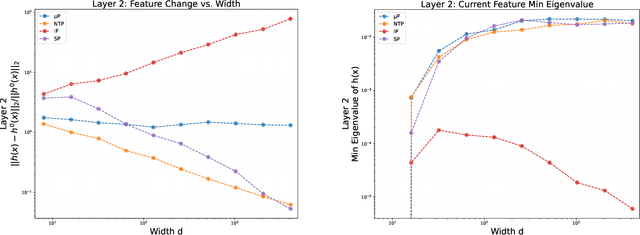
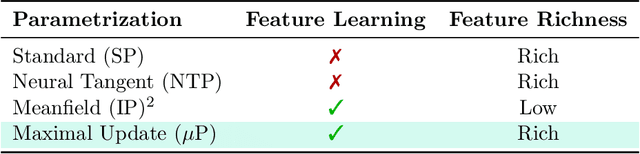

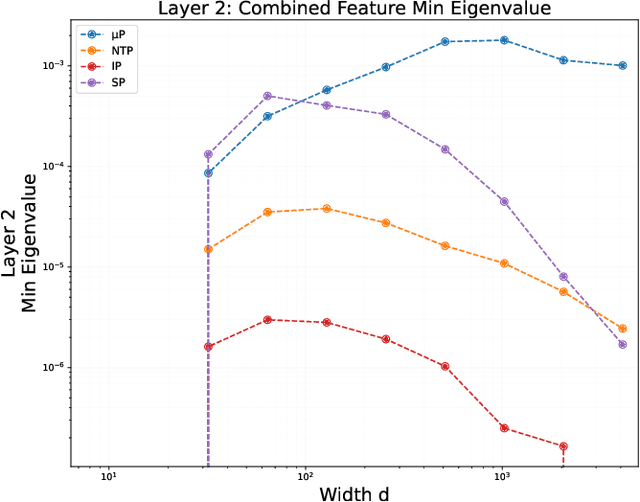
Despite deep neural networks' powerful representation learning capabilities, theoretical understanding of how networks can simultaneously achieve meaningful feature learning and global convergence remains elusive. Existing approaches like the neural tangent kernel (NTK) are limited because features stay close to their initialization in this parametrization, leaving open questions about feature properties during substantial evolution. In this paper, we investigate the training dynamics of infinitely wide, $L$-layer neural networks using the tensor program (TP) framework. Specifically, we show that, when trained with stochastic gradient descent (SGD) under the Maximal Update parametrization ($\mu$P) and mild conditions on the activation function, SGD enables these networks to learn linearly independent features that substantially deviate from their initial values. This rich feature space captures relevant data information and ensures that any convergent point of the training process is a global minimum. Our analysis leverages both the interactions among features across layers and the properties of Gaussian random variables, providing new insights into deep representation learning. We further validate our theoretical findings through experiments on real-world datasets.
Nearly Optimal Sample Complexity of Offline KL-Regularized Contextual Bandits under Single-Policy Concentrability
Feb 09, 2025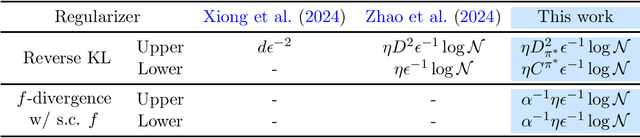
KL-regularized policy optimization has become a workhorse in learning-based decision making, while its theoretical understanding is still very limited. Although recent progress has been made towards settling the sample complexity of KL-regularized contextual bandits, existing sample complexity bounds are either $\tilde{O}(\epsilon^{-2})$ under single-policy concentrability or $\tilde{O}(\epsilon^{-1})$ under all-policy concentrability. In this paper, we propose the \emph{first} algorithm with $\tilde{O}(\epsilon^{-1})$ sample complexity under single-policy concentrability for offline contextual bandits. Our algorithm is designed for general function approximation and based on the principle of \emph{pessimism in the face of uncertainty}. The core of our proof leverages the strong convexity of the KL regularization, and the conditional non-negativity of the gap between the true reward and its pessimistic estimator to refine a mean-value-type risk upper bound to its extreme. This in turn leads to a novel covariance-based analysis, effectively bypassing the need for uniform control over the discrepancy between any two functions in the function class. The near-optimality of our algorithm is demonstrated by an $\tilde{\Omega}(\epsilon^{-1})$ lower bound. Furthermore, we extend our algorithm to contextual dueling bandits and achieve a similar nearly optimal sample complexity.
Towards the Fundamental Limits of Knowledge Transfer over Finite Domains
Oct 17, 2023


We characterize the statistical efficiency of knowledge transfer through $n$ samples from a teacher to a probabilistic student classifier with input space $\mathcal S$ over labels $\mathcal A$. We show that privileged information at three progressive levels accelerates the transfer. At the first level, only samples with hard labels are known, via which the maximum likelihood estimator attains the minimax rate $\sqrt{{|{\mathcal S}||{\mathcal A}|}/{n}}$. The second level has the teacher probabilities of sampled labels available in addition, which turns out to boost the convergence rate lower bound to ${{|{\mathcal S}||{\mathcal A}|}/{n}}$. However, under this second data acquisition protocol, minimizing a naive adaptation of the cross-entropy loss results in an asymptotically biased student. We overcome this limitation and achieve the fundamental limit by using a novel empirical variant of the squared error logit loss. The third level further equips the student with the soft labels (complete logits) on ${\mathcal A}$ given every sampled input, thereby provably enables the student to enjoy a rate ${|{\mathcal S}|}/{n}$ free of $|{\mathcal A}|$. We find any Kullback-Leibler divergence minimizer to be optimal in the last case. Numerical simulations distinguish the four learners and corroborate our theory.
Horizon-free Reinforcement Learning in Adversarial Linear Mixture MDPs
May 15, 2023Recent studies have shown that episodic reinforcement learning (RL) is no harder than bandits when the total reward is bounded by $1$, and proved regret bounds that have a polylogarithmic dependence on the planning horizon $H$. However, it remains an open question that if such results can be carried over to adversarial RL, where the reward is adversarially chosen at each episode. In this paper, we answer this question affirmatively by proposing the first horizon-free policy search algorithm. To tackle the challenges caused by exploration and adversarially chosen reward, our algorithm employs (1) a variance-uncertainty-aware weighted least square estimator for the transition kernel; and (2) an occupancy measure-based technique for the online search of a \emph{stochastic} policy. We show that our algorithm achieves an $\tilde{O}\big((d+\log (|\mathcal{S}|^2 |\mathcal{A}|))\sqrt{K}\big)$ regret with full-information feedback, where $d$ is the dimension of a known feature mapping linearly parametrizing the unknown transition kernel of the MDP, $K$ is the number of episodes, $|\mathcal{S}|$ and $|\mathcal{A}|$ are the cardinalities of the state and action spaces. We also provide hardness results and regret lower bounds to justify the near optimality of our algorithm and the unavoidability of $\log|\mathcal{S}|$ and $\log|\mathcal{A}|$ in the regret bound.