 Add to Chrome
 Add to Firefox
 Add to Edge
NSL-SLAM: High-Fidelity Neural Structured-Light Depth for Practical SLAM and Reconstruction
Jul 27, 2026
Structured-light (SL) cameras power depth sensing in millions of devices, and recent neural SL decoding methods have substantially improved their depth quality. SLAM systems can benefit greatly from such strong depth sensing, where reliable geometry enables stable tracking and faithful reconstruction. In this work, we present NSL-SLAM, a practical SLAM system tailored for high-fidelity structured-light depth. We first strengthen SL depth sensing: inspired by the neural structured-light (NSL) method, we further incorporate strong monocular depth priors into the SL stereo decoding, reducing depth RMSE by 35% on Replica-SL compared to NSL. We then build a depth-centric SLAM pipeline with this stronger depth: because structured-light geometry is dense and metrically accurate, we keep it as the primary tracking signal, and add only sparse visual correspondences for geometrically degenerate cases and lightweight bundle adjustment for long-range drift. Our depth estimator and SLAM design reinforce each other: stronger depth makes a simple SLAM pipeline effective, and the depth-centric pipeline ensures this advantage transfers to downstream reconstruction. Experimentally, on the synthetic Replica-SL benchmark, NSL-SLAM achieves the best tracking accuracy and improves reconstruction F-score by 1.6 points over the SOTA baseline under a shared-depth protocol. On a real benchmark of 8 challenging scenes, it is the only method that avoids catastrophic failure on all sequences while achieving 43.3% lower trajectory deviation than selected baselines. The SLAM system runs online at 20.9 FPS, demonstrating that stronger structured-light depth and depth-centric system design together enable practical, robust SLAM.

Beyond Importance Sampling: Rejection-Gated Policy Optimization
Apr 16, 2026We propose a new perspective on policy optimization: rather than reweighting all samples by their importance ratios, an optimizer should select which samples are trustworthy enough to drive a policy update. Building on this view, we introduce Rejection-Gated Policy Optimization (RGPO), which replaces the importance sampling ratio r_theta = pi_theta / pi_old with a smooth, differentiable acceptance gate alpha_theta(s, a) = g(r_theta(s, a)) in the range [0, 1]. Unlike prior work that applies rejection sampling as a data-level heuristic before training, RGPO elevates rejection to an optimization principle: the gate participates directly in gradient computation and is implicitly updated alongside the policy. RGPO provides a unified framework: the policy gradients of TRPO, PPO, and REINFORCE all correspond to specific choices of the effective gradient weight w(r) = g'(r) * r. We prove that RGPO guarantees finite, bounded gradient variance even when importance sampling ratios are heavy-tailed (where IS variance diverges). We further show that RGPO incurs only a bounded, controllable bias and provides an approximate monotonic policy improvement guarantee analogous to TRPO. RGPO matches PPO in computational cost, requires no second-order optimization, and extends naturally to RLHF-style preference alignment. In online preference fine-tuning of Qwen2.5-1.5B-Instruct on Anthropic HH-RLHF (n = 3 seeds), RGPO uses a dual-ratio gate that anchors learning to both the previous policy and the reference model, achieving a Pareto-dominant outcome: the highest reward among online RL methods (+14.8% vs. PPO-RLHF) and the lowest KL divergence to the reference model (-16.0% vs. PPO-RLHF, -53.1% vs. GRPO).
PRISM: Parallel Residual Iterative Sequence Model
Feb 12, 2026Generative sequence modeling faces a fundamental tension between the expressivity of Transformers and the efficiency of linear sequence models. Existing efficient architectures are theoretically bounded by shallow, single-step linear updates, while powerful iterative methods like Test-Time Training (TTT) break hardware parallelism due to state-dependent gradients. We propose PRISM (Parallel Residual Iterative Sequence Model) to resolve this tension. PRISM introduces a solver-inspired inductive bias that captures key structural properties of multi-step refinement in a parallelizable form. We employ a Write-Forget Decoupling strategy that isolates non-linearity within the injection operator. To bypass the serial dependency of explicit solvers, PRISM utilizes a two-stage proxy architecture: a short-convolution anchors the initial residual using local history energy, while a learned predictor estimates the refinement updates directly from the input. This design distills structural patterns associated with iterative correction into a parallelizable feedforward operator. Theoretically, we prove that this formulation achieves Rank-$L$ accumulation, structurally expanding the update manifold beyond the single-step Rank-$1$ bottleneck. Empirically, it achieves comparable performance to explicit optimization methods while achieving 174x higher throughput.
Robust Single-shot Structured Light 3D Imaging via Neural Feature Decoding
Dec 16, 2025We consider the problem of active 3D imaging using single-shot structured light systems, which are widely employed in commercial 3D sensing devices such as Apple Face ID and Intel RealSense. Traditional structured light methods typically decode depth correspondences through pixel-domain matching algorithms, resulting in limited robustness under challenging scenarios like occlusions, fine-structured details, and non-Lambertian surfaces. Inspired by recent advances in neural feature matching, we propose a learning-based structured light decoding framework that performs robust correspondence matching within feature space rather than the fragile pixel domain. Our method extracts neural features from the projected patterns and captured infrared (IR) images, explicitly incorporating their geometric priors by building cost volumes in feature space, achieving substantial performance improvements over pixel-domain decoding approaches. To further enhance depth quality, we introduce a depth refinement module that leverages strong priors from large-scale monocular depth estimation models, improving fine detail recovery and global structural coherence. To facilitate effective learning, we develop a physically-based structured light rendering pipeline, generating nearly one million synthetic pattern-image pairs with diverse objects and materials for indoor settings. Experiments demonstrate that our method, trained exclusively on synthetic data with multiple structured light patterns, generalizes well to real-world indoor environments, effectively processes various pattern types without retraining, and consistently outperforms both commercial structured light systems and passive stereo RGB-based depth estimation methods. Project page: https://namisntimpot.github.io/NSLweb/.
Zero-shot Load Forecasting for Integrated Energy Systems: A Large Language Model-based Framework with Multi-task Learning
Feb 24, 2025The growing penetration of renewable energy sources in power systems has increased the complexity and uncertainty of load forecasting, especially for integrated energy systems with multiple energy carriers. Traditional forecasting methods heavily rely on historical data and exhibit limited transferability across different scenarios, posing significant challenges for emerging applications in smart grids and energy internet. This paper proposes the TSLLM-Load Forecasting Mechanism, a novel zero-shot load forecasting framework based on large language models (LLMs) to address these challenges. The framework consists of three key components: a data preprocessing module that handles multi-source energy load data, a time series prompt generation module that bridges the semantic gap between energy data and LLMs through multi-task learning and similarity alignment, and a prediction module that leverages pre-trained LLMs for accurate forecasting. The framework's effectiveness was validated on a real-world dataset comprising load profiles from 20 Australian solar-powered households, demonstrating superior performance in both conventional and zero-shot scenarios. In conventional testing, our method achieved a Mean Squared Error (MSE) of 0.4163 and a Mean Absolute Error (MAE) of 0.3760, outperforming existing approaches by at least 8\%. In zero-shot prediction experiments across 19 households, the framework maintained consistent accuracy with a total MSE of 11.2712 and MAE of 7.6709, showing at least 12\% improvement over current methods. The results validate the framework's potential for accurate and transferable load forecasting in integrated energy systems, particularly beneficial for renewable energy integration and smart grid applications.
Gradient Based Method for the Fusion of Lattice Quantizers
Feb 09, 2025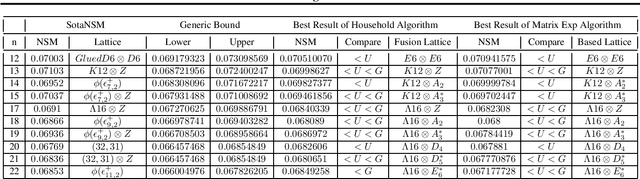
In practical applications, lattice quantizers leverage discrete lattice points to approximate arbitrary points in the lattice. An effective lattice quantizer significantly enhances both the accuracy and efficiency of these approximations. In the context of high-dimensional lattice quantization, previous work proposed utilizing low-dimensional optimal lattice quantizers and addressed the challenge of determining the optimal length ratio in orthogonal splicing. Notably, it was demonstrated that fixed length ratios and orthogonality yield suboptimal results when combining low-dimensional lattices. Building on this foundation, another approach employed gradient descent to identify optimal lattices, which inspired us to explore the use of neural networks to discover matrices that outperform those obtained from orthogonal splicing methods. We propose two novel approaches to tackle this problem: the Household Algorithm and the Matrix Exp Algorithm. Our results indicate that both the Household Algorithm and the Matrix Exp Algorithm achieve improvements in lattice quantizers across dimensions 13, 15, 17 to 19, 21, and 22. Moreover, the Matrix Exp Algorithm demonstrates superior efficacy in high-dimensional settings.
Real-time Multi-view Omnidirectional Depth Estimation System for Robots and Autonomous Driving on Real Scenes
Sep 12, 2024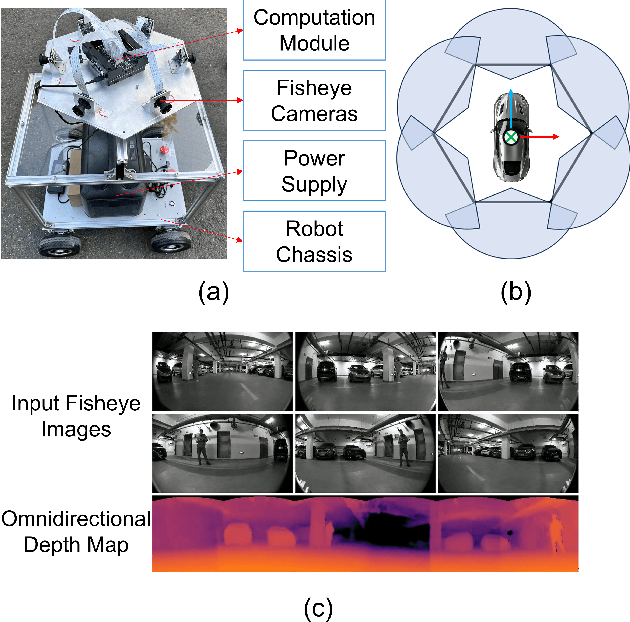
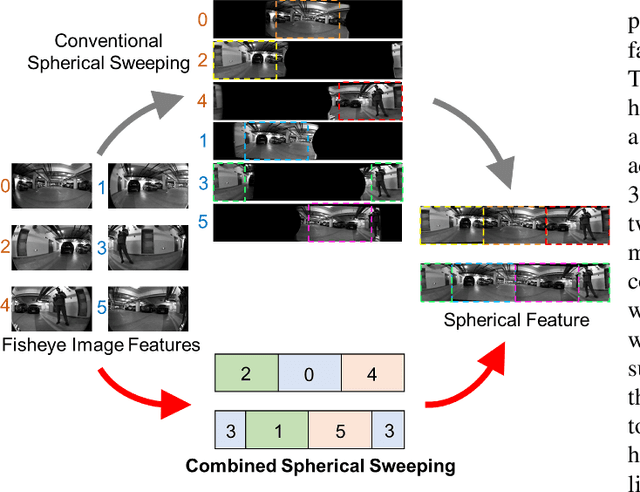
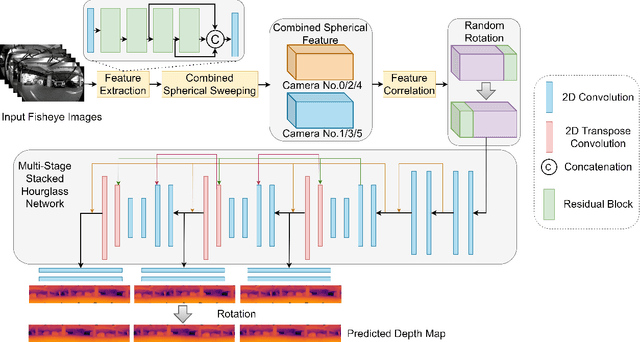
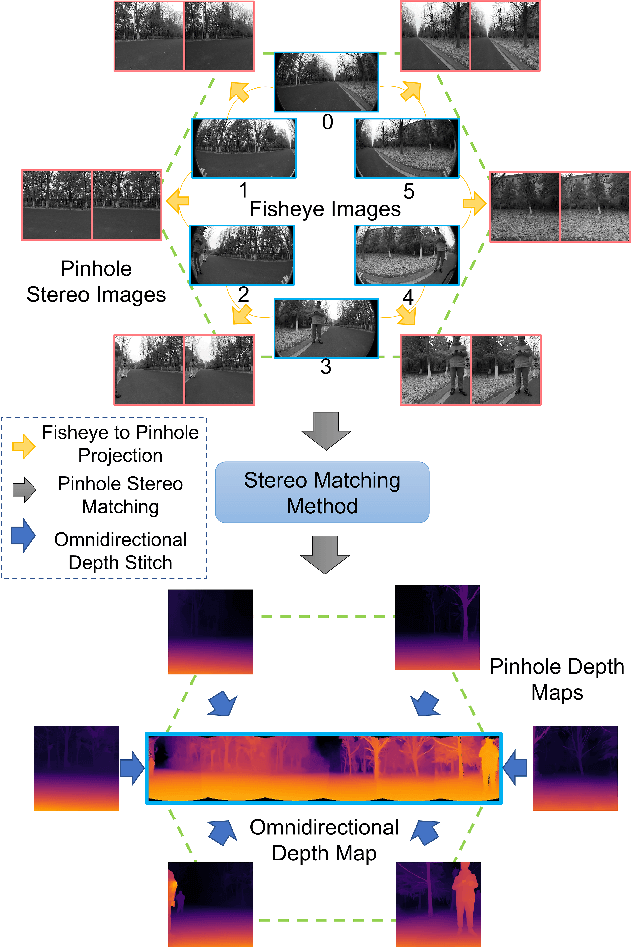
Omnidirectional Depth Estimation has broad application prospects in fields such as robotic navigation and autonomous driving. In this paper, we propose a robotic prototype system and corresponding algorithm designed to validate omnidirectional depth estimation for navigation and obstacle avoidance in real-world scenarios for both robots and vehicles. The proposed HexaMODE system captures 360$^\circ$ depth maps using six surrounding arranged fisheye cameras. We introduce a combined spherical sweeping method and optimize the model architecture for proposed RtHexa-OmniMVS algorithm to achieve real-time omnidirectional depth estimation. To ensure high accuracy, robustness, and generalization in real-world environments, we employ a teacher-student self-training strategy, utilizing large-scale unlabeled real-world data for model training. The proposed algorithm demonstrates high accuracy in various complex real-world scenarios, both indoors and outdoors, achieving an inference speed of 15 fps on edge computing platforms.