 Add to Chrome
 Add to Firefox
 Add to Edge
What the Eyes See, the LLMs Miss: Exploiting Human Perception for Adversarial Text Attacks
Jun 08, 2026
Large language model (LLM)-powered content moderation systems have become a critical defense against harmful online content. However, these systems primarily operate on tokenized text and largely ignore the visual cues that humans naturally rely on when interpreting content. We show that this discrepancy creates a fundamental perceptual mismatch: content that is readily recognized as harmful by humans can become effectively invisible to automated moderation systems. To study this vulnerability, we introduce a class of Human-Perceptible Adversarial Attacks (HPAA), in which harmful expressions are embedded into otherwise benign text through visually salient typographic manipulations. Our key insight is that typographic features, including spacing, visual emphasis, and spatial arrangement, can be strategically combined to preserve human recognition of harmful content while substantially reducing machine detectability. Operating in black-box settings with only a small query budget, our attack automatically generates evasive content without requiring model access or gradient information. We evaluate the attack across multiple datasets and ten deployed moderation systems, including commercial APIs and state-of-the-art open-source guardrails. Results reveal a striking gap between human and machine perception: with only three detector queries, generated attacks achieve over 86\% human recognition while maintaining detection rates below 1\% across the evaluated systems. We further conduct ablation studies to identify the typographic factors driving successful evasion, analyze why current moderation architectures fail to capture these signals, and discuss practical defenses. Our findings expose a fundamental blind spot in today's LLM-based moderation ecosystem and highlight need for moderation systems that reason about content in a manner more consistent with human perceptual understanding.

Forcing-KV: Hybrid KV Cache Compression for Efficient Autoregressive Video Diffusion Models
May 10, 2026Autoregressive (AR) video diffusion models adopt a streaming generation framework, enabling long-horizon video generation with real-time responsiveness, as exemplified by the Self Forcing training paradigm. However, existing AR video diffusion models still suffer from significant attention complexity and severe memory overhead due to the redundant key-value (KV) caches across historical frames, which limits scalability. In this paper, we tackle this challenge by introducing KV cache compression into autoregressive video diffusion. We observe that attention heads in mainstream AR diffusion models exhibit markedly distinct attention patterns and functional roles that remain stable across samples and denoising steps. Building on our empirical study of head-wise functional specialization, we divide the attention heads into two categories: static heads, which focus on transitions across autoregressive chunks and intra-frame fidelity, and dynamic heads, which govern inter-frame motion and consistency. We then propose Forcing-KV, a hybrid KV cache compression strategy that performs structured static pruning for static heads and dynamic pruning based on segment-wise similarity for dynamic heads. While maintaining output quality, our method achieves a generation speed of over 29 frames per second on a single NVIDIA H200 GPU along with 30% cache memory reduction, delivering up to 1.35x and 1.50x speedups on LongLive and Self Forcing at 480P resolution, and further scaling to 2.82x speedup at 1080P resolution. Code and demo videos are provided at https://zju-jiyicheng.github.io/Forcing-KV-Page.
EvidenceBench: A Benchmark for Extracting Evidence from Biomedical Papers
Apr 25, 2025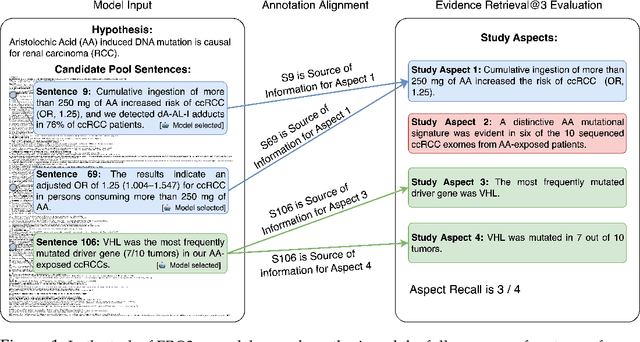

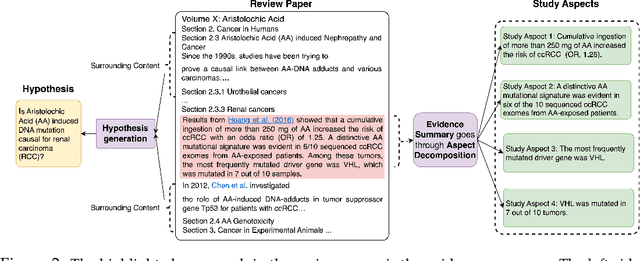

We study the task of automatically finding evidence relevant to hypotheses in biomedical papers. Finding relevant evidence is an important step when researchers investigate scientific hypotheses. We introduce EvidenceBench to measure models performance on this task, which is created by a novel pipeline that consists of hypothesis generation and sentence-by-sentence annotation of biomedical papers for relevant evidence, completely guided by and faithfully following existing human experts judgment. We demonstrate the pipeline's validity and accuracy with multiple sets of human-expert annotations. We evaluated a diverse set of language models and retrieval systems on the benchmark and found that model performances still fall significantly short of the expert level on this task. To show the scalability of our proposed pipeline, we create a larger EvidenceBench-100k with 107,461 fully annotated papers with hypotheses to facilitate model training and development. Both datasets are available at https://github.com/EvidenceBench/EvidenceBench
Digital Twin-Enabled Real-Time Control in Robotic Additive Manufacturing via Soft Actor-Critic Reinforcement Learning
Jan 29, 2025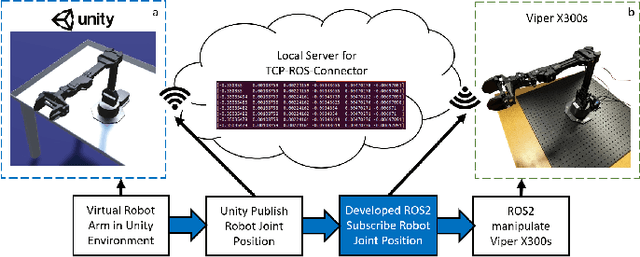
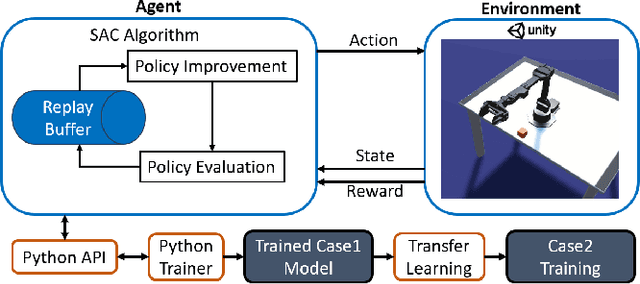
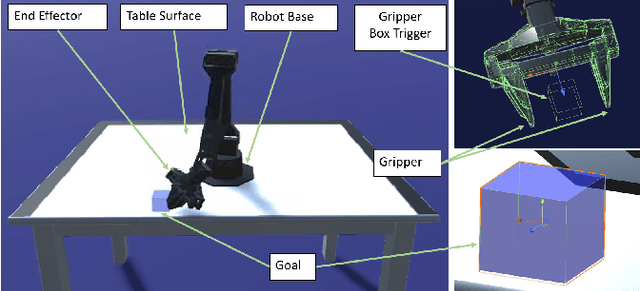
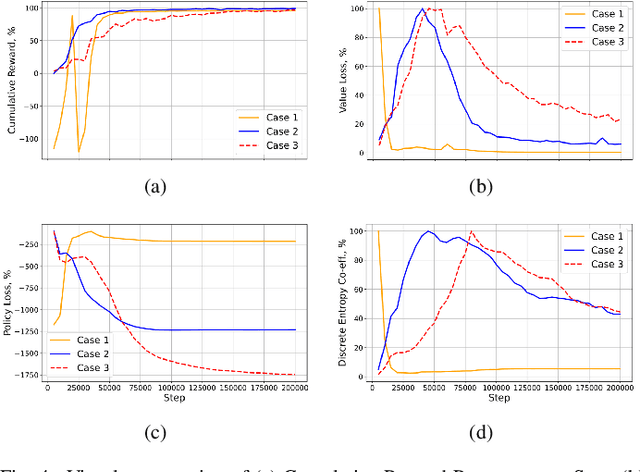
Smart manufacturing systems increasingly rely on adaptive control mechanisms to optimize complex processes. This research presents a novel approach integrating Soft Actor-Critic (SAC) reinforcement learning with digital twin technology to enable real-time process control in robotic additive manufacturing. We demonstrate our methodology using a Viper X300s robot arm, implementing two distinct control scenarios: static target acquisition and dynamic trajectory following. The system architecture combines Unity's simulation environment with ROS2 for seamless digital twin synchronization, while leveraging transfer learning to efficiently adapt trained models across tasks. Our hierarchical reward structure addresses common reinforcement learning challenges including local minima avoidance, convergence acceleration, and training stability. Experimental results show rapid policy convergence and robust task execution in both simulated and physical environments, with performance metrics including cumulative reward, value prediction accuracy, policy loss, and discrete entropy coefficient demonstrating the effectiveness of our approach. This work advances the integration of reinforcement learning with digital twins for industrial robotics applications, providing a framework for enhanced adaptive real-time control for smart additive manufacturing process.
Rationality based Innate-Values-driven Reinforcement Learning
Nov 14, 2024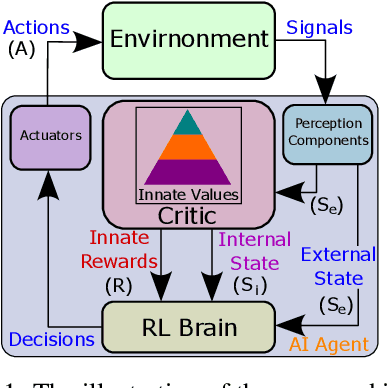
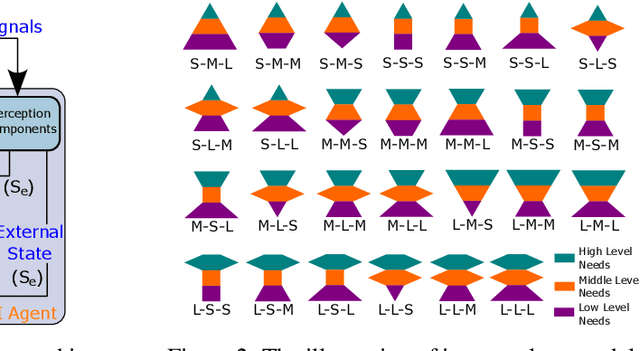

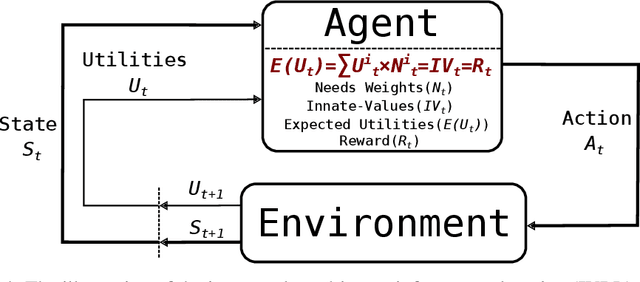
Innate values describe agents' intrinsic motivations, which reflect their inherent interests and preferences to pursue goals and drive them to develop diverse skills satisfying their various needs. The essence of reinforcement learning (RL) is learning from interaction based on reward-driven behaviors, much like natural agents. It is an excellent model to describe the innate-values-driven (IV) behaviors of AI agents. Especially developing the awareness of the AI agent through balancing internal and external utilities based on its needs in different tasks is a crucial problem for individuals learning to support AI agents integrating human society with safety and harmony in the long term. This paper proposes a hierarchical compound intrinsic value reinforcement learning model -- innate-values-driven reinforcement learning termed IVRL to describe the complex behaviors of AI agents' interaction. We formulated the IVRL model and proposed two IVRL models: DQN and A2C. By comparing them with benchmark algorithms such as DQN, DDQN, A2C, and PPO in the Role-Playing Game (RPG) reinforcement learning test platform VIZDoom, we demonstrated that rationally organizing various individual needs can effectively achieve better performance.
LMO-DP: Optimizing the Randomization Mechanism for Differentially Private Fine-Tuning (Large) Language Models
May 29, 2024Differentially Private Stochastic Gradient Descent (DP-SGD) and its variants have been proposed to ensure rigorous privacy for fine-tuning large-scale pre-trained language models. However, they rely heavily on the Gaussian mechanism, which may overly perturb the gradients and degrade the accuracy, especially in stronger privacy regimes (e.g., the privacy budget $\epsilon < 3$). To address such limitations, we propose a novel Language Model-based Optimal Differential Privacy (LMO-DP) mechanism, which takes the first step to enable the tight composition of accurately fine-tuning (large) language models with a sub-optimal DP mechanism, even in strong privacy regimes (e.g., $0.1\leq \epsilon<3$). Furthermore, we propose a novel offline optimal noise search method to efficiently derive the sub-optimal DP that significantly reduces the noise magnitude. For instance, fine-tuning RoBERTa-large (with 300M parameters) on the SST-2 dataset can achieve an accuracy of 92.20% (given $\epsilon=0.3$, $\delta=10^{-10}$) by drastically outperforming the Gaussian mechanism (e.g., $\sim 50\%$ for small $\epsilon$ and $\delta$). We also draw similar findings on the text generation tasks on GPT-2. Finally, to our best knowledge, LMO-DP is also the first solution to accurately fine-tune Llama-2 with strong differential privacy guarantees. The code will be released soon and available upon request.
Research on Credit Risk Early Warning Model of Commercial Banks Based on Neural Network Algorithm
May 17, 2024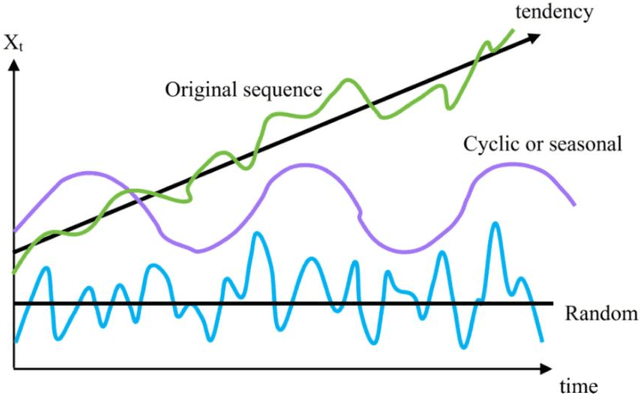
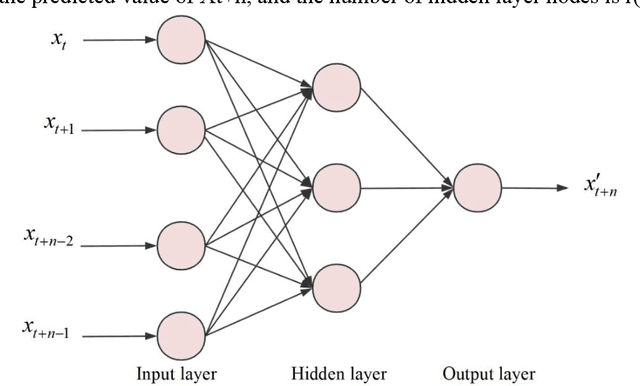
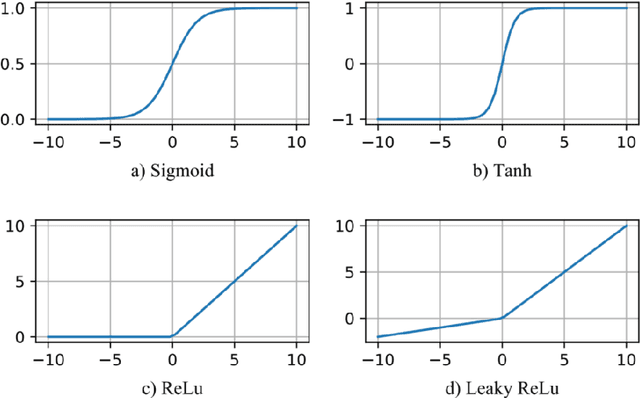
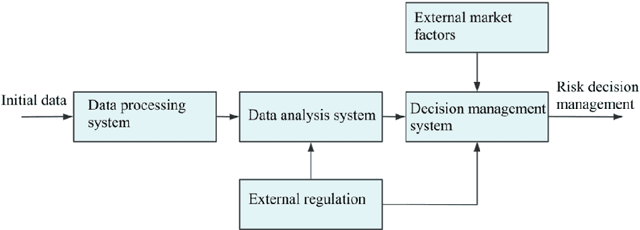
In the realm of globalized financial markets, commercial banks are confronted with an escalating magnitude of credit risk, thereby imposing heightened requisites upon the security of bank assets and financial stability. This study harnesses advanced neural network techniques, notably the Backpropagation (BP) neural network, to pioneer a novel model for preempting credit risk in commercial banks. The discourse initially scrutinizes conventional financial risk preemptive models, such as ARMA, ARCH, and Logistic regression models, critically analyzing their real-world applications. Subsequently, the exposition elaborates on the construction process of the BP neural network model, encompassing network architecture design, activation function selection, parameter initialization, and objective function construction. Through comparative analysis, the superiority of neural network models in preempting credit risk in commercial banks is elucidated. The experimental segment selects specific bank data, validating the model's predictive accuracy and practicality. Research findings evince that this model efficaciously enhances the foresight and precision of credit risk management.
Research on Splicing Image Detection Algorithms Based on Natural Image Statistical Characteristics
Apr 26, 2024With the development and widespread application of digital image processing technology, image splicing has become a common method of image manipulation, raising numerous security and legal issues. This paper introduces a new splicing image detection algorithm based on the statistical characteristics of natural images, aimed at improving the accuracy and efficiency of splicing image detection. By analyzing the limitations of traditional methods, we have developed a detection framework that integrates advanced statistical analysis techniques and machine learning methods. The algorithm has been validated using multiple public datasets, showing high accuracy in detecting spliced edges and locating tampered areas, as well as good robustness. Additionally, we explore the potential applications and challenges faced by the algorithm in real-world scenarios. This research not only provides an effective technological means for the field of image tampering detection but also offers new ideas and methods for future related research.
Transformer-Based Classification Outcome Prediction for Multimodal Stroke Treatment
Apr 19, 2024This study proposes a multi-modal fusion framework Multitrans based on the Transformer architecture and self-attention mechanism. This architecture combines the study of non-contrast computed tomography (NCCT) images and discharge diagnosis reports of patients undergoing stroke treatment, using a variety of methods based on Transformer architecture approach to predicting functional outcomes of stroke treatment. The results show that the performance of single-modal text classification is significantly better than single-modal image classification, but the effect of multi-modal combination is better than any single modality. Although the Transformer model only performs worse on imaging data, when combined with clinical meta-diagnostic information, both can learn better complementary information and make good contributions to accurately predicting stroke treatment effects..
Research on Detection of Floating Objects in River and Lake Based on AI Intelligent Image Recognition
Apr 10, 2024With the rapid advancement of artificial intelligence technology, AI-enabled image recognition has emerged as a potent tool for addressing challenges in traditional environmental monitoring. This study focuses on the detection of floating objects in river and lake environments, exploring an innovative approach based on deep learning. By intricately analyzing the technical pathways for detecting static and dynamic features and considering the characteristics of river and lake debris, a comprehensive image acquisition and processing workflow has been developed. The study highlights the application and performance comparison of three mainstream deep learning models -SSD, Faster-RCNN, and YOLOv5- in debris identification. Additionally, a detection system for floating objects has been designed and implemented, encompassing both hardware platform construction and software framework development. Through rigorous experimental validation, the proposed system has demonstrated its ability to significantly enhance the accuracy and efficiency of debris detection, thus offering a new technological avenue for water quality monitoring in rivers and lakes