 Add to Chrome
 Add to Firefox
 Add to Edge
Mechanistic Interpretability of Structure-Aware Numerical Reasoning in LLaMA 3.1 8B
Aug 19, 2026
Recent work has shown that large language models (LLMs) exhibit strong numerical sequence modeling capabilities and show promise in time-series prediction. While LLMs display in-context learning capabilities, the mechanisms with which they accomplish time-series prediction remain unclear. Specifically, whether they truly understand the underlying structure, which at a minimum requires reasoning over first differences in the sequence of numbers. To study this, we investigate Llama 3.1-8B from a mechanistic interpretability point of view. Mechanistic interpretability is an emerging field concerned with the reverse engineering of the algorithms learned by neural networks such as LLMs. To assess Llamas' numerical sequence modeling capabilities and to facilitate our mechanistic interpretability analysis, we create a sequence modeling task that cannot be solved without picking up structural cues. Specifically, we sample n random numbers and repeat them with an offset. We find that Llama displays strong performance on our tasks suggesting that it can pick up on the underlying structure. To understand the mechanisms that allow it to do so, we perform probing experiments and activation patching based counterfactual analysis. Probing reveals that the model computes and stores first differences in its internal representations without explicit supervision, indicating that it tracks structural information about the sequence. Activation patching reveals that Llama retrieves the relevant first-difference with a mechanism similar to an induction circuit and subsequently adds it to the current value. Notably, our work represents one of the first studies to identify this form of concept induction in LLMs.

Memory-Bounded Continuation of Greedy Sampling for Continual Anomaly Detection
Aug 15, 2026Greedy sampling produces a compact yet representative summary of normal data, which is essential for reliable anomaly detection that relies on measuring distance from normality. For continual anomaly detection where tasks arrive sequentially, extending greedy sampling is straightforward with unbounded memory through coreset accumulation. However, practical deployment requires fixed memory where the coreset size remains constant regardless of task count. We observe that continued greedy sampling, which iteratively applies greedy selection over previously greedy-sampled sets, effectively preserves representativeness under strict memory limits. Despite discarding data at each step to satisfy the memory constraint, coreset quality degrades gracefully rather than catastrophically, enabling reliable anomaly detection across the tasks. We provide theoretical justification by showing that resulting greedy-continued coreset approximates the oracle coreset within a bounded gap. We instantiate this principle in ContCore, which constructs a greedy-continued coreset through greedy expansion on new task features followed by greedy consolidation to enforce the memory budget. Unlike neural methods susceptible to catastrophic forgetting or naive coreset accumulation requiring unbounded memory, ContCore maintains fixed memory with theoretical guarantees. Empirically, ContCore achieves state-of-the-art performance across 11 task schedules on MVTecAD and VisA, and extends effectively to online continual AD settings where prior methods degrade significantly. Code: https://github.com/jungyg/ContCore
OnPoint: Offline-to-Online Multi-Level Distillation for Point-Supervised Online Temporal Action Localization
Jul 01, 2026Temporal Action Localization (TAL) typically relies on segment annotations or offline access to full videos, limiting scalability and online use. We introduce Point-Supervised Online TAL (POTAL), which localizes actions in streaming videos using only one temporal point per instance. To solve POTAL, we propose OnPoint, an offline-to-online multi-level distillation framework that transfers knowledge from a point-supervised offline teacher to an online student via (i) pseudo-segment instance distillation, (ii) class-activation sequence distillation, and (iii) anticipatory window-level distillation. We further improve robustness by incorporating the original point labels into student training and by refining anchor decoding with actionness-guided attention calibration. Experiments on five datasets show OnPoint consistently outperforms strong baselines, establishing a solid foundation for POTAL.
Memory-Distilled Selection for Noise-Robust Anomaly Detection
May 26, 2026Anomaly detection (AD) under data contamination is critical for deploying unsupervised defect detection in industrial environments, where curating perfectly clean training sets is impractical. However, existing methods are sensitive to contamination, suffering significant performance degradation as the noise ratio increases. In this paper, we propose Memory-Distilled Selection (MeDS), a training algorithm based on data selection. MeDS constructs an ensemble of partial memories via random subsampling, where the resulting sparsity acts as a low-pass filter that captures nominal patterns across a wide range of noise ratios, enabling coarse-level identification of contaminated samples. The aggregated distances to the bootstrapped memories are then distilled into a reconstruction score network, which is subsequently fine-tuned on clean data filtered using scores from the distilled model, enabling fine-grained localization of anomalies. MeDS is robust across a wide range of noise ratios without requiring noise-ratio-specific hyperparameter tuning, achieving 99.16\% image-level AUROC on MVTecAD at a 40\% noise ratio, and attaining state-of-the-art performance on both VisA and Real-IAD under noisy settings. We thoroughly verify the efficacy of MeDS on industrial AD benchmarks under noisy data scenarios, accompanied by in-depth empirical analyses.
REEF: Relevance-Aware and Efficient LLM Adapter for Video Understanding
Apr 07, 2025Integrating vision models into large language models (LLMs) has sparked significant interest in creating vision-language foundation models, especially for video understanding. Recent methods often utilize memory banks to handle untrimmed videos for video-level understanding. However, they typically compress visual memory using similarity-based greedy approaches, which can overlook the contextual importance of individual tokens. To address this, we introduce an efficient LLM adapter designed for video-level understanding of untrimmed videos that prioritizes the contextual relevance of spatio-temporal tokens. Our framework leverages scorer networks to selectively compress the visual memory bank and filter spatial tokens based on relevance, using a differentiable Top-K operator for end-to-end training. Across three key video-level understanding tasks$\unicode{x2013}$ untrimmed video classification, video question answering, and video captioning$\unicode{x2013}$our method achieves competitive or superior results on four large-scale datasets while reducing computational overhead by up to 34%. The code will be available soon on GitHub.
TailedCore: Few-Shot Sampling for Unsupervised Long-Tail Noisy Anomaly Detection
Apr 03, 2025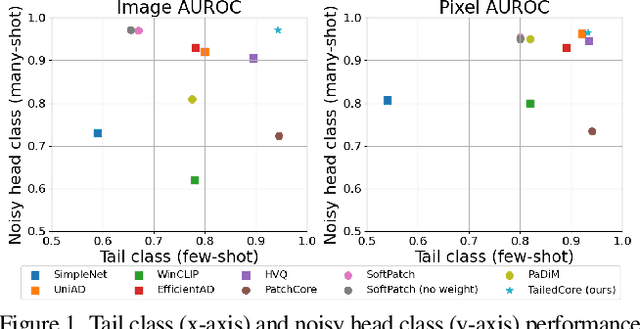
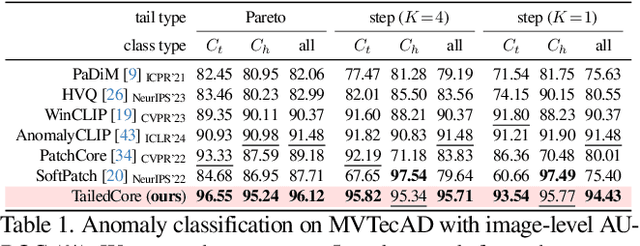
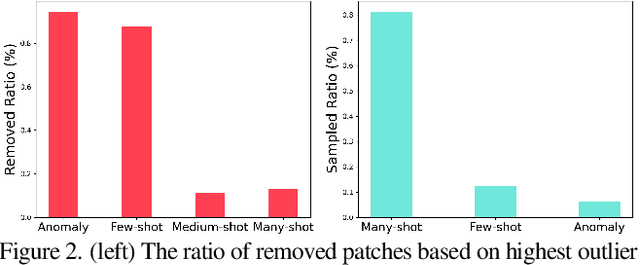
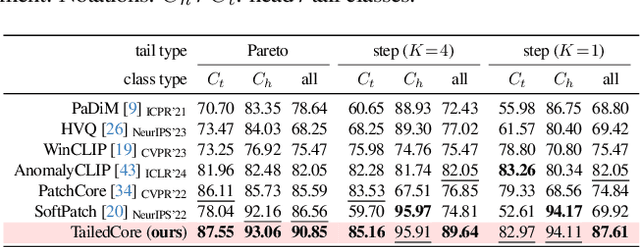
We aim to solve unsupervised anomaly detection in a practical challenging environment where the normal dataset is both contaminated with defective regions and its product class distribution is tailed but unknown. We observe that existing models suffer from tail-versus-noise trade-off where if a model is robust against pixel noise, then its performance deteriorates on tail class samples, and vice versa. To mitigate the issue, we handle the tail class and noise samples independently. To this end, we propose TailSampler, a novel class size predictor that estimates the class cardinality of samples based on a symmetric assumption on the class-wise distribution of embedding similarities. TailSampler can be utilized to sample the tail class samples exclusively, allowing to handle them separately. Based on these facets, we build a memory-based anomaly detection model TailedCore, whose memory both well captures tail class information and is noise-robust. We extensively validate the effectiveness of TailedCore on the unsupervised long-tail noisy anomaly detection setting, and show that TailedCore outperforms the state-of-the-art in most settings.
Generalization Error Analysis for Selective State-Space Models Through the Lens of Attention
Feb 03, 2025State-space models (SSMs) are a new class of foundation models that have emerged as a compelling alternative to Transformers and their attention mechanisms for sequence processing tasks. This paper provides a detailed theoretical analysis of selective SSMs, the core components of the Mamba and Mamba-2 architectures. We leverage the connection between selective SSMs and the self-attention mechanism to highlight the fundamental similarities between these models. Building on this connection, we establish a length independent covering number-based generalization bound for selective SSMs, providing a deeper understanding of their theoretical performance guarantees. We analyze the effects of state matrix stability and input-dependent discretization, shedding light on the critical role played by these factors in the generalization capabilities of selective SSMs. Finally, we empirically demonstrate the sequence length independence of the derived bounds on two tasks.
HAT: History-Augmented Anchor Transformer for Online Temporal Action Localization
Aug 12, 2024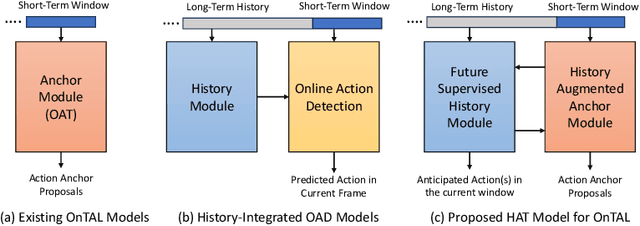
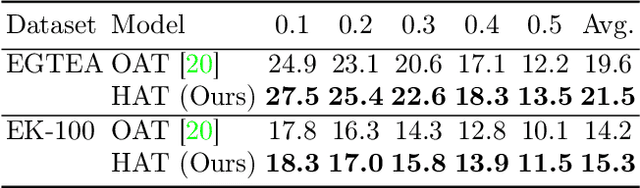
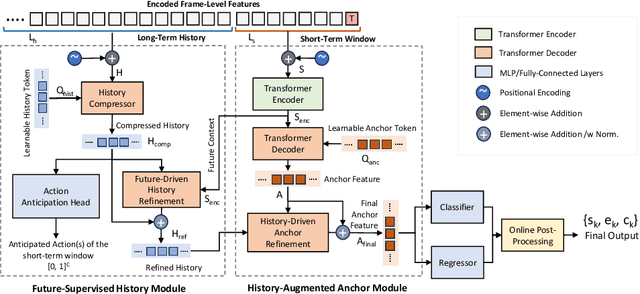
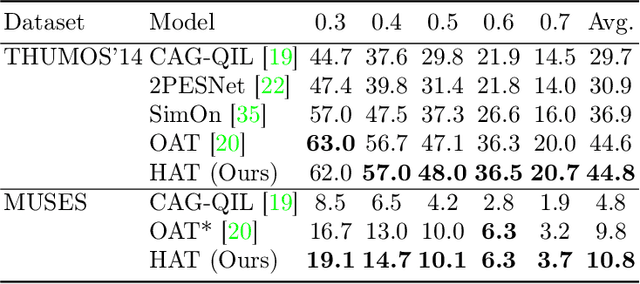
Online video understanding often relies on individual frames, leading to frame-by-frame predictions. Recent advancements such as Online Temporal Action Localization (OnTAL), extend this approach to instance-level predictions. However, existing methods mainly focus on short-term context, neglecting historical information. To address this, we introduce the History-Augmented Anchor Transformer (HAT) Framework for OnTAL. By integrating historical context, our framework enhances the synergy between long-term and short-term information, improving the quality of anchor features crucial for classification and localization. We evaluate our model on both procedural egocentric (PREGO) datasets (EGTEA and EPIC) and standard non-PREGO OnTAL datasets (THUMOS and MUSES). Results show that our model outperforms state-of-the-art approaches significantly on PREGO datasets and achieves comparable or slightly superior performance on non-PREGO datasets, underscoring the importance of leveraging long-term history, especially in procedural and egocentric action scenarios. Code is available at: https://github.com/sakibreza/ECCV24-HAT/
Face Reconstruction Transfer Attack as Out-of-Distribution Generalization
Jul 02, 2024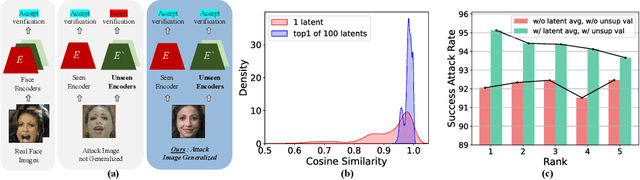
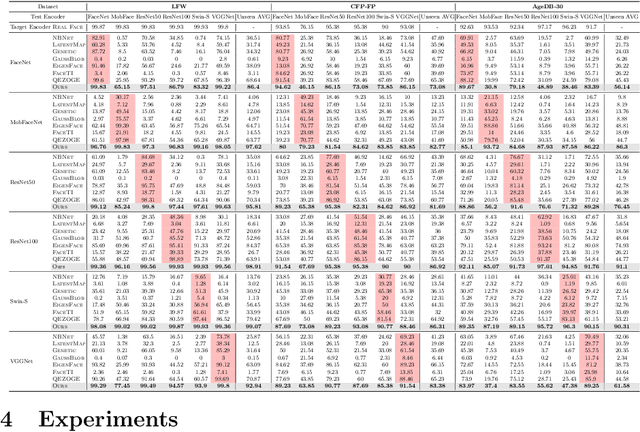

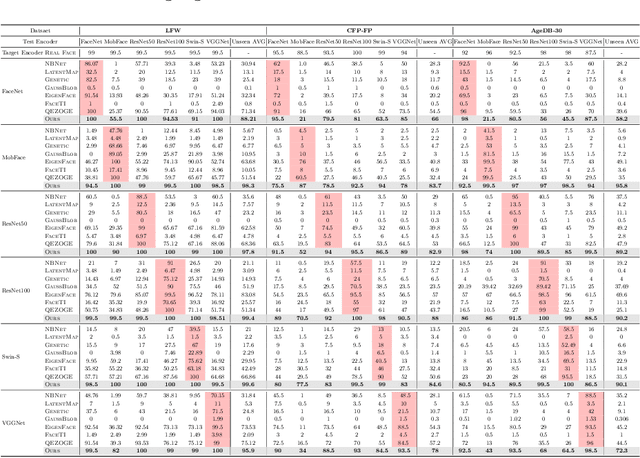
Understanding the vulnerability of face recognition systems to malicious attacks is of critical importance. Previous works have focused on reconstructing face images that can penetrate a targeted verification system. Even in the white-box scenario, however, naively reconstructed images misrepresent the identity information, hence the attacks are easily neutralized once the face system is updated or changed. In this paper, we aim to reconstruct face images which are capable of transferring face attacks on unseen encoders. We term this problem as Face Reconstruction Transfer Attack (FRTA) and show that it can be formulated as an out-of-distribution (OOD) generalization problem. Inspired by its OOD nature, we propose to solve FRTA by Averaged Latent Search and Unsupervised Validation with pseudo target (ALSUV). To strengthen the reconstruction attack on OOD unseen encoders, ALSUV reconstructs the face by searching the latent of amortized generator StyleGAN2 through multiple latent optimization, latent optimization trajectory averaging, and unsupervised validation with a pseudo target. We demonstrate the efficacy and generalization of our method on widely used face datasets, accompanying it with extensive ablation studies and visually, qualitatively, and quantitatively analyses. The source code will be released.
3D-HGS: 3D Half-Gaussian Splatting
Jun 04, 2024Photo-realistic 3D Reconstruction is a fundamental problem in 3D computer vision. This domain has seen considerable advancements owing to the advent of recent neural rendering techniques. These techniques predominantly aim to focus on learning volumetric representations of 3D scenes and refining these representations via loss functions derived from rendering. Among these, 3D Gaussian Splatting (3D-GS) has emerged as a significant method, surpassing Neural Radiance Fields (NeRFs). 3D-GS uses parameterized 3D Gaussians for modeling both spatial locations and color information, combined with a tile-based fast rendering technique. Despite its superior rendering performance and speed, the use of 3D Gaussian kernels has inherent limitations in accurately representing discontinuous functions, notably at edges and corners for shape discontinuities, and across varying textures for color discontinuities. To address this problem, we propose to employ 3D Half-Gaussian (3D-HGS) kernels, which can be used as a plug-and-play kernel. Our experiments demonstrate their capability to improve the performance of current 3D-GS related methods and achieve state-of-the-art rendering performance on various datasets without compromising rendering speed.