 Add to Chrome
 Add to Firefox
 Add to Edge
Finding the Right Tables and Columns: A Benchmark and Corpus-Adaptive Embeddings for SQL Schema Retrieval
Jul 14, 2026
Retrieval in the SQL setting has largely been studied as the task of finding, within a large collection of SQL statements, the statement that answers a natural-language question. At scale, however, a more fundamental retrieval problem precedes generation: schema retrieval, identifying the tables and columns a question requires in a database that may contain thousands of them, far more than fit in a model's context. We argue that this step warrants first-class evaluation. To this end, we recast five text-to-SQL datasets (Spider, BIRD, BEAVER, and two LiveSQLBench variants) as retrieval tasks at both table and column granularity, covering realistic and enterprise-scale schemas under two document representations, and we show that off-the-shelf text and code embedders transfer poorly to this setting. We then propose corpus-adaptive fine-tuning: natural-language queries are synthesized directly from the target schema corpus, granularity-aware hard negatives are mined, and a 305M-parameter embedder is fine-tuned contrastively. This procedure raises average recall@10 from 60.4 to 75.6 (nDCG@10 from 51.9 to 68.0), making the 305M model the strongest retriever under one billion parameters and competitive with state-of-the-art embedders of 4-8B parameters, more than an order of magnitude larger. The same recipe improves an 8B state-of-the-art embedder from 77.8 to 78.4 recall@10, matching the best result on the benchmark and indicating that the adaptation is backbone-agnostic. Leave-one-corpus-out experiments and a leakage audit show that these gains reflect a transferable schema-retrieval ability rather than memorization of the evaluation data. Our results establish schema linking as a standalone retrieval task and lightweight, label-free corpus adaptation as a practical route to deploying it at enterprise scale.

Beyond Monolingual Deep Research: Evaluating Agents and Retrievers with Cross-Lingual BrowseComp-Plus
Jun 17, 2026Deep research agents are increasingly evaluated on their ability to search for evidence, reason over retrieved sources, and produce grounded answers. Existing browsing benchmarks, however, largely assume that the user's query and the supporting evidence are written in the same language, leaving open whether agentic search systems can operate when relevant evidence appears in another language. We introduce XBCP (Cross-lingual BrowseComp-Plus), a controlled benchmark that preserves the English question-and-answer space of BrowseComp-Plus but varies the languages of the supporting documents. XBCP instantiates two complementary settings: in the cross-lingual setting, each query is paired with evidence in a single assigned language. In the multilingual setting, the full evidence corpus is distributed equally and randomly across 12 languages spanning high-resource and low-resource regimes. We evaluate four deep research agents using sparse and dense multilingual retrievers, measuring answer accuracy, evidence recall, search behavior, calibration, citation fidelity, and oracle retrieval. Results reveal substantial degradation when evidence is translated. Even strong, dense retrievers lose evidence recall, and agents become less calibrated and cite evidence less reliably. Notably, accuracy remains lower even when all gold evidence is supplied directly. These findings suggest that cross-lingual deep research exposes both retrieval failures and an independent, agent-side difficulty in integrating language-mismatched evidence.
Larch: Learned Query Optimization for Semantic Predicates
Jun 06, 2026With the advent of Large Language Models (LLMs), many database systems introduced semantic operators that enabled analytical queries over unstructured data (e.g. text, images, videos). Semantic operators typically incur high inference costs and latencies making semantic (AI) SQL queries challenging to apply on large scale datasets. At the same time, their semantic nature leads database engines to treat them as black boxes, making AISQL queries difficult to optimize. In this paper, we introduce Larch, a framework for optimizing the execution of semantic filters in AI SQL queries. Larch was inspired by two key observations: i) the high latency of semantic operators leaves significant room for computationally-heavy runtime optimization techniques, ii) unstructured data are typically accompanied by semantic information in the form of embeddings allowing for efficient semantic comparisons between AI_FILTER prompts and data values. Based on these two key observations, we present two Larch variants: Larch-A2C and Larch-Sel. Larch-A2C encodes arbitrary semantic filters expression tree using an embedding-augmented Gated Graph Neural Network and formulates the filter evaluation order as a Markov decision process. In contrast, Larch-Sel leverages a supervised learning model to predict filter selectivities, subsequently applying dynamic programming to find a near-optimal evaluation order for each input row. Evaluated across diverse real-world datasets and comprehensive synthetic workloads, both Larch variants always outperform existing semantic filter optimization techniques in terms of token usage. Our results demonstrate that Larch is robust across diverse workloads, reducing total token cost overhead by 3x-19x compared to Palimpzest and Quest.
Dual-View Training for Instruction-Following Information Retrieval
Apr 20, 2026Instruction-following information retrieval (IF-IR) studies retrieval systems that must not only find documents relevant to a query, but also obey explicit user constraints such as required attributes, exclusions, or output preferences. However, most retrievers are trained primarily for semantic relevance and often fail to distinguish documents that match the topic from those that satisfy the instruction. We propose a dual-view data synthesis strategy based on polarity reversal: given a query, a document that is relevant under the instruction, and a hard negative that matches the query but violates the instruction, we prompt an LLM to generate a complementary instruction under which the two documents swap relevance labels. By presenting the same document pair under complementary instructions that invert their relevance labels, the training signal forces the retriever to reconsider the same candidate set through the instruction, rather than relying on fixed topical cues. On a 305M-parameter encoder, our method improves performance on the FollowIR benchmark by 45%, surpassing general-purpose embedding models of comparable or larger scale. Through head-to-head comparisons at matched data budgets, we further show that data diversity and instruction supervision play complementary roles: the former preserves general retrieval quality, while the latter improves instruction sensitivity. These results highlight the value of targeted data synthesis for building retrieval systems that are both broadly capable and instruction-aware.
Code-Switching Information Retrieval: Benchmarks, Analysis, and the Limits of Current Retrievers
Apr 19, 2026Code-switching is a pervasive linguistic phenomenon in global communication, yet modern information retrieval systems remain predominantly designed for, and evaluated within, monolingual contexts. To bridge this critical disconnect, we present a holistic study dedicated to code-switching IR. We introduce CSR-L (Code-Switching Retrieval benchmark-Lite), constructing a dataset via human annotation to capture the authentic naturalness of mixed-language queries. Our evaluation across statistical, dense, and late-interaction paradigms reveals that code-switching acts as a fundamental performance bottleneck, degrading the effectiveness of even robust multilingual models. We demonstrate that this failure stems from substantial divergence in the embedding space between pure and code-switched text. Scaling this investigation, we propose CS-MTEB, a comprehensive benchmark covering 11 diverse tasks, where we observe performance declines of up to 27%. Finally, we show that standard multilingual techniques like vocabulary expansion are insufficient to resolve these deficits completely. These findings underscore the fragility of current systems and establish code-switching as a crucial frontier for future IR optimization.
A Survey of Model Architectures in Information Retrieval
Feb 20, 2025This survey examines the evolution of model architectures in information retrieval (IR), focusing on two key aspects: backbone models for feature extraction and end-to-end system architectures for relevance estimation. The review intentionally separates architectural considerations from training methodologies to provide a focused analysis of structural innovations in IR systems.We trace the development from traditional term-based methods to modern neural approaches, particularly highlighting the impact of transformer-based models and subsequent large language models (LLMs). We conclude by discussing emerging challenges and future directions, including architectural optimizations for performance and scalability, handling of multimodal, multilingual data, and adaptation to novel application domains beyond traditional search paradigms.
Arctic-Embed 2.0: Multilingual Retrieval Without Compromise
Dec 03, 2024This paper presents the training methodology of Arctic-Embed 2.0, a set of open-source text embedding models built for accurate and efficient multilingual retrieval. While prior works have suffered from degraded English retrieval quality, Arctic-Embed 2.0 delivers competitive retrieval quality on multilingual and English-only benchmarks, and supports Matryoshka Representation Learning (MRL) for efficient embedding storage with significantly lower compressed quality degradation compared to alternatives. We detail the design and implementation, presenting several important open research questions that arose during model development. We conduct experiments exploring these research questions and include extensive discussion aimed at fostering further discussion in this field.
Explain then Rank: Scale Calibration of Neural Rankers Using Natural Language Explanations from Large Language Models
Feb 19, 2024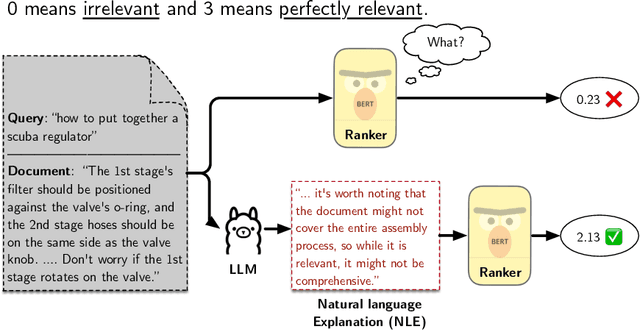
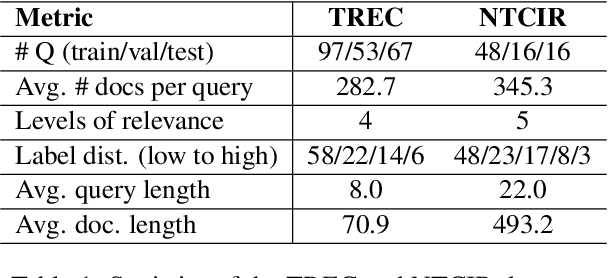
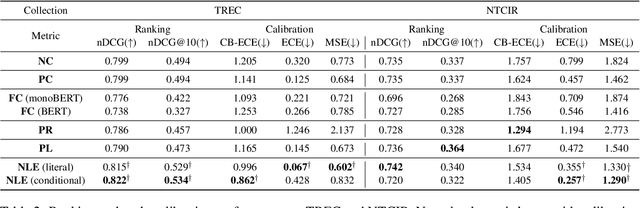
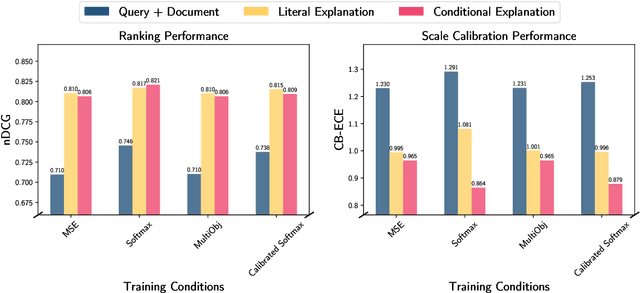
The process of scale calibration in ranking systems involves adjusting the outputs of rankers to correspond with significant qualities like click-through rates or relevance, crucial for mirroring real-world value and thereby boosting the system's effectiveness and reliability. Although there has been research on calibrated ranking losses within learning-to-rank models, the particular issue of adjusting the scale for neural rankers, which excel in handling textual information, has not been thoroughly examined. Neural ranking models are adept at processing text data, yet the application of existing scale calibration techniques to these models poses significant challenges due to their complexity and the intensive training they require, often resulting in suboptimal outcomes. This study delves into the potential of large language models (LLMs) to provide uncertainty measurements for a query and document pair that correlate with the scale-calibrated scores. By employing Monte Carlo sampling to gauge relevance probabilities from LLMs and incorporating natural language explanations (NLEs) to articulate this uncertainty, we carry out comprehensive tests on two major document ranking datasets. Our findings reveal that the approach leveraging NLEs outperforms existing calibration methods under various training scenarios, leading to better calibrated neural rankers.
Improved Learned Sparse Retrieval with Corpus-Specific Vocabularies
Jan 12, 2024We explore leveraging corpus-specific vocabularies that improve both efficiency and effectiveness of learned sparse retrieval systems. We find that pre-training the underlying BERT model on the target corpus, specifically targeting different vocabulary sizes incorporated into the document expansion process, improves retrieval quality by up to 12% while in some scenarios decreasing latency by up to 50%. Our experiments show that adopting corpus-specific vocabulary and increasing vocabulary size decreases average postings list length which in turn reduces latency. Ablation studies show interesting interactions between custom vocabularies, document expansion techniques, and sparsification objectives of sparse models. Both effectiveness and efficiency improvements transfer to different retrieval approaches such as uniCOIL and SPLADE and offer a simple yet effective approach to providing new efficiency-effectiveness trade-offs for learned sparse retrieval systems.
Cross-lingual Knowledge Transfer via Distillation for Multilingual Information Retrieval
Feb 26, 2023In this paper, we introduce the approach behind our submission for the MIRACL challenge, a WSDM 2023 Cup competition that centers on ad-hoc retrieval across 18 diverse languages. Our solution contains two neural-based models. The first model is a bi-encoder re-ranker, on which we apply a cross-lingual distillation technique to transfer ranking knowledge from English to the target language space. The second model is a cross-encoder re-ranker trained on multilingual retrieval data generated using neural machine translation. We further fine-tune both models using MIRACL training data and ensemble multiple rank lists to obtain the final result. According to the MIRACL leaderboard, our approach ranks 8th for the Test-A set and 2nd for the Test-B set among the 16 known languages.