 Add to Chrome
 Add to Firefox
 Add to Edge
Analysis of the Neglect-Zero Effect in Large Language Models
Jun 04, 2026
We investigate the extent to which the language processing of LLMs resembles human cognitive processes, focusing on a human cognitive bias called the $\textit{neglect-zero effect}$. This effect refers to the human tendency to ignore $\textit{zero-models}$, which are configurations that render a proposition vacuously true by virtue of an empty set. We focus on two types of inferences driven by the neglect-zero effect, and examine how LLMs process these inferences by comparing their behavior with that in an inference that does not involve the neglect-zero effect. For this purpose, we employ a paradigm based on $\textit{structural priming}$, where recent exposure to a preceding sentence (the $\textit{prime}$) facilitates the processing of a subsequent sentence (the $\textit{target}$) due to their structural similarity. We prepare primes to force LLMs to consider the zero-model, and analyze whether they also consider it in the target. The results suggest that the neglect-zero effect may not occur in the LLMs analyzed in this study. Our code is available at https://github.com/ynklab/neglect_zero

What Makes Words Hard? Sakura at BEA 2026 Shared Task on Vocabulary Difficulty Prediction
May 14, 2026We describe two types of models for vocabulary difficulty prediction: a high-accuracy black-box model, which achieved the top shared task result in the open track, and an explainable model, which outperforms a fine-tuned encoder baseline. As the black-box model, we fine-tuned an LLM using a soft-target loss function for effective application to the rating task, achieving r > 0.91. The explainable model provides insights into what impacts the difficulty of each item while maintaining a strong correlation (r > 0.77). We further analyze the results, demonstrating that the difficulty of items in the British Council's Knowledge-based Vocabulary Lists (KVL) is often affected by spelling difficulty or the construction of the test items, in addition to the genuine production difficulty of the words. We make our code available online at https://github.com/adno/vocabulary-difficulty .
Fine-Grained Analysis of Shared Syntactic Mechanisms in Language Models
Apr 24, 2026While language models demonstrate sophisticated syntactic capabilities, the extent to which their internal mechanisms align with cross-constructional principles studied in linguistics remains poorly understood. This study investigates whether models employ shared neural mechanisms across different syntactic constructions by applying causal interpretability methods at a granular level. Focusing on filler-gap dependencies and negative polarity item (NPI) licensing, we utilize activation patching to identify the functional roles of specific attention heads and MLP blocks. Our results reveal a highly localized and shared mechanism for filler-gap dependencies located in the early to middle layers, whereas NPI processing exhibits no such unified mechanism. Furthermore, we find that these mechanisms identified by activation patching generalize to out-of-distribution, while distributed alignment search, a supervised interpretability method, is susceptible to overfitting on narrow linguistic distributions. Finally, we validate our findings by demonstrating that the manipulation of the identified components improves model performance on acceptability judgment benchmarks.
Code-Switching Information Retrieval: Benchmarks, Analysis, and the Limits of Current Retrievers
Apr 19, 2026Code-switching is a pervasive linguistic phenomenon in global communication, yet modern information retrieval systems remain predominantly designed for, and evaluated within, monolingual contexts. To bridge this critical disconnect, we present a holistic study dedicated to code-switching IR. We introduce CSR-L (Code-Switching Retrieval benchmark-Lite), constructing a dataset via human annotation to capture the authentic naturalness of mixed-language queries. Our evaluation across statistical, dense, and late-interaction paradigms reveals that code-switching acts as a fundamental performance bottleneck, degrading the effectiveness of even robust multilingual models. We demonstrate that this failure stems from substantial divergence in the embedding space between pure and code-switched text. Scaling this investigation, we propose CS-MTEB, a comprehensive benchmark covering 11 diverse tasks, where we observe performance declines of up to 27%. Finally, we show that standard multilingual techniques like vocabulary expansion are insufficient to resolve these deficits completely. These findings underscore the fragility of current systems and establish code-switching as a crucial frontier for future IR optimization.
What Do Vision-Language Models Encode for Personalized Image Aesthetics Assessment?
Apr 13, 2026Personalized image aesthetics assessment (PIAA) is an important research problem with practical real-world applications. While methods based on vision-language models (VLMs) are promising candidates for PIAA, it remains unclear whether they internally encode rich, multi-level aesthetic attributes required for effective personalization. In this paper, we first analyze the internal representations of VLMs to examine the presence and distribution of such aesthetic attributes, and then leverage them for lightweight, individual-level personalization without model fine-tuning. Our analysis reveals that VLMs encode diverse aesthetic attributes that propagate into the language decoder layers. Building on these representations, we demonstrate that simple linear models can perform PIAA effectively. We further analyze how aesthetic information is transferred across layers in different VLM architectures and across image domains. Our findings provide insights into how VLMs can be utilized for modeling subjective, individual aesthetic preferences. Our code is available at https://github.com/ynklab/vlm-latent-piaa.
Developing a Guideline for the Labovian-Structural Analysis of Oral Narratives in Japanese
Mar 31, 2026Narrative analysis is a cornerstone of qualitative research. One leading approach is the Labovian model, but its application is labor-intensive, requiring a holistic, recursive interpretive process that moves back and forth between individual parts of the transcript and the transcript as a whole. Existing Labovian datasets are available only in English, which differs markedly from Japanese in terms of grammar and discourse conventions. To address this gap, we introduce the first systematic guidelines for Labovian narrative analysis of Japanese narrative data. Our guidelines retain all six Labovian categories and extend the framework by providing explicit rules for clause segmentation tailored to Japanese constructions. In addition, our guidelines cover a broader range of clause types and narrative types. Using these guidelines, annotators achieved high agreement in clause segmentation (Fleiss' kappa = 0.80) and moderate agreement in two structural classification tasks (Krippendorff's alpha = 0.41 and 0.45, respectively), one of which is slightly higher than that found in prior work despite the use of finer-grained distinctions. This paper describes the Labovian model, the proposed guidelines, the annotation process, and their utility. It concludes by discussing the challenges encountered during the annotation process and the prospects for developing a larger dataset for structural narrative analysis in Japanese qualitative research.
NeuronMoE: Neuron-Guided Mixture-of-Experts for Efficient Multilingual LLM Extension
Mar 05, 2026Extending large language models to low-resource languages is essential for global accessibility, but training separate models per language is prohibitively expensive. Mixture-of-Experts (MoE) architectures address this by adding sparse language-specific parameters, but determining how many experts each layer needs remains an open question. Current approaches allocate experts based on layer-level similarity, yet language processing exhibits fine-grained specialization at individual neurons. We propose $\textbf{NeuronMoE}$, a method that analyzes language-specific neurons across all transformer components to guide expert allocation per layer based on empirically measured cross-lingual neuron diversity. Applied to Llama-3.2-3B for low-resource languages (Greek, Turkish, and Hungarian), this approach achieves approximately 40% average parameter reduction while matching the performance of the LayerMoE baseline. We find that low-resource language experts independently develop neuron specialization patterns mirroring the high-resource language, which are concentrated in early and late layers. This reveals potential universal architectural principles in how multilingual models organize linguistic knowledge.
Towards Automated Lexicography: Generating and Evaluating Definitions for Learner's Dictionaries
Jan 05, 2026We study dictionary definition generation (DDG), i.e., the generation of non-contextualized definitions for given headwords. Dictionary definitions are an essential resource for learning word senses, but manually creating them is costly, which motivates us to automate the process. Specifically, we address learner's dictionary definition generation (LDDG), where definitions should consist of simple words. First, we introduce a reliable evaluation approach for DDG, based on our new evaluation criteria and powered by an LLM-as-a-judge. To provide reference definitions for the evaluation, we also construct a Japanese dataset in collaboration with a professional lexicographer. Validation results demonstrate that our evaluation approach agrees reasonably well with human annotators. Second, we propose an LDDG approach via iterative simplification with an LLM. Experimental results indicate that definitions generated by our approach achieve high scores on our criteria while maintaining lexical simplicity.
Investigating Training and Generalization in Faithful Self-Explanations of Large Language Models
Dec 08, 2025Large language models have the potential to generate explanations for their own predictions in a variety of styles based on user instructions. Recent research has examined whether these self-explanations faithfully reflect the models' actual behavior and has found that they often lack faithfulness. However, the question of how to improve faithfulness remains underexplored. Moreover, because different explanation styles have superficially distinct characteristics, it is unclear whether improvements observed in one style also arise when using other styles. This study analyzes the effects of training for faithful self-explanations and the extent to which these effects generalize, using three classification tasks and three explanation styles. We construct one-word constrained explanations that are likely to be faithful using a feature attribution method, and use these pseudo-faithful self-explanations for continual learning on instruction-tuned models. Our experiments demonstrate that training can improve self-explanation faithfulness across all classification tasks and explanation styles, and that these improvements also show signs of generalization to the multi-word settings and to unseen tasks. Furthermore, we find consistent cross-style generalization among three styles, suggesting that training may contribute to a broader improvement in faithful self-explanation ability.
Interpreting Multi-Attribute Confounding through Numerical Attributes in Large Language Models
Nov 10, 2025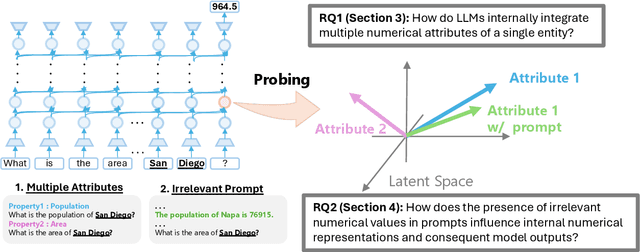
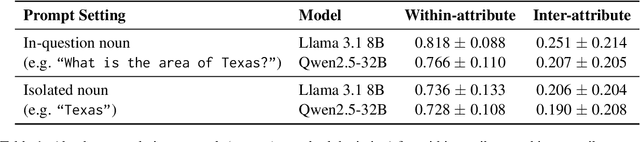
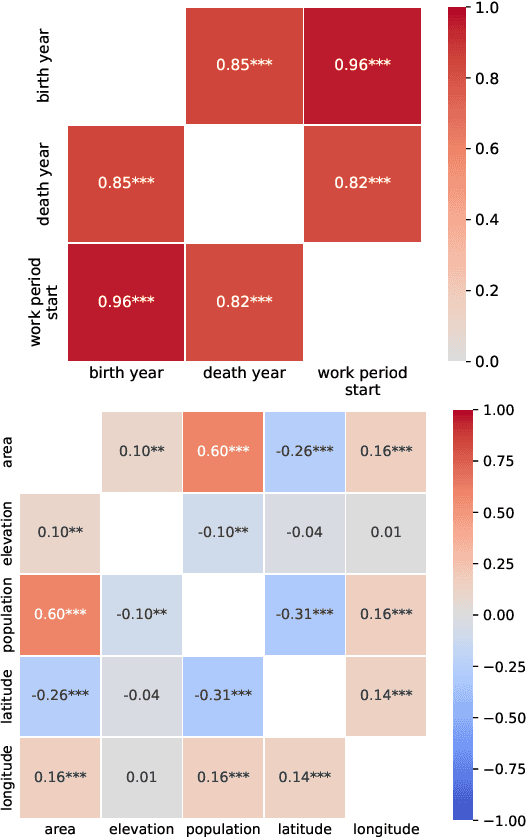
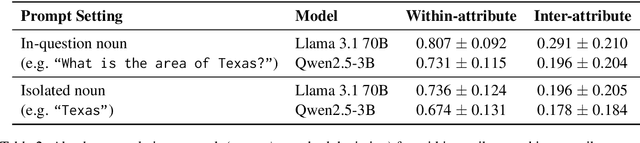
Although behavioral studies have documented numerical reasoning errors in large language models (LLMs), the underlying representational mechanisms remain unclear. We hypothesize that numerical attributes occupy shared latent subspaces and investigate two questions:(1) How do LLMs internally integrate multiple numerical attributes of a single entity? (2)How does irrelevant numerical context perturb these representations and their downstream outputs? To address these questions, we combine linear probing with partial correlation analysis and prompt-based vulnerability tests across models of varying sizes. Our results show that LLMs encode real-world numerical correlations but tend to systematically amplify them. Moreover, irrelevant context induces consistent shifts in magnitude representations, with downstream effects that vary by model size. These findings reveal a vulnerability in LLM decision-making and lay the groundwork for fairer, representation-aware control under multi-attribute entanglement.