 Add to Chrome
 Add to Firefox
 Add to Edge
Dynamic-I2V: Exploring Image-to-Video Generaion Models via Multimodal LLM
May 26, 2025
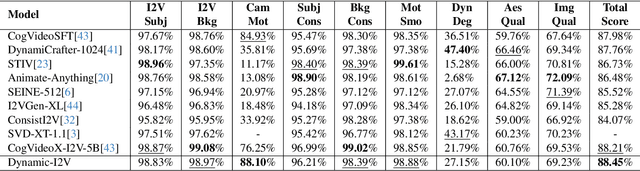
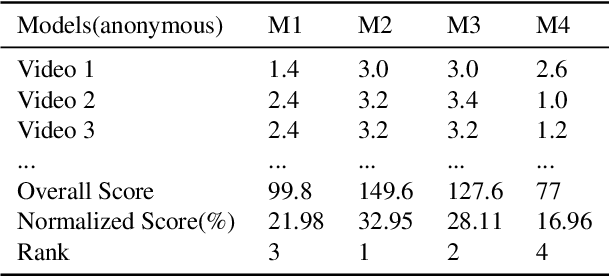
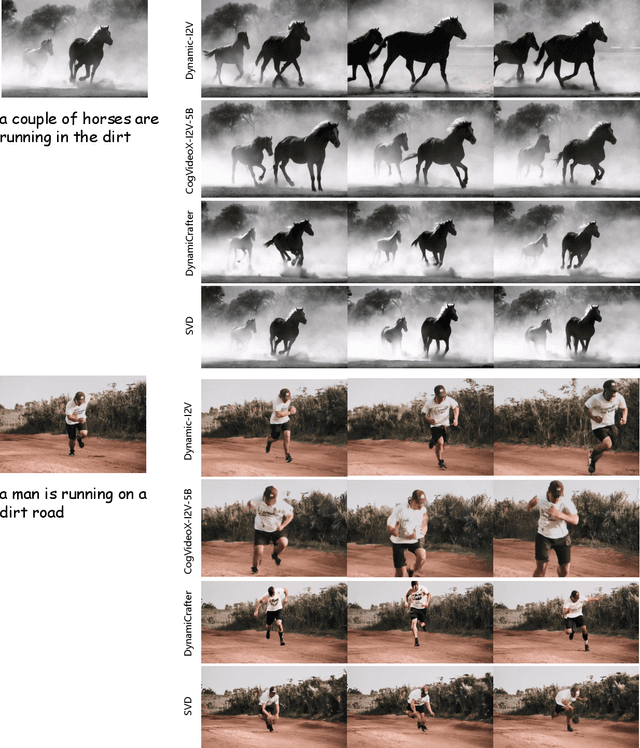
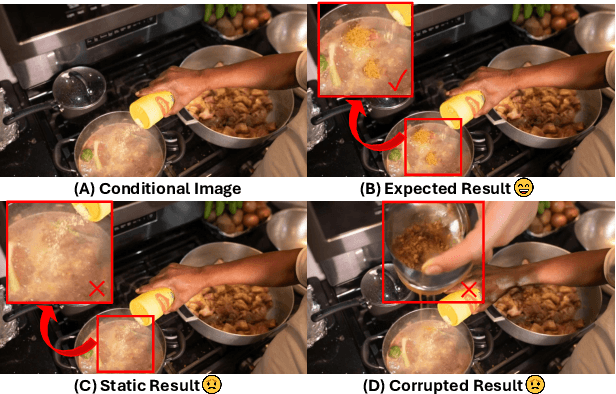
Recent advancements in image-to-video (I2V) generation have shown promising performance in conventional scenarios. However, these methods still encounter significant challenges when dealing with complex scenes that require a deep understanding of nuanced motion and intricate object-action relationships. To address these challenges, we present Dynamic-I2V, an innovative framework that integrates Multimodal Large Language Models (MLLMs) to jointly encode visual and textual conditions for a diffusion transformer (DiT) architecture. By leveraging the advanced multimodal understanding capabilities of MLLMs, our model significantly improves motion controllability and temporal coherence in synthesized videos. The inherent multimodality of Dynamic-I2V further enables flexible support for diverse conditional inputs, extending its applicability to various downstream generation tasks. Through systematic analysis, we identify a critical limitation in current I2V benchmarks: a significant bias towards favoring low-dynamic videos, stemming from an inadequate balance between motion complexity and visual quality metrics. To resolve this evaluation gap, we propose DIVE - a novel assessment benchmark specifically designed for comprehensive dynamic quality measurement in I2V generation. In conclusion, extensive quantitative and qualitative experiments confirm that Dynamic-I2V attains state-of-the-art performance in image-to-video generation, particularly revealing significant improvements of 42.5%, 7.9%, and 11.8% in dynamic range, controllability, and quality, respectively, as assessed by the DIVE metric in comparison to existing methods.

Bridging Theory and Experiment in Materials Discovery: Machine-Learning-Assisted Prediction of Synthesizable Structures
May 14, 2025Even though thermodynamic energy-based crystal structure prediction (CSP) has revolutionized materials discovery, the energy-driven CSP approaches often struggle to identify experimentally realizable metastable materials synthesized through kinetically controlled pathways, creating a critical gap between theoretical predictions and experimental synthesis. Here, we propose a synthesizability-driven CSP framework that integrates symmetry-guided structure derivation with a Wyckoff encode-based machine-learning model, allowing for the efficient localization of subspaces likely to yield highly synthesizable structures. Within the identified promising subspaces, a structure-based synthesizability evaluation model, fine-tuned using recently synthesized structures to enhance predictive accuracy, is employed in conjunction with ab initio calculations to systematically identify synthesizable candidates. The framework successfully reproduces 13 experimentally known XSe (X = Sc, Ti, Mn, Fe, Ni, Cu, Zn) structures, demonstrating its effectiveness in predicting synthesizable structures. Notably, 92,310 structures are filtered from the 554,054 candidates predicted by GNoME, exhibiting great potential for promising synthesizability. Additionally, eight thermodynamically favorable Hf-X-O (X = Ti, V, and Mn) structures have been identified, among which three HfV$_2$O$_7$ candidates exhibit high synthesizability, presenting viable candidates for experimental realization and potentially associated with experimentally observed temperature-induced phase transitions. This work establishes a data-driven paradigm for machine-learning-assisted inorganic materials synthesis, highlighting its potential to bridge the gap between computational predictions and experimental realization while unlocking new opportunities for the targeted discovery of novel functional materials.
Towards Intelligent Edge Sensing for ISCC Network: Joint Multi-Tier DNN Partitioning and Beamforming Design
Apr 30, 2025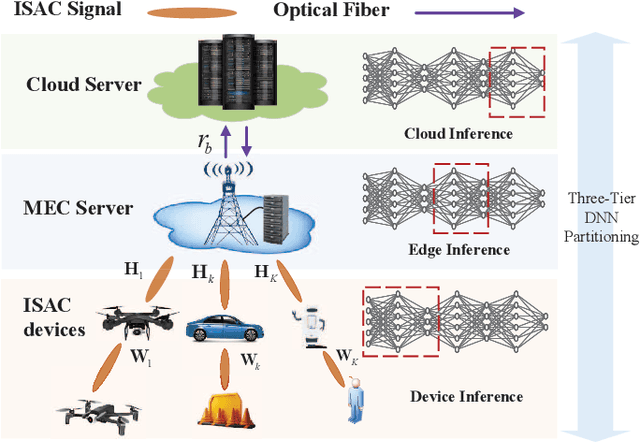
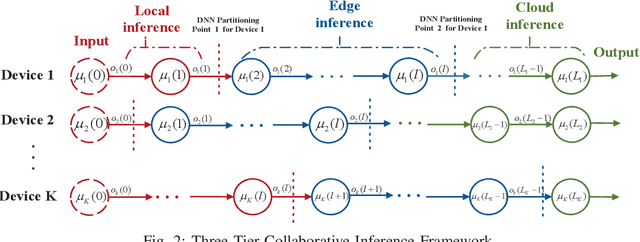
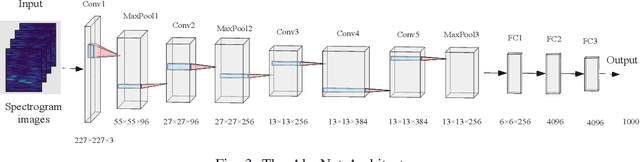
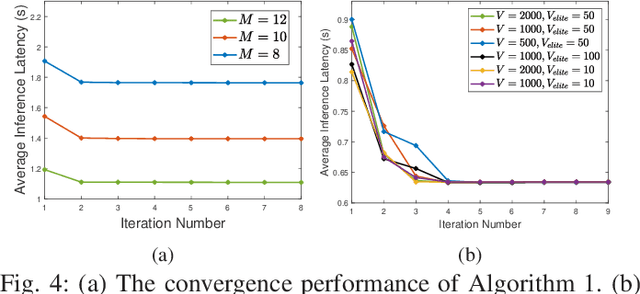
The combination of Integrated Sensing and Communication (ISAC) and Mobile Edge Computing (MEC) enables devices to simultaneously sense the environment and offload data to the base stations (BS) for intelligent processing, thereby reducing local computational burdens. However, transmitting raw sensing data from ISAC devices to the BS often incurs substantial fronthaul overhead and latency. This paper investigates a three-tier collaborative inference framework enabled by Integrated Sensing, Communication, and Computing (ISCC), where cloud servers, MEC servers, and ISAC devices cooperatively execute different segments of a pre-trained deep neural network (DNN) for intelligent sensing. By offloading intermediate DNN features, the proposed framework can significantly reduce fronthaul transmission load. Furthermore, multiple-input multiple-output (MIMO) technology is employed to enhance both sensing quality and offloading efficiency. To minimize the overall sensing task inference latency across all ISAC devices, we jointly optimize the DNN partitioning strategy, ISAC beamforming, and computational resource allocation at the MEC servers and devices, subject to sensing beampattern constraints. We also propose an efficient two-layer optimization algorithm. In the inner layer, we derive closed-form solutions for computational resource allocation using the Karush-Kuhn-Tucker conditions. Moreover, we design the ISAC beamforming vectors via an iterative method based on the majorization-minimization and weighted minimum mean square error techniques. In the outer layer, we develop a cross-entropy based probabilistic learning algorithm to determine an optimal DNN partitioning strategy. Simulation results demonstrate that the proposed framework substantially outperforms existing two-tier schemes in inference latency.
DR.FIX: Automatically Fixing Data Races at Industry Scale
Apr 22, 2025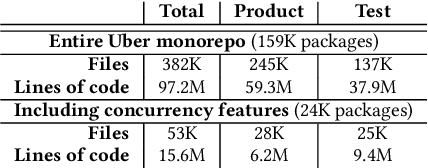
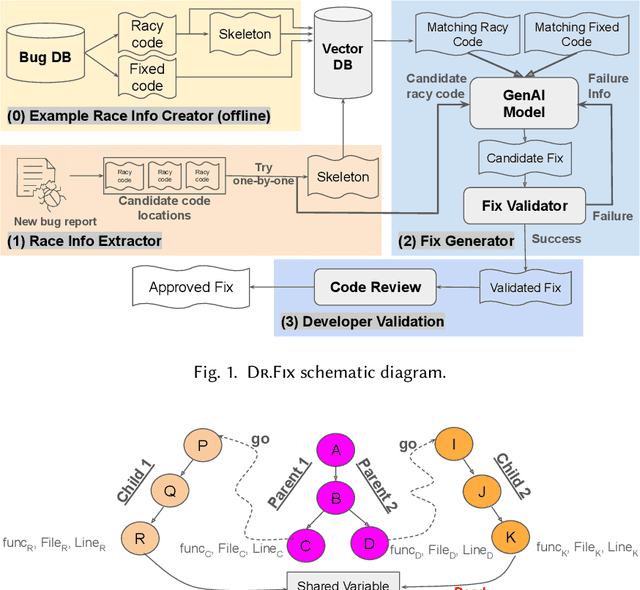

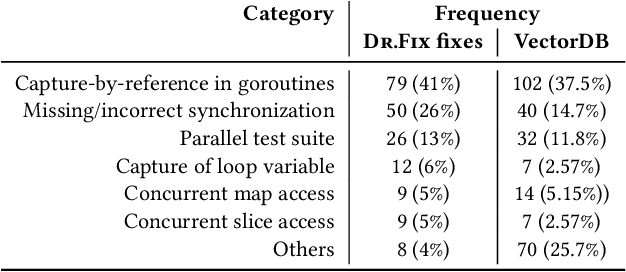
Data races are a prevalent class of concurrency bugs in shared-memory parallel programs, posing significant challenges to software reliability and reproducibility. While there is an extensive body of research on detecting data races and a wealth of practical detection tools across various programming languages, considerably less effort has been directed toward automatically fixing data races at an industrial scale. In large codebases, data races are continuously introduced and exhibit myriad patterns, making automated fixing particularly challenging. In this paper, we tackle the problem of automatically fixing data races at an industrial scale. We present Dr.Fix, a tool that combines large language models (LLMs) with program analysis to generate fixes for data races in real-world settings, effectively addressing a broad spectrum of racy patterns in complex code contexts. Implemented for Go--the programming language widely used in modern microservice architectures where concurrency is pervasive and data races are common--Dr.Fix seamlessly integrates into existing development workflows. We detail the design of Dr.Fix and examine how individual design choices influence the quality of the fixes produced. Over the past 18 months, Dr.Fix has been integrated into developer workflows at Uber demonstrating its practical utility. During this period, Dr.Fix produced patches for 224 (55%) from a corpus of 404 data races spanning various categories; 193 of these patches (86%) were accepted by more than a hundred developers via code reviews and integrated into the codebase.
VLM-R1: A Stable and Generalizable R1-style Large Vision-Language Model
Apr 10, 2025
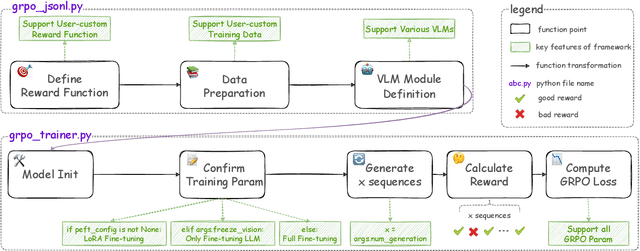
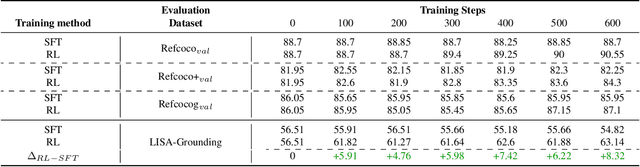
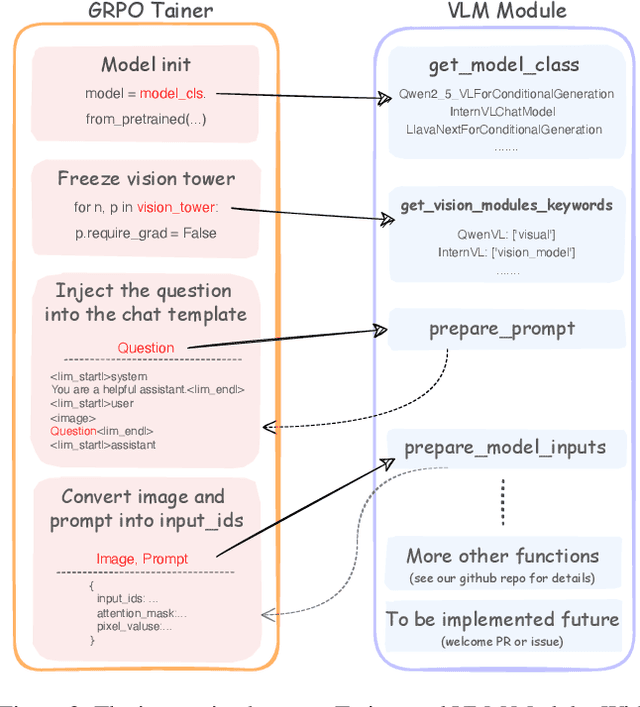
Recently DeepSeek R1 has shown that reinforcement learning (RL) can substantially improve the reasoning capabilities of Large Language Models (LLMs) through a simple yet effective design. The core of R1 lies in its rule-based reward formulation, which leverages tasks with deterministic ground-truth answers to enable precise and stable reward computation. In the visual domain, we similarly observe that a wide range of visual understanding tasks are inherently equipped with well-defined ground-truth annotations. This property makes them naturally compatible with rule-based reward mechanisms. Motivated by this observation, we investigate the extension of R1-style reinforcement learning to Vision-Language Models (VLMs), aiming to enhance their visual reasoning capabilities. To this end, we develop VLM-R1, a dedicated framework designed to harness RL for improving VLMs' performance on general vision-language tasks. Using this framework, we further explore the feasibility of applying RL to visual domain. Experimental results indicate that the RL-based model not only delivers competitive performance on visual understanding tasks but also surpasses Supervised Fine-Tuning (SFT) in generalization ability. Furthermore, we conduct comprehensive ablation studies that uncover a series of noteworthy insights, including the presence of reward hacking in object detection, the emergence of the "OD aha moment", the impact of training data quality, and the scaling behavior of RL across different model sizes. Through these analyses, we aim to deepen the understanding of how reinforcement learning enhances the capabilities of vision-language models, and we hope our findings and open-source contributions will support continued progress in the vision-language RL community. Our code and model are available at https://github.com/om-ai-lab/VLM-R1
RCCFormer: A Robust Crowd Counting Network Based on Transformer
Apr 07, 2025Crowd counting, which is a key computer vision task, has emerged as a fundamental technology in crowd analysis and public safety management. However, challenges such as scale variations and complex backgrounds significantly impact the accuracy of crowd counting. To mitigate these issues, this paper proposes a robust Transformer-based crowd counting network, termed RCCFormer, specifically designed for background suppression and scale awareness. The proposed method incorporates a Multi-level Feature Fusion Module (MFFM), which meticulously integrates features extracted at diverse stages of the backbone architecture. It establishes a strong baseline capable of capturing intricate and comprehensive feature representations, surpassing traditional baselines. Furthermore, the introduced Detail-Embedded Attention Block (DEAB) captures contextual information and local details through global self-attention and local attention along with a learnable manner for efficient fusion. This enhances the model's ability to focus on foreground regions while effectively mitigating background noise interference. Additionally, we develop an Adaptive Scale-Aware Module (ASAM), with our novel Input-dependent Deformable Convolution (IDConv) as its fundamental building block. This module dynamically adapts to changes in head target shapes and scales, significantly improving the network's capability to accommodate large-scale variations. The effectiveness of the proposed method is validated on the ShanghaiTech Part_A and Part_B, NWPU-Crowd, and QNRF datasets. The results demonstrate that our RCCFormer achieves excellent performance across all four datasets, showcasing state-of-the-art outcomes.
Embedding Reliability Verification Constraints into Generation Expansion Planning
Apr 06, 2025Generation planning approaches face challenges in managing the incompatible mathematical structures between stochastic production simulations for reliability assessment and optimization models for generation planning, which hinders the integration of reliability constraints. This study proposes an approach to embedding reliability verification constraints into generation expansion planning by leveraging a weighted oblique decision tree (WODT) technique. For each planning year, a generation mix dataset, labeled with reliability assessment simulations, is generated. An WODT model is trained using this dataset. Reliability-feasible regions are extracted via depth-first search technique and formulated as disjunctive constraints. These constraints are then transformed into mixed-integer linear form using a convex hull modeling technique and embedded into a unit commitment-integrated generation expansion planning model. The proposed approach is validated through a long-term generation planning case study for the Electric Reliability Council of Texas (ERCOT) region, demonstrating its effectiveness in achieving reliable and optimal planning solutions.
Overcoming the Identity Mapping Problem in Self-Supervised Hyperspectral Anomaly Detection
Apr 05, 2025The surge of deep learning has catalyzed considerable progress in self-supervised Hyperspectral Anomaly Detection (HAD). The core premise for self-supervised HAD is that anomalous pixels are inherently more challenging to reconstruct, resulting in larger errors compared to the background. However, owing to the powerful nonlinear fitting capabilities of neural networks, self-supervised models often suffer from the Identity Mapping Problem (IMP). The IMP manifests as a tendency for the model to overfit to the entire image, particularly with increasing network complexity or prolonged training iterations. Consequently, the whole image can be precisely reconstructed, and even the anomalous pixels exhibit imperceptible errors, making them difficult to detect. Despite the proposal of several models aimed at addressing the IMP-related issues, a unified descriptive framework and validation of solutions for IMP remain lacking. In this paper, we conduct an in-depth exploration to IMP, and summarize a unified framework that describes IMP from the perspective of network optimization, which encompasses three aspects: perturbation, reconstruction, and regularization. Correspondingly, we introduce three solutions: superpixel pooling and uppooling for perturbation, error-adaptive convolution for reconstruction, and online background pixel mining for regularization. With extensive experiments being conducted to validate the effectiveness, it is hoped that our work will provide valuable insights and inspire further research for self-supervised HAD. Code: \url{https://github.com/yc-cui/Super-AD}.
A Decade of Deep Learning for Remote Sensing Spatiotemporal Fusion: Advances, Challenges, and Opportunities
Apr 01, 2025Hardware limitations and satellite launch costs make direct acquisition of high temporal-spatial resolution remote sensing imagery challenging. Remote sensing spatiotemporal fusion (STF) technology addresses this problem by merging high temporal but low spatial resolution imagery with high spatial but low temporal resolution imagery to efficiently generate high spatiotemporal resolution satellite images. STF provides unprecedented observational capabilities for land surface change monitoring, agricultural management, and environmental research. Deep learning (DL) methods have revolutionized the remote sensing spatiotemporal fusion field over the past decade through powerful automatic feature extraction and nonlinear modeling capabilities, significantly outperforming traditional methods in handling complex spatiotemporal data. Despite the rapid development of DL-based remote sensing STF, the community lacks a systematic review of this quickly evolving field. This paper comprehensively reviews DL developments in remote sensing STF over the last decade, analyzing key research trends, method classifications, commonly used datasets, and evaluation metrics. It discusses major challenges in existing research and identifies promising future research directions as references for researchers in this field to inspire new ideas. The specific models, datasets, and other information mentioned in this article have been collected in: https://github.com/yc-cui/Deep-Learning-Spatiotemporal-Fusion-Survey.
H2VU-Benchmark: A Comprehensive Benchmark for Hierarchical Holistic Video Understanding
Mar 31, 2025With the rapid development of multimodal models, the demand for assessing video understanding capabilities has been steadily increasing. However, existing benchmarks for evaluating video understanding exhibit significant limitations in coverage, task diversity, and scene adaptability. These shortcomings hinder the accurate assessment of models' comprehensive video understanding capabilities. To tackle this challenge, we propose a hierarchical and holistic video understanding (H2VU) benchmark designed to evaluate both general video and online streaming video comprehension. This benchmark contributes three key features: Extended video duration: Spanning videos from brief 3-second clips to comprehensive 1.5-hour recordings, thereby bridging the temporal gaps found in current benchmarks. Comprehensive assessment tasks: Beyond traditional perceptual and reasoning tasks, we have introduced modules for countercommonsense comprehension and trajectory state tracking. These additions test the models' deep understanding capabilities beyond mere prior knowledge. Enriched video data: To keep pace with the rapid evolution of current AI agents, we have expanded first-person streaming video datasets. This expansion allows for the exploration of multimodal models' performance in understanding streaming videos from a first-person perspective. Extensive results from H2VU reveal that existing multimodal large language models (MLLMs) possess substantial potential for improvement in our newly proposed evaluation tasks. We expect that H2VU will facilitate advancements in video understanding research by offering a comprehensive and in-depth analysis of MLLMs.