 Add to Chrome
 Add to Firefox
 Add to Edge
X-OmniClaw Technical Report: A Unified Mobile Agent for Multimodal Understanding and Interaction
May 07, 2026
Inspired by the development of OpenClaw, there is a growing demand for mobile-based personal agents capable of handling complex and intuitive interactions. In this technical report, we introduce X-OmniClaw, a unified mobile agent designed for multimodal understanding and interaction in the Android ecosystem. This unified architecture of perception, memory, and action enables the agent to handle complex mobile tasks with high contextual awareness. Specifically, Omni Perception provides a unified multimodal ingress pipeline that integrates UI states, real-world visual contexts, and speech inputs, leveraging a temporal alignment module to decompose raw data into structured multimodal intent representations. Omni Memory leverages multimodal memory optimization to enhance personalized intelligence by integrating runtime working memory for task continuity with long-term personal memory distilled from local data, enabling highly context-aware and personalized interactions. Finally, Omni Action employs a hybrid grounding strategy that combines structural XML metadata with visual perception for robust interaction. Through Behavior Cloning and Trajectory Replay, the system captures user navigation as reusable skills, enabling precise direct-access execution. Demonstrations across diverse scenarios show that X-OmniClaw effectively enhances interaction efficiency and task reliability, providing a practical architectural blueprint for the next generation of mobile-native personal assistants.

Thinking in Streaming Video
Mar 13, 2026Real-time understanding of continuous video streams is essential for interactive assistants and multimodal agents operating in dynamic environments. However, most existing video reasoning approaches follow a batch paradigm that defers reasoning until the full video context is observed, resulting in high latency and growing computational cost that are incompatible with streaming scenarios. In this paper, we introduce ThinkStream, a framework for streaming video reasoning based on a Watch--Think--Speak paradigm that enables models to incrementally update their understanding as new video observations arrive. At each step, the model performs a short reasoning update and decides whether sufficient evidence has accumulated to produce a response. To support long-horizon streaming, we propose Reasoning-Compressed Streaming Memory (RCSM), which treats intermediate reasoning traces as compact semantic memory that replaces outdated visual tokens while preserving essential context. We further train the model using a Streaming Reinforcement Learning with Verifiable Rewards scheme that aligns incremental reasoning and response timing with the requirements of streaming interaction. Experiments on multiple streaming video benchmarks show that ThinkStream significantly outperforms existing online video models while maintaining low latency and memory usage. Code, models and data will be released at https://github.com/johncaged/ThinkStream
H2VU-Benchmark: A Comprehensive Benchmark for Hierarchical Holistic Video Understanding
Mar 31, 2025With the rapid development of multimodal models, the demand for assessing video understanding capabilities has been steadily increasing. However, existing benchmarks for evaluating video understanding exhibit significant limitations in coverage, task diversity, and scene adaptability. These shortcomings hinder the accurate assessment of models' comprehensive video understanding capabilities. To tackle this challenge, we propose a hierarchical and holistic video understanding (H2VU) benchmark designed to evaluate both general video and online streaming video comprehension. This benchmark contributes three key features: Extended video duration: Spanning videos from brief 3-second clips to comprehensive 1.5-hour recordings, thereby bridging the temporal gaps found in current benchmarks. Comprehensive assessment tasks: Beyond traditional perceptual and reasoning tasks, we have introduced modules for countercommonsense comprehension and trajectory state tracking. These additions test the models' deep understanding capabilities beyond mere prior knowledge. Enriched video data: To keep pace with the rapid evolution of current AI agents, we have expanded first-person streaming video datasets. This expansion allows for the exploration of multimodal models' performance in understanding streaming videos from a first-person perspective. Extensive results from H2VU reveal that existing multimodal large language models (MLLMs) possess substantial potential for improvement in our newly proposed evaluation tasks. We expect that H2VU will facilitate advancements in video understanding research by offering a comprehensive and in-depth analysis of MLLMs.
HEIE: MLLM-Based Hierarchical Explainable AIGC Image Implausibility Evaluator
Nov 26, 2024


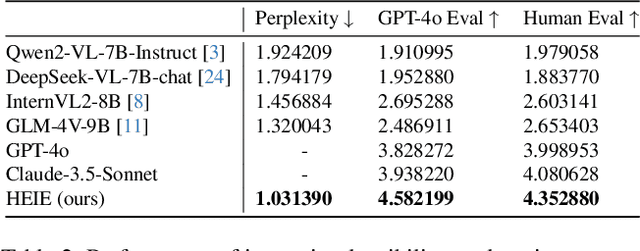
AIGC images are prevalent across various fields, yet they frequently suffer from quality issues like artifacts and unnatural textures. Specialized models aim to predict defect region heatmaps but face two primary challenges: (1) lack of explainability, failing to provide reasons and analyses for subtle defects, and (2) inability to leverage common sense and logical reasoning, leading to poor generalization. Multimodal large language models (MLLMs) promise better comprehension and reasoning but face their own challenges: (1) difficulty in fine-grained defect localization due to the limitations in capturing tiny details; and (2) constraints in providing pixel-wise outputs necessary for precise heatmap generation. To address these challenges, we propose HEIE: a novel MLLM-Based Hierarchical Explainable image Implausibility Evaluator. We introduce the CoT-Driven Explainable Trinity Evaluator, which integrates heatmaps, scores, and explanation outputs, using CoT to decompose complex tasks into subtasks of increasing difficulty and enhance interpretability. Our Adaptive Hierarchical Implausibility Mapper synergizes low-level image features with high-level mapper tokens from LLMs, enabling precise local-to-global hierarchical heatmap predictions through an uncertainty-based adaptive token approach. Moreover, we propose a new dataset: Expl-AIGI-Eval, designed to facilitate interpretable implausibility evaluation of AIGC images. Our method demonstrates state-of-the-art performance through extensive experiments.