 Add to Chrome
 Add to Firefox
 Add to Edge
Do Sequential Recommendation Benchmarks Really Require Higher-Order Sequence Modelling?
Aug 20, 2026
Sequential recommenders increasingly use language-model architectures designed to capture complex, context-dependent interactions. Yet it remains unclear whether widely used benchmarks actually require this modelling capacity. We investigate this question using two simple, recency-weighted pairwise probes that do not learn higher-order sequence representations: Sequential Rules (SeqRules) and our Probabilistic Collaborative Transition Model (PCTM). Using the evaluation protocol of eSASRec, at least one probe exceeds our eSASRec reproduction by 15-38% on three Amazon datasets and by 4.4% on MovieLens-1M, but trails it by 27.3% on MovieLens-20M. On the four remaining datasets, at least one probe also outperforms our sampled-softmax SASRec reproduction by 9-28%, suggesting that these widely used benchmarks are poorly suited to measuring gains from higher-order sequence modelling. More broadly, comparing Transformer-based models against strong recency-weighted pairwise probes provides a concrete test of whether a benchmark can meaningfully measure gains from higher-order sequence modelling.

Deploying Semantic ID-based Generative Retrieval for Large-Scale Podcast Discovery at Spotify
Mar 18, 2026Podcast listening is often grounded in a set of favorite shows, while listener intent can evolve over time. This combination of stable preferences and changing intent motivates recommendation approaches that support both familiarity and exploration. Traditional recommender systems typically emphasize long-term interaction patterns, and are less explicitly designed to incorporate rich contextual signals or flexible, intent-aware discovery objectives. In this setting, models that can jointly reason over semantics, context, and user state offer a promising direction. Large Language Models (LLMs) provide strong semantic reasoning and contextual conditioning for discovery-oriented recommendation, but deploying them in production introduces challenges in catalog grounding, user-level personalization, and latency-critical serving. We address these challenges with GLIDE, a production-scale generative recommender for podcast discovery at Spotify. GLIDE formulates recommendation as an instruction-following task over a discretized catalog using Semantic IDs, enabling grounded generation over a large inventory. The model conditions on recent listening history and lightweight user context, while injecting long-term user embeddings as soft prompts to capture stable preferences under strict inference constraints. We evaluate GLIDE using offline retrieval metrics, human judgments, and LLM-based evaluation, and validate its impact through large-scale online A/B testing. Across experiments involving millions of users, GLIDE increases non-habitual podcast streaming on Spotify home surface by up to 5.4% and new-show discovery by up to 14.3%, while meeting production cost and latency constraints.
A Unified Language Model for Large Scale Search, Recommendation, and Reasoning
Mar 18, 2026LLMs are increasingly applied to recommendation, retrieval, and reasoning, yet deploying a single end-to-end model that can jointly support these behaviors over large, heterogeneous catalogs remains challenging. Such systems must generate unambiguous references to real items, handle multiple entity types, and operate under strict latency and reliability constraints requirements that are difficult to satisfy with text-only generation. While tool-augmented recommender systems address parts of this problem, they introduce orchestration complexity and limit end-to-end optimization. We view this setting as an instance of a broader research problem: how to adapt LLMs to reason jointly over multiple-domain entities, users, and language in a fully self-contained manner. To this end, we introduce NEO, a framework that adapts a pre-trained decoder-only LLM into a tool-free, catalog-grounded generator. NEO represents items as SIDs and trains a single model to interleave natural language and typed item identifiers within a shared sequence. Text prompts control the task, target entity type, and output format (IDs, text, or mixed), while constrained decoding guarantees catalog-valid item generation without restricting free-form text. We refer to this instruction-conditioned controllability as language-steerability. We treat SIDs as a distinct modality and study design choices for integrating discrete entity representations into LLMs via staged alignment and instruction tuning. We evaluate NEO at scale on a real-world catalog of over 10M items across multiple media types and discovery tasks, including recommendation, search, and user understanding. In offline experiments, NEO consistently outperforms strong task-specific baselines and exhibits cross-task transfer, demonstrating a practical path toward consolidating large-scale discovery capabilities into a single language-steerable generative model.
PODTILE: Facilitating Podcast Episode Browsing with Auto-generated Chapters
Oct 21, 2024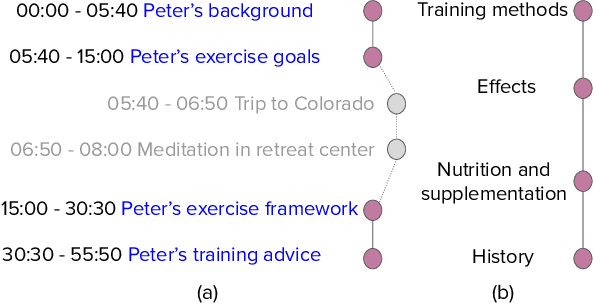

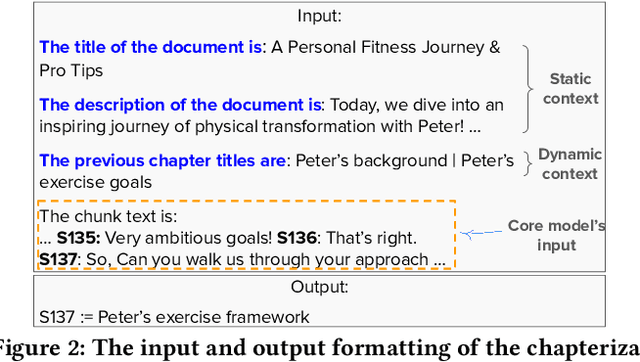
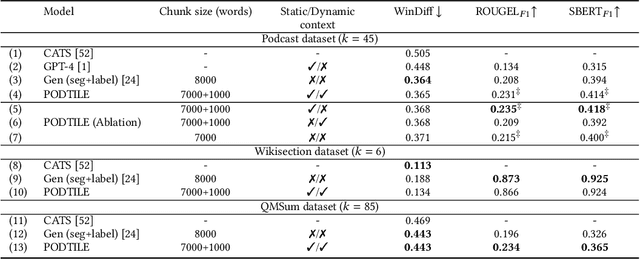
Listeners of long-form talk-audio content, such as podcast episodes, often find it challenging to understand the overall structure and locate relevant sections. A practical solution is to divide episodes into chapters--semantically coherent segments labeled with titles and timestamps. Since most episodes on our platform at Spotify currently lack creator-provided chapters, automating the creation of chapters is essential. Scaling the chapterization of podcast episodes presents unique challenges. First, episodes tend to be less structured than written texts, featuring spontaneous discussions with nuanced transitions. Second, the transcripts are usually lengthy, averaging about 16,000 tokens, which necessitates efficient processing that can preserve context. To address these challenges, we introduce PODTILE, a fine-tuned encoder-decoder transformer to segment conversational data. The model simultaneously generates chapter transitions and titles for the input transcript. To preserve context, each input text is augmented with global context, including the episode's title, description, and previous chapter titles. In our intrinsic evaluation, PODTILE achieved an 11% improvement in ROUGE score over the strongest baseline. Additionally, we provide insights into the practical benefits of auto-generated chapters for listeners navigating episode content. Our findings indicate that auto-generated chapters serve as a useful tool for engaging with less popular podcasts. Finally, we present empirical evidence that using chapter titles can enhance effectiveness of sparse retrieval in search tasks.
SummaC: Re-Visiting NLI-based Models for Inconsistency Detection in Summarization
Nov 18, 2021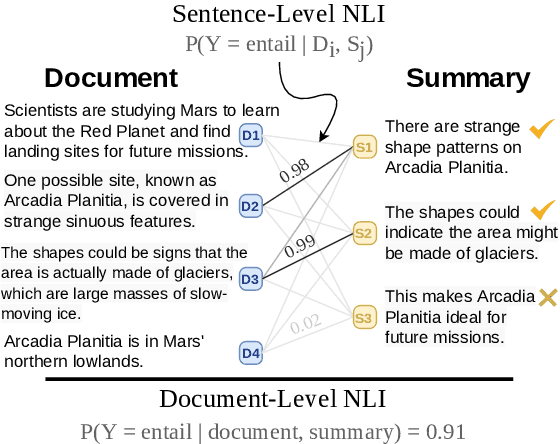
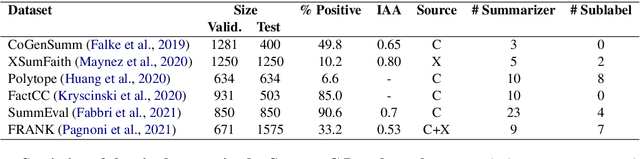
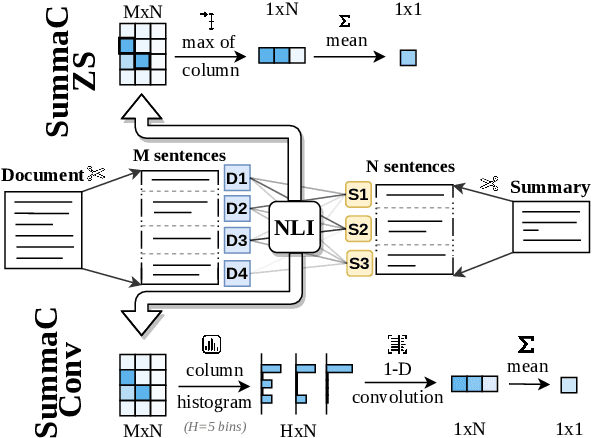
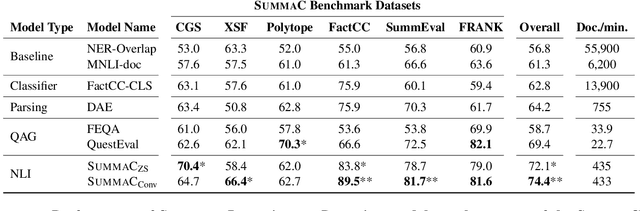
In the summarization domain, a key requirement for summaries is to be factually consistent with the input document. Previous work has found that natural language inference (NLI) models do not perform competitively when applied to inconsistency detection. In this work, we revisit the use of NLI for inconsistency detection, finding that past work suffered from a mismatch in input granularity between NLI datasets (sentence-level), and inconsistency detection (document level). We provide a highly effective and light-weight method called SummaCConv that enables NLI models to be successfully used for this task by segmenting documents into sentence units and aggregating scores between pairs of sentences. On our newly introduced benchmark called SummaC (Summary Consistency) consisting of six large inconsistency detection datasets, SummaCConv obtains state-of-the-art results with a balanced accuracy of 74.4%, a 5% point improvement compared to prior work. We make the models and datasets available: https://github.com/tingofurro/summac
Zero-Shot Dense Retrieval with Momentum Adversarial Domain Invariant Representations
Oct 14, 2021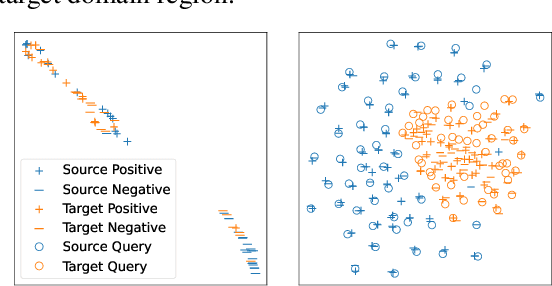
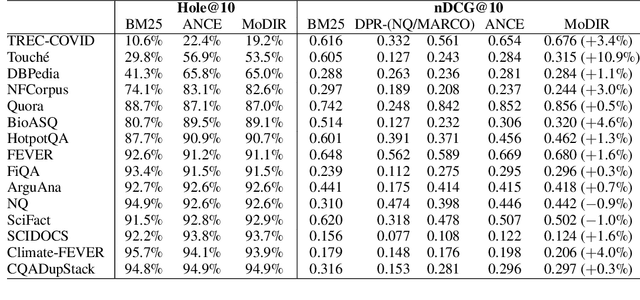
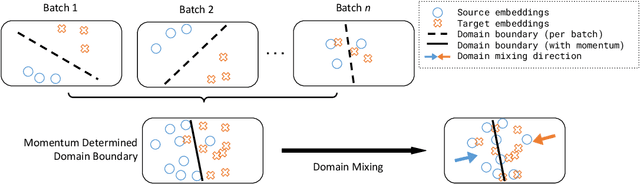

Dense retrieval (DR) methods conduct text retrieval by first encoding texts in the embedding space and then matching them by nearest neighbor search. This requires strong locality properties from the representation space, i.e, the close allocations of each small group of relevant texts, which are hard to generalize to domains without sufficient training data. In this paper, we aim to improve the generalization ability of DR models from source training domains with rich supervision signals to target domains without any relevant labels, in the zero-shot setting. To achieve that, we propose Momentum adversarial Domain Invariant Representation learning (MoDIR), which introduces a momentum method in the DR training process to train a domain classifier distinguishing source versus target, and then adversarially updates the DR encoder to learn domain invariant representations. Our experiments show that MoDIR robustly outperforms its baselines on 10+ ranking datasets from the BEIR benchmark in the zero-shot setup, with more than 10% relative gains on datasets with enough sensitivity for DR models' evaluation. Source code of this paper will be released.
Domain-Specific Pretraining for Vertical Search: Case Study on Biomedical Literature
Jun 25, 2021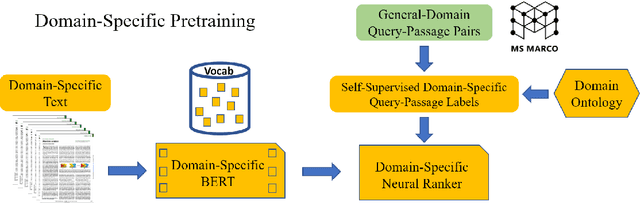
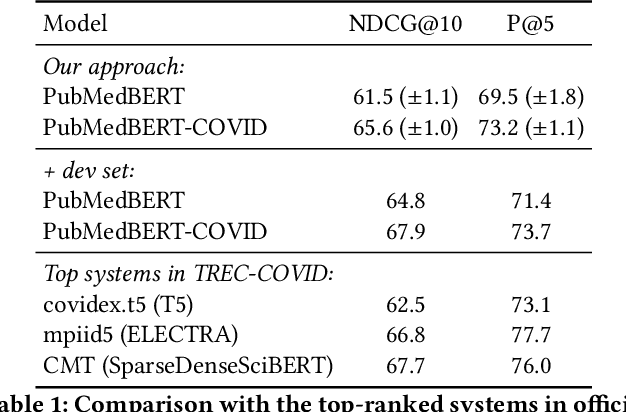
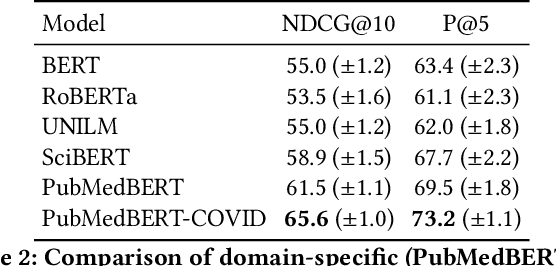
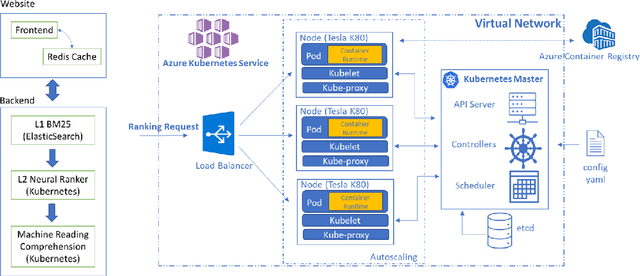
Information overload is a prevalent challenge in many high-value domains. A prominent case in point is the explosion of the biomedical literature on COVID-19, which swelled to hundreds of thousands of papers in a matter of months. In general, biomedical literature expands by two papers every minute, totalling over a million new papers every year. Search in the biomedical realm, and many other vertical domains is challenging due to the scarcity of direct supervision from click logs. Self-supervised learning has emerged as a promising direction to overcome the annotation bottleneck. We propose a general approach for vertical search based on domain-specific pretraining and present a case study for the biomedical domain. Despite being substantially simpler and not using any relevance labels for training or development, our method performs comparably or better than the best systems in the official TREC-COVID evaluation, a COVID-related biomedical search competition. Using distributed computing in modern cloud infrastructure, our system can scale to tens of millions of articles on PubMed and has been deployed as Microsoft Biomedical Search, a new search experience for biomedical literature: https://aka.ms/biomedsearch.
Generic Intent Representation in Web Search
Jul 24, 2019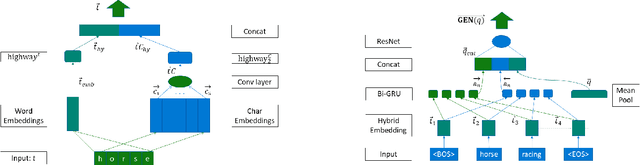
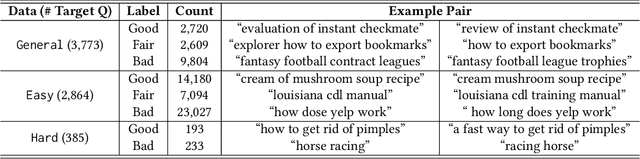

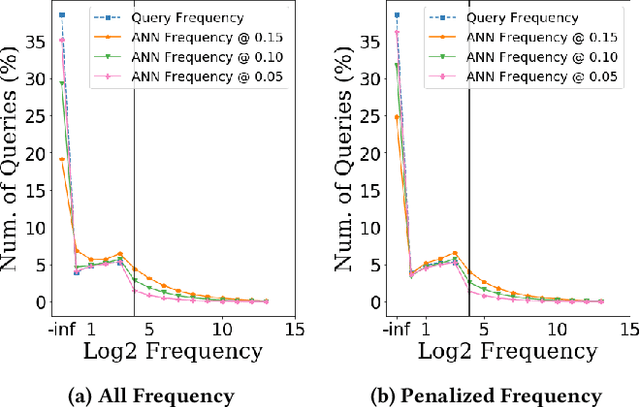
This paper presents GEneric iNtent Encoder (GEN Encoder) which learns a distributed representation space for user intent in search. Leveraging large scale user clicks from Bing search logs as weak supervision of user intent, GEN Encoder learns to map queries with shared clicks into similar embeddings end-to-end and then finetunes on multiple paraphrase tasks. Experimental results on an intrinsic evaluation task - query intent similarity modeling - demonstrate GEN Encoder's robust and significant advantages over previous representation methods. Ablation studies reveal the crucial role of learning from implicit user feedback in representing user intent and the contributions of multi-task learning in representation generality. We also demonstrate that GEN Encoder alleviates the sparsity of tail search traffic and cuts down half of the unseen queries by using an efficient approximate nearest neighbor search to effectively identify previous queries with the same search intent. Finally, we demonstrate distances between GEN encodings reflect certain information seeking behaviors in search sessions.
Using Shortlists to Support Decision Making and Improve Recommender System Performance
Feb 08, 2016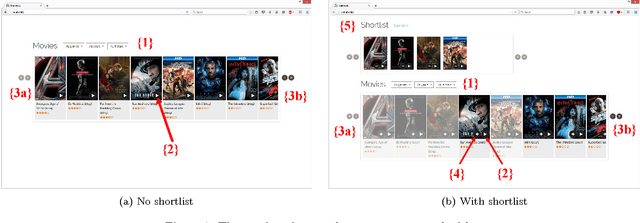
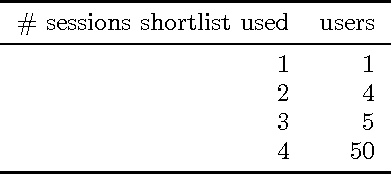
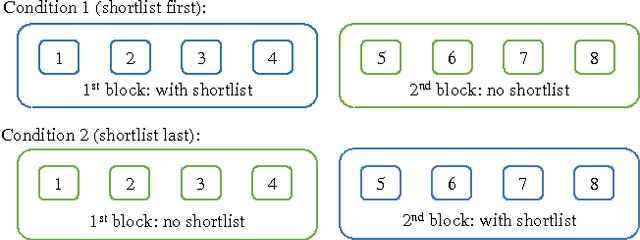
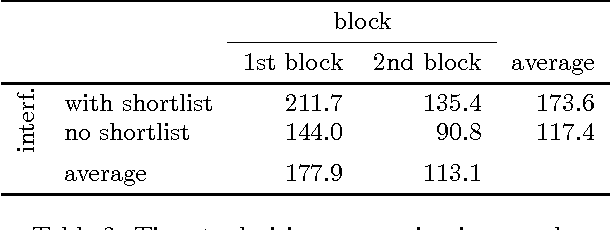
In this paper, we study shortlists as an interface component for recommender systems with the dual goal of supporting the user's decision process, as well as improving implicit feedback elicitation for increased recommendation quality. A shortlist is a temporary list of candidates that the user is currently considering, e.g., a list of a few movies the user is currently considering for viewing. From a cognitive perspective, shortlists serve as digital short-term memory where users can off-load the items under consideration -- thereby decreasing their cognitive load. From a machine learning perspective, adding items to the shortlist generates a new implicit feedback signal as a by-product of exploration and decision making which can improve recommendation quality. Shortlisting therefore provides additional data for training recommendation systems without the increases in cognitive load that requesting explicit feedback would incur. We perform an user study with a movie recommendation setup to compare interfaces that offer shortlist support with those that do not. From the user studies we conclude: (i) users make better decisions with a shortlist; (ii) users prefer an interface with shortlist support; and (iii) the additional implicit feedback from sessions with a shortlist improves the quality of recommendations by nearly a factor of two.